Real Estate Social Media Content Calendar: Get More Clients

You've felt this before. A listing goes live, your day gets hijacked by showings, a negotiation blows up at noon, and by evening you realize your Instagram feed has gone quiet again. Then you post three listing graphics in a row, get polite likes from other agents, and wonder why social still feels like work instead of pipeline.
That's the trap. Most agents treat social media like a series of last-minute tasks. High-performing agents treat it like an operating system. A real estate social media content calendar isn't just a posting plan. It's the structure that keeps your brand visible, your message consistent, and your marketing compliant when your schedule gets chaotic.
Beyond the Feed Your Content Calendar as a Business System
If social is bringing business in, it needs the same discipline you apply to lead follow-up, pricing strategy, and transaction management. The stakes are clear. According to National Association of REALTORS® 2023 data, 63% of real estate professionals actively use social media to generate leads, and 39% cite it as the source of the highest number of quality leads in their business. The same data shows that top-performing agents maintain a disciplined schedule of 5 to 7 posts per week, which is hard to sustain without a calendar.
That matters because inconsistency has a cost. When agents disappear for a week, then return with a burst of listing posts, they train their audience to ignore them. People don't build trust from random visibility. They build trust from repeated, useful contact over time.
What a real system does
A real estate social media content calendar should handle more than dates and captions. It should define:
- Content mix: What percentage of posts are educational, local, market-focused, and promotional.
- Workflow ownership: Who drafts, who reviews, who approves, and who publishes.
- Format planning: Which ideas become Reels, Stories, carousels, static posts, or short video clips.
- Risk control: How captions get reviewed for Fair Housing compliance before anything goes live.
Practical rule: If your calendar only tells you when to post, you don't have a business system. You have a reminder list.
The agents who stay visible without burning out usually work from repeatable frameworks and light automation. That's where real estate listing to social media automation becomes useful. It turns new inventory and recurring expertise into scheduled content instead of one-off marketing emergencies.
What works and what fails
What works is boring in the best way. Batch your content. Keep your post categories consistent. Review before publishing. Reuse themes that your audience already responds to.
What fails is easy to spot:
- Posting only when a listing launches
- Using the same “Just Listed” template repeatedly
- Writing captions from scratch every night
- Skipping review because you're in a hurry
- Assuming consistency alone is enough
Consistency matters. But consistency without structure creates noise, not authority.
A strong calendar removes decision fatigue. It lets you show up whether you're closing deals, onboarding a listing, or spending the day in back-to-back appointments. That's why the calendar belongs inside your business process, not on the edge of it.
Structuring Your Content Pillars The 80-20 Rule in Action
Most agent feeds underperform for one simple reason. They ask for business too often and teach too little.
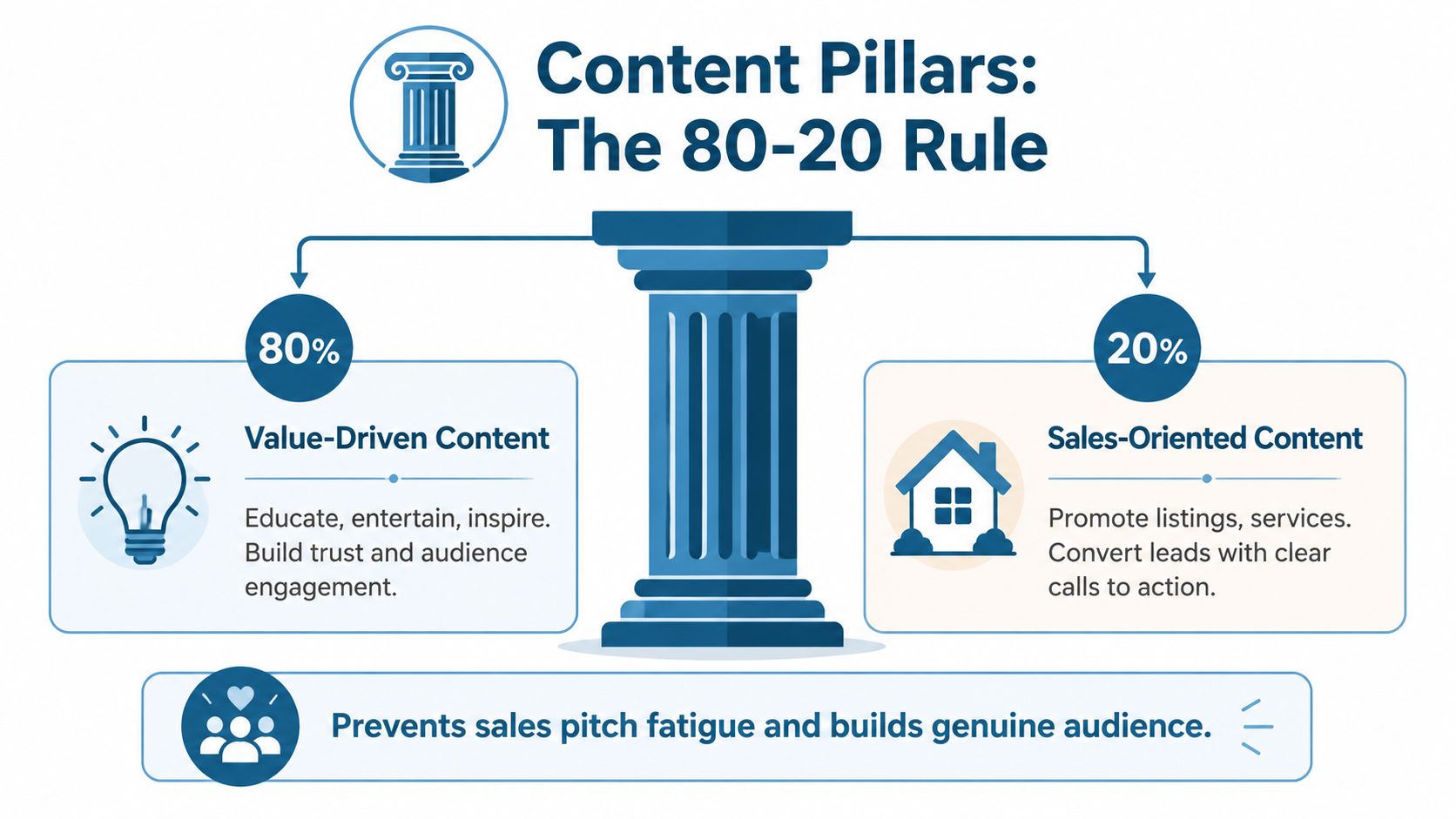
The fix is a disciplined mix. The M.E.A.L.L. framework gives you a clean way to plan topics without turning your feed into a running sales pitch. It stands for Market Updates, Events, Advice, Local news, and Listings. This structure supports the 80/20 rule, where most content delivers value and a smaller portion promotes listings or services. That balance helps maintain trust and engagement, as noted in Xara's real estate social media calendar guide.
Market Updates
The goal is to interpret the market instead of dumping stats into a graphic. Agents often post charts that mean nothing to a buyer or seller scrolling quickly.
Better options include:
- Short video commentary: Explain what reduced inventory means for negotiation strategy in your area.
- Carousel breakdowns: Show what changed this month in pricing behavior, days on market, or buyer competition, using plain language.
- Seller-facing insight: Explain how presentation, pricing, and timing affect response.
Keep it local and practical. Your goal isn't to sound academic. Your goal is to sound useful.
Events
Events give your feed texture. They also keep you from looking like you only show up when there's a commission opportunity.
Good event content includes:
- Community calendars: Weekend roundups of local markets, festivals, and neighborhood activities.
- Open house tie-ins: Pair an event post with a nearby open house route, while keeping the property description feature-based.
- Seasonal reminders: Parking changes, community improvements, or public events that matter to residents.
Avoid language that implies who belongs in an area. Focus on the event itself, the location, and the experience.
Advice
Advice is one of the strongest categories because it answers the questions clients are already asking privately. Turn those repeat questions into public assets.
A few examples:
- Buyer education: Pre-approval steps, inspection preparation, contract timelines, earnest money basics.
- Seller tips: Decluttering, light repairs, photography prep, showing readiness.
- Process clarity: What happens after mutual acceptance, how appraisal issues get handled, what title work involves.
The best advice posts usually come from the same five questions you answered in calls this week.
Local News
This pillar often gets handled poorly. Agents either ignore it or post vague “love my city” content that doesn't do anything.
Use local content to show market fluency:
- Infrastructure updates: Road projects, transit changes, zoning decisions, new public amenities.
- Business openings: New coffee shops, fitness studios, retail, or service businesses.
- Lifestyle details: Park upgrades, trail access, municipal improvements, public gathering spaces.
Describe places by features and facts, not by the type of people you think should live nearby. That keeps the post both stronger and safer.
Listings
Listings still matter. They just shouldn't dominate the feed.
Use this category for:
- New listings
- Price adjustments
- Open houses
- Pending and sold posts
- Feature spotlights from active inventory
The mistake is posting only the hero image and a generic caption. Strong listing content isolates one feature at a time. Think kitchen layout, lot size, natural light, renovation details, storage, floor plan flow, or outdoor use.
A simple weekly ratio
Try this rhythm:
| Pillar | Weekly Role |
|---|---|
| Market Updates | 1 post |
| Events | 1 post |
| Advice | 1 to 2 posts |
| Local News | 1 post |
| Listings | 1 post |
That keeps the promotional share under control without making your feed soft or irrelevant.
When agents say they don't know what to post, they usually don't have a pillar problem. They have a classification problem. Once each idea belongs to M.E.A.L.L., content planning gets faster, approval gets easier, and the feed starts looking like a trusted advisor's feed instead of a digital flyer rack.
Optimal Posting Times and Frequency on Instagram
Timing advice gets oversimplified. Agents hear “post in the morning” or “evenings work best” and then wonder why results are uneven. The key question isn't what time is universally best. It's what mindset your audience is in when they see that post.
On Instagram, different content types perform better in different windows because the viewer is bringing a different level of attention. A market update asks for focus. A listing teaser benefits from relaxed scrolling. A seller tip might do better when someone has enough mental space to save it for later.

Match the post to the audience mindset
Use timing as a strategy, not a superstition.
| Content Type | Strong Window | Why it fits |
|---|---|---|
| Market insights | Morning | People are in information mode and more willing to absorb context |
| Buyer and seller tips | Midday | Quick educational content works well during breaks |
| New listings and open house posts | Evening | Visual browsing tends to be stronger when people are winding down |
| Local business or event posts | Midday or evening | These are lighter, lifestyle-oriented posts |
| Stories reminders | Late afternoon | Good for same-day visibility and event prompts |
A “Just Listed” post at night often performs better than the same post in the middle of a busy workday because your audience has more time to pause on photos, tap through a carousel, or send it to someone else. A market explainer often lands better earlier because it fits a more professional mindset.
Frequency should fit your operating capacity
You don't need a heroic posting schedule. You need one you can sustain and review properly. On Instagram, I'd rather see an agent publish fewer polished, approved posts than churn out rushed content with weak captions and compliance risk.
A practical cadence looks like this:
- Core feed posts: Keep a consistent weekly rhythm tied to your content pillars.
- Stories: Use them for reminders, event support, listing updates, and quick behind-the-scenes moments.
- Reels and short video: Prioritize when you have a strong visual or a specific teaching point.
- Carousel posts: Use for education, process explanations, and feature-led listing content.
If your team can't approve it consistently, don't add it to the calendar yet.
That's also why scheduling tools matter. If you want another view on timing windows and publishing workflow, PostSyncer for Instagram scheduling is a useful resource for planning around audience behavior rather than guessing.
Adjust for market and client type
A relocation-heavy market behaves differently from a hyperlocal repeat-and-referral market. A luxury audience may spend more time with polished visuals and slower storytelling. Entry-level and move-up audiences may respond more to practical education and step-by-step guidance.
Use these filters when setting your calendar:
Transaction stage
A first-time buyer audience usually needs more educational repetition. Seller-heavy databases often respond better to market interpretation and presentation advice.
Geography
If you serve more than one time zone or a broad metro area, avoid building your schedule around your own habits. Build it around your audience's local day.
Inventory flow
When you have active listings, keep evenings open for feature posts and open house reminders. When inventory is light, lean harder into advice and local authority.
What to test without overcomplicating it
You don't need a full analytics stack to improve timing. Run simple tests:
- Same topic, different window: Post buyer tips in morning one week and midday the next.
- Same listing, different format: Test a carousel versus a Reel.
- Same CTA, different placement: Put the call to action in line one on one post and near the end on the next.
Watch for patterns in saves, shares, replies, and direct inquiries. Likes are nice. They're not enough to guide your calendar by themselves.
The best Instagram schedule is usually earned, not borrowed. Start with behavior-based timing, test deliberately, then lock in the windows that fit your market and your capacity to maintain quality.
Sample Content Calendar Templates You Can Use Today
A content calendar only works if it's simple enough to repeat. Most agents don't need a complicated dashboard to get started. They need a weekly structure they can readily fill, review, and publish.
This template is built for Instagram, but the same framework can support Facebook, LinkedIn, or short-form video planning. The point is to assign each slot a job before the week starts.
Sample one-week real estate Instagram calendar
| Day | Morning (8-10 AM) | Midday (12-2 PM) | Evening (7-9 PM) |
|---|---|---|---|
| Monday | Market update carousel | Story Q&A sticker on buyer questions | Listing feature post |
| Tuesday | Seller tip video | Local business spotlight | Behind-the-scenes Story |
| Wednesday | Buyer education carousel | Event roundup post | Open house reminder |
| Thursday | Neighborhood news update | Poll in Stories | Listing photo carousel |
| Friday | Weekly market commentary | Vendor or service tip | New listing teaser |
| Saturday | Open house Story sequence | Event or local amenity post | Recap Reel |
| Sunday | Home prep or maintenance tip | Client FAQ graphic | Week-ahead preview |
A few rules make this template useful.
- Morning slots work well for educational or market-oriented content.
- Midday slots are strong for lighter engagement, local content, and Stories.
- Evening slots are ideal for listings, open houses, and visual posts that benefit from browsing behavior.
How to turn a weekly template into a biweekly system
Don't reinvent week two. Rotate the pillar, the format, or the angle.
For example:
| Week One | Week Two |
|---|---|
| Market update carousel | Market update short video |
| Seller tip static post | Seller tip Reel |
| Local business spotlight | Park or amenity spotlight |
| New listing hero post | Feature-specific listing carousel |
| Buyer FAQ | Contract timeline explainer |
That gives you variety without losing structure.
Batch creation beats daily improvisation
The fastest way to stay consistent is to batch by category, not by day. Write all advice posts in one sitting. Gather local content together. Pull listing assets and create multiple variations at once.
A workable review workflow looks like this:
- Draft the next two weeks of topics
- Create captions and asset notes
- Run compliance review
- Get broker or team lead approval where needed
- Schedule posts
- Leave room for live inventory updates
That approve-before-publish step matters. It protects you from rushed language, off-brand messaging, and preventable compliance mistakes.
Your calendar should reduce decision-making during the week, not create more of it.
If you want to scale one property into a fuller calendar without starting from zero, this guide on how to turn one listing into 30 days of content is a practical model.
When to move from manual planning to automation
Manual planning works up to a point. Then volume catches up with you. The moment you're managing multiple listings, trying to keep brand voice consistent, and reviewing content across platforms, generic AI tools become clumsy.
A real-estate-specific system is worth considering. ListingBooster.ai is built to generate listing descriptions and social content tied to actual property marketing workflows, which is more useful than prompting a general-purpose chatbot over and over. Even then, the standard should stay the same: draft, review, approve, publish.
That's how a weekly calendar turns into a repeatable biweekly and monthly engine instead of a document you abandon by Wednesday.
Beyond Posting How to Make Your Content AI-Searchable
A lot of agents still believe the job ends once the post is published. It doesn't. A post can be visible in the feed and still be nearly useless in the environments where buyers increasingly start their search.
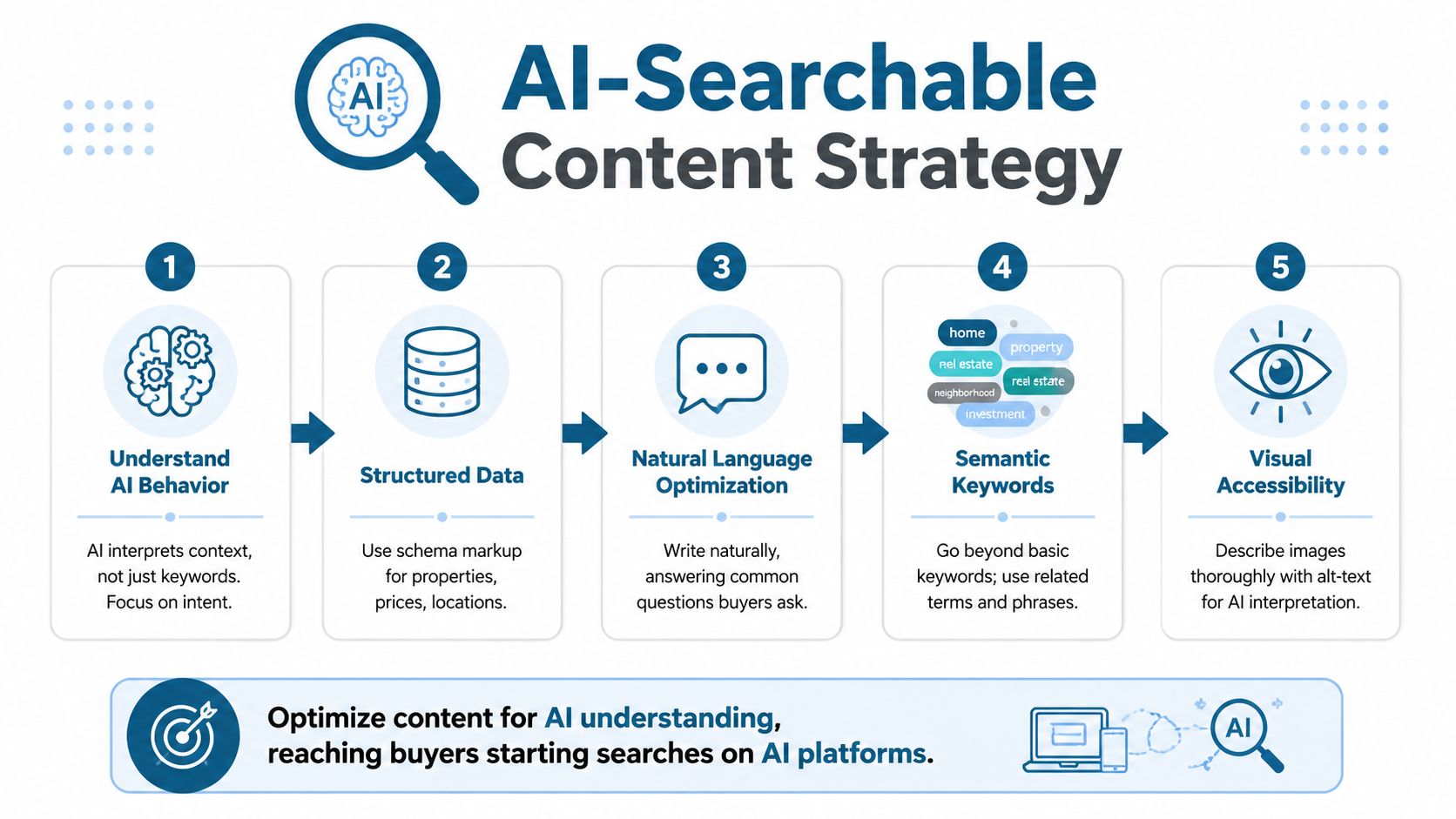
Over 40% of modern homebuyers now initiate agent searches via AI assistants, and content without structured data such as property schema and authorship tags can suffer a 60 to 70% reduction in visibility for those queries. If your content isn't structured clearly, AI systems may not understand what property you're describing, where it is, or why you're a credible source.
What AI-readable content looks like
AI-searchable content is usually clearer, not more clever.
A weak caption says:
“Obsessed with this stunning new home. DM for details.”
A stronger caption says:
“New listing in North Scottsdale with 4 bedrooms, 3 bathrooms, updated kitchen finishes, a covered patio, and a three-car garage. Listed by [agent name], licensed in Arizona. Message for current availability and showing details.”
The second version gives both people and AI more to work with. It includes concrete attributes, location, subject matter, and authorship.
The practical structure to use
When building your real estate social media content calendar, train every listing-related post to include these elements where appropriate:
- Specific property attributes: price, location, bed and bath count, notable features
- Clear authorship: agent name, brokerage identity, licensure details where your workflow requires it
- Context-rich language: avoid empty adjectives and use descriptive facts
- Accessible image descriptions: write useful alt text and asset notes
- Compliance footer or review cue: especially for templated content
Most generic calendar templates fall short at this point. They tell you to post more often. They don't tell you how to structure content so AI tools can interpret it.
Where most agents get this wrong
Three common mistakes make content harder for AI systems to understand:
Vague captions
“Dream home,” “must-see,” and “won't last” don't carry much usable information.
Missing authority signals
If your content never identifies the agent, brokerage, or service area, AI tools have less basis to connect your expertise to a market.
Platform-only thinking
Agents write for Instagram but ignore the broader discoverability layer. Good content now has to work for both feed behavior and machine interpretation.
Publish for two audiences. The human scrolling now, and the system deciding who gets recommended later.
If you want another perspective on building a planning workflow around this shift, AgentPulse's social media calendar resource is worth reviewing alongside your existing calendar process.
Use purpose-built drafting instead of generic prompts
This is also where specialized tools have an edge. A generic AI chatbot can write a caption. It usually won't structure listing language, authority signals, and channel-ready marketing in a way that fits real estate operations without heavy editing.
An AI listing copy generator for agents is more useful because it starts with property marketing logic instead of generic copywriting logic.
The bigger point is simple. Posting consistently still matters, but consistency alone no longer protects visibility. If your content isn't readable by AI systems, you're building a library that buyers may never find.
Measure What Matters Analytics and Compliance Guardrails
Once the calendar is live, two jobs remain. First, you need to know what is working. Second, you need to know what should never have gone out in the first place.
Agents often overfocus on vanity metrics and underbuild their review process. That's backwards. A real social system should improve output quality while reducing legal and brand risk.
Track the signals that affect business decisions
You don't need to measure everything. Start with the signals that help you make better content decisions.
Engagement on value-driven posts
Look at which advice, market, and local posts get comments, shares, saves, and thoughtful replies. Those signals tell you where trust is building.
Clicks and inquiry actions on lead-gen posts
Your listing and open house content should create direct next steps. Track which formats and offers lead to profile visits, form fills, DMs, or showing requests.
Saved posts
Saves often indicate authority. People save market explainers, buyer tips, checklists, and process content when they expect to use them later.
A simple review cadence works well:
| Review Window | What to Check |
|---|---|
| Weekly | Best and worst-performing posts by format and topic |
| Biweekly | Which content pillars are driving replies, saves, or inquiries |
| Monthly | Which themes deserve reuse, expansion, or retirement |
Run clean tests, not random experiments
A/B testing doesn't need to be fancy. Keep one variable steady and change one variable at a time.
Examples:
- Hook test: Question-based opener versus statement-based opener
- Format test: Carousel versus talking-head video
- CTA test: “DM for details” versus “Comment ‘guide' and I'll send it”
Document the result inside your calendar notes. Otherwise you'll repeat the same weak experiments and forget what happened.
Compliance has to be built into the workflow
This part isn't optional. Static Fair Housing checklists are insufficient, and NAR data indicates that 15% of new agents face compliance complaints related to social media, which is why content needs dynamic guardrails before publishing.
Manual review alone breaks down in real life. Agents rush. Team members reuse old captions. Someone copies language from a listing flyer. A well-meaning assistant writes a neighborhood post with phrasing that creates unnecessary risk.
Use an approve-before-publish workflow that includes:
- Draft review: Caption, visual, and CTA checked together
- Compliance screening: Language reviewed before scheduling
- Broker or brand approval: Required where team or office policy calls for it
- Final signoff: Nothing publishes automatically without review on sensitive content
What compliant content sounds like
Replace audience-based or lifestyle-coded phrasing with feature-based descriptions.
Use this approach:
Instead of: language suggesting who a property is for
Use: layout, lot, finishes, storage, updates, transit access, outdoor featuresInstead of: neighborhood labels that imply social or demographic judgments
Use: public amenities, business districts, commute routes, parks, and municipal featuresInstead of: urgency language that pushes beyond accuracy
Use: direct, factual calls to action tied to availability or showing information
Compliance review isn't there to make your content bland. It's there to keep your marketing precise.
The strongest teams build guardrails into the calendar itself. Every post gets a status. Drafted. Reviewed. Approved. Scheduled. Published. That simple workflow does more for risk control than most style guides ever will.
Conclusion From Calendar to Predictable Growth
A real estate social media content calendar works best when you stop treating it like a marketing accessory. It's a business system. It organizes your expertise, protects your brand, and gives you a repeatable way to stay visible when client work gets heavy.
The agents who get the most from it usually do four things well. They plan content by pillar instead of by mood. They publish on a schedule that matches audience behavior. They structure posts so AI systems can understand them. And they use review workflows that catch compliance issues before anything goes live.
That last piece matters more than a lot of agents admit. Social content today sits at the intersection of brand, lead generation, search visibility, and regulation. A calendar that only answers “what do I post on Thursday?” is too small for the job.
Build the system around approve-before-publish. Keep listing posts in proportion. Turn recurring client questions into education. Use local content to demonstrate market fluency. And don't rely on generic tools when your workflow requires real estate-specific outputs and compliance awareness.
If your current process still depends on late-night caption writing and scattered approval, it's time to tighten the system.
If you want a more efficient way to run that process, ListingBooster.ai helps agents, teams, and brokerages generate real-estate-specific listing descriptions and social content inside a workflow built for consistency, AI readability, and approve-before-publish review. It's a practical next step if you're ready to replace improvisation with a calendar that supports growth.
Walk In With the Campaign Already Built
Listing copy, social posts, sourced Market Insights, growth scheduling, and direct publishing after approval from one real-estate-specific system. 25 free credits to start.
Related Posts
 Uncategorized
Real Estate Content Marketing: The 2026 Playbook
Listings with video can generate 49% more qualified leads, according to a 2026 real estate digital marketing roundup. That figure changes the question. Real estate content marketing isn't about how often you post. It's about whether your listing, expertise, and local knowledge can be found, understood, and cited by people and by the AI tools […]
 Uncategorized
AI for Real Estate Marketing: A Practical Playbook
A new listing goes live on Tuesday morning. You write the description from memory, schedule three social posts, answer showing requests, and move on to the next client task. By afternoon, the listing has plenty of activity on your side of the business, but the phone still isn't producing the conversations you expected. That gap […]
 Uncategorized
What Is IDX and Why It Still Matters for Real Estate
A new agent usually hears “IDX” during a brokerage onboarding call, nods along, and hopes nobody asks for a definition. Then the questions arrive: Why are listings appearing on the website? Who controls the data? Why did a property remain visible after its status changed? And will the same pages be readable by ChatGPT, Perplexity, […]