Real Estate Marketing Software: The 2026 Guide
Most agents don't need more marketing tools. They need fewer tools that do more useful work. A stack can look complex, yet still miss the only metrics that matter in practice, like whether a listing gets found, whether a lead gets contacted fast enough to stay warm, and whether the content stays compliant before it goes live.
That's why the essential question isn't which platform has the longest feature list. It's which real estate marketing software helps you publish faster, show up in AI-powered search, and turn attention into inquiries without creating a compliance headache. The market is expanding quickly, which makes the selection problem worse, not easier. One report estimates marketing automation software will grow from $1.31 billion in 2025 to $1.53 billion in 2026 at a 17.3% CAGR, and a broader forecast puts the global market at $4.26 billion by 2034, up from $1.12 billion in 2024 (Research and Markets).
Why Most Agents Choose the Wrong Marketing Software
Agents who buy software for activity end up with tools that create motion without improving results. A platform can spit out posts, flyers, drips, and prompts all day long, but if it doesn't improve inquiry flow or speed up response, it is just more work dressed up as a system.
The problem is easier to spot now because the broader software market is already cloud-first. The U.S. real estate software market is estimated at $3.21 billion in 2025 and forecast to reach $5.24 billion by 2030 at a 10.31% CAGR, while cloud deployment accounted for 78.16% of U.S. market share in 2024 (Grand View Research). The infrastructure is there. What matters is whether your stack helps you use it to increase inquiry rates, improve AI discoverability, and cut compliance risk before content goes live.
The three questions that matter
Most buyers should start with these:
- Will it make me discoverable in AI search? If your listing pages and agent pages cannot be read clearly by answer engines, you are building content for people who may never see it.
- Will it reduce time-to-publish for compliant content? Speed matters, but only if the copy is ready to use without a second pass from legal or a manager.
- Will it measurably improve lead conversion at some stage of the funnel? More posts and more scheduled emails do not mean more appointments.
Practical rule: if a tool only proves it can create content, it has not proven it can create business.
Hidden labor is the other trap. A lot of teams stitch together a flyer builder, a social scheduler, an email tool, a CRM, and a separate AI writer, then spend their week copying fields between them. That is busywork dressed up as a system.
The better filter is simple. Choose software that shortens the path from listing data to live campaign, and then from lead capture to follow-up. If you are comparing options, a guide to AI marketing tools for small businesses can help you see where lightweight tools stop and where real workflow support begins.
What Real Estate Marketing Software Actually Does
A useful platform starts with one input, a property URL, MLS record, or basic listing data, then turns it into multiple pieces of marketing output. The point isn't novelty. The point is reducing the handoffs that usually slow agents down.
At a mature level, category definitions from SoftwareReviews and G2 describe platforms that combine lead management, CRM-like contact tracking, campaign automation, social and email marketing, listing management, and analytics, with some tools adding IDX websites and behavior tracking (Info-Tech / SoftwareReviews categories). That combination matters because it lets a lead move from capture to nurture without someone manually transferring data.
Standalone tools versus integrated platforms
A standalone flyer builder is fine if you only need a flyer. A social scheduler is fine if you only need scheduled posts. But those tools usually stop at output. They don't connect the campaign to the contact record, or the contact record to the next touchpoint.
Integrated platforms do more of the wiring. They can pull in listing data, generate the initial campaign, and then keep track of who clicked, opened, or visited a page so the next message can be timed properly. That reduces the chance of a lead falling through the cracks when the office gets busy.
For agents comparing categories, a useful companion read is this guide to AI marketing tools for small, especially if you're deciding whether a general-purpose stack is enough or whether you need something built around real estate workflows.
What good workflow design looks like
A practical system does three things well. It creates the marketing assets, routes the right lead to the right person, and preserves the context so nobody has to ask the same questions twice.
That's why tools like ListingBooster.ai matter in the conversation, because its purpose-built listing and content workflows are designed around real estate input rather than generic prompts. On the advertising side, if you're building paid campaigns, this real estate ad campaign tips resource is useful because it keeps the focus on campaign structure instead of random creative ideas.
A clean stack doesn't feel impressive in a demo. It feels invisible in daily use because the listing, the message, and the follow-up already know where to go.
Core Features That Drive Real Results
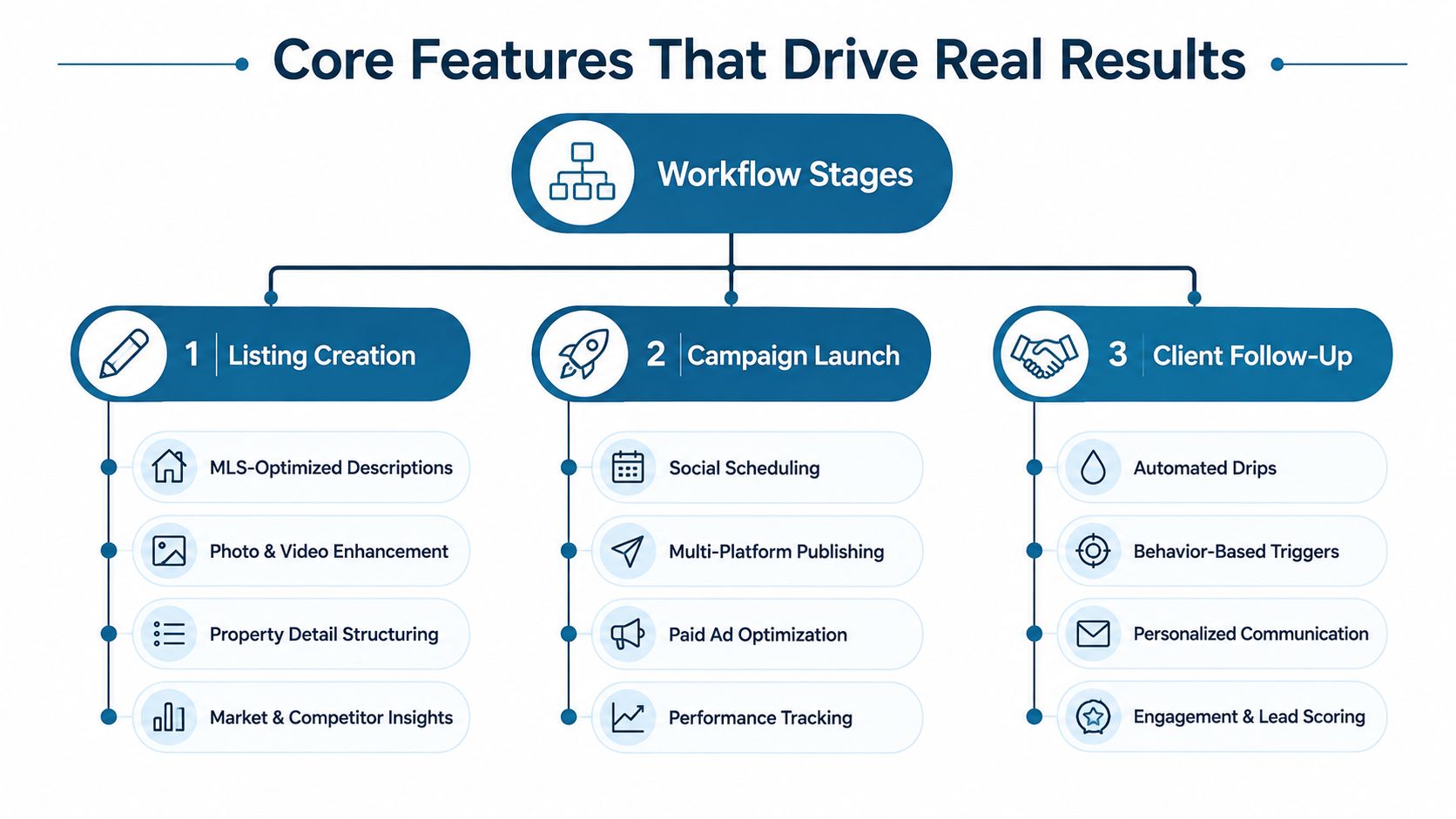
The strongest software stack removes friction from the actual workday. That usually means tools that speed up listing creation, campaign launch, and follow-up, while leaving the flashy extras untouched.
Features that change the workflow
MLS-optimized descriptions save time only if the output is usable without heavy editing. The better tools produce copy that highlights verifiable property features and avoids protected-class language, which matters because HUD and NAR both tie housing marketing to Fair Housing compliance rules. NAR's guidance on effective online marketing also stresses that online listing content has to stay accurate and inclusive, which makes review workflows just as important as generation speed (NAR on effective online marketing).
Automated social calendars remove one of the most repetitive bottlenecks in an agent's week. They let you publish new listing posts, open house reminders, price-drop updates, and just-sold content without rebuilding every asset from zero. The point is consistency, because a steady posting rhythm does more for recall and inquiry volume than scattered bursts of activity.
Authority content generation matters because sellers and buyers rarely hire from a single post. Market updates, neighborhood pages, and buyer education content create a visible trail of competence before a lead ever fills out a form. That trail matters more now that search behavior is shifting toward AI-assisted answers, which means your content has to be easy for both people and systems to interpret.
A useful benchmark is the top AI real estate marketing tools review, especially if you're comparing general-purpose writers with platforms built around property workflows.
What separates purpose-built tools
The divide is data structure. A generic AI writer can produce passable copy, but it usually cannot pull MLS fields, brokerage assets, and campaign pieces into one repeatable workflow. Industry comparisons note that stronger platforms can auto-populate flyers, brochures, social posts, listing presentations, and email campaigns from MLS, CRM, property photography, agent, and brokerage data. RealAnalytica's comparison also points out that MLS-driven generation can fill address, price, photos, and stats automatically, while Smart Lists can be built from plain English for bulk email sequences (DesignHuddle blog).
That cuts duplicate entry and reduces the odds of publishing inconsistent facts across channels. It also gives brokerages a clearer source of truth for tone, branding, and listing details.
The other feature to watch is AI-readable schema markup. It helps search systems understand listing pages, agent pages, and service pages more clearly, which matters if you care about discoverability in AI search results, not just traditional rankings.
For paid distribution, the reporting and creative workflow have to match the channel. A social post generator that looks impressive in a demo can still waste budget if it doesn't support clean campaign structure, audience segmentation, and compliance review. The practical guidance in these real estate ad campaign tips is useful because it keeps the focus on setup and execution, not decorative features.
The right way to judge software is simple. Ask whether it reduces manual steps, improves inquiry rates, increases AI discoverability, and lowers compliance risk. Feature counts do not tell you that. Workflow impact does.
Choosing the Right Platform for Your Business Model
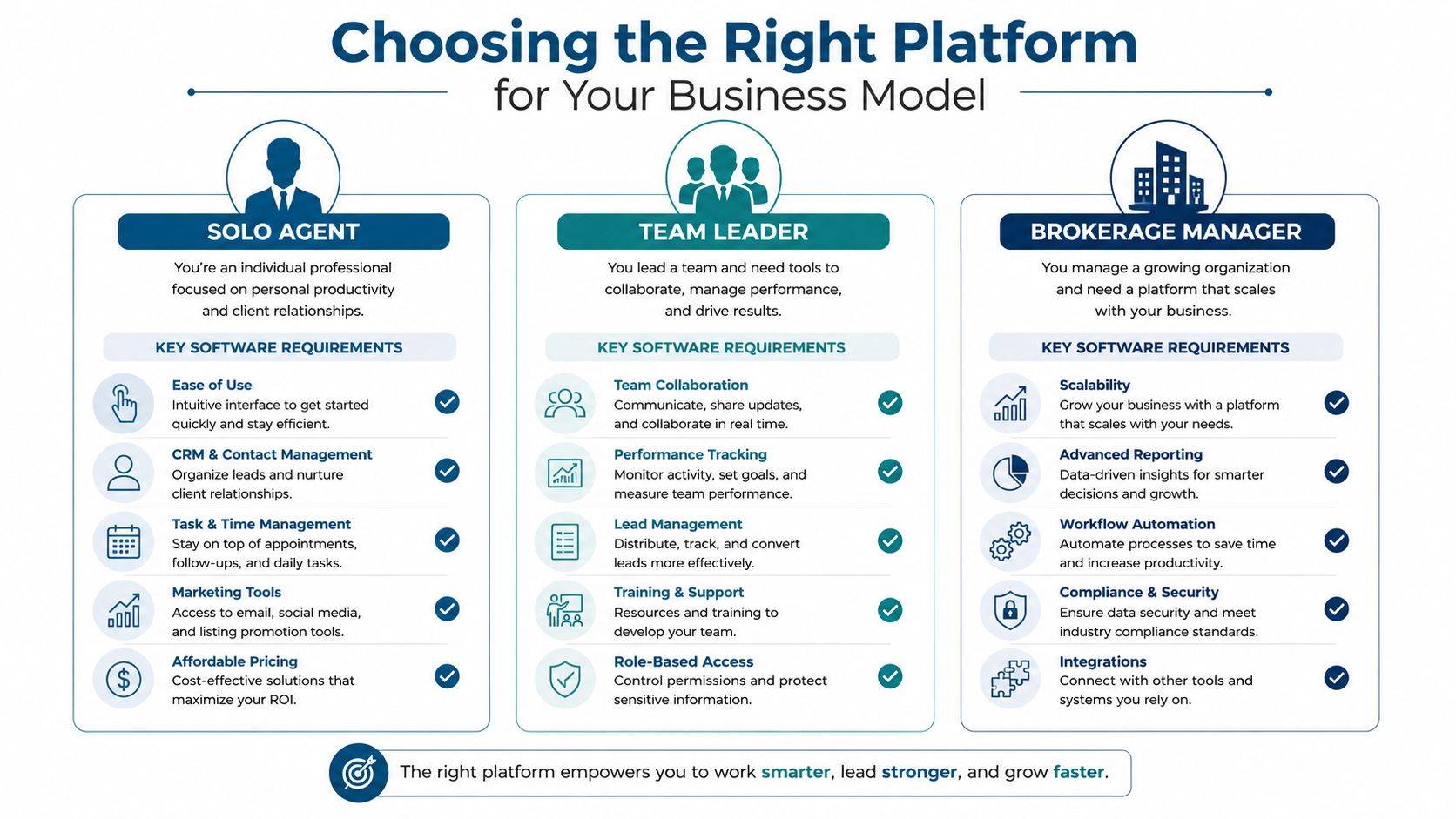
The right platform depends on who has to use it every day and what failure costs you most. A solo agent loses time. A team loses consistency. A brokerage loses control, and that usually shows up first in messy branding, slow approvals, and compliance gaps.
Solo agents need speed and simplicity
Solo agents win when software shortens the path from listing intake to live promotion. The workflow should be straightforward, create the listing copy, turn it into social content, and keep the next action obvious so you are not rebuilding the same campaign from scratch each time.
That matters more now because AI search rewards clear, structured content, not just volume. A solo agent who can publish accurate listing pages, agent bios, and neighborhood content in a consistent format has a better shot at being surfaced in AI-driven answers and local discovery results.
For that use case, AI marketing software for real estate agents makes sense only if it cuts manual work without creating new review burdens. Generic AI can draft decent text, but it usually does not fit the way real estate teams handle MLS fields, disclosure language, or final approval. The trade-off is simple. Extra features are useless if they slow the agent down or create cleanup work after every post.
Teams need consistency first
Teams usually have enough output. The core issue is drift. One agent writes clean, on-brand property posts, another improvises, and a third copies stale language that no longer matches the listing. That inconsistency weakens the brand and creates avoidable review work for whoever manages marketing.
A team platform should solve for repeatability. Shared templates, approved language blocks, and role-based edits matter more than a bigger content menu. If the system lets each agent make the campaign look different every time, you gain more activity but lose the brand patterns that help prospects recognize you across channels.
Teams also need measurable handoffs. A good setup shows who created the asset, who approved it, and which campaigns drove inquiries. Without that visibility, managers end up policing process instead of improving it. The software should reduce the number of decisions agents make, while still leaving room for local market details and listing-specific adjustments.
Brokerages need oversight without bottlenecks
Brokerages have the hardest balancing act. They need agents to move quickly, but they also need a centralized standard for messaging, brand usage, and Fair Housing review. A platform that makes one office productive but forces leadership to manually correct everything later is a bad fit for scale.
Brokerage buyers should care most about approval paths, permission controls, and shared asset libraries. Those features keep marketing from turning into a free-for-all. They also reduce compliance risk, because the system can catch risky phrasing before it spreads across multiple agents, landing pages, and ad variants.
The practical test is whether the software supports governance without forcing every request through a bottleneck. Managers should be able to set the rules once, then let agents work inside them. That keeps local speed intact while protecting the brokerage from inconsistent claims, broken branding, and preventable policy issues.
Your Software Evaluation Checklist
Many software demos look convincing because they showcase output instead of impact. A stronger evaluation process asks whether the tool helps you publish better, respond faster, and stay compliant without adding another manual review step.
Score every platform on five criteria
Use this checklist to compare options:
- AI-search visibility. Can it create content that is structured clearly enough for search and answer engines to read?
- Compliance automation. Does it flag Fair Housing issues before anything gets published?
- Workflow integration. Does it pull from MLS and CRM data instead of making you retype everything?
- Brand consistency. Can it keep your tone, formatting, and messaging stable across channels?
- Measured ROI. Does it help you track inquiries and appointments, not just posts and clicks?
What to watch during demos
The awkward moments tell you more than the polished ones. Ask what happens when the MLS data is incomplete, who approves edits before publishing, and whether reporting can connect content to actual lead activity.
A few red flags usually show up fast:
- Feature overload without routing logic. Plenty of tools create content, fewer help it move through the funnel.
- Vague compliance answers. If the vendor cannot explain how it prevents risky language, keep moving.
- No useful reporting. If the dashboard only shows output counts, you still will not know what converted.
The software that passes this test usually is not the loudest one. It is the one that can show how content becomes an inquiry without forcing you to manage five disconnected tools. For teams that want to start with a narrower use case, listing to social media campaign automation can be a practical first filter.
Implementing Your Marketing Stack Without Disruption
The first week matters more than the sales demo. Many teams fail here because they try to redesign everything at once, then get buried in templates, permissions, and half-finished settings.
A realistic first-week rollout
Start with the smallest useful setup. Connect your MLS or listing inputs, define the brand voice rules, and decide who reviews compliance-sensitive content. Then generate one listing campaign from start to finish before you touch the rest of the stack.
A good first campaign should include a listing description, social posts, a short email, and a print-ready asset. The goal is not perfection. The goal is to prove that the system can move from listing data to publishable content without constant manual cleanup.
What usually goes wrong
Over-customizing templates before testing is a classic mistake. Teams spend hours tweaking fields that they haven't even used in real conditions yet. Ignoring analytics setup is another one, because if you don't track performance from day one, you can't tell which content produced the inquiry.
Training matters too. If agents don't know where compliance checks live, they'll bypass them when the office gets busy. If managers don't know how approvals work, they'll create bottlenecks that make the system feel slow.
For teams that want to start with a narrower use case, listing to social media campaign automation is often the cleanest entry point because it gives the system a clear job before you expand into broader workflows.
A steady operating rhythm
After launch, keep the motion simple. Review performance weekly, update templates when messaging drifts, and keep a close eye on what content gets inquiries instead of just impressions.
The best implementation feels boring after the first week. That's a good sign. It means the software has become part of the workflow instead of a new project the team keeps postponing.
Frequently Asked Questions About Real Estate Marketing Software
Can generic AI tools replace real estate marketing software
Not cleanly. Generic tools can draft copy, but they don't reliably handle MLS-driven workflows, structured content output, or compliance checks built for housing marketing. They're useful as assistants, not as a complete operating system.
What does AI-search visibility mean in real estate
It means your listing pages, agent pages, and authority content are structured so answer engines can understand who you are, what you offer, and what a property includes. That's different from writing for traditional SEO alone, which still matters but doesn't cover the whole discovery path anymore.
How should ROI be measured
Measure whether the software improves inquiry quality, response speed, and appointment activity. Vanity metrics like post counts or email sends can be helpful diagnostics, but they don't tell you whether the platform moved a lead closer to a conversation.
How can brokerages protect brand standards without micromanaging agents
Use templated content, approval workflows, and shared brand rules. The goal is to let agents personalize within guardrails, not to let everyone reinvent the brand every week.
Where do video and follow-up fit in
Video still plays a major role in listing promotion, and fast follow-up is still one of the most operationally important levers in the funnel. The software should help you publish richer listing content and respond quickly when a lead shows intent, not force you to choose between marketing and speed.
If you're comparing platforms and want a workflow built around listing descriptions, social content, and AI-readable content rather than generic templates, take a look at ListingBooster.ai. It's built to turn property data into publishable marketing assets while keeping brand consistency and compliance in mind. If that's the gap in your current stack, start there and evaluate how much manual work it removes from your week.
Walk In With the Campaign Already Built
Listing copy, social posts, sourced Market Insights, growth scheduling, and direct publishing after approval from one real-estate-specific system. 25 free credits to start.
Related Posts
 Uncategorized
Real Estate Content Marketing: The 2026 Playbook
Listings with video can generate 49% more qualified leads, according to a 2026 real estate digital marketing roundup. That figure changes the question. Real estate content marketing isn't about how often you post. It's about whether your listing, expertise, and local knowledge can be found, understood, and cited by people and by the AI tools […]
 Uncategorized
AI for Real Estate Marketing: A Practical Playbook
A new listing goes live on Tuesday morning. You write the description from memory, schedule three social posts, answer showing requests, and move on to the next client task. By afternoon, the listing has plenty of activity on your side of the business, but the phone still isn't producing the conversations you expected. That gap […]
 Uncategorized
What Is IDX and Why It Still Matters for Real Estate
A new agent usually hears “IDX” during a brokerage onboarding call, nods along, and hopes nobody asks for a definition. Then the questions arrive: Why are listings appearing on the website? Who controls the data? Why did a property remain visible after its status changed? And will the same pages be readable by ChatGPT, Perplexity, […]