AI Real Estate Listing Description Generator: A 2026 Guide

You know the drill. A new listing is going live, photos are in, the MLS deadline is close, your phone is ringing, and you still need a description, an Instagram caption, a Facebook post, a LinkedIn update, and something usable for email. Most agents don't lose time on marketing because they lack ideas. They lose it because every listing creates a fresh content pileup.
That pileup used to be annoying. Now it affects visibility.
Over 40% of homebuyers now incorporate AI tools like ChatGPT, Perplexity, and Google AI into their search process, which means agents without a consistent, AI-readable digital footprint risk getting overlooked, as noted in Propphy's real estate AI guide. That changes the job. You're not just writing one description for the MLS anymore. You're building a listing marketing system that has to work across search, social, and syndication.
An AI real estate listing description generator earns its keep when it removes that scramble. Not by replacing your judgment. By giving you a repeatable starting point that turns verified property facts into clean first drafts you can adapt fast, review carefully, and publish everywhere with confidence.
The End of the Late-Night Content Scramble
A lot of agents still treat listing content as a last-minute writing task. That's the bottleneck.
You finish pricing strategy, coordinate staging, approve photos, and handle seller questions. Then marketing gets compressed into whatever time is left. The result is familiar: a rushed MLS description, copied captions across platforms, and inconsistent messaging from one listing to the next.
That approach breaks down fast when your listing has to do more than fill a text box.
The real problem isn't the blank page
The issue usually isn't writing skill. It's production capacity. One property now needs multiple versions of the same core message. The MLS needs factual, compliant copy. Instagram needs a concise hook. Facebook needs more context. LinkedIn needs a professional angle. Email needs a reason to click.
Good listing marketing starts with one verified source of truth, then branches into channel-specific versions.
That's why a solid AI workflow matters. It lets you start with structured property data and generate usable drafts quickly, while keeping your message aligned across every place the listing appears.
What changes when you use AI well
A strong system does three things at once:
- Cuts the initial drafting burden: You stop writing every asset from scratch.
- Improves consistency: The same property story carries across MLS, social, and email.
- Protects your time: You spend more energy on review, positioning, and client service than on repetitive copywriting.
Used this way, AI isn't a novelty. It's an operating layer for listing launch.
Choosing the Right AI Generator for Your Business
Not every AI tool belongs in a real estate workflow. Generic AI can write fluent text, but fluent text is not the same thing as listing-ready marketing.
The difference starts with data. Effective real estate AI is built on structured data, and a purpose-built tool can process inputs like address, beds, baths, and square footage to generate compliant, localized, and channel-specific assets, according to ListingAI's description generator workflow. That matters because real estate content isn't just creative. It's operational.
Generic AI versus real estate-specific AI
Here's the practical comparison.
| Feature | Generic AI (e.g., ChatGPT) | Purpose-Built Tool (e.g., ListingBooster.ai) |
|---|---|---|
| Property fact intake | Manual prompt entry | Structured fields for listing data |
| MLS-ready copy | Possible, but inconsistent | Designed for MLS-style output |
| Social versions | Requires extra prompting | Built to produce multiple channel variants |
| Fair Housing screening | Manual review required | Often included as a workflow guardrail |
| Brand voice control | Prompt-dependent | Usually guided by saved preferences or templates |
| Editable drafts | Yes | Yes, usually within a listing workflow |
| Fact grounding | Depends on what you type | Anchored to listing fields and source inputs |
A generic tool is fine for brainstorming. It's less reliable when you need repeatable output from verified facts, especially under deadline.
What a good generator must do
If you're evaluating an AI real estate listing description generator, don't get distracted by how polished the demo sounds. Check whether it handles the parts that matter in daily practice:
- MLS-ready copy: The draft should be concise, factual, and easy to edit for local MLS rules.
- Social media versions: One listing should generate short-form posts without forcing you to reprompt from scratch.
- Fair Housing screening: This should be part of the workflow, not an afterthought.
- Editable drafts: You need to tighten language, remove weak claims, and tailor the message.
- Brand voice support: Luxury, new construction, relocation, urban condo, and suburban move-up listings shouldn't all sound identical.
- Fact grounding: The tool should work from actual property inputs, not guesswork.
Practical rule: If a tool saves time on drafting but creates more review risk, it's not efficient.
For a broader look at category options, this guide to AI content tools is useful as a general overview. For a more industry-specific roundup, this overview of top AI solutions for agents is a better fit for real estate workflows.
Where purpose-built tools fit
A platform like ListingBooster.ai fits naturally. It's built around real estate inputs and multi-channel output, rather than asking you to build the entire workflow from prompts alone. That's a meaningful distinction if your goal is speed with control, not just speed.
Establishing Your AI Content Workflow and Compliance Guardrails
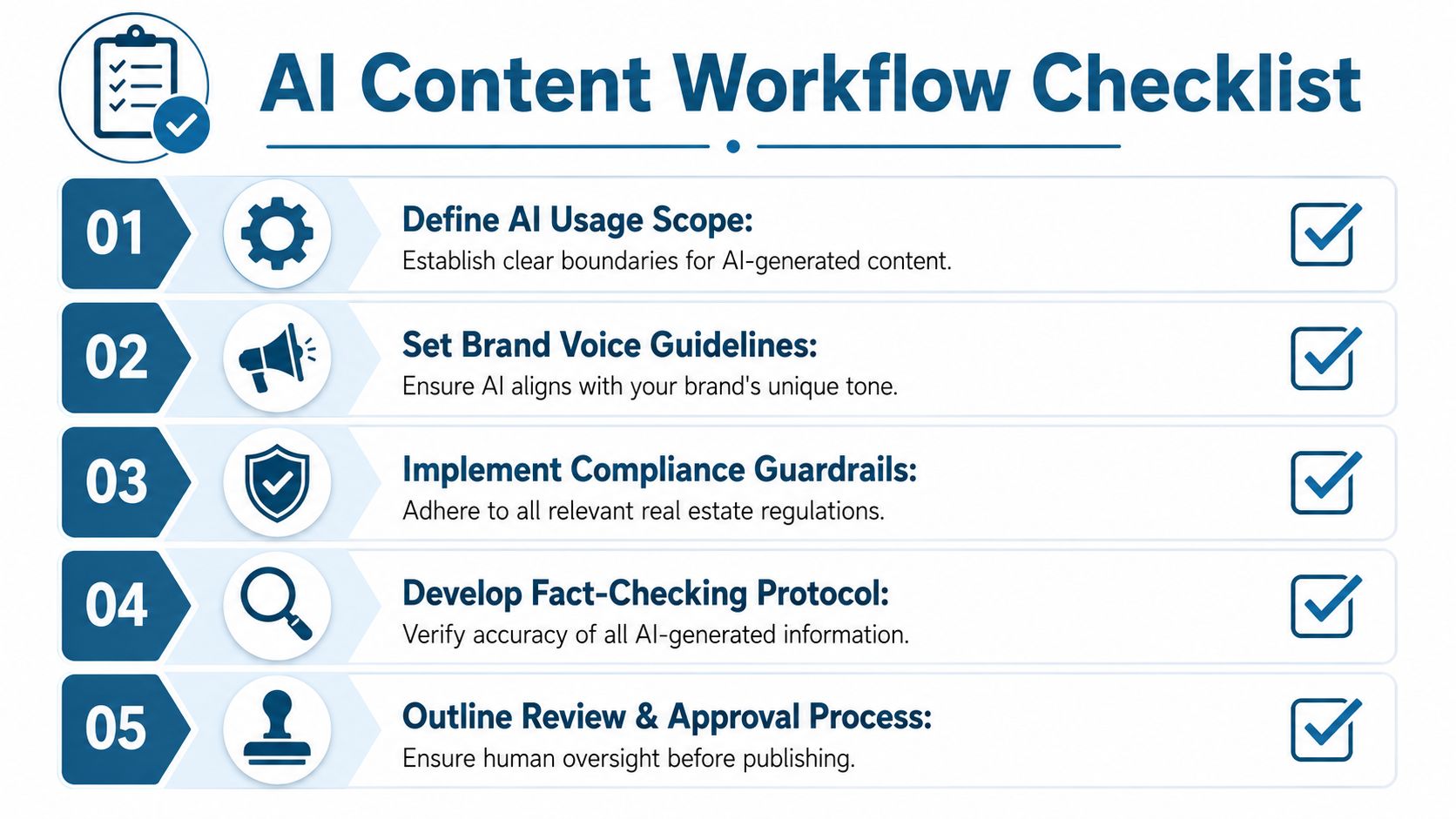
The most important decision happens before you generate anything. You need a review process.
The biggest risk in AI content generation isn't poor writing. It's liability. A single unsupported claim or Fair Housing issue can spread across MLS, portals, and social posts, which is why a human approval workflow is essential, as discussed in Hypotenuse AI's real estate generator guide.
Verify facts before style
The AI draft should only be as strong as the facts you feed it. Manually confirm the fields that commonly cause problems:
- Property basics: Bedrooms, bathrooms, square footage, lot size, parking, year built.
- Upgrades and features: Renovation details, appliance brands, roof or HVAC updates, outdoor improvements.
- Location details: School names, HOA references, transit claims, neighborhood amenities.
- Status-sensitive details: Open house timing, price changes, concessions, occupancy notes.
If you can't verify it, don't publish it.
Screen for Fair Housing risk every time
Many agents get casual at this stage. Don't.
Avoid language that describes who should live in the home or implies anything about protected classes. Skip phrases like “perfect for families,” “safe neighborhood,” or “ideal for young professionals.” Describe the property itself instead.
Use this kind of translation:
- Instead of: “Perfect for families”
Use: “Flexible floor plan with multiple living areas and a fenced yard” - Instead of: “Safe, quiet street”
Use: “Located on a cul-de-sac” or “set on a low-traffic residential street,” if accurate - Instead of: “Walk to church”
Use: “Close to neighborhood services and community amenities,” if verified and appropriate
For a more focused look at compliant workflow standards, review how to generate legal property descriptions.
Your license doesn't care whether a problematic phrase came from you or from software. You're still responsible for the final copy.
Build a simple approval sequence
Keep it tight:
- Load verified listing facts
- Generate draft variations
- Review for factual accuracy
- Screen for compliance and unsupported claims
- Approve platform versions for publishing
That process is what turns AI from a risk into an asset.
Executing Your 30-Day Listing Marketing Plan
The best use of an AI real estate listing description generator is to treat the MLS description as the core asset, not the final deliverable. One approved draft can drive a month of coordinated marketing if you plan it correctly.
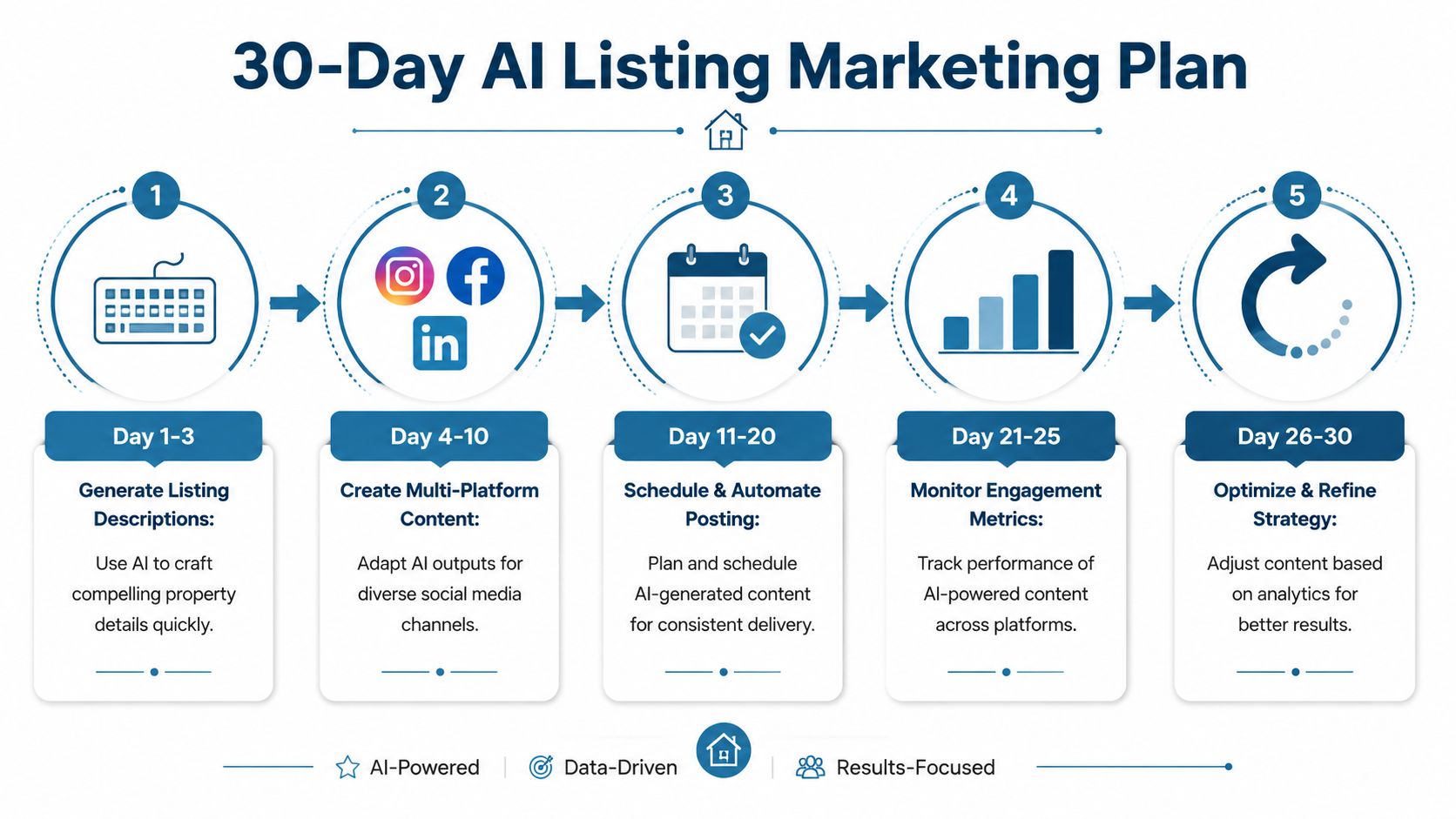
Days 1 to 3 with the cornerstone asset
Start with the verified property record and your own notes from the home. Generate:
- An MLS description: Clear, accurate, and stripped of fluff
- A longer website version: More room for narrative and feature grouping
- A short-form summary: Useful for portals, email intros, and teaser posts
At this stage, you're deciding what story the listing will tell. Is the angle architectural detail, updated interiors, lot utility, outdoor living, or location convenience? Pick one primary angle and one secondary angle. Don't try to make every feature the headline.
Days 4 to 10 with launch content
Once the core description is approved, derive launch assets from it.
A practical sequence looks like this:
- Coming soon post: Focus on anticipation. Tease the strongest visual or functional feature.
- Just listed post: Use the clearest summary version and strongest first image.
- Story or Reel script: Turn the description into a walkthrough voiceover.
- Email announcement: Keep the first paragraph tight and direct readers to photos or a tour page.
Days 11 to 20 with event-based updates
Most listings need more than one announcement. Build around the actual sales cycle.
| Listing stage | Best content angle | What AI should generate |
|---|---|---|
| Open house | Access and urgency | Caption, story slides, reminder text |
| Price adjustment | Fresh value framing | Updated copy emphasizing features and positioning |
| Under contract | Momentum and proof of activity | Status post and seller-facing credibility content |
| Just sold | Marketing recap and market presence | Closing announcement and authority post |
Content planning offers assistance. If you want a repeatable schedule instead of posting ad hoc, use a framework that helps you attract clients with content planning.
Days 21 to 30 with follow-up and reuse
After the listing has been live for a while, don't abandon the content. Recut it.
Use the original description to create a feature spotlight post, a behind-the-scenes caption about prep and launch, or a market positioning post that explains what the property represented in the local market. The same listing can support both lead generation and authority building when the workflow is organized from the start.
Adapting AI-Generated Content for Each Social Platform
The draft shouldn't be identical everywhere. Platform-native packaging matters.

Instagram and TikTok need movement
Instagram captions work best when they lead with a visual hook, then quickly anchor the property's strongest selling point. Reels need a short script with scene-by-scene pacing, not a pasted MLS paragraph.
For TikTok, use the listing description as raw material for voiceover structure:
- opening hook tied to the standout feature
- quick room-to-room progression
- short closing line with next action
If you're turning approved listing copy into video ads or short-form creative, tools like ShortGenius automated ad generation can help speed up video production after the messaging is finalized.
Facebook needs context and conversation
Facebook still works well for community-aware listing posts and event promotion. The copy can be a little longer. Give enough detail for someone to understand why the property stands out, then invite a practical next step such as attending an open house or requesting details.
Good Facebook posts often combine:
- a concise lead sentence
- two to three verified features
- one action prompt
LinkedIn should build professional credibility
LinkedIn is the place to frame the listing as evidence of your marketing process and market knowledge. Don't write like you're posting to Instagram with a suit on.
A LinkedIn listing post should sound like a professional market update attached to a property, not a sales flyer.
Use angles like pricing strategy, presentation quality, neighborhood demand patterns, or the importance of clean syndication-ready content. The property is still the hook, but your expertise is the core subject.
Building Your Authority Engine with AI
The smartest agents use listing content to build a body of work, not just fill a weekly posting slot.

With 43% of shoppers willing to use generative AI in their home search, discoverability now depends on a consistent footprint of authority content that helps AI systems recognize trusted local expertise, according to Skyline School's write-up on listing description generators.
The content pillars that actually help
Your AI workflow shouldn't stop at active listings. Build around a few durable themes:
- Local market interpretation: Short commentary on inventory, pricing patterns, or buyer behavior in your area
- Buyer guidance: Financing prep, showing strategy, offer readiness, inspection expectations
- Seller preparation: Pre-listing updates, pricing discipline, launch planning, presentation tips
- Neighborhood knowledge: Amenity access, commute patterns, housing stock, style trends, public-space features
This kind of content gives AI search systems more evidence about who you are, what market you know, and what topics you consistently cover.
Why listing-only content isn't enough
If your digital presence only appears when you have a property to sell, your footprint stays thin. A stronger pattern is to use each listing as a content trigger. One home can lead to an evergreen post about staging decisions, another about lot utility, another about condo positioning, another about pricing communication.
That's how an AI real estate listing description generator becomes part of your authority engine. It helps you start faster, then expand outward with judgment and local knowledge.
Measuring What Matters and Refining Your AI Strategy
If you only watch likes, you won't know whether the content is helping the business.

Track actions, not applause
Review your listing content monthly and focus on signals tied to actual intent:
- Comments and direct messages: Did the post start real conversations?
- Saves and shares: Did people treat it as useful enough to revisit or send along?
- Website clicks: Did the content move people to the listing page or contact form?
- Lead quality: Did inquiries relate to the property, the neighborhood, or future selling plans?
- Appointments set: Did any content lead to a showing, consultation, or listing conversation?
Use the review to improve prompts
Look for patterns in what worked. Maybe feature-focused captions drove better inquiries than generic launch posts. Maybe your LinkedIn market commentary brought in referral conversations. Maybe short walkthrough scripts held attention better than static image posts.
Then adjust the workflow. Refine the source inputs, improve your prompts, shorten weak openings, and keep your review process tight. AI should make your system sharper over time, not just faster.
Conclusion: From Content Creator to Content Strategist
An AI real estate listing description generator is most useful when you stop treating it like a writing shortcut and start using it like marketing infrastructure. The win isn't just faster copy. It's a cleaner launch process, stronger consistency across channels, and fewer last-minute content decisions.
Agents still need to verify facts, apply judgment, and protect compliance. That part doesn't change. What changes is the amount of manual drafting required to get a listing in front of buyers professionally.
Used well, AI moves you out of production mode and into strategy mode. You spend less time wrestling captions and more time guiding positioning, reviewing quality, and serving clients. That's the right role for a working agent or team.
If you want to see what that kind of workflow looks like in practice, ListingBooster.ai is worth exploring. It's built for real estate-specific inputs and can help turn one set of verified listing facts into MLS-ready copy and supporting social content, while keeping editing and compliance review in your hands.
Walk In With the Campaign Already Built
Listing copy, social posts, sourced Market Insights, growth scheduling, and direct publishing after approval from one real-estate-specific system. 25 free credits to start.
Related Posts
 Listing Descriptions
MLS Description vs Zillow Description How to Win on Both
A listing can have strong photography, sharp pricing, and a solid property, then still underperform online because the description isn't doing the right job in the right place. That's the part many agents miss. They write one paragraph, paste it everywhere, and assume syndication will handle the rest. It won't. The MLS, Zillow, Realtor-style portals, […]
 Listing Descriptions
Top Real Estate Listing Description Examples for 2026
The MLS remarks field opens. The photos are sharp, the pricing is disciplined, and the prep work is done. Then the description underperforms. A generic write-up can drain momentum from an otherwise strong launch because buyers, portal readers, and now AI systems all rely on that copy to decide what the property is, who it […]
 Listing Descriptions
The Ultimate Real Estate Listing Description Playbook
You've seen this happen. The photographer delivers strong images, the seller wants the home live today, and the MLS text box is still blank. That last step looks simple, but it isn't. A real estate listing description now has to persuade, stay compliant, and read cleanly on platforms where buyers skim in seconds. That's why […]