A Guide to Real Estate MLS Compliant Marketing
Real estate marketing that follows MLS and Fair Housing rules isn't just about checking boxes. It’s about making sure everything you publish—from your listing description and photos to your social media ads—is accurate, non-discriminatory, and totally transparent.
Getting this right is fundamental to protecting your license, steering clear of hefty fines, and building the kind of professional reputation that brings in referrals.
Getting a Handle on MLS and Fair Housing Compliance
Compliance can feel like a tangled web of rules designed to trip you up, but it’s actually much simpler than that. Think of it as the foundation for ethical, effective marketing, built to keep the marketplace fair for consumers and protect the data we all rely on as agents. Every single rule, from photo guidelines to wording restrictions, is there to ensure a level playing field for everyone involved.
To get it right, you have to nail both sides of the coin: Fair Housing laws and your local MLS regulations. Let's break down what that really means for your day-to-day work.
Core Pillars of MLS and Fair Housing Compliance
This table simplifies the two main areas you need to focus on. On one hand, you have federal law (Fair Housing), and on the other, you have the hyper-local rules of your specific MLS.
| Compliance Pillar | What It Means for You | Common Violation Example |
|---|---|---|
| Fair Housing Act | Your marketing language must never discriminate or show a preference based on race, color, religion, sex, national origin, disability, or familial status. The focus is on the property, not the potential buyer. | Describing a property as a “perfect family home,” which could imply it’s not suitable for individuals or couples without children. |
| MLS Data Integrity | The information you enter into the MLS must be 100% accurate and verifiable. This includes everything from square footage and the number of bedrooms to the photos and public remarks. | Listing a 3-bedroom home as a 4-bedroom because a den "could be" a bedroom. All data must reflect the current, factual state of the property. |
| MLS Photo & Branding Rules | Photos and virtual tours must be free of any agent or brokerage branding, contact information, or external website links. They should be an honest representation of the property itself. | Watermarking a listing photo with your name and phone number or adding a link to your personal website in the virtual tour. |
Ultimately, these pillars work together to create a trustworthy and reliable system for both the public and other real estate professionals.
The Real Cost of Getting It Wrong
Ignoring these guidelines can have serious consequences that go way beyond a slap on the wrist. Violations can lead to major fines, mandatory ethics courses, having your MLS access suspended, or even putting your real estate license on the line. The damage to your bank account and your reputation can be incredibly difficult to come back from.
An agent’s reputation is their most valuable asset. Compliance isn’t just about following rules; it’s about proving your commitment to professionalism and ethical conduct that builds lasting trust with clients and colleagues.
Common Pitfalls We All Need to Avoid
Most compliance issues I see aren't intentional; they’re just simple mistakes or old habits that are hard to break. Being aware of the common slip-ups is the best way to avoid them in the first place.
Here are a few of the most frequent errors agents make:
- Using Discriminatory Language: Phrases like “quiet neighborhood” or “walking distance to churches” seem harmless, but they can unintentionally violate Fair Housing laws by suggesting a preference for a certain type of buyer.
- Fudging Property Details: That office could maybe be a bedroom, but if it doesn't have a closet and a proper egress window, you can't list it as one. All data has to be factual and verifiable.
- Misleading Photo Edits: It’s fine to brighten up a dark photo, but you can’t digitally remove a cell tower from the backyard view or photoshop a lush green lawn over a dirt patch. That's deception, plain and simple.
- Sneaking in Branding: Your local MLS almost certainly has strict rules against putting your personal branding, phone number, or website links in the public remarks, photos, or virtual tours.
The good news is that technology is catching up to help us manage all this. The market for MLS listing software is expected to jump from $5 billion in 2025 to a staggering $14 billion by 2033. This shows just how much brokerages and agents are investing in tools to keep their marketing compliant. You can read more about the growth of MLS software and see how it’s shaping the industry.
By understanding these core principles, you can tackle every new listing with the confidence that your marketing is not just powerful, but perfectly compliant.
Your Practical Checklist for Compliant Listings

Creating a compliant listing isn't about memorizing a massive rulebook. It's about building a solid, repeatable workflow. I've broken down the process into a simple checklist to make sure every listing you create is accurate, ethical, and effective right from the start.
Think of this as your pre-flight check before launching a new property onto the market. Following these steps helps you sidestep common mistakes, minimize risk, and showcase your professionalism.
Nail the Foundational Data First
Before you even think about writing a single word of marketing copy, your first job is to be a fact-checker. Trust me, inaccurate data is one of the fastest ways to get a violation notice from your MLS, and it’s completely avoidable with a little due diligence.
Start with the basics, and pull them directly from official sources like tax records and property deeds. Don't ever rely on the seller's memory or, worse, data from an old listing.
Here's your data integrity checklist:
- Square Footage: Is the number from an appraisal, tax records, or a professional measurement? Whatever it is, note your source in the private agent remarks.
- Bedroom and Bathroom Counts: Make sure every room you call a bedroom meets local legal requirements (like having a closet and a proper egress window). A den is just a den until it’s a legal bedroom.
- Lot Size and Dimensions: Pull this straight from the plat map or county records, not a guesstimate.
- Tax Info and Parcel ID: Double-check these numbers. They're often used to auto-populate data across dozens of other platforms, so a mistake here can multiply quickly.
The golden rule of real estate MLS compliant marketing is simple: if you can't prove it, don't publish it. Verifiable facts are your best defense against any compliance claim.
Crafting Compelling and Compliant Copy
Once your data is locked in, you can start telling the property's story. This is where you get to be creative, but your language has to stay objective and focused on the home's features—not on the potential buyer's identity.
Your goal is to describe the home in a way that feels welcoming to everyone. This means steering clear of words that could be seen as discriminatory under the Fair Housing Act. Even phrases that seem harmless can land you in hot water.
Here are a few quick swaps I use to keep my copy clean:
- Instead of "Perfect family home," try "Spacious layout with multiple living areas."
- Instead of "Quiet, safe neighborhood," describe the why: "Located on a low-traffic cul-de-sac."
- Instead of "Walking distance to St. Mary's Church," go broader: "Conveniently located near places of worship, schools, and parks."
- Instead of "Great for empty-nesters," highlight the features: "Offers a main-level primary suite and a low-maintenance yard."
This shift in language does more than just keep you compliant. It actually strengthens your marketing by letting all potential buyers picture themselves in the home. You can also boost your listing's visibility by getting specific with its structural details, a technique we cover in our guide to schema markup for real estate listings.
Scrutinizing Photos and Visuals
Your photos and videos are a huge part of your marketing, and they're held to the same standards as your written descriptions. MLS rules are very clear: your visuals must be a "true picture" of the property.
This means that while basic edits like adjusting brightness are fine, major alterations that misrepresent the property are a huge no-no. You're selling the property as it is today, not some idealized version of it.
Review your visuals against these guidelines:
- No Digital Deception: If you use virtual staging, you must disclose it. You can't digitally add a swimming pool or remove that power line from the backyard view.
- Permanent Fixtures Stay Put: Never digitally erase permanent fixtures, like built-in shelving or an ugly light fixture, just to make a room look better.
- Be Honest About Condition: Don't use editing to hide known problems, like photoshopping over a water stain on the ceiling.
- Branding is Banned: Your photos, virtual tours, and videos must be completely free of any agent or brokerage branding. That means no logos, names, phone numbers, or websites.
Finalizing Disclosures and Permissions
The very last step before you hit that "submit" button is to triple-check that all your disclosures are in place. Transparency isn't just good ethics—it's a legal requirement.
Confirm you have the seller's written permission to advertise their property. And make absolutely sure that all known material facts have been properly disclosed according to your state's laws. This includes things like lead-based paint, known foundation issues, or whether the property is in a flood zone.
Running through this final review protects you, your client, and your brokerage. It turns compliance from a headache into a simple routine that proves you're a true professional.
Real-World Scenarios: Putting Compliance Into Practice
Theory is one thing, but seeing how compliance plays out in the real world is what really makes it click. The fine line between a great marketing piece and a Fair Housing violation can be subtle.
Let’s walk through some everyday examples you’ll definitely recognize. We'll look at property descriptions, social media posts, and photos to see how a few small tweaks can make all the difference.
The Art of the Compliant Property Description
Your public remarks are where your salesmanship shines, but they're also a minefield for accidental Fair Housing violations. The golden rule? Describe the property, not the person. When you start painting a picture of who should live there, you’re walking on thin ice.
Here’s a classic example I see all the time:
Non-Compliant Example:
"Welcome to this charming starter home in a quiet, family-friendly neighborhood. With a master bedroom perfect for a couple and two smaller rooms for the kids, this is the ideal spot for a young family to plant their roots. It's also a great fit for active professionals, with walking distance to the community center and local churches."
Even with the best intentions, this description is loaded with red flags. It expresses clear preferences based on familial status ("family-friendly," "kids"), marital status ("couple"), and religion ("churches").
Compliant Example:
"Welcome to this charming home located on a peaceful, low-traffic street. The functional floor plan includes a spacious primary suite and two additional versatile rooms, offering flexible living options. Enjoy convenient access to the community center and a variety of local amenities."
See the difference? We're selling the exact same features—a quiet street, three bedrooms, and nearby amenities—but we've shifted the focus entirely to the house itself. This version is not only compliant but also better marketing, because it invites everyone to imagine their life there.
Keeping Your Social Media Posts Clean
Social media feels casual, and that’s where agents get into trouble. It’s easy to forget that a quick Instagram post is still an advertisement, subject to the very same MLS and state licensing rules. And unlike a private email, mistakes on social media are out there for the whole world to see.
Let's look at a common "Just Listed" post.
Non-Compliant Post:
A photo of the house with a caption that reads:
"Just listed this beauty! Perfect for empty-nesters looking to downsize. Call me today before it's gone! John Smith, 555-123-4567. #realestate #newlisting"
This post has two big problems. First, "empty-nesters" is a code word for age and familial status, which is a Fair Housing no-go. Second, it's missing the agent's brokerage name—a non-negotiable requirement in most states for all advertising.
Compliant Post:
The same photo, but with a much smarter caption:
"Just Listed! This beautiful property offers single-level living and a low-maintenance yard, perfect for a simplified lifestyle. Featuring 2 bedrooms, 2 baths, and an updated kitchen. For more details, click the link in bio or send me a message! John Smith, Realtor® | ABC Realty | DRE #01234567"
This version is professional and compliant. It swaps the problematic "empty-nesters" for descriptive features like "single-level living" and "low-maintenance yard." Crucially, it also includes the required brokerage affiliation and license number.
Pro Tip: Your social media bio is your best friend. Make sure it contains your full brokerage name, license number, and any other state-required info. Then, you can keep your post captions cleaner while remaining compliant.
Your Photos Must Tell the Truth
Your listing photos and virtual tours are your most powerful tools for grabbing a buyer's attention. But with great power comes great responsibility. The images must be an honest representation of the property.
Minor edits like brightening a dark room or correcting color are standard practice. But digitally altering permanent physical features of the property? That crosses the line into misrepresentation.
Imagine a house with an otherwise great view, but there’s an electrical tower off in the distance.
Non-Compliant Visuals:
The agent tells the photographer to just Photoshop the electrical tower out of all the backyard photos. Now the listing showcases a perfect, uninterrupted view that simply doesn't exist. This isn't just unethical; it’s a material misrepresentation.
Compliant Visuals:
A skilled photographer knows how to handle this. They might use a different lens, shoot from a lower angle, or frame the shot with a beautiful tree in the foreground to minimize the tower's impact. The photos are still bright, crisp, and professional, but they don't lie. They accurately show the property, tower and all.
Honesty in your visuals builds trust. When a buyer shows up and the property looks just like they expected, you’ve started the relationship off on the right foot. No one likes feeling duped the second they pull into the driveway.
Navigating Syndication and Portal-Specific Rules
Getting your listing live and compliant on the MLS is a huge win, but your job isn't done yet. In fact, it's just getting started. The moment you hit "publish," that carefully crafted listing begins its journey across the web, popping up on major portals like Zillow, Realtor.com, and Redfin. This is where things can get messy.
Each of these sites is its own world with its own rules. They have different character limits, unique ways of displaying information, and their own data mapping protocols. What looked perfect on your MLS dashboard can suddenly appear broken, incomplete, or even non-compliant on the very sites where millions of buyers are looking. The only way to protect your listing—and your reputation—is to stay on top of it.
The Syndication Data Gap
Think of your MLS as the master copy, the source of truth. When third-party portals grab that data, they often have to translate it to fit their own system. This is an automated process, and it’s far from perfect.
That beautiful, multi-paragraph property description you wrote? It might get chopped down to a couple of sentences on one portal, completely losing the story you were trying to tell. The custom fields you used to highlight "HOA details" or "Recent Upgrades" might not map correctly, leaving those sections blank. These aren’t just small glitches; they create a misleading picture of the property and can kill a buyer's interest before it even starts.
This is the core of the problem: what looks good in one place can look terrible in another.
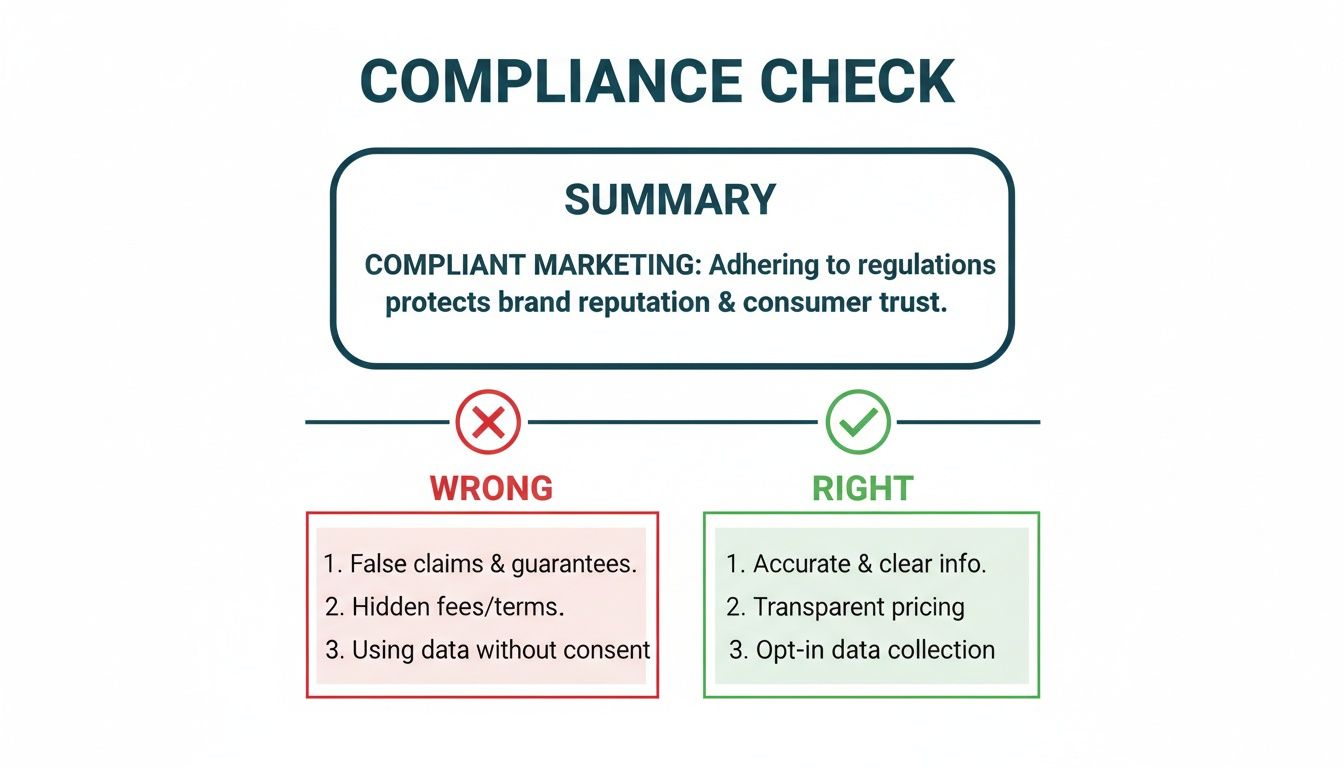
The bottom line is that true compliance means ensuring your listing is presented accurately and consistently everywhere a buyer might see it.
Your Post-Launch Portal Audit Process
Never assume the syndication feed worked perfectly. As soon as your listing is live, you need to do a quick manual audit. I know, it sounds like one more thing to do, but this 15-minute check can save you from a world of frustration and lost leads.
Here’s a simple workflow I use every single time:
- Check the Big Three: Pull up your listing on Zillow, Realtor.com, and whatever the dominant regional portal is in your market. Don't just glance—open them in separate tabs and compare them directly against your MLS entry.
- Verify the Vitals: Make sure the price, address, bed/bath count, and square footage are 100% identical. An error here, though rare, is a deal-breaker.
- Read Your Remarks: Did the full description make it over? I always scroll to the end to check if it got cut off. Also, look for weird formatting issues where bullet points or line breaks have turned into a block of jumbled text.
- Scan the Photo Gallery: Are all your photos there? And are they in the right order? It’s amazing how often a syndication feed will drop an image or shuffle them around, burying that killer twilight shot at the end of the gallery.
- Confirm Open House Info: If you added an open house, double-check that the dates and times are correct. A simple typo here could mean you’re sitting in an empty house on Sunday.
A listing isn't truly "live" until you've verified its accuracy on the major consumer-facing portals. Your responsibility for the listing extends to every platform where it appears.
This kind of hands-on management is more important than ever. Agents are putting real money into their marketing, with paid social media ad adoption now at 42%. The average ad budget is climbing to $201–$300 per listing, and that money is going toward high-quality assets like professional photography (98% adoption) and 3D tours (46%) that all originate from the MLS.
Following this audit process ensures the beautiful assets you paid for are actually being seen by buyers, no matter where they find your listing. To dig deeper into how the structure of your data impacts visibility, check out our guide on how to optimize your listings for AI search.
Using AI for Faster and Smarter Compliance
Let's be honest: manually checking every single property description against a constantly growing list of Fair Housing trigger words is a drain on your time. It’s tedious, and it’s a process where one small slip-up can create a massive compliance headache. This is exactly where modern AI tools are making a real difference for agents in the trenches.
These aren't just basic content spinners. Think of them more like an intelligent co-pilot for your compliance efforts, built from the ground up to help you create real estate MLS compliant marketing. They act as a powerful safety net, saving you hours of work while dramatically cutting down your risk.
This kind of technology is designed to take something as simple as a property address or a few key details and spin up a complete set of marketing materials—all pre-screened for compliance issues.
How AI Works as a Compliance Engine
The real magic of a dedicated real estate AI isn't just that it can edit your text; it’s that it acts as a proactive compliance engine. These systems are trained on huge amounts of data, including countless MLS rules and the full spectrum of Fair Housing guidelines. This allows them to spot potential red flags before your listing ever goes live.
Here's how it works: the AI automatically scans the text it generates for any problematic words or phrases. When it finds a trigger word, it doesn't just delete it. It suggests a compliant alternative that keeps the spirit of your marketing message intact.
For instance, it might catch things like:
- "Family-friendly neighborhood" and instead suggest "Community with numerous amenities."
- "Perfect for professionals" and recommend something like "Convenient commute to the business district."
- "Exclusive community" and offer a more objective description like "Gated entry for added privacy."
This built-in review process is an incredibly valuable first line of defense. It catches those subtle mistakes that even a seasoned agent might miss, especially when you're rushing to get a new listing on the market. The sheer complexity of these rules is a big reason the MLS software market is projected to grow at a 7.7% CAGR through 2031—agents need smarter tools. You can explore the MLS software market trends to get a better sense of how technology is evolving to meet these demands.
Generating Compliant Marketing in Minutes
Imagine taking a single property URL and turning it into an entire marketing package. That's the kind of efficiency we're talking about. Platforms like ListingBooster.ai can take a Zillow or Realtor.com link and, in moments, generate a full suite of ready-to-use assets.
In less time than it takes to finish your morning coffee, you can have:
- Multiple MLS Remarks: A few different options for both public descriptions and private agent remarks, all written to fit character limits and pass compliance checks.
- Portal-Specific Descriptions: Copy that's already tailored for major sites like Zillow and Redfin, so your listing looks great everywhere.
- Social Media Content: A whole calendar's worth of posts for your new listing, open houses, price adjustments, and "just sold" announcements.
- Print-Ready Materials: Flyers and brochures you can have ready to go for your open house weekend.
This completely changes the game, turning what used to be hours of careful, painstaking work into a quick and simple task. To see more on how this works under the hood, check out our deep dive on using AI for MLS compliant content generation.
You Still Have the Final Say
A common worry I hear about AI is that it will make marketing sound generic or robotic, stripping away the agent's personality. But the best way to use these tools is as a powerful assistant, not as a replacement for your own expertise. The goal is to get a high-quality, fully compliant first draft that's about 90% of the way there.
AI should create the foundation, but you are the architect. Use AI-generated content as a starting point, then infuse it with your unique market insights, personal brand voice, and specific details only you would know.
This hybrid approach gives you the best of both worlds. You get the speed and safety that comes from automation, but you combine it with the authentic, human touch that only you can provide. You always have complete editorial control, so you can refine the copy, add a personal story, or tweak the tone to perfectly match your brand. It’s simply a smarter, faster way to create marketing that not only sells but is also impeccably compliant.
Answering Your Top Compliance Questions
Even with the best systems in place, some tricky situations will always come up. Let's walk through a few of the most common questions I hear from agents about staying compliant in their day-to-day marketing.
What's the Single Biggest MLS Mistake Agents Make?
Hands down, the most frequent violation is advertising another agent's listing without getting their explicit permission first. It seems innocent enough, right? You see a great new listing from a colleague at your brokerage and want to share it on your Instagram. But doing so is a serious misstep.
The NAR Code of Ethics is unambiguous on this in Standard of Practice 12-4: you absolutely must have authority to advertise a property. That authority is granted by the listing agreement. While the IDX feed lets you display other agents' listings on your website, that's where the permission ends. It doesn't give you a green light to create your own social posts, flyers, or other ads for that property.
The bottom line is simple: always get permission in writing before you market a listing that isn't yours. A quick email to the listing agent is all it takes. This small professional courtesy protects you, the agent, and their client. It's a cornerstone of what real estate MLS compliant marketing is all about.
Can I Actually Rely on AI for My Property Descriptions?
Yes, you can, but think of it as a highly skilled assistant, not the final decision-maker. You are always the final checkpoint. AI tools are incredible for getting you past that dreaded blank page, producing a solid, compliant first draft in seconds. They can act as a great safety net, flagging potential Fair Housing trigger words and offering safer alternatives.
But AI has its limits. It doesn't know the story behind the home, the feeling of the neighborhood, or the specific things that make it special. It can't confirm that the "brand-new roof" was actually installed last month. Your role is to take that AI-generated draft, verify every single fact, and then weave in your own local expertise and unique voice to make the listing truly compelling.
- AI's job: Give you a well-structured, compliant starting point.
- Your job: Fact-check everything, add personal and local insights, and polish the final copy.
How Do I Talk About Schools Without Violating Fair Housing?
This is a real tightrope walk. You know that school districts are a huge deal for many buyers, but the way you talk about them can easily drift into steering, which has serious discriminatory implications.
The key is to stick to objective, verifiable facts and avoid subjective praise or quality ratings.
- Don't say: "Zoned for the top-rated Northwood High School." This is a value judgment and can be interpreted as steering buyers toward a specific demographic.
- Do this instead: "This home is located within the attendance boundaries for the public schools listed on the official district website. You can find more information here: [link to the school district's official site]."
This approach empowers buyers to conduct their own research without you making any claims or judgments. You're being helpful and informative without crossing a critical legal line. The same logic applies to other amenities. Instead of saying "walking distance to churches," a more inclusive and compliant phrase would be "located near several places of worship."
Ready to stop stressing over compliance and start creating powerful marketing in minutes? ListingBooster.ai takes any property URL and generates a complete marketing kit—including MLS-compliant descriptions, social media posts, and print materials—all pre-scanned for Fair Housing issues. Give it a try for free and see how simple compliant marketing can be.
Walk In With the Campaign Already Built
Listing copy, social posts, sourced Market Insights, growth scheduling, and direct publishing after approval from one real-estate-specific system. 25 free credits to start.
Related Posts
 Listing Descriptions
MLS Description vs Zillow Description How to Win on Both
A listing can have strong photography, sharp pricing, and a solid property, then still underperform online because the description isn't doing the right job in the right place. That's the part many agents miss. They write one paragraph, paste it everywhere, and assume syndication will handle the rest. It won't. The MLS, Zillow, Realtor-style portals, […]
 Listing Descriptions
Top Real Estate Listing Description Examples for 2026
The MLS remarks field opens. The photos are sharp, the pricing is disciplined, and the prep work is done. Then the description underperforms. A generic write-up can drain momentum from an otherwise strong launch because buyers, portal readers, and now AI systems all rely on that copy to decide what the property is, who it […]
 Listing Descriptions
The Ultimate Real Estate Listing Description Playbook
You've seen this happen. The photographer delivers strong images, the seller wants the home live today, and the MLS text box is still blank. That last step looks simple, but it isn't. A real estate listing description now has to persuade, stay compliant, and read cleanly on platforms where buyers skim in seconds. That's why […]