How to Optimize Listings for AI Search and Win More Clients

If you want your listings to show up in AI search, you have to stop thinking like a data entry clerk and start writing like a human. Forget about stuffing keywords. Instead, create rich, conversational descriptions that directly answer the kinds of questions real buyers are asking.
The goal is to write copy that makes sense to platforms like ChatGPT, Google's AI, and Perplexity. Your listing needs to tell a story and "speak" like a person, not read like a database entry.
Why AI Search Is a Game-Changer for Real Estate Listings

The ground is shifting under our feet in the real estate world, and AI is the tectonic plate. For years, we mastered keywords on Zillow and Google. We knew that phrases like "Austin homes for sale" were the key to getting found. That whole playbook is quickly becoming obsolete.
Today’s homebuyers are starting to bypass the traditional search bar. They’re turning to AI assistants and asking complex, conversational questions.
They aren't just typing keywords anymore; they're describing their dream home in plain English. Think about a query like, "Find me a quiet, family-friendly home in the suburbs of Atlanta with a fenced-in yard for my dog, a home office, and good natural light, all under $600,000." A standard MLS description, full of abbreviations and jargon, is completely invisible to this kind of search. AI isn't looking for keywords; it's hunting for answers.
From Keywords to Real-World Context
This evolution from simple keywords to deep contextual understanding is the biggest shift in property discovery we've seen in a decade. AI models are built to understand nuance, intent, and the relationships between different concepts. A traditional listing might just say "4 BR, 3 BA," but an AI-ready description would paint a picture: "This four-bedroom home offers plenty of space, including a downstairs bedroom with an en-suite bathroom perfect for guests or multigenerational living."
The first is just data. The second is a genuine solution to a buyer's potential problem—and AI is designed to prioritize the solution. This means your listings have to move beyond just spitting out features and start telling a compelling story about the lifestyle a property offers.
The biggest hurdle we face is that most real estate listings are written for databases, not for dialogue. AI search engines are conversational. If your content can't join that conversation, it simply won't be found.
To understand just how different this approach is, let's break down the old way versus the new way.
Traditional Keyword SEO vs AI Conversational Search
| Optimization Factor | Traditional SEO (Google Search) | AI Search Optimization (ChatGPT, Google AI) |
|---|---|---|
| Primary Goal | Rank for specific, high-volume keywords (e.g., "Miami condos for sale"). | Directly answer complex, natural language questions (e.g., "Find a Miami condo with ocean views and a pet-friendly policy"). |
| Content Focus | Keyword density and placement. Use of abbreviations and standard terms. | Narrative, context, and lifestyle benefits. Answers the "why" behind the features. |
| Language Style | Formal, data-driven, often uses industry jargon ("HDWD flrs," "updtd kit"). | Conversational, descriptive, and human-like. Uses full sentences and evocative language. |
| Data Structure | Relies on basic metadata and page titles. | Heavily benefits from structured data (Schema.org) to define entities like price, address, and features. |
| User Intent | Assumes user is searching with broad, specific terms. | Understands the nuanced intent behind a long, detailed conversational query. |
This table really highlights the fundamental change in strategy. We're moving from a technical, keyword-based game to a more human, story-driven approach.
Why Your Current Listings Are Probably Invisible to AI
Let’s be honest: most property descriptions are written to fit into the rigid fields of the MLS. They’re often short, packed with industry-specific abbreviations, and they completely fail to paint a complete picture of what makes a home special. This format, while efficient for agents, is a massive roadblock for AI.
Here’s exactly where the old method is failing:
- It Lacks Natural Language: An AI struggles to figure out what "HDWD flrs" or "lrg MBR" actually means. It needs full, descriptive sentences to really grasp the context.
- It's Missing Contextual Clues: Your listing might mention a "bonus room," but does it explain if it's "an ideal space for a home gym" or "a quiet, dedicated home office"? That's the context AI needs to match the property to a specific user's prompt.
- The Structure is Poor: Without clear headings or structured data (which we’ll get into), an AI model just sees a wall of text. It can't easily pull out key features like an "updated kitchen" or an "EV charging station."
This isn't some far-off future trend; it's happening right now. Projections show that over 40% of homebuyers in 2026 will start their property search on AI platforms like ChatGPT instead of traditional search engines.
For agents whose content isn't ready for this shift, invisibility is almost guaranteed. To dig deeper into this, check out our guide on AI-powered real estate marketing. It's no longer enough to just be online; you have to be understood by the AI that's guiding buyers to their next home.
Writing Listing Descriptions That AI Understands and Recommends
Let's be honest, the days of writing generic, feature-list descriptions for properties are over. If you want your listing to stand out in a world powered by AI, your copy needs to do more than just list the basics. It has to be "prompt-ready"—written to directly answer the kind of complex, conversational questions real buyers are now asking.
This means we need to shift our mindset. Forget the old industry jargon and start thinking like a buyer. Instead of just "3 BR, 2 BA," we need to paint a picture that connects with a specific lifestyle. That's how you get an AI to see your property as the perfect match for a detailed search query.
Weave in Natural Language Phrases
AI search is getting incredibly good at understanding what people actually mean. It’s looking for phrases that signal how a property fits into someone's life. Our job is to sprinkle these phrases naturally throughout our descriptions.
Think about how a real person would ask for a home:
- "I'm looking for a house with an in-law suite for my parents."
- "Find me a home with a dedicated office space."
- "Show me houses with a big, fenced-in backyard for my dogs."
Now, we need to embed the answers right into our copy. For example, that "bonus room" in your listing could be described as "a versatile upstairs loft, perfect as a kids' playroom or a quiet media room." That one small change gives an AI a ton of context, helping it categorize the home’s features with much greater accuracy.
An AI doesn’t just see a "fenced-in yard." It understands that this feature solves a problem for a family who needs a safe place for their kids or pets. When you frame features as benefits, you're speaking the AI's language.
Embedding Structured Data Within Your Narrative
While natural language is your foundation, you still need to include hard data. The trick is to weave these facts directly into your storytelling. This approach makes your description compelling for a human reader and incredibly easy for a machine to scan and pull out key details like dates, brand names, or specific materials.
Don't just bury important specs in a bulleted list. Integrate them into your sentences. For example, instead of just saying "New Roof," try this: "Enjoy peace of mind with a brand-new architectural shingle roof installed in May 2024, complete with a 30-year transferable warranty."
Here’s a quick before-and-after to show you what I mean:
Before (AI-Unfriendly):
"Updated kitchen w/ SS appliances. New floors. Great for entertaining."
After (AI-Optimized):
"The chef’s kitchen was completely renovated in 2023 and features sleek quartz countertops, custom soft-close cabinetry, and a full suite of Bosch stainless steel appliances. New wide-plank oak flooring flows seamlessly into the open-concept living area, creating an ideal space for entertaining family and friends."
The second version is packed with specific, verifiable details—2023 renovation, quartz, Bosch, oak flooring—that an AI can grab and index. This lets it answer incredibly specific buyer questions. This mix of great storytelling and hard data is the new gold standard. If you're looking for help with this, you might want to check out our guide on the top AI tools for real estate agents.
The Power of Prompt-Ready Snippets
A really effective tactic is to create "prompt-ready snippets." These are short, powerful sentences that call out a home’s best use cases. Think of them as pre-written answers to the questions buyers are asking their AI assistants.
Here are a few examples you can adapt for your own listings:
- For the remote worker: "A dedicated main-floor office with French doors provides the privacy needed for uninterrupted remote work."
- For the growing family: "The property is situated within the highly-rated Northwood school district, just a short walk from the community park and playground."
- For the eco-conscious buyer: "Lower your carbon footprint and utility bills with the home’s rooftop solar panels and a dedicated EV charging station in the two-car garage."
These snippets go beyond just listing features; they highlight the lifestyle benefits. This makes it incredibly easy for an AI to connect your listing with a buyer who searches for "home office," "good schools," or "EV charger." You're proactively giving the AI exactly what it needs to make the match.
This isn't just theory—it's where the industry is heading. A 2026 survey revealed that AI adoption among real estate agents has skyrocketed to 97%, a huge jump from just 80% in 2024. The main reason? Content creation. A whopping 82% of agents now use AI to write optimized listing descriptions, which shows just how vital these skills have become. You can learn more by reading this trend in the full real estate news report.
Using Schema Markup to Speak Directly to Search Engines
Your listing description is crucial for connecting with buyers, but there's a powerful, hidden layer that speaks directly to search engines and AI. This is where schema markup comes in. It’s a bit technical, but think of it as a secret language that gives platforms like Google a perfectly organized digital file on your property.
Instead of an AI trying to guess what "four beds" or "$500k" means from a block of text, schema explicitly tells it: "This is the number of bedrooms" and "This is the price." It removes all the guesswork, allowing AI systems to understand your listing’s most important details with 100% accuracy. If you're serious about getting your listings ready for AI discovery, you can't skip this.
What Real Estate Schema Actually Looks Like
For real estate, we primarily lean on two types of schema that work together: RealEstateListing and Residence.
RealEstateListing: This is all about the transaction. It covers the asking price, listing agent details, when it was posted, and whether it’s still on the market.Residence: This one describes the physical house itself—the number of bedrooms and bathrooms, the square footage, architectural style, and specific features.
Using both gives an AI a rich, complete picture it can instantly digest. This is how a conversational search for "a three-bedroom home with a two-car garage under $500k" surfaces your listing—not by chance, but by reading the structured data you’ve provided.
The diagram below shows how your core data, this structured data layer, and your natural language description all fit together.
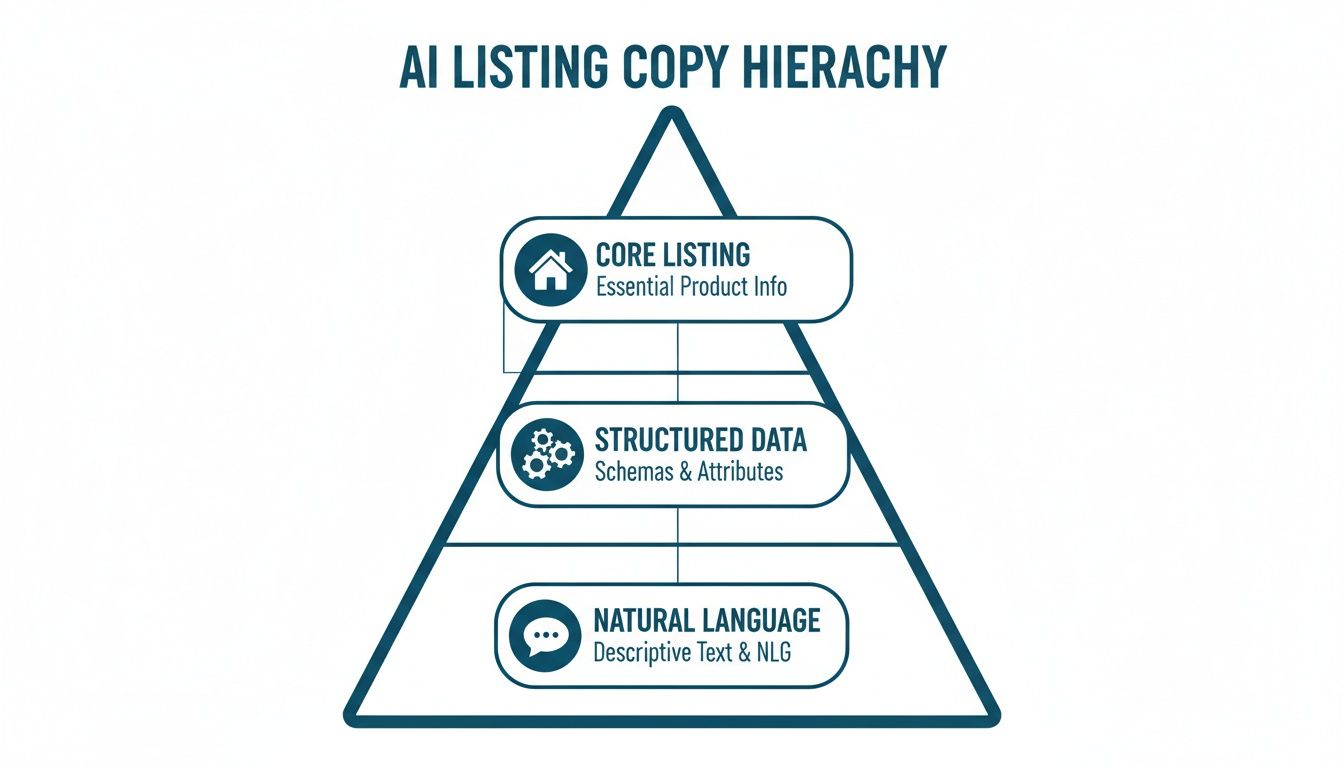
You can see that while the core listing is the foundation, structured data is the critical bridge that makes your beautifully written copy fully understandable to machines.
The Details That Matter Most to AI Search
Not all data fields are equally important. When you’re implementing schema, you need to zero in on the details that buyers ask about the most. These are the exact fields AI systems look for first.
Make sure your schema clearly defines:
- The Basics: Address, price, number of bedrooms, number of bathrooms, and total square footage. These are non-negotiable.
- Key Property Specs: Explicitly tag items like
numberOfRooms,floorSize, andyearBuilt. - Standout Amenities: This is where you gain a real edge. Use the
amenityFeatureproperty to list high-demand items that an AI can easily match to a specific query. Good examples include:- EV charging station
- Fenced-in yard
- Swimming pool
- Home office
- Quartz countertops
By structuring these features with schema, you're not just hoping an AI picks up on keywords. You're handing it a perfectly categorized, machine-readable inventory of what makes your property special.
A Practical JSON-LD Template You Can Use
This might sound intimidating, but it's simpler than it looks. The go-to format is JSON-LD, a script you or your web developer can pop into the <head> section of your listing's webpage.
Here’s a simplified template you can adapt. Just swap out the placeholder info with your property's details.
{
"@context": "https://schema.org",
"@type": "RealEstateListing",
"name": "Charming Family Home in Sunnyvale",
"url": "https://yourwebsite.com/listing/123-maple-street",
"image": "https://yourwebsite.com/images/main-photo.jpg",
"description": "A beautiful 4-bedroom, 3-bathroom home perfect for a growing family, featuring a modern kitchen and a spacious, fenced-in backyard.",
"offers": {
"@type": "Offer",
"price": "750000",
"priceCurrency": "USD"
},
"itemOffered": {
"@type": "Residence",
"address": {
"@type": "PostalAddress",
"streetAddress": "123 Maple Street",
"addressLocality": "Sunnyvale",
"addressRegion": "CA",
"postalCode": "94086",
"addressCountry": "US"
},
"numberOfRooms": "8",
"bed": {
"@type": "BedDetails",
"numberOfBeds": "4"
},
"accommodationFloorPlan": {
"@type": "FloorPlan",
"numberOfBathroomsTotal": "3"
},
"floorSize": {
"@type": "QuantitativeValue",
"value": "2200",
"unitCode": "SQF"
},
"amenityFeature": [
{
"@type": "LocationFeatureSpecification",
"name": "EV Charging Station"
},
{
"@type": "LocationFeatureSpecification",
"name": "Fenced-in yard"
},
{
"@type": "LocationFeatureSpecification",
"name": "Home Office"
}
]
}
}

Adding this snippet to your listing’s code instantly transforms it from a simple webpage into a rich data source. This one move significantly boosts your chances of being surfaced by an AI as a direct, relevant answer to a buyer's highly specific question.
How to Win on Zillow, Redfin, and the Major Real Estate Portals

Let's be real: while your own website is your digital home base, most buyers are scrolling through Zillow, Redfin, and Realtor.com. These sites aren't just simple property databases anymore. Their internal search engines are powered by some seriously smart AI designed to figure out exactly what a buyer is looking for, often before the buyer even knows.
To get your listings seen, you have to learn to speak their language. It's no longer enough to just push your MLS data out and hope for the best. You need to be strategic, tailoring your content to what each portal’s algorithm values most. If you skip this, you’re basically telling a huge chunk of your potential audience that your listing doesn't exist.
Start with the MLS Agent Remarks
Everything flows from your Multiple Listing Service (MLS). It's the source of truth for all the other platforms, which makes the "Agent Remarks" or "Private Remarks" section one of the most powerful, yet overlooked, tools in your arsenal to optimize listings for AI search. This is where you can inject the rich, narrative detail we’ve been talking about, right at the very beginning of the data chain.
Think of it as the first domino. When Zillow and Redfin pull your data, they are absolutely parsing this section for clues and context that their own systems can use to categorize and rank your property.
Here's how to make it count:
- Don't Just State Facts, Sell the Benefit: "New HVAC in 2023" is fine. But "Enjoy worry-free comfort and lower energy bills with a brand-new HVAC system installed in 2023" is what connects with a buyer and gives the AI more context.
- Match Your Language to Buyer Dreams: Use phrases that line up with how people actually search. For instance, "The finished basement offers a perfect setup for a home theater or in-law suite."
- Call Out the Unique Stuff: Does the home have something most don't? Mention it! Things like "smart home integration with Nest thermostats" or "a dedicated dog run" are the kinds of specific, searchable terms that can get you found.
By beefing up your MLS remarks, you're building a stronger foundation for every single place your listing shows up.
Quick tip: Consistency is king. An AI builds confidence in a listing when the details on Zillow, Redfin, and your own site all match up perfectly. Any discrepancies can create digital confusion and potentially hurt your ranking.
Play Zillow’s Game with Tags and Features
Zillow's AI has one job: learn what features buyers love and show them more of it. It sits on a mountain of data about user behavior, and it uses that to push listings with in-demand features to the top. Your job is to make it dead simple for Zillow's AI to see that your listing has those features.
The easiest win here is to be meticulous when you're entering the listing. Don't you dare skip the "Interior Features" or "Exterior Features" sections. If the home has quartz countertops, central air, or a walk-in closet, check the box. Every. Single. Time.
Zillow’s system also scans your public description for keywords it can automatically turn into little blue tags, like "hardwood floors" or "updated kitchen." By weaving these terms naturally into your description, you’re sending a double signal to its algorithm—you've checked the box and you've written about it. That's a powerful combo that tells Zillow your property is a fantastic match for users looking for those amenities.
Dig into Redfin’s Unique Data Fields
Redfin often gets a bit more granular than the other portals, offering unique data fields you won’t see elsewhere. For example, it might have specific drop-down options for different types of flooring, specific roof materials, or particular architectural styles. It may feel tedious, but taking an extra five minutes to fill out these Redfin-specific fields can give you a real leg up on that platform.
Why? Because Redfin's AI uses this detailed data to answer hyper-specific search queries. A buyer looking for a "Craftsman-style home with a metal roof" will only be shown listings where those attributes are correctly tagged. If you left those fields blank, your perfect-fit listing will be completely invisible to that highly qualified buyer.
This is the new reality of marketing a property. The "one-size-fits-all" approach is officially dead. You have to tailor your data for each major portal, feeding their AI systems the exact information they need to confidently push your listing to the front of the line. It's this strategic effort that separates the top agents from everyone else in this AI-powered market.
How Do You Know If Your AI Optimization Is Actually Working?
This is the big question, right? You’ve put in the work to craft a compelling story, you’ve implemented the right data, but how can you tell if your efforts to show up in AI searches are paying off? The old-school metrics like page views just don't cut it anymore.
We need to think differently. The goal isn’t just to get more eyeballs on a listing; it's about attracting buyers who are already pre-sold on the property. Success means your listings are being found by the right people and sparking genuine, high-intent inquiries from buyers who feel the home is a perfect fit before they even step through the door.
Tracking the Metrics That Really Matter
Your standard analytics are a decent starting point, but they barely scratch the surface. To really understand your AI optimization performance, you have to look for signals that reflect a buyer's true interest and the quality of their engagement.
Here’s what I’m tracking in my own business:
- Lead Source Attribution: This is as simple as it sounds. Start asking every single person who inquires, "How did you find us?" If they mention asking Google a question, using ChatGPT, or another AI assistant, you've got a direct hit. That’s your proof.
- Quality of Inquiries: Pay close attention to the type of questions you're getting. Are people asking about the "dedicated home office with built-in bookshelves" or the "fenced-in yard perfect for a golden retriever" that you specifically highlighted? When their questions mirror your detailed copy, you know you're attracting well-matched buyers.
- Time on Page: If you host listings on your own website, keep an eye on this. A longer-than-average time on page is a strong indicator that your story-driven descriptions are capturing and holding a reader's attention, which is a world away from a boring list of features.
- Saves and Favorites: On portals like Zillow and Redfin, a noticeable increase in users "hearting" or saving your property suggests the platform's AI is successfully surfacing your listing to a more relevant, interested audience.
The Simple Power of an A/B Test
One of the most straightforward ways to see what works is to run a simple A/B test. It's not as complicated as it sounds.
Take two similar properties in the same neighborhood. For one, stick with a more traditional, feature-heavy description. For the other, go all-in with the AI-optimized, narrative-driven style we've been talking about. Then, just track the number and quality of inquiries for each over a couple of weeks. The results will give you a clear, side-by-side comparison of which approach is truly connecting with buyers.
The real estate AI market is exploding toward $1.3 trillion by 2034, growing at a blistering 36% compound annual rate. This isn't just about fancy tech; it's about tools that cut down our operational time and boost accuracy—directly impacting how listings get seen. In 2026, 97% of agents at top firms are expected to use AI, with 82% of them focusing on crafting listing descriptions that use real-time data and structured markup to rank higher in AI recommendations. You can find more insights on the growth of real estate AI tools.
Staying Ahead of the Curve
AI is moving at a breakneck pace, which means our strategy for measuring success has to be just as nimble. Your job isn't finished once you've updated your current listings; this is about creating a process for constant improvement.
Make it a habit to set aside time each month to:
- Monitor AI Platform Updates: Keep an ear to the ground for news from Google, Perplexity, and the big real estate portals. When they announce changes to their AI or search algorithms, you need to be ready to adjust your game plan.
- Experiment with New Formats: Don't get stuck in a rut. Try adding a short, prompt-ready Q&A section to your next listing. Test out embedding different types of schema to see what moves the needle.
- Refine Your Templates: Use what you learn from your A/B tests and the quality of your inquiries to continuously improve your templates for listing descriptions and MLS remarks. What works best today might be table stakes tomorrow.
This forward-thinking approach is what will keep your strategies effective as the technology evolves. For a closer look at streamlining these kinds of tasks, our guide on real estate marketing automation offers some great ideas. When you combine smart implementation with sharp measurement, you’ll ensure your listings don't just get seen—they get sold.
Your Questions About AI Listing Optimization, Answered
Jumping into AI optimization for your real estate listings can bring up a lot of questions. It's a new frontier, after all. We get it. Below, I’ve pulled together some of the most common questions agents ask when they're getting their feet wet with this stuff, along with practical, no-fluff answers.
How Long Until I Actually See Results?
This isn't a magic wand, but you'll see a shift faster than you might think. Unlike traditional Google SEO, which can be a slow burn taking months, AI-powered search works on a different clock. You could start seeing better-quality leads—think buyers asking about specific, unique features you've detailed—within just a few weeks of pushing your updated listings live on the major portals.
The real variable is the re-indexing speed of platforms like Zillow, Redfin, and Google itself. The more detailed and context-rich your descriptions and structured data are, the quicker their AI systems will flag your listing as a top-tier answer to a user's conversational search.
Do I Really Need to Hire a Web Developer for Schema Markup?
Not always, but it's an option. If your website is on a common platform like WordPress, you're in luck. There are fantastic plugins that handle all the heavy lifting, letting you add schema by just filling out a form with the property details. No coding required.
But if you have a custom-built site or the thought of touching your website's backend gives you hives, a developer can knock it out correctly in about an hour. Don't let the tech side scare you off; the competitive edge you gain is too valuable to pass up.
The biggest mistake I see agents make is aiming for perfection right out of the gate. Just start. You can rewrite your listing descriptions with rich, natural language today. Tackle the technical stuff like schema next. Making progress is what matters most.
Is This Strategy Just for Sales, or Does It Work for Rentals?
It absolutely works for rentals. The core idea is identical. Renters are using AI assistants just as much as buyers, firing off questions like, "Find me a pet-friendly two-bedroom apartment near downtown that has in-unit laundry."
Applying these same optimization methods to your rental listings will help you connect with serious, qualified tenants much faster. Just make sure you're highlighting the amenities and details that matter most to renters in both your narrative and your structured data.
- Pet Policies: Be crystal clear. Are pets allowed? Are there size or breed restrictions?
- Lease Terms: Mention your flexibility. Something like "flexible 6 to 12-month lease options" is great.
- Included Utilities: Spell out what's covered. Does the rent include water, gas, or internet?
- Community Perks: Call out features like a "24-hour fitness center" or a "secure package room."
Is This Going to Replace My Regular Real Estate SEO?
Think of it as the next step in its evolution, not a total replacement. Your traditional SEO work, which targets broad keywords like "Denver homes for sale," is still crucial for catching people at the top of the funnel. It gets your name in the hat.
AI optimization is the layer on top of that. It's built to capture the highly specific, detailed search queries that come from buyers who are much further along in their journey—the ones who know exactly what they're looking for. The two approaches are a powerful combination. A solid SEO foundation gets you on the playing field, but optimizing for AI search is how you connect with the most motivated buyers.
Ready to stop being invisible in AI search? ListingBooster.ai transforms your properties into complete marketing suites with AI-optimized descriptions for MLS and portals, social content, and schema markup that gets you found. Start your 30-day free trial today!
Walk In With the Campaign Already Built
Listing copy, social posts, sourced Market Insights, growth scheduling, and direct publishing after approval from one real-estate-specific system. 25 free credits to start.
Related Posts
 Real Estate SEO
How to Get More Seller Leads with Real Estate SEO in 2026
Organic search still produces seller leads. The difference is how those leads are discovered, filtered, and trusted before a homeowner ever contacts you. For years, agents treated SEO as a way to rank a few pages and wait for form fills. That approach misses what seller SEO does. It puts your name, market coverage, and […]
 Real Estate SEO
Local SEO for Real Estate Agents with AI: A 2026 Guide
Real estate leads are still won or lost in local search, but the way agents earn visibility has changed. A strong position in search no longer guarantees attention, because buyers and sellers increasingly see AI-generated summaries before they ever click a website. That changes the job. Agents now need a web presence that search engines […]
 Real Estate SEO
How to Build Topical Authority as a Real Estate Agent: 2026
Real estate SEO used to reward volume. Publish enough pages, target enough keywords, and you could usually earn some visibility. That playbook is fading. The stronger model now is a connected authority system, built around pillar pages and supporting clusters that cover the buyer and seller journey in depth, as outlined in this real estate […]