Master Your Real Estate Listing Syndication Strategy

A modern real estate listing syndication strategy has to be about more than just distribution. It's a precise, AI-first game plan to make sure your properties actually get discovered by the next wave of homebuyers. This means structuring your listing data so that AI assistants and sophisticated search algorithms can understand, interpret, and ultimately recommend your properties. Just pushing listings to the portals and calling it a day isn't going to cut it anymore.
Why Your Syndication Strategy Needs an AI-First Approach

Let’s be honest: just getting your listings onto Zillow isn’t a strategy. That’s the bare minimum. For years, the process was straightforward—enter a listing into the Multiple Listing Service (MLS) and let the syndication feeds do the rest, blasting that info out to a bunch of real estate portals.
That old model was a game-changer back in the day, giving listings massive exposure. It’s a proven method; syndicated listings can pull in up to 50% more leads than those stuck on a single MLS. To really get a feel for its impact, it's worth digging into how syndication works and its key platforms.
The Shift from Distribution to Discovery
But the ground has shifted under our feet. The explosion of AI-powered search and conversational assistants means buyers are starting their home search in completely new ways. They aren't just typing "3-bedroom homes in Austin" into a search bar. They’re asking specific, conversational questions like, "Find me a home near a good elementary school with a fenced-in yard for my dog."
If your listing data isn't structured to answer that kind of query, it's invisible. An AI assistant can't recommend a property it can't fully understand. This is where a modern real estate listing syndication strategy has to evolve from a simple distribution mindset to a strategic, AI-optimized placement model.
The real challenge now isn't about where your listing appears, but how it appears to the algorithms that are the new gatekeepers for a growing chunk of the market.
Structuring Listings for Machines, Not Just Humans
This new reality requires us to think about listings as structured data sets, not just pretty sales pitches. Of course, compelling descriptions are still crucial for human buyers, but the data underneath has to be clean, tagged, and machine-readable.
Here's how the mindset needs to change:
- From Keywords to Concepts: Forget keyword stuffing. Instead, focus on clearly defining property features. An AI needs to know it’s a "fenced yard," not just pick that phrase out of a flowery sentence.
- From Static Text to Dynamic Answers: Your listing should be built to answer a buyer's potential questions before they even ask. This means getting granular with details on school districts, commute times, and unique amenities.
- From Manual Entry to Automated Optimization: Trying to manually tweak listings for every single portal and AI is a recipe for burnout. This is where modern tools are essential. Platforms like ListingBooster.ai automate the heavy lifting, ensuring your listings are structured correctly for maximum visibility everywhere they go.
When you adopt an AI-first approach, you're not just getting ready for the future of real estate—you're getting a leg up on the competition today. This guide will walk you through building that strategy, step by step.
Building Your Syndication Blueprint for Maximum Reach
A truly effective syndication strategy isn’t about just blasting a listing out to every corner of the internet. That's the old "spray and pray" method, and frankly, it's a massive waste of time that just dilutes your message. A smarter approach is to think like a publisher, carefully selecting the right channels for the right property and then tailoring your content to fit each platform's unique audience.
This means you have to ditch the copy-paste mentality for good. The super-detailed, technical description you crafted for the local MLS is going to get completely ignored in a fast-scrolling Instagram feed. To get real traction, you need to think in tiers, putting the most effort where you'll see the biggest return.
Tier 1: The Heavy Hitters of Real Estate Search
This is the bedrock of your entire syndication plan. Tier 1 is all about your local Multiple Listing Service (MLS) and the major national portals like Zillow, Realtor.com, and Redfin. These are the destinations where serious buyers live—they're actively searching, setting up alerts, and comparing properties.
Getting seen here isn't optional. The audience on these platforms is hunting for hard data: price, square footage, bed/bath counts, and great photos. Your job is to deliver complete, accurate, and richly detailed information. A listing with missing fields or only a few low-quality photos feels unprofessional and often gets skipped by buyers and demoted by the platform’s own search algorithm.
Success in Tier 1 isn't about creative writing; it's about data integrity. Make sure every single field in the MLS is filled out, your photo gallery is stacked with at least 25 high-resolution images, and your main description clearly spells out the key selling points in the first couple of sentences.
Tier 2: Niche Portals for Pinpoint Targeting
With your foundation firmly in place, it's time to get more surgical. Tier 2 channels are specialty websites that serve a very specific type of buyer. We're talking about platforms dedicated exclusively to luxury estates, historic homes, equestrian properties, or even eco-friendly new builds.
Pushing a starter home to a luxury portal is just noise. But syndicating a multi-million dollar waterfront property there? That's essential. The buyers on these sites are highly qualified and are looking for specific features that mainstream portals might not highlight. Your content needs to reflect that—focus on telling the unique story of the property. Use more evocative language to call out the bespoke finishes, high-end appliance brands, and the architect's vision.
Here are a few examples of niche categories to consider:
- Luxury Properties: Sites that curate top-tier listings for high-net-worth individuals.
- Vacation & Second Homes: Portals geared toward resort areas or properties with strong rental income potential.
- Historic Real Estate: Platforms for buyers who are specifically looking for the charm and character of an older home.
- Land & Farm: Sites dedicated to rural acreage, ranches, and agricultural operations.
Tier 3: Social Platforms for Storytelling and Discovery
Now we shift gears from a data-first approach to a story-first one. Platforms like Instagram, Facebook, and even LinkedIn aren't where people go to search for homes. They're there for discovery and entertainment. Your goal is to interrupt their endless scroll with something visually arresting that tells a compelling story.
A simple "Just Listed" graphic with a link to the MLS just won't cut it anymore. Your content has to feel native to the platform. For Instagram, that means a dynamic video Reel walking through the front door, a beautiful carousel of twilight photos, or an interactive Story poll asking which kitchen feature is their favorite. On Facebook, you have more room to share a longer video tour and can engage directly with local community groups.
The strategy here is to create content that sparks curiosity and drives conversation, ultimately leading people back to the more detailed Tier 1 listing. This is where a modern real estate listing syndication strategy really comes together, using each channel's strengths to build a complete marketing funnel for every single property.
Real Estate Syndication Channel Comparison
To really nail your blueprint, you have to understand the specific job of each channel. Not every platform is created equal, and knowing where to focus your energy is half the battle.
This table breaks down the different tiers to help guide your content and optimization efforts.
| Channel Type | Examples | Primary Audience | Key Optimization Tactic |
|---|---|---|---|
| Tier 1 Powerhouses | MLS, Zillow, Realtor.com | High-intent buyers actively searching for homes. | Maximize data completeness, use high-res photos, and write a clear, feature-focused description. |
| Tier 2 Niche Portals | LuxuryPortfolio.com, Land.com | Highly qualified buyers seeking specific property types. | Craft an elevated, narrative-driven description focusing on unique lifestyle benefits and premium features. |
| Tier 3 Social Media | Instagram, Facebook, LinkedIn | Passive audience in discovery mode; local community. | Create engaging, visual-first content (video reels, carousels) that tells a story and sparks conversation. |
By thinking in these three distinct tiers, you can move from a one-size-fits-all approach to a much more nuanced and powerful marketing plan that gives every listing the specific attention it deserves.
Crafting Listing Content That AI and Buyers Love
Once you've figured out where your listings are going, it’s time to focus on what you're sending. Just blasting the same generic MLS description everywhere is a recipe for being ignored. A truly effective real estate listing syndication strategy today means creating content that speaks to two completely different audiences at the same time: the emotional, story-seeking human buyer and the logical, data-hungry AI algorithm.
Your job is to stop the scroll for a potential buyer while feeding clean, structured data to AI assistants so they can easily find and recommend your property. It’s not one or the other; you have to nail both to get maximum visibility. The listing has to be compelling to a person and crystal clear to a machine.
Writing for Human Emotion and Aspiration
Before we dive into the technical stuff, let's talk about people. Buyers don't buy houses; they buy a vision of their future life. They make decisions with their heart and then look for facts to back it up. That's why your property descriptions on big portals like Zillow and Realtor.com need to do more than list features.
Instead of just stating "3 bedrooms, 2 bathrooms," you need to paint a picture. Try something like this: "Imagine waking up in a sun-drenched primary suite, with two additional bedrooms perfect for family, guests, or that home office you've always wanted." See the difference? You’re turning specs into lifestyle benefits.
To make your descriptions really connect, think about:
- Telling a Story: Every home has a vibe. Is it the ultimate spot for hosting game day? A quiet retreat from the city chaos? Frame your narrative around the life your ideal buyer wants to live.
- Using Sensory Details: Go beyond what the house looks like. Talk about the "warmth of the original hardwood floors," the "quiet hum of the new energy-efficient HVAC," or the "aroma of coffee from the private balcony."
- Solving a Problem: Hit on common buyer frustrations. Mention the "spacious mudroom that keeps clutter out of sight" or the "upstairs bonus room—a perfect escape for the kids."
This is how you get potential buyers to mentally move in before they’ve even booked a showing.
The best descriptions don't just list what a house has; they articulate what a buyer's life could be in that house. That’s the emotional hook that gets you the call.
Optimizing for AI and Algorithmic Discovery
While a great story wins over buyers, AI needs something entirely different: clean, organized, unambiguous data. AI assistants need to pull out facts like price, square footage, and amenities without having to guess. This is where the technical side of your content plan is so important.
The single most powerful tool for this is schema markup. Think of schema as a set of tags you add to your listing's backend code. It doesn't change how the listing looks to a human, but it explicitly tells search engines and AI what each piece of information is. For example, it labels "123 Main St" as a street address and "$500,000" as the asking price.
With proper schema, you make it incredibly easy for an AI to answer a user's query like, "Find me a four-bedroom home under $550,000 with a two-car garage." The AI can pull your listing with confidence because the data is clearly defined, not just buried somewhere in a descriptive paragraph. If you want to get really granular on this, we've put together a full guide where you can learn more about optimizing listings for AI search.
From Standard Blurb to AI-Optimized Masterpiece
Let's look at a real-world example. So many agents just copy and paste the character-limited MLS description everywhere. It’s a massive missed opportunity.
Before (The Standard MLS Blurb):
3BR/2BA home w/ updated kitchen. Granite counters, SS appliances. Fenced yard. Close to parks & schools. Motivated seller.
It gets the basic facts across, but it’s completely uninspired. It does a poor job for humans and an even worse one for AI, offering no emotional connection and very little structured detail.
Now, let’s see how we can transform this into a description that works hard for you on a major portal.
After (The AI-Optimized Portal Description):
Welcome to your serene retreat in the heart of the desirable Northwood neighborhood! This stunning 3-bedroom, 2-bathroom residence perfectly blends modern updates with timeless charm. Step inside to discover a bright, open-concept living area where warm hardwood floors guide you into a beautifully renovated kitchen. Here, you'll find gleaming granite countertops, a full suite of stainless steel appliances, and custom cabinetry—a true chef's dream.
The spacious primary suite offers a private oasis, while two additional bedrooms provide flexible space for family, a home office, or a fitness room. Outside, the fully fenced backyard is your personal haven, perfect for weekend barbecues, gardening, or letting your furry friends roam free.
Key Features for Your Search:
- Bedrooms: 3
- Bathrooms: 2 Full
- Kitchen Features: Granite Countertops, Stainless Steel Appliances, Gas Range
- Outdoor Space: Private Fenced Yard, Patio
- Parking: Attached 2-Car Garage
- Proximity: Walking distance to Northwood Park and top-rated Lincoln Elementary School.
This updated version does it all. The narrative paragraphs draw the buyer in, while the clean, bulleted list of features gives AI the structured data it needs to match the property to highly specific searches. This dual-purpose approach is the heart of a modern real estate listing syndication strategy.
Automating Your Syndication Workflow to Save Time
Let's be honest: an agent's most precious resource is time. If you're manually pushing every new listing to every single portal, social media channel, and niche website, you're not just wasting hours—you're building a business model that can't scale. A truly effective real estate listing syndication strategy is all about creating a well-oiled machine that runs in the background. It ensures every property gets a powerful marketing launch without you having to manage every single detail, every single day.
This isn't just about being more efficient; it's about delivering consistent, high-quality marketing for every client. When you automate, you're building a repeatable system. You guarantee that every listing, from a starter condo to a luxury estate, gets the same level of exposure from the day it's signed to the day it's sold. The real goal here is to set up a workflow that triggers the right actions at the right time, so you can get back to what you do best: serving your clients.
Establishing Your Core Automation Hub
Your entire automated workflow begins with the MLS. Think of it as the central nervous system for your listing data. Most modern MLS platforms have pretty solid syndication settings that let you control which portals automatically pull your listings. Getting this right is your first, most critical move.
Start by making sure your feeds to the big players—Zillow, Realtor.com, and Redfin—are active and working correctly. This establishes the primary data pipeline that everything else will feed off of.
Once that pipeline is flowing, you can add some serious horsepower with AI-powered tools. A platform like ListingBooster.ai can become your marketing command center. Instead of slaving away writing a dozen slightly different property descriptions, you just feed it the property URL. Within minutes, the AI generates all the content you need—from a keyword-rich, AI-friendly description for Zillow to a compelling, story-driven caption for an Instagram post.
This diagram shows just how simple the process becomes when AI steps in, taking raw data and turning it into a published, optimized asset.
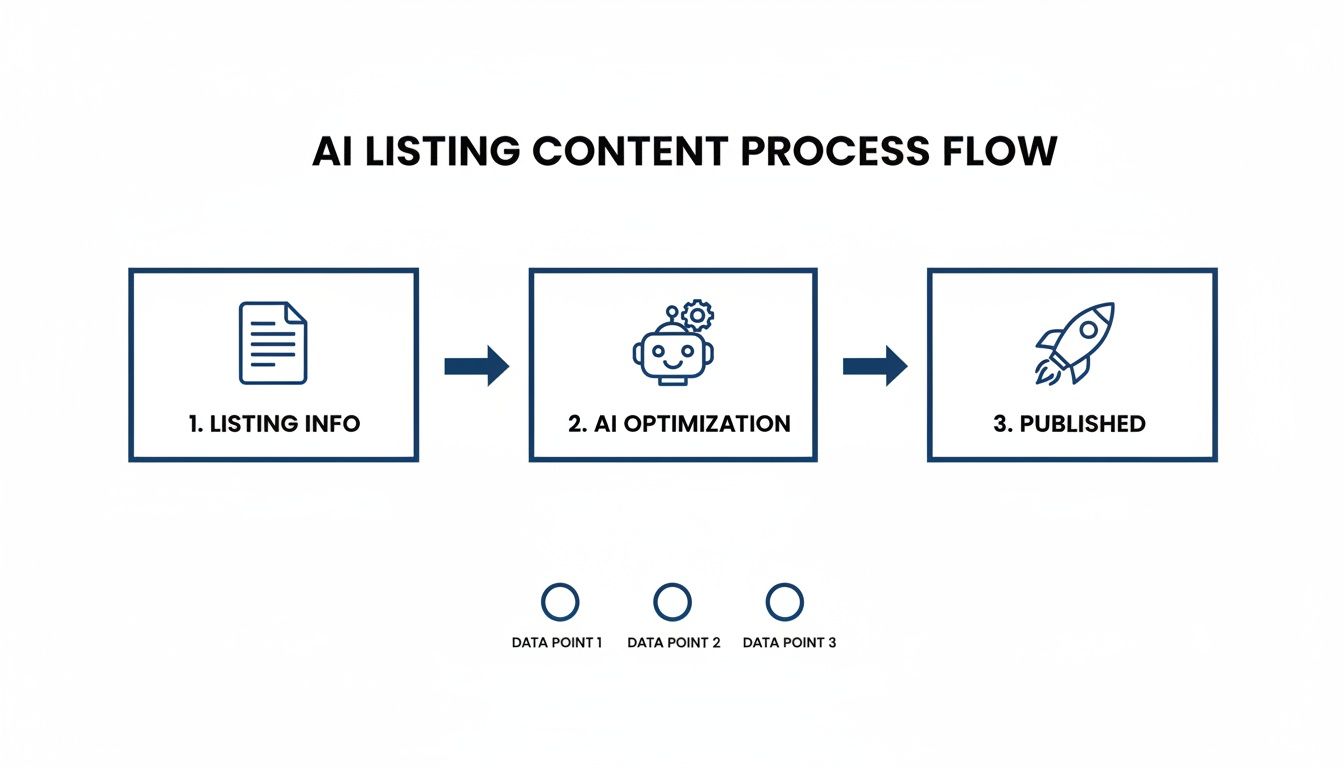
What used to be a tedious manual task is now a quick, three-step automated sequence, cutting your content creation time down dramatically.
Creating a Distribution Cadence for Key Events
Automation shouldn't just be a one-and-done action when a listing goes live. A smart strategy includes pre-planned content pushes tied to the natural lifecycle of a property listing. This approach keeps the listing feeling fresh in the market and maintains buyer interest. When you have a defined cadence, you're never scrambling for content when something important happens.
I recommend building automated content triggers around these four key milestones:
- New Listing Launch: This is your big moment. Your system should automatically create and schedule a complete set of assets: the optimized MLS description, unique portal descriptions, a "Just Listed" social media carousel, a video reel, and a broadcast email to your database.
- Open House Promotion: About three or four days before the event, a fresh wave of content should deploy. This could be social media posts with the date and time, another email blast, and maybe an Instagram story series counting down to the event.
- Price Reduction Alert: A price change is a huge marketing opportunity. This trigger should instantly push "Price Improvement" graphics to social media, update all the listing portals, and send a targeted email to buyers who may have viewed or saved the property.
- Just Sold Celebration: Once the deal is done, your final automated push is all about showcasing your success. Think "Just Sold" posts for social media that highlight a great result (e.g., "Sold in 7 days for 102% of asking price!"). This is powerful social proof for future sellers.
By setting this cadence, you’re not just a marketer anymore. You're the conductor of a fully orchestrated campaign that runs flawlessly in the background, reacting intelligently to key events without you lifting a finger.
For any agent looking to put a system like this in place, the next logical step is to explore real estate content marketing automation. It's a deeper look into the specific tools and tactics that turn this strategy into a time-saving reality, ensuring your marketing can keep up as your business grows.
Measuring Performance to Prove Your Value

A top-tier real estate listing syndication strategy isn't just about broadcasting a listing far and wide; it's about proving that every single effort translates into real results. Let’s be honest, syndication without data is just guesswork. By getting a handle on the right performance metrics, you can stop hoping for the best and start making smart, data-driven decisions that sharpen your approach.
More importantly, this is how you demonstrate your undeniable value to sellers.
Walking into a listing presentation armed with hard data and a professional reporting system sets you miles apart from the competition. It instantly shows you’re not just another agent who plans to stick a sign in the yard. Instead, it positions you as a strategic marketing partner who knows precisely how to maximize a property's exposure—and can prove it with numbers.
Defining Your Key Performance Indicators
Before you can show off your success, you need to know what it actually looks like. While every platform has its own set of analytics, your focus should be on the numbers that directly signal genuine buyer interest. These are your Key Performance Indicators (KPIs).
Here are the core KPIs you should be tracking:
- Listing Views per Channel: This is your top-of-funnel metric. How many eyeballs did you get on Zillow versus Realtor.com or your own brokerage site? This tells you which channels are winning the awareness game.
- Saves and Favorites: A "save" is a far more powerful signal than a simple view. Tracking this shows you which listings are compelling enough for buyers to bookmark, which is a clear indicator of serious interest.
- Inquiries and Messages: This is the ultimate conversion. How many tour requests, direct messages, or emails did the listing generate from each portal? This metric pinpoints which platforms deliver the most qualified leads right to your inbox.
- Click-Through Rate (CTR): For channels like social media or your own website, what percentage of people who saw the listing actually clicked to learn more? A high CTR means your photos and headlines are doing their job and grabbing attention.
Once you start tracking these KPIs for every listing, you'll uncover patterns that will make your future strategy even stronger. You might find that luxury homes kill it on a specific niche portal, while starter homes get more action from targeted Facebook ads. That's the kind of insight that turns your marketing from a service into a science.
Building Your Client Marketing Report
The real magic happens when you package this data for your clients. A sharp, clear Client Marketing Report is one of the most powerful tools in your arsenal, whether you're at the initial listing presentation or providing weekly updates. It makes your marketing efforts tangible and professional.
Your report needs to be simple, visual, and easy for any homeowner to grasp. The goal isn't to bury them in spreadsheets; it's to tell a compelling story of your marketing activity and its impact. And if you're looking to get even more eyes on your listings through search, our guide on AI-powered SEO for real estate agents can give you a serious competitive advantage.
When you can show a seller their home received 1,200 views and 45 saves in the first week, you’re doing more than just giving an update. You are actively reinforcing their decision to hire you and building unshakable trust through transparency.
Here’s what a simple weekly report summary might look like:
| Marketing Channel | This Week's Views | Total Saves | Inquiries |
|---|---|---|---|
| Zillow | 750 | 28 | 3 |
| Realtor.com | 450 | 12 | 1 |
| Facebook Campaign | 1,500 Impressions | 5 Clicks | 0 |
| Your Website | 110 | 5 | 1 |
Presenting a clean table like this gives immediate proof of the massive exposure your real estate listing syndication strategy is generating. It justifies your commission by showcasing the hard work happening behind the scenes, turning your marketing plan from a promise into a documented success story.
Answering the Tough Questions About Listing Syndication
Even the most buttoned-up strategy runs into questions. A smart real estate syndication plan has a lot of moving pieces, and knowing how to handle the common hiccups is what separates the pros from the amateurs. It’s how you keep your marketing machine humming.
Let’s dig into the questions that pop up most often. Think of this as your field guide for troubleshooting your syndication and handling those tricky seller conversations. The right answers build confidence, for you and for them.
How Do I Keep Listing Information Accurate Everywhere?
This is the classic syndication headache. You drop the price in the MLS, but an hour later, some third-party site is still showing the old number. Inaccurate data isn't just annoying; it kills buyer trust and can even get you into hot water with compliance.
The culprit is usually the lag time. Different portals pull data from the MLS feed at their own pace. Some might update every 15 minutes, while others only refresh a couple of times a day.
Here’s how I’ve learned to manage it:
- Make the MLS Your Single Source of Truth: Your MLS is the master record. Period. Get every detail 100% correct there before it goes anywhere else. This prevents the vast majority of problems downstream.
- Spot-Check the Big Players: After a major update like a price change, I'll manually check the listing on my top-tier portals like Zillow and Realtor.com within a few hours. If a discrepancy is still there after 24 hours, it's time to reach out to their support team.
- Use Direct Feeds When Possible: Many modern brokerages and syndication platforms have direct data feeds to the major portals. These often bypass the middlemen aggregators, leading to much faster and more reliable updates.
Are Niche Listing Sites Really Worth The Effort?
It’s a fair question. When the giant portals get all the traffic, why bother manually posting a luxury lakefront home to a small, specialty site?
Because you’re not after all the traffic. You’re after the right traffic.
Think of it this way: you can cast a giant net in the ocean (Zillow) and see what you get, or you can drop the perfect lure into a pond you know is stocked with trophy fish (a niche site). The buyer looking at luxury-specific sites has already self-qualified. They’re there for a reason.
Niche sites aren’t about volume; they’re about precision. You're trading mass exposure for laser-focused visibility in front of a high-intent audience that is already looking for exactly what you're selling.
How Do I Explain Syndication Value to My Sellers?
Sellers want to see exactly how you're earning that commission. "I'll put it on the internet" is a response that died with dial-up. You need to position your real estate listing syndication strategy as the comprehensive, multi-channel marketing campaign it is.
Don't just give them a list of websites. Show them your tiered approach. Use a simple visual in your listing presentation that breaks it down:
- Tier 1 Portals: This is where we get maximum eyeballs from the biggest pool of active buyers.
- Tier 2 Niche Sites: Here's where we target specific, highly-qualified buyers looking for homes just like yours.
- Tier 3 Social Media: This is how we create a story around your home and build local buzz.
When you can lay out a clear, strategic plan that covers all the bases—from data-driven portals to story-driven social posts—you’re no longer just another agent. You’re a sharp marketing expert who justifies their value with a professional strategy that leaves the competition looking dated.
Stop wasting hours on manual marketing and start winning more listings. With ListingBooster.ai, you can generate a complete, AI-optimized marketing suite for any property in minutes. Transform your listings, prove your value, and dominate your market. Start your free trial of ListingBooster.ai today
Walk In With the Campaign Already Built
Listing copy, social posts, sourced Market Insights, growth scheduling, and direct publishing after approval from one real-estate-specific system. 25 free credits to start.
Related Posts
 Listing Descriptions
MLS Description vs Zillow Description How to Win on Both
A listing can have strong photography, sharp pricing, and a solid property, then still underperform online because the description isn't doing the right job in the right place. That's the part many agents miss. They write one paragraph, paste it everywhere, and assume syndication will handle the rest. It won't. The MLS, Zillow, Realtor-style portals, […]
 Listing Descriptions
Top Real Estate Listing Description Examples for 2026
The MLS remarks field opens. The photos are sharp, the pricing is disciplined, and the prep work is done. Then the description underperforms. A generic write-up can drain momentum from an otherwise strong launch because buyers, portal readers, and now AI systems all rely on that copy to decide what the property is, who it […]
 Listing Descriptions
The Ultimate Real Estate Listing Description Playbook
You've seen this happen. The photographer delivers strong images, the seller wants the home live today, and the MLS text box is still blank. That last step looks simple, but it isn't. A real estate listing description now has to persuade, stay compliant, and read cleanly on platforms where buyers skim in seconds. That's why […]