Mastering MLS Compliant AI Content for Real Estate

When we talk about creating MLS-compliant AI content, we're talking about using artificial intelligence to write property descriptions and other marketing copy that plays by the rules—specifically, the rules of your Multiple Listing Service (MLS) and Fair Housing laws. It’s all about tapping into AI's incredible speed without sacrificing accuracy or integrity. Every word has to be right, non-discriminatory, and respectful of data privacy.
The New Reality of Real Estate Marketing

The way people search for homes has fundamentally changed. Buyers aren't just scrolling through portals anymore. Many are now starting with conversational AI tools, asking for agent recommendations or quick summaries of available properties.
This shift puts immense pressure on your digital first impression. For agents on the ground, the challenge is straightforward: how do you churn out compelling, high-volume marketing content without accidentally stepping over a legal or regulatory line?
This is precisely where MLS-compliant AI content becomes a game-changer. It’s not just about grabbing any AI off the shelf; it's about using tools specifically built with the real estate industry's unique constraints in mind.
Defining Compliance in an AI Context
So, what separates a genuinely "compliant" AI tool from a generic one? It really boils down to a few core principles that a purpose-built platform will have baked into its DNA.
A compliant tool absolutely must prioritize these three things:
- Data Privacy and Integrity: The AI should never, ever be trained on proprietary MLS data. It needs to process your listing information without storing or learning from it, which is crucial for protecting the integrity of the MLS database and following IDX rules.
- Fair Housing Adherence: The system needs built-in guardrails to actively prevent discriminatory language. This isn't just about blocking obvious no-no words; it's about flagging subtle phrases that could imply preferences related to family status, neighborhood demographics, or other protected classes.
- Factual Accuracy: It has to stick to the script. The AI should only generate descriptions based on the specific, factual data you provide for a listing. This prevents it from making up "features" or embellishing details that could lead to misrepresentation.
Key Takeaway: Using a generic AI for real estate is like driving without insurance. You might get away with it for a bit, but the risk of a costly compliance violation is always there. A specialized, compliant tool is your policy for marketing safely and effectively.
The Surge in Agent Adoption
The shift to AI isn't some far-off trend—it's happening right now. AI has quickly become a standard part of the real estate world. A staggering 97% of agents at major U.S. brokerages are now using AI tools in their daily work.
This isn't a small change; it shows how AI has gone from a curiosity to an essential piece of an agent's toolkit, especially for writing content. You can see the full breakdown in this Delta Media Group survey analysis.
What this massive adoption rate tells us is that agents who don't start integrating these tools risk getting left behind. The goal isn't to let AI run wild but to use it as a powerful, safe partner to stay competitive and give your clients the best service possible.
Building Your Compliance-First AI Framework
Before you let an AI write a single word of your marketing copy, you need a solid, compliance-first framework. This isn't about adding red tape; it's about building a smart, repeatable process that keeps you, your brokerage, and your clients out of hot water. Your entire strategy needs to be built on two pillars: protecting MLS data integrity and strictly adhering to Fair Housing laws.
Think of your MLS database like a private, members-only library. Every member contributes their books (listing data) under a very specific set of rules. A generic AI tool, when given this data, might just treat it like any other information on the public internet, using it to train its own model. That's a huge problem.
Unauthorized data scraping or letting an AI train on proprietary MLS feeds is a surefire way to get hit with fines or even lose your MLS access. The fundamental rule is simple: the data belongs to the cooperative, and its use is tightly controlled.
Upholding MLS Data Integrity
The gold standard for working with MLS data is something called stateless AI processing. It sounds technical, but the concept is critical: the AI uses your listing information for the specific task you give it and then immediately forgets it. It absolutely does not learn from, store, or share the proprietary data you provided.
This approach is non-negotiable for maintaining the integrity of the MLS. In fact, MLS executives are adamant about creating "walled garden" architectures to prevent data leaks. According to industry analysis, MLSs require this kind of transient AI processing where tools guarantee no training occurs on their data. This is essential for upholding broker attribution and IDX rules. If you want to go deeper, this analysis on MLS data and AI risk management really breaks down the technical side.
When you're vetting an AI partner, you need to ask some direct questions:
- Is your processing stateless?
- Do you train your models on my listing data?
- How do you ensure compliance with our IDX rules?
You're looking for clear, unequivocal answers: "No," "No," and "We have built-in safeguards." Anything less is a red flag. This due diligence protects the entire real estate ecosystem.
Navigating Fair Housing Laws with AI
The second pillar, Fair Housing, demands even more careful attention. AI models learn from scraping unimaginable amounts of text from the internet, a place that's unfortunately full of hidden biases. Without the right guardrails, an AI can easily spit out language that sounds great on the surface but is actually discriminatory.
The danger isn't just about avoiding obviously illegal words. The real risk is in the subtle stuff—phrases that describe people instead of the property. For instance, calling a home's location a "quiet, family-friendly neighborhood" seems innocent enough. But it could be interpreted as discriminating against people without children, which is a violation of familial status protections.
Expert Tip: The safest rule of thumb is to always describe the property, never the potential buyer or neighbor. Focus on tangible features like "a spacious, fenced-in backyard" instead of "a perfect yard for kids to play in." Let the features speak for themselves.
Here are a few common areas where seemingly harmless phrases can land you in trouble:
- Familial Status: Steer clear of terms like "family home," "perfect for singles," or "no kids."
- Protected Classes: Any mention of nearby churches, specific cultural centers, or a neighborhood’s demographic makeup is off-limits.
- Disability: While "walk-in closets" is perfectly fine, stating a property is "not handicap accessible" can be problematic. Focus on what the property has, not what it lacks.
One of the smartest things you can do is create your own internal guardrails. Put together a simple checklist to run every piece of AI-generated copy through before it goes live. That final human review is your ultimate safety net, making sure every description is not only compelling but also completely above board. And if you're looking for more ways to up your marketing game, check out our guide on the top AI tools for real estate agents for some great ideas.
Alright, let's get into the nitty-gritty of how you actually talk to an AI to get what you want. This is where the magic happens. Think of it less like barking an order and more like briefing a very talented, but extremely literal, assistant.
Your goal is to get brilliant, compliant copy by being crystal clear about what you want—and just as clear about what you don't want.
Tossing a generic prompt like "Write a description for 123 Main St" into the AI is a recipe for a bland, and potentially risky, result. A well-engineered prompt, on the other hand, builds a set of guardrails. It guides the AI to create MLS compliant AI content that’s both compelling and safe from the start.
This whole process is about layering your instructions correctly. You start with the rules, add the property facts, and always, always end with a human check.
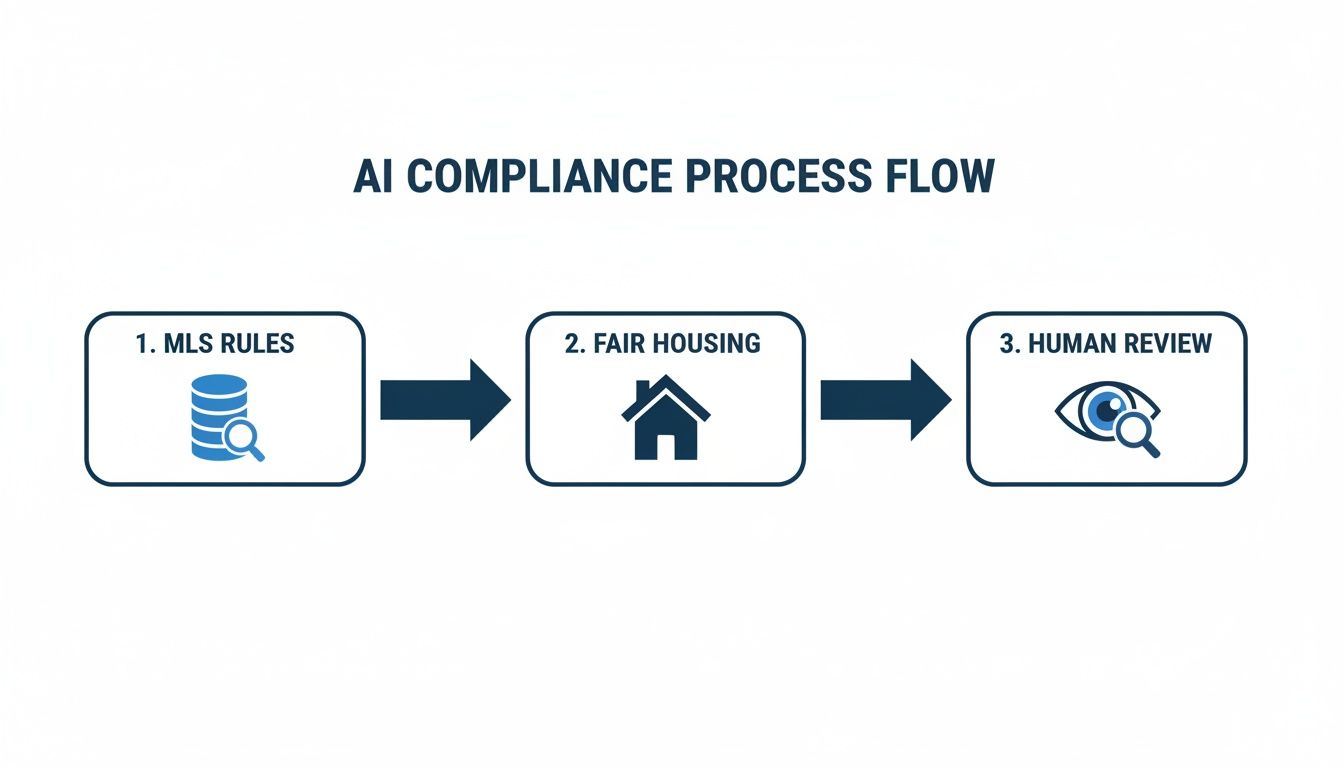
As you can see, compliance isn't a one-and-done task. It's a structured workflow, and human oversight is the final, non-negotiable step.
The Anatomy Of A Perfect Prompt
So, what does a great prompt actually look like? It’s like a recipe—miss one key ingredient, and the whole thing can fall flat.
Every solid real estate prompt needs these elements:
- Set the Scene: Tell the AI its role and objective. "You are an expert real estate copywriter creating an engaging MLS description for a luxury property."
- Feed it the Facts: This is the raw data. Address, square footage, bed/bath count, and a bulleted list of key features (e.g., Calacatta quartz countertops, new architectural shingle roof, saltwater pool).
- Define the Vibe: Give the AI a clear direction on tone. Is it "elegant and sophisticated," "warm and inviting," or "modern and minimalist"?
- Describe the Lifestyle, Not the Person: This is where agents get into trouble. Instead of saying it’s for "a family," describe the lifestyle the home supports, like "a home designed for entertaining and seamless indoor-outdoor living."
- Build Your "Do Not" List: This is your most powerful compliance tool. Be explicit about what the AI cannot do.
My best piece of advice: Your negative constraints are your first line of defense. I start nearly every prompt with a hard-and-fast set of rules like, "Strictly adhere to all Fair Housing guidelines. Do not mention family, children, race, religion, or any other protected class. Focus only on the property’s features and amenities, not who might live here."
Effective vs Ineffective AI Prompts for Real Estate
The difference between a prompt that gets you into hot water and one that gets you a great listing description is all in the details. A vague prompt invites the AI to fill in the blanks, often with stereotypes or problematic language. A specific, constrained prompt forces it to be creative within safe boundaries.
Here's a look at how that plays out in the real world:
| Scenario | Ineffective Prompt (High Risk) | Effective Prompt (Low Risk & High Impact) |
|---|---|---|
| Suburban Home | "Write a fun description for this 4-bed house. It's in a great, family-friendly neighborhood with good schools." | "You are a real estate copywriter. Write a warm, inviting description for the 4-bed, 3-bath home at 123 Maple Lane. Highlight the large, fenced-in yard, the bonus room over the garage, and its location just a short walk from community green spaces. CRITICAL: Do not use language that violates Fair Housing laws. Describe the home's features, not the potential buyer." |
| Downtown Loft | "Draft a description for a trendy downtown loft. Perfect for a single professional or a young couple." | "Act as a copywriter for urban real estate. Create a modern, sophisticated description for Loft #5B at 45 Main St. Emphasize the 15-foot ceilings, exposed brick walls, and oversized industrial windows. Mention the building's rooftop deck and its Walk Score of 98. CRITICAL: Do not mention age, profession, or marital status." |
| Luxury Waterfront | "Write a luxury listing for this waterfront mansion. It's an exclusive community for elite buyers." | "You are a luxury property specialist. Write an elegant and compelling description for the estate at 7 Ocean Drive. Focus on the direct ocean access from the private dock, the chef's kitchen with Sub-Zero and Wolf appliances, and the infinity-edge pool. Use a tone of understated luxury. CRITICAL: Avoid exclusionary or preferential language. Adhere to Fair Housing laws." |
As you can see, the effective prompts aren't just longer; they are fundamentally different. They guide the AI with precision, leaving no room for error while pushing for high-quality, descriptive language.
Real-World Prompt Examples
Let's walk through a couple of common scenarios to see how this works in practice.
The Charming Starter Home
A quick, thoughtless prompt might be: "Write a description for a 3 bed, 2 bath starter home. It's in a great neighborhood for families." This is a Fair Housing minefield.
Here’s how to do it right:
Prompt:
"You are a real estate copywriter. Write a warm and inviting MLS description for the property at 456 Oak Avenue.
Property Details:
- 3 bedrooms, 2 bathrooms, 1,400 sq ft
- Fenced-in backyard with a large deck
- Updated kitchen with new stainless steel appliances
- Located two blocks from a public park and community center
Instructions:
- Highlight the updated kitchen and the backyard deck as key selling points.
- Focus on the property's features and its proximity to community amenities.
- CRITICAL: Do not mention families, children, or describe the type of people who should live here. Adhere strictly to Fair Housing guidelines."
This prompt steers the AI toward tangible assets, making it a perfect example of creating MLS compliant AI content that sells the space, not a discriminatory stereotype. If you're curious about how AI is changing property discovery, we have an article on ChatGPT's impact on real estate search visibility.
The Sleek Downtown Condo
A weak attempt: "Write about a cool 1-bed condo downtown. Perfect for a young professional." Again, we're describing a person, which is a major red flag.
Here's the compliant, high-impact version:
Prompt:
"Act as a copywriter specializing in urban properties. Create a sophisticated and modern property description for Unit 702 at 789 City Plaza.
Property Details:
- 1 bedroom, 1 bathroom, 850 sq ft
- Floor-to-ceiling windows with panoramic city views
- Building amenities: rooftop terrace, 24-hour concierge, fitness center
- Walk score of 95, steps from public transit and restaurants
Instructions:
- Emphasize the stunning city views and the convenience of a high walk score.
- Use a tone that reflects a contemporary, upscale lifestyle.
- CRITICAL: Do not use any discriminatory language. Focus only on the unit's features, building amenities, and location. Do not mention age, profession, or marital status."
By engineering your prompts with this level of detail, you turn a generic AI into a specialized marketing partner—one that produces compelling copy that attracts buyers without attracting lawsuits.
Your Most Important Step: The Human Review

Think of your AI tool as a highly skilled assistant. It can draft content with incredible speed, but you’re still the one in charge. The final call, the critical checks, and the ultimate responsibility all land squarely on your shoulders.
That’s why a final human review is the most vital, non-negotiable part of this entire process. Skipping it is a gamble you just can't afford to take in this business. A small mistake can lead to big problems.
This isn't about rewriting everything from scratch. It’s a focused, five-minute audit to make sure every word is accurate, compliant, and genuinely sounds like it came from you. This quick check is what separates professional, risk-managed marketing from reckless automation.
Your Three-Point Inspection Checklist
A systematic approach makes this review fast and effective. Before you even think about hitting "publish," every single AI-generated draft needs to pass this simple three-point inspection. Consider it your final safety net.
- Fact-Check the Details: Does the description perfectly match the listing data? Double-check the square footage, room counts, lot size, and specific features you fed the AI. No exceptions.
- Scan for Compliance and Tone: Read through with an eye for Fair Housing and MLS rules. Is the language inclusive and appropriate? You’re also checking to see if the tone aligns with your brand or if it sounds too robotic.
- Align with Your Brand Voice: Does this actually sound like you? AI can mimic a style, but it can't replicate your unique market insights or that personal touch your clients know and trust.
A Real-World Example: I once saw an AI-generated description for a beautiful historic home that proudly mentioned a "newly installed oak staircase." One problem: the staircase was original, century-old pine. It was a small detail, but it was a material misrepresentation. The agent caught it during a quick two-minute review, avoiding a potentially serious issue.
This AI-driven productivity boost is changing the game. With 91% of marketers already actively using AI, the efficiency gains are undeniable. The teams who adapt are seeing 2-3x returns, mostly from how fast they can now create content. This is mirrored in real estate, where 74% of agents use AI for social media and emails, cutting down tasks that once took hours to just minutes. You can dig deeper into how human-AI teams are scaling operations in recent industry reports.
The Agent's Final Polish
Once you've done the technical checks for accuracy and compliance, it’s time to make the content truly yours. This is where you shift from fact-checker to storyteller.
An AI can’t capture the feeling of the morning sun hitting the kitchen island just right or the specific charm of the local coffee shop down the street. Adding just one sentence with a personal observation can elevate a good description into a great one.
Here’s a quick guide to adding that final, human touch:
- Read It Out Loud: This is the fastest way to catch clunky phrasing or a robotic tone. If it sounds weird when you say it, it will feel weird when they read it.
- Swap One Generic Word: Find a boring adjective like "nice" or "great" and replace it with something more evocative, like "sun-drenched" or "meticulously maintained."
- Add a Local Gem: Mention the home's proximity to a beloved park, a popular farmer's market, or a key commuter route. This proves you have local expertise an AI can't fake.
This final step does more than just improve the copy. It reinforces your value as an expert agent, blending the efficiency of technology with the irreplaceable nuance of human experience.
Getting Your Listing Seen Everywhere That Matters
You’ve done the hard work. You’ve crafted a fantastic, human-verified property description that’s fully MLS-compliant. But that’s only half the battle. Now, you have to make sure it actually gets in front of the right buyers.
This isn’t just about posting to your local MLS anymore. Your listing’s journey takes it to major portals like Zillow and Realtor.com, and increasingly, it needs to be ready for the new wave of AI search from tools like Google’s AI Overviews and Perplexity. Each platform has its own quirks, and getting visibility means playing by their rules.
Tweaking Your Copy for the Major Portals
Think of each real estate portal as its own little world. They all have different character limits, display formats, and audience expectations. A one-size-fits-all approach just won’t cut it. What reads beautifully on your MLS feed might get awkwardly chopped off on Zillow, losing all its punch.
I've seen it happen too many times: a perfectly good description becomes a jumbled mess because the agent didn't account for how a specific portal handles line breaks or character counts.
Here's my quick-start guide for tailoring your copy:
- Zillow: The first sentence is everything. Zillow often truncates the description preview, so your opening 50-75 words have to do the heavy lifting. Get the single most compelling feature in there immediately.
- Realtor.com: Watch your formatting. This site can be notorious for stripping out line breaks and turning your nicely spaced feature list into a wall of text. Stick to simple paragraphs and always double-check the live listing.
- Redfin: This portal loves scannable information. While it pulls from the MLS, its interface highlights bullet points and key features. Make sure your best assets are listed clearly so they stand out.
The smartest move is to have a few variations of your description ready to go. You can easily ask your AI tool to create them for you. For example, a simple follow-up prompt like, "Now, create a concise, under-250-character version of this for Zillow," can save you a ton of time and headaches.
Getting Ready for the Future of Search
The next big thing in real estate marketing is optimizing for AI search. We're already seeing buyers ask their phones or AI assistants, "Find me a three-bedroom home with a new kitchen in Denver under $600k." You need your listing to be the answer.
This goes way beyond simple keywords. The key is structured data.
This is where schema markup comes into play. It's a bit of code you can add to your website that acts like a set of labels, telling search engines exactly what each piece of information is. For a listing, you can explicitly tag things like:
- Number of bedrooms and bathrooms
- Square footage
- Amenities (e.g., "swimming pool," "granite countertops")
- The exact address and price
When you structure your data this way, you're basically speaking the language of AI. You're making it incredibly simple for a search engine to understand your listing's features and match them to a buyer's very specific query. It's a massive advantage. If you want to go deeper on this, we've put together a full breakdown on using schema markup for real estate listings to get more eyes on your properties.
Why Meticulous Records Are Your Best Friend
In a business where compliance and liability are always top of mind, your records are your safety net. It’s not enough to just publish great, compliant AI content—you have to be able to prove how you did it. Think of it as your get-out-of-jail-free card.
Pro Tip: Treat your AI-generated content records with the same importance as a signed contract. They are a critical part of your compliance file for every listing and create a clear audit trail of your marketing efforts.
For every single property you market with AI, you need to save three key things. No exceptions.
- The Final Prompt: Keep the exact prompt you used. This shows your intent and the guardrails you put in place, like your Fair Housing "do not say" list.
- The Raw AI Output: Save a copy of the first draft the AI gave you, before any edits. This is your "before" picture.
- The Final Published Version: Archive the final, edited copy that went live. This is your "after" picture, clearly showing your human oversight and review.
This simple three-step documentation process provides undeniable proof that you followed a thoughtful, compliance-first workflow. If a complaint ever arises, you can instantly pull these records and show that you took deliberate steps to create fair, accurate, and responsible marketing. It's a small habit that lets you work with confidence, knowing you've got the receipts to back it up.
Answering Your Biggest Questions About AI in Real Estate
New tech always brings up new questions, and that’s a good thing. When you're dealing with something as important as compliance, asking the right questions is critical. I hear from agents all the time who are curious about AI but also pretty cautious, and for good reason. Let’s clear the air and tackle some of the most common concerns I hear.
Can I Actually Get in Trouble for Using This Stuff?
The short answer is yes, the risk is real. But it’s not about using AI—it’s about how you use it.
If you grab a generic AI tool and it spits out a description using language that violates Fair Housing laws, you and your brokerage are on the hook. It’s that simple. For example, a phrase like "perfect for families" might seem harmless, but it can be flagged as discriminatory against people without kids. The same goes for copyrighted MLS data; if a general-purpose AI was trained on it improperly, you could be facing liability.
The only way to do this safely is to use a platform built from the ground up for real estate compliance. These tools are designed to know the rules, with MLS guidelines and Fair Housing checks baked right in. At the end of the day, the agent who hits "publish" is the one responsible, which is why a compliance-focused tool is a must-have for your business.
Let's be crystal clear: liability for AI-generated content falls squarely on you, the user. If you publish it, you own it—its accuracy and its compliance. This makes a specialized, compliant tool a non-negotiable part of your tech stack.
How Do I Make AI Content Not Sound Like a Robot?
This is where you come in. An AI can give you a solid draft, but you’re the one who gives it a soul and makes it sound like you. Getting this right is a two-part process that quickly becomes second nature.
First, you have to guide the AI by baking your brand voice directly into your prompts. Don't just ask for a generic description. Tell it what kind of personality you're looking for.
- Try prompting with terms like "luxurious and professional" for a high-end property.
- Ask for a "warm and inviting" tone for a cozy family home.
- For a downtown condo, you might specify "modern and minimalist."
Second, and this is crucial, always treat the AI output as a strong first draft, not the final copy. Take a few minutes to polish it. Swap a boring word for a more powerful one, tweak a few key phrases, and add a little insider detail about the neighborhood that only a local expert like you would know. The best tools make this easy by giving you fully editable text.
Is a Paid AI Tool Really Worth the Money?
I get it, free tools are tempting. But for real estate pros, they're a huge gamble. A free, general-purpose AI has no concept of MLS rules or Fair Housing laws, which leaves you wide open to serious compliance risks.
Think of a paid, industry-specific tool as an investment in protecting your business and buying back your time. You're not just paying for software; you're paying for peace of mind.
Here’s what you get with a specialized subscription that you just won't find with a free tool:
- Built-in Compliance Scans: These are automated checks that flag problematic language before you publish it.
- Real Estate-Specific Prompts: You get templates and features designed by people who actually understand the nuances of our industry.
- Data Protection: This is a big one. You get a guarantee that your private MLS data isn't being scraped to train a massive, public AI model.
When you weigh the small monthly cost against the risk of thousands in potential fines—not to mention the hours of work it saves you—the return on investment is a no-brainer.
What Else Can a Real Estate AI Do?
A great real estate AI platform is so much more than a description writer; it's a full-on marketing command center. Once you have a tool that understands the compliance landscape, you can use it to create content for your entire digital presence.
Beyond just the MLS remarks, it can help you generate all sorts of marketing materials:
- Social Media Posts: Think engaging captions for Instagram, updates for Facebook, and professional posts for LinkedIn.
- Listing Announcements: Need copy for a new listing, open house, price drop, or a "Just Sold" post? It’s done in seconds.
- Authority-Building Content: You can quickly draft market updates, neighborhood guides, or even blog posts to establish yourself as the go-to expert.
This shifts your whole content strategy from reactive to proactive. You can consistently build your brand everywhere online, all while knowing every word is compliant.
Ready to generate a full month of compliant, scroll-stopping marketing content in minutes? ListingBooster.ai is the AI command center for agents who need to build authority without the burnout. Start your free 30-day trial and see the difference at https://listingbooster.ai.
Walk In With the Campaign Already Built
Listing copy, social posts, sourced Market Insights, growth scheduling, and direct publishing after approval from one real-estate-specific system. 25 free credits to start.
Related Posts
 Listing Descriptions
MLS Description vs Zillow Description How to Win on Both
A listing can have strong photography, sharp pricing, and a solid property, then still underperform online because the description isn't doing the right job in the right place. That's the part many agents miss. They write one paragraph, paste it everywhere, and assume syndication will handle the rest. It won't. The MLS, Zillow, Realtor-style portals, […]
 Listing Descriptions
Top Real Estate Listing Description Examples for 2026
The MLS remarks field opens. The photos are sharp, the pricing is disciplined, and the prep work is done. Then the description underperforms. A generic write-up can drain momentum from an otherwise strong launch because buyers, portal readers, and now AI systems all rely on that copy to decide what the property is, who it […]
 Listing Descriptions
The Ultimate Real Estate Listing Description Playbook
You've seen this happen. The photographer delivers strong images, the seller wants the home live today, and the MLS text box is still blank. That last step looks simple, but it isn't. A real estate listing description now has to persuade, stay compliant, and read cleanly on platforms where buyers skim in seconds. That's why […]