8 Realtor Bio Examples That Build Trust

The most common advice about a realtor bio is also the least useful: list every credential, service, award, and market you touch, then call the result a complete overview. A bio written that way reads like a résumé because it tries to serve everyone at once. Buyers and sellers aren't looking for an inventory of your career. They're looking for a clear reason to believe you're relevant to their situation.
A strong bio makes one audience-relevant promise, supports it with verifiable proof, uses geographic and specialty language naturally, and avoids Fair Housing risk. That matters in a crowded digital environment. A 2024 National Association of Realtors technology survey reported that 97% of agents maintained at least one active social media profile, compared with 74% in 2019, a 23-point increase over five years. The same reporting found that 52% of agents received at least one closed transaction per year directly attributed to a social media contact. The survey reporting makes the business case for a credible, consistent presence.
Below are eight positioning models, from market authority to personality-forward. Choose the structure that matches your actual experience, replace every placeholder with verified information, and personalize the result with ListingBooster.ai instead of accepting a generic AI draft. For broader inspiration on structuring professional introductions, review these powerful company bio examples.
1. Market Expert and AI-Optimized Bio
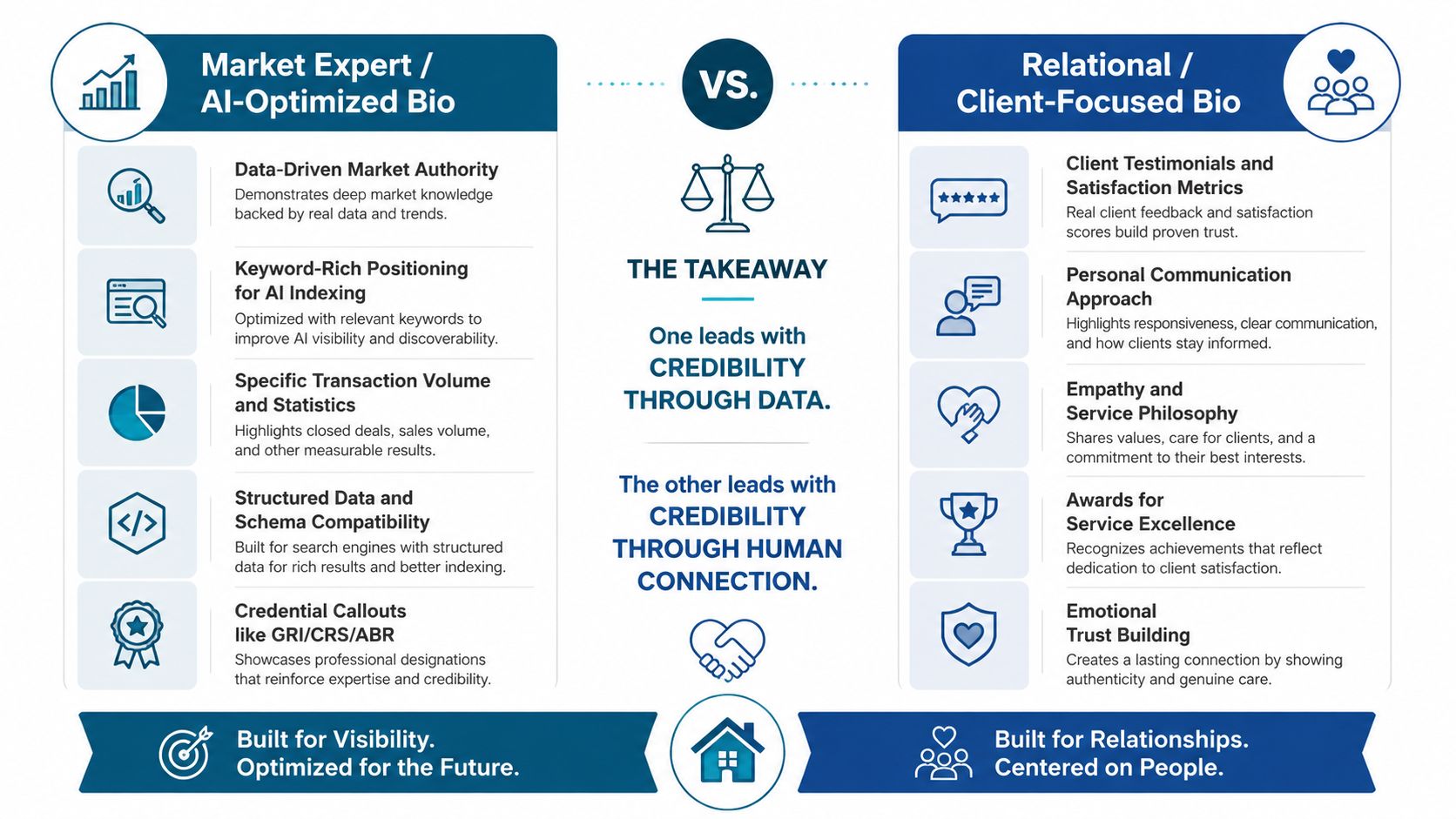
A market-expert bio demonstrates authority rather than merely announcing it. Open with your name, brokerage, location, license, specialty, and relevant designation, then provide facts a buyer or seller can verify. This model fits agents whose experience, market knowledge, and documented results support a clear position in search.
A credible template might read:
[Name] is a GRI-designated real estate agent with [years] years serving [City] and [County]. [He/She/They] specializes in [property type or niche], with [transactions] closed and [sales volume] in verified sales. Recent business includes [market segment breakdown]. Clients rely on [Name] for comparable-sales analysis, pricing strategy, and clear guidance from consultation through closing. Contact [phone] or visit [link] to discuss your next move.
Replace each placeholder with current, documented information. If you claim “top-performing real estate agent in [City]” or cite a local ranking, name the organization, period, and category. Keep transaction counts current. A smaller figure that can be verified is more persuasive than an outdated one.
Make the facts easy to parse
Place the geographic market and specialty near the beginning. Use designations such as GRI, CRS, or ABR only when you hold them, and keep the same terminology across your website, MLS profile, social accounts, and business listings. A structured facts block can include:
- Market: [City], [County], and named service areas
- Specialty: [property type, client need, or transaction category]
- Credentials: [verified designations and license details]
- Proof: [current transactions, sales volume, or documented ranking]
- Method: [specific analysis or marketing process]
Describe your method with evidence. “Based on 18 months of comparable-sales analysis in [neighborhood]” gives readers a concrete basis for your expertise, provided the statement is accurate. “I know the market” does not.
Review AI tools for realtors for ideas on structured information and consistent terminology. Use ListingBooster.ai to adapt the template, then check every AI-generated claim before publishing. For additional models of professional positioning, see these powerful company bio examples. Refresh the bio when your business changes, and remove claims you can no longer document.
2. Relational and Client-Focused Bio
Some clients choose an agent who makes the process understandable and responsive. A relational bio should show how you communicate, how you reduce confusion, and what clients have experienced. Replace broad adjectives such as “dedicated” or “trusted” with specific behaviors and client outcomes.
Use a structure like this:
I guide first-time buyers in [market] from pre-approval through the final walkthrough with clear explanations and reliable communication. My process includes [specific communication practice], so clients know what happens next and who to contact when questions arise. Past clients have described my approach as [accurate review language], and I'm available by [phone, text, or email] during [stated hours]. Start with [consultation or resource CTA].
The strength of this example comes from its defined process. Adapt it around an experience you can document. You could describe coordinating a relocation sale with remote signing or helping a seller manage a time-sensitive estate transaction. Explain your actions, the communication method you used, and the benefit for the client. Remove identifying details and avoid promising availability you cannot maintain.
Proof should support the relationship claim
Use one or two testimonials, a documented referral measure, or a review average that you can substantiate. Do not write “98% of my clients refer friends and family” unless your records support that exact figure. “Much of my business comes from past-client referrals” is stronger when accurate than an impressive claim you cannot verify.
Review information also varies across major platforms. 77% of Zillow profiles displayed customer-review information, compared with 55% on Realtor.com, 38% on Facebook, 26% on Yelp, and 12% on HomeLight in the cited comparison. The platform comparison shows why the bio should direct readers to current reviews where permitted. Keep the same service promise across those profiles, and use ListingBooster.ai to generate alternative drafts from verified communication practices, testimonials, and Fair Housing compliant client descriptions. Review every claim before publishing.

3. Niche Specialist Bio
A niche bio gives a specific client a fast answer to a practical question: Does this agent regularly handle the kind of property or transaction I have? The niche can be defined by property type, geography, or transaction complexity. The narrower the claim, the more carefully your proof should match it.
A luxury-focused version could say:
I represent estates and high-value properties in [County], with [years] years focused on luxury transactions. My work includes [verified transaction type or property feature], supported by [designation, training, or documented experience]. I coordinate valuation, presentation, negotiation, and confidentiality around each seller's objectives. For a private discussion about [market or property type], contact [name] at [CTA].
An investment version needs a different vocabulary:
I help owner-operators and 1031 exchange investors evaluate [property type] in [market]. My process includes deal screening, cash-flow modeling, due diligence coordination, and closing management. I've completed [verified number] investment-property transactions and work with licensed professionals when legal, tax, or lending advice is required. Request a conversation at [link].
Define the boundary
A niche claim becomes more credible when it explains what you do and what falls outside your service. “Luxury specialist” is weak without a market, property type, or relevant experience. “Waterfront specialist with [verified transaction experience] in [named area]” gives readers a clearer basis for evaluation.
Your proof might include specialty-specific transactions, recent training, certifications, association memberships, or client testimonials. Don't imply that a designation makes you qualified for every related service. If you work with probate, estate, commercial, or investment transactions, state the scope of your role and refer legal, tax, lending, or accounting questions to the appropriate professionals.
Fair Housing compliance remains central. A niche should describe properties, transactions, and services, not the people who supposedly belong in an area. “Historic-home specialist in [district]” is service-based. Language such as “exclusive,” “safe neighborhood,” or “ideal for young professionals” creates unnecessary risk and doesn't improve positioning.

4. Multi-Property and Portfolio Bio
Broad experience can be valuable, but a list of every possible service often sounds unfocused. A portfolio bio must show range while giving readers a clear organizing idea, such as complex transactions, coordinated team expertise, or a particular strength in investment property.
Compare these two openings:
- “I help everyone with every real estate need.”
- “Our full-service team handles residential sales, investment property, new construction, land, and commercial transactions, with dedicated specialists for each category.”
The second version explains how the breadth is managed. It doesn't ask one agent to appear equally expert in unrelated fields.
Use a category breakdown
A team template might read:
[Team Name] serves [markets] across residential, investment, land, and commercial real estate. Our [team size] agents bring distinct expertise to each transaction, while a shared process keeps communication and accountability consistent. Recent business includes [verified residential figure], [verified investment figure], and [verified commercial or land figure]. Known for [distinctive strength], we help clients choose the right strategy for the property and objective. Schedule a consultation at [link].
Only include team size, transaction totals, or monthly activity when your records support them. Break down results by category so readers can understand the experience behind the claim. If your team has handled 12 agents and 1,200 combined transactions, for example, verify that the figure covers the stated period and includes only transactions your team can legitimately represent.
A portfolio bio also needs a human benefit. “Full service” is not a benefit by itself. Explain whether clients receive a dedicated commercial specialist, a coordinated listing team, investment analysis support, or a documented communication process.
The broad approach is a poor fit when you have limited proof in several categories. In that case, lead with your strongest current specialty and mention adjacent services secondarily. Range should reinforce stability, not create doubt about depth.
5. New and Emerging Agent Bio
A new agent doesn't need to imitate an experienced producer. The bio should be honest about career stage while making competence visible through education, mentorship, prior professional skills, technology, and a defined process.
Try this template:
I'm a newly licensed real estate agent serving [market] with [brokerage or team]. I bring experience in [prior career or skill] to a process built around organized timelines, clear explanations, and responsive communication. I'm mentored by [broker or team], who brings [verified experience], and I've completed [accurate training or designation coursework]. My focus is [service or niche], and I help clients understand each step from [starting point] through closing. Begin with [specific CTA].
If you were licensed in 2023, say so. If you closed 18 transactions in your first year, use that fact only if it is accurate and current. Transparency gives the reader useful context and lets your actual strengths carry the message.
Replace experience with evidence
New agents often have more proof than they realize:
- Relevant background: Project management, sales, construction, finance, customer service, or marketing can explain a useful working skill.
- Current education: Name completed coursework, training, and designations accurately.
- Mentorship: State the relationship and role without borrowing another professional's production record as your own.
- Process discipline: Describe how you organize communication, deadlines, vendor coordination, and client education.
- Technology fluency: Mention digital marketing, video, or content skills when you use them for clients.
First-person language usually helps here because it makes the transition into the profession feel direct and accountable. Avoid “expert” unless the evidence supports it. “I'm building my practice around clear communication and current market education” is more credible than an inflated authority claim.
Social profiles can carry the personality component, while the website and portal version can explain your process in more detail. ListingBooster.ai can help you turn one verified fact set into platform-specific drafts, but you still need to check every credential, date, and claim before publishing.
6. Community Leader and Local Authority Bio
A community-based bio earns authority through verified involvement. It suits agents whose business has grown through nonprofit work, civic participation, coaching, local boards, or sustained knowledge of a specific market. The positioning works only when the local connection produces useful client insight.
Lead with your specific role and organization rather than a general claim of local connection:
I serve [market] as a real estate agent and [specific role] with [organization]. Through [years or current involvement], I've developed practical knowledge of [local feature, planning process, or community resource]. I bring those relationships and local insights into pricing, preparation, and marketing decisions, while keeping each recommendation tied to the client's stated goals. To discuss a move in [area], contact [name] at [CTA].
Local history alone doesn't establish authority. Pair “Born and raised in [Neighborhood]” with a specific role, contribution, or service area. A specific board membership carries more credibility than a general claim of community involvement. If you chaired a fundraiser and raised $75,000 or more, verify the amount, date, and your actual role before publishing it.
Connect involvement to client value
A community fact belongs in a realtor bio when it clarifies how you work:
- Local organizations: Explain the knowledge or relationships your role provides.
- Civic work: Describe familiarity with planning, development, or local resources without predicting neighborhood outcomes.
- Volunteer service: Name the organization and state your contribution accurately.
- Team involvement: Identify who handles each market or transaction type.
Use this rewrite prompt in ListingBooster.ai: “Draft a community-authority realtor bio from these verified roles, organizations, service areas, and client benefits. Keep every claim factual, distinguish personal work from team work, and suggest objective local keywords such as transit access, zoning information, lot characteristics, building age, and available amenities.”
Fair Housing compliance also shapes the copy. Avoid language that steers readers toward or away from an area, including “safe,” “exclusive,” or wording aimed at a particular demographic. Describe accurate, current property and location features instead.
For agents building a location-based presence, this guide explains how to optimize GBP for AI search. Keep your name, brokerage, market, specialty, and contact details consistent across your profile, Google Business Profile, website, and social accounts.
7. Results-Driven and Performance Bio
A performance bio is seller-oriented and evidence-heavy. It can be persuasive when the numbers are recent, verifiable, and explained in context. It fails when it relies on unsupported superlatives or presents a result without identifying the period, category, or methodology.
A useful version might say:
In the last [verified period], I closed [transactions] homes in [market] and achieved an average [verified metric] of list price, with an average [verified time metric] on market. My business is supported by [verified referral or repeat-client measure]. I pair performance analysis with [specific service process], including [pricing, preparation, marketing, or negotiation step]. For a current pricing discussion in [area], request [CTA].
If your records show 47 homes sold, an average of 96% of list price, and 18 days on market during the last 12 months, you can use those facts with the period clearly stated. If your team closed 32 transactions and $18.4 million in volume in 2024, identify whether those figures belong to you personally or to the team. Never blur individual and team production.
Add context and restraint
Performance metrics need definitions. “Average days on market” may refer to listed homes, sold homes, a specific property class, or a defined market. State the category and source in your internal records. If you claim a ranking such as “Top 1% nationally” or “Ranked #2 in [County],” include the organization, ranking period, and measurement category.
A results-first opening can sound cold, so add one sentence about how the result is achieved. Sellers want evidence, but they also need to know what communication and marketing will feel like. A referral percentage can support satisfaction, yet it shouldn't replace current reviews or a clear service promise.
Don't promise a sale price, appreciation, or future market performance. Use historical results as context, not as a guarantee. Update the metrics whenever the underlying period changes, and remove a claim when you can no longer verify it.
8. Personal Brand and Personality-Forward Bio
A personality-forward bio gives readers a reason to remember you before they know your production history. It suits agents with a distinct voice, a strong content presence, or a personal story that shapes their client service.
A workable template is:
I became interested in real estate because [specific personal reason]. Today, I help buyers and sellers in [market] navigate [specific challenge] with [values or working style]. My approach is [two accurate traits], supported by [process or proof]. Outside of transactions, I [authentic local, professional, or community detail]. If you're considering a move in [area], [specific CTA].
“Real estate obsessive since age 12” can be memorable if it's true, but the line needs a client connection afterward. “Former nonprofit director” matters when it explains strategic planning, empathy, communication, or community knowledge that clients will experience in your work. A personal story shouldn't consume the entire bio.
Let voice support positioning
Use language that sounds like you, but edit out humor or bluntness that could undermine professionalism. “Straight shooter” may communicate directness, while “no BS” could be a poor fit for a brokerage website or a luxury audience. Test the tone across Instagram, LinkedIn, listings, and your website. Consistency doesn't require identical wording, but the same values and market language should remain recognizable.
The personal angle also needs boundaries. Don't use family status, religion, age, or other personal details in ways that suggest who should live in a property or neighborhood. Avoid “perfect for families,” “walk to church,” and “ideal for young professionals.” Describe the home, location, services, and transaction instead.
Agents refining their voice can use these agent brand identity tips to turn a personal story into reusable profile and social copy. Video and behind-the-scenes content can reinforce the bio, but every post still needs accurate brokerage information and compliant property language. A distinctive voice helps people remember you. It doesn't excuse unsupported claims.
8 Realtor Bio Types, Quick Comparison
| Approach | Implementation Complexity 🔄 | Resource Requirements ⚡ | Expected Outcomes ⭐📊 | Ideal Use Cases 💡 | Key Advantages ⭐ |
|---|---|---|---|---|---|
| Market Expert / AI-Optimized Bio | 🔄 High, data integration, schema & SEO work | ⚡ High, market data feeds, analytics, technical SEO | ⭐ High credibility; 📊 improved AI/indexing and matching | Sellers seeking analytical authority; AI-driven discovery channels | Data-driven credibility; better algorithmic visibility |
| Relational / Client-Focused Bio | 🔄 Medium, testimonial collection & narrative craft | ⚡ Low–Medium, time for client outreach and content | ⭐ Strong trust; 📊 more referrals but less quantifiable proof | First-time buyers, emotionally-driven sellers, social platforms | Emotional resonance; high referral potential |
| Niche Specialist Bio | 🔄 Medium, focused expertise and clear boundaries | ⚡ Medium, niche education, certifications, targeted ads | ⭐ High conversion for target clients; 📊 supports premium pricing | Specialized markets (luxury, probate, investments) | Clear positioning; efficient targeted marketing |
| Multi-Property / Portfolio Bio | 🔄 High, coordinate multiple specialties and messaging | ⚡ High, team resources, diverse tools, category reporting | ⭐ Versatile credibility; 📊 appeals to complex/mixed needs | Teams, full-service firms, clients with mixed portfolios | Full-service positioning; resilience across markets |
| New / Emerging Agent Bio | 🔄 Low, honest framing and modern presentation | ⚡ Low–Medium, training, mentorship, digital marketing tools | ⭐ Builds trust over time; 📊 early wins show competence | New agents, digital-native clients, first-time buyers | Fresh perspective; strong digital fluency |
| Community Leader / Local Authority Bio | 🔄 Medium, sustained civic engagement required | ⚡ Medium, time investment in volunteer/boards | ⭐ Strong local authority; 📊 gradual organic referrals | Hyperlocal markets; long-term practice growth | Deep local trust; hard-to-replicate referral network |
| Results-Driven / Performance Bio | 🔄 Medium, requires accurate tracking and context | ⚡ Medium–High, analytics, documentation, verification | ⭐ Very persuasive to sellers; 📊 measurable performance metrics | Competitive seller markets; clients who shop on results | Verifiable outcomes; competitive differentiation |
| Personal Brand / Personality-Forward Bio | 🔄 Medium, consistent voice and content cadence | ⚡ Medium, ongoing content creation and social media | ⭐ High loyalty and engagement; 📊 platform-driven leads | Influencer-style agents, social-first audiences | Distinct differentiation; strong audience loyalty |
Turn the Right Bio Framework Into Your Own
Start by choosing one primary positioning model. A market expert can add relational proof. A new agent can use a personal story. A community leader can include performance evidence. The mistake is not combining elements. The mistake is giving every element equal weight, so the reader can't tell what makes you the right fit.
Replace each placeholder with a fact you can verify today. Confirm your license title, brokerage name, service areas, designations, transaction history, rankings, sales volume, testimonials, and contact details. A useful bio structure often leads with a tight positioning statement and then supports it with concrete metrics rather than vague adjectives. Independent agent-bio guidance also keeps the canonical profile version around 120 words for profile pages, as described in these realtor bio examples and templates.
Then add one concrete client benefit. “I specialize in [market]” identifies you. “I use [specific process] to help clients understand pricing, preparation, and deadlines” explains why the specialization matters. Keep the CTA simple, such as scheduling a consultation, requesting a pricing conversation, viewing current listings, or contacting you through a single link hub.
Adapt the copy to each platform
Length should follow the channel, not personal preference. Guidance cited by independent real-estate marketing sources recommends roughly 50 to 100 words for social profiles, 50 to 75 words for Google Business Profile, 120 to 200 words for Zillow or Realtor.com-style profiles, 150 to 250 words for LinkedIn summaries, and 150 to 300 words for website bios. The platform-specific bio guidance also organizes the content around the hook, niche, proof, process, local credibility, personality, social proof, and CTA.
Use one source of truth, then create shorter versions. Keep your name, brokerage, market, specialties, and contact information consistent across your website, MLS, social profiles, Google Business Profile, and AI-readable content. Research from the Consumer Federation of America found that only 49% of agent websites studied included at least one review, and 13% of those had three reviews or fewer, according to the cited platform analysis. That makes accurate proof and review visibility important parts of profile maintenance, not decorative extras.
Before publishing, remove demographic or predictive language. Fair Housing compliance applies to bios and social content, not only listing descriptions. Use property and location features, avoid steering language, and follow your brokerage's policies. Regulatory guidance also states that social media advertising by licensees must display the firm name and firm telephone number no more than one click away from the viewable page, while listing information must remain current and accurate. Review the requirements in the social media advertising compliance handout, then consult your broker or compliance counsel.
ListingBooster.ai offers a real-estate-specific way to generate and refine personalized bios and related social content from your verified information. It can be useful when you need one positioning idea adapted for multiple channels, but no AI tool should be trusted to invent a credential, number, testimonial, ranking, or compliance detail. Review the final copy with the same care you would apply to a listing presentation.
For agents evaluating broader real estate content automation tools, the practical standard is simple: the tool should save drafting time without taking responsibility away from the professional whose name appears on the profile. Choose clarity over volume, proof over adjectives, and a specific client benefit over a complete résumé.
ListingBooster.ai helps real estate agents turn verified positioning, listing details, and service expertise into editable bios and social content designed for real estate workflows. Use it to adapt one accurate message across your website and social profiles, then visit ListingBooster.ai to build a more consistent, compliant presence.
Walk In With the Campaign Already Built
Listing copy, social posts, sourced Market Insights, growth scheduling, and direct publishing after approval from one real-estate-specific system. 25 free credits to start.
Related Posts
 Uncategorized
Real Estate Content Marketing: The 2026 Playbook
Listings with video can generate 49% more qualified leads, according to a 2026 real estate digital marketing roundup. That figure changes the question. Real estate content marketing isn't about how often you post. It's about whether your listing, expertise, and local knowledge can be found, understood, and cited by people and by the AI tools […]
 Uncategorized
AI for Real Estate Marketing: A Practical Playbook
A new listing goes live on Tuesday morning. You write the description from memory, schedule three social posts, answer showing requests, and move on to the next client task. By afternoon, the listing has plenty of activity on your side of the business, but the phone still isn't producing the conversations you expected. That gap […]
 Uncategorized
What Is IDX and Why It Still Matters for Real Estate
A new agent usually hears “IDX” during a brokerage onboarding call, nods along, and hopes nobody asks for a definition. Then the questions arrive: Why are listings appearing on the website? Who controls the data? Why did a property remain visible after its status changed? And will the same pages be readable by ChatGPT, Perplexity, […]