AI for Real Estate Marketing: A Practical Playbook
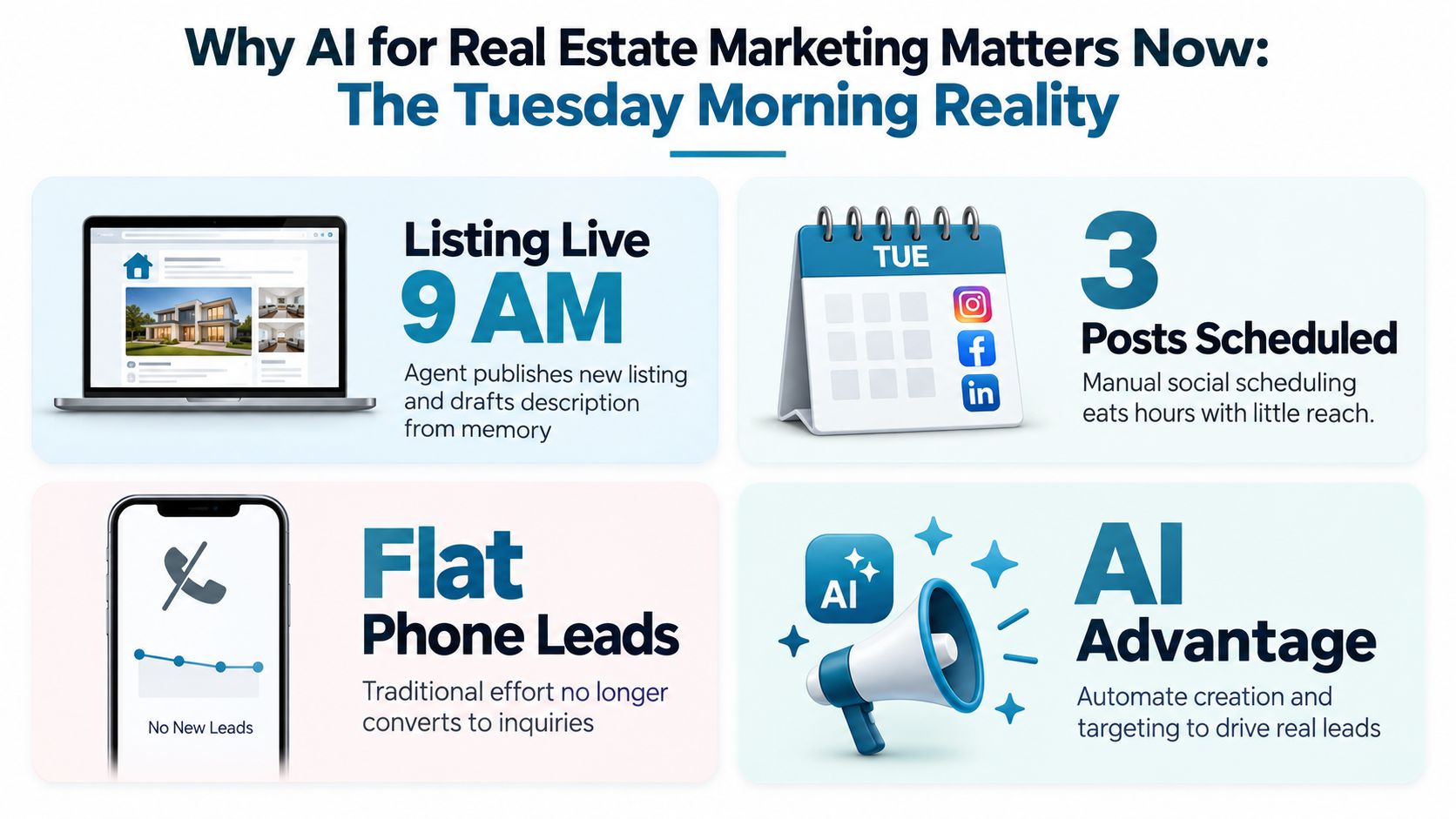
A new listing goes live on Tuesday morning. You write the description from memory, schedule three social posts, answer showing requests, and move on to the next client task. By afternoon, the listing has plenty of activity on your side of the business, but the phone still isn't producing the conversations you expected.
That gap is where AI for real estate marketing matters. The issue isn't that you need to write faster. Buyers increasingly discover homes, neighborhoods, and agents through conversational tools that summarize information and recommend what to consider. If your facts are inconsistent, your local expertise is thin, or your content never gives AI systems a clear reason to connect you with a market, producing more posts won't solve the visibility problem.
The playbook below treats AI as a discovery and compliance system first, and a content-production system second.
Why AI for Real Estate Marketing Matters Now
AI has moved from an experiment to a normal production tool inside real estate marketing. A Delta Media Group survey of more than 100 brokerage leaders, representing firms tied to over two-thirds of U.S. real estate transactions, found that 97% said their agents were using AI tools in 2026, up from 80% in 2024. The same reporting found that 82% of agents used AI for listing descriptions, compared with 58% a year earlier, while 74% used it for marketing content such as email, social media, and blog posts. Real Estate News reported the adoption findings.
That tells me the competitive question has changed. Agents aren't deciding whether to try AI. They're deciding whether their systems produce accurate, locally relevant content that can be retrieved when a buyer asks an assistant for help.
Buyers aren't searching the same way
New real estate search tools let buyers describe a need conversationally, such as “a two-bedroom townhouse walkable to restaurants,” instead of assembling a short keyword query. Realtor.com's RealAssist was launched to answer questions about listings, amenities, commute times, school ratings, affordability, and mortgage topics, as reported by Axios in its coverage of AI-assisted real estate search.
That format changes what your marketing needs to communicate. A listing can't just repeat attractive adjectives. It needs clear property facts, usable neighborhood context, service-area signals, and answers to the questions buyers ask.
The practical shift: Faster content helps only after your business has created enough accurate, connected information for AI systems to understand and recommend it.
The rest of your strategy should follow that order. First, make your listings and authority content readable, consistent, and compliant. Then use AI to distribute and adapt that material across MLS, social, email, and buyer conversations.
What AI for Real Estate Marketing Means
A buyer asks an AI assistant for a home that fits a specific commute, budget, and set of property features. Whether your team appears in that answer depends on more than publishing another post. AI for real estate marketing is a system for making accurate property and local information easy to find, understand, verify, and reuse. Content production follows discovery and compliance.
The useful question is, which recurring task should AI prepare so an agent can review, correct, and publish it?
Practical applications include:
- Listing copy: Convert verified property details into MLS descriptions, feature summaries, open-house copy, and social variations.
- Social content: Adapt one listing into captions, carousel text, video hooks, and platform-specific posts.
- Buyer conversations: Answer routine questions about property features, showing requests, affordability topics, and next steps, then route qualified inquiries to the team.
- Local authority content: Create neighborhood guides, market explainers, buyer resources, and seller FAQs from documented local information.
- CMA preparation: Organize comparable-property information and draft a narrative for the agent to check before a listing appointment.
AI works like a prep cook in a serious kitchen. It organizes ingredients and prepares a draft. The chef still decides what belongs on the menu, checks quality, adjusts the result, and serves the customer. In real estate, the agent remains responsible for context, accuracy, client strategy, negotiation, and every consumer-facing decision.
Start with inputs, not prompts
Generic prompts produce generic marketing because the system lacks reliable material. Begin with a structured property record:
- Confirm bedrooms, bathrooms, square footage, lot details, price, improvements, amenities, and known restrictions.
- Separate verified facts from interpretation. “Updated kitchen with quartz countertops” is a fact when supported by the listing record. “Best kitchen in the neighborhood” is an opinion.
- Add documented location information, including nearby public amenities, transportation options, and services.
- State what the system must not infer, especially about residents, schools, safety, or lifestyle.
- Require agent review before publication.
This structure also helps your business become recommendable inside AI answers. Consistent facts across listings, profiles, guides, and follow-up materials give systems clearer signals about your services and coverage area. More output cannot compensate for contradictory or unsupported information.
ListingBooster.ai supports this workflow by generating editable property descriptions and multi-channel social content from listing details. A general AI chat tool can draft prose, but a real estate-specific process makes source facts, channel requirements, and review easier to control.
The goal is recovered time, not automation for its own sake. Use AI to reduce repeated rewriting, formatting, and routine research while keeping editorial and legal responsibility with the team.
The Core Use Cases That Move the Needle
The strongest applications connect directly to a calendar problem. If a task happens repeatedly, starts from structured information, and still needs professional judgment, it's a good candidate for AI assistance.
Listing descriptions
A three-bedroom, 1,800-square-foot bungalow may begin as a bullet list of rooms, updates, parking details, and outdoor features. AI can turn those verified details into an MLS-friendly narrative quickly, then produce shorter versions for portals and social channels. The agent should check every claim, remove unsupported superlatives, and confirm that the copy describes the property rather than a preferred buyer.
Social content
One listing can support a week of content without repeating the same sentence. Ask for a property-focused caption, a short video hook, an open-house reminder, a feature carousel, and a post explaining a renovation detail. The content should preserve one factual source of truth while changing the format and call to action.
Chatbots and lead routing
A property assistant can handle routine questions at any hour, including whether a showing is available, what features a listing includes, or how to request more information. It should not improvise legal, lending, school, or pricing advice. Configure it to identify questions that require an agent and pass those conversations to the right person.
Neighborhood guides
A useful guide answers concrete questions about a defined area, such as transportation, public amenities, housing characteristics, and access to services. Ground the page in verifiable information and connect it to the agent's service area. This is also where a broader resource on real estate AI for lead gen can help teams think through the relationship between content workflows and inquiry handling.
CMA drafts
Before a listing appointment, AI can organize comparable-property notes and prepare a draft explanation of pricing factors. It can't replace the agent's market judgment. Review the comparable selection, dates, condition differences, improvements, and local context before presenting anything to a seller.
For a broader comparison of platforms and workflows, use this guide to the best AI tools for real estate agents.
| Use Case | Replaces | Weekly Time Reclaimed |
|---|---|---|
| Listing descriptions | Repetitive first drafts | Time spent starting copy from a blank page |
| Social content | Manual caption and format changes | Time spent adapting one listing across channels |
| Chatbots | Routine first-response work | Time spent answering recurring questions |
| Neighborhood guides | Unstructured local research and drafting | Time spent preparing authority content |
| CMA drafts | Manual organization of notes | Time spent formatting a preliminary narrative |
The trade-off is straightforward. AI removes repetitive preparation, but it creates a review obligation. A fast incorrect answer is worse than a slower accurate one, especially when the output reaches a buyer, seller, or public listing feed.
From Search Rankings to AI Search Visibility
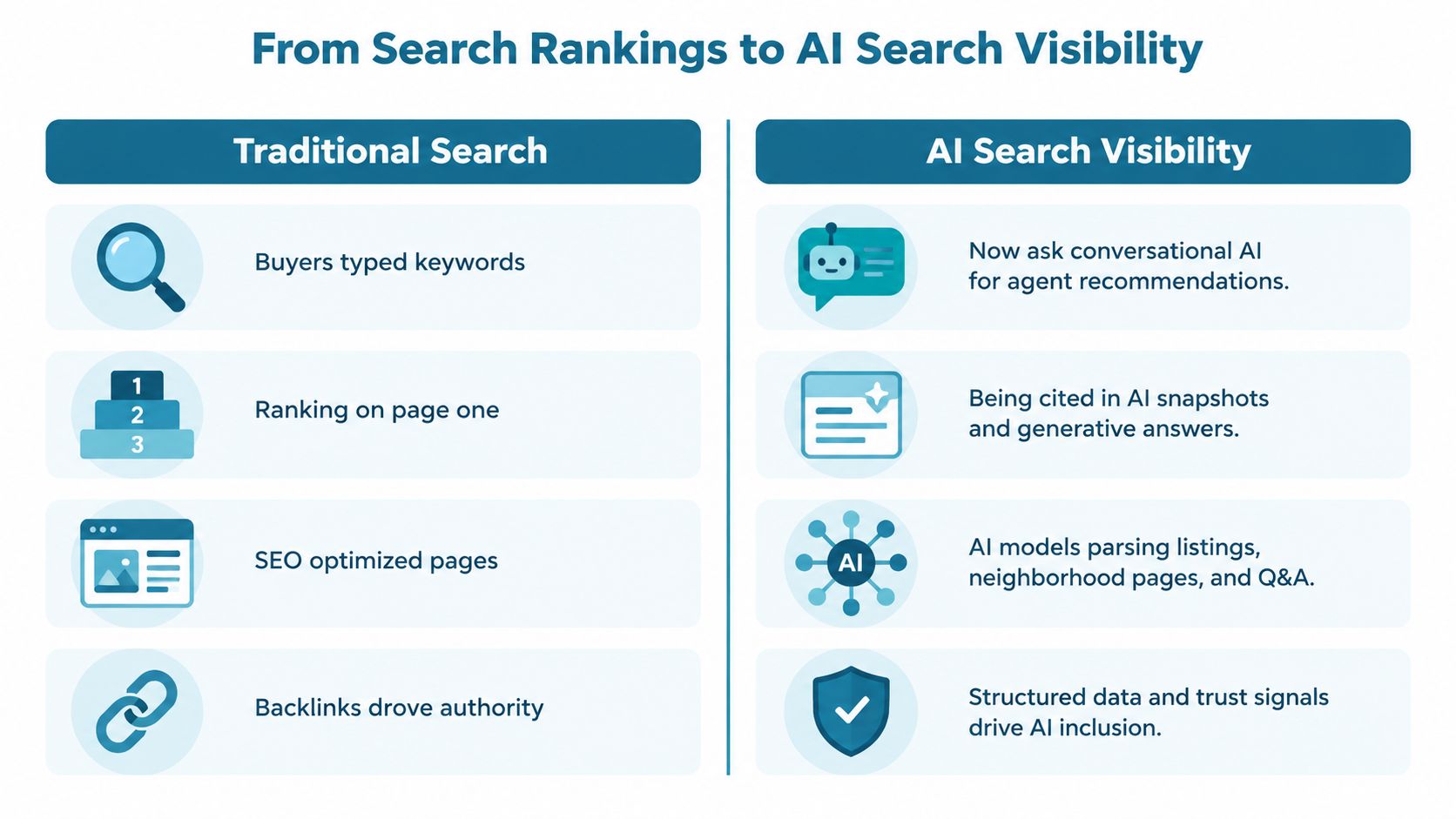
Traditional SEO asks whether a page can rank for a query. AI search asks whether a system can identify your business, understand its local relevance, trust its facts, and use it in an answer.
That distinction matters because conversational systems assemble responses from multiple sources. They may parse listing pages, neighborhood guides, agent profiles, FAQs, reviews, and structured property information before producing a recommendation. Keyword repetition has limited value if your brokerage name, service area, expertise, and factual claims don't align across those sources.
The market signals are significant. A 2026 benchmark covering 12,400 AI-generated responses and 8.2 million tracked queries reported that 67% of homebuyers use an AI tool as their primary research method before contacting an agent, while real estate searches triggered AI Overviews on only about 4.5% of Google queries. HousingWire's benchmark coverage explains the visibility problem.
Build signals models can connect
Your content should make these relationships explicit:
- Identity: Agent name, brokerage, market, and service areas.
- Expertise: Seller resources, buyer guides, transaction explanations, and local market content.
- Evidence: Consistent property facts, dated market information, reviews, and clearly identified sources.
- Structure: FAQ sections, descriptive headings, schema markup, and clean page relationships.
- Consistency: Matching facts across your website, profiles, portals, and social accounts.
An ownable neighborhood guide is more useful than a broad article about “moving tips.” A detailed FAQ page is more useful than a thin service page that says you help buyers and sellers. Review-rich profiles add a trust layer, but only when the reviews describe real experiences and your business information remains consistent.
Tools that support structured property discovery, including AI-powered Zillow data queries, illustrate the direction of search. Buyers and systems can work from natural-language requests, so your content needs to expose the attributes that answer those requests.
You can use this practical guide to get found in ChatGPT and AI Overviews, but don't treat visibility as a one-time technical project. Update facts, strengthen local pages, add useful questions, maintain profiles, and remove outdated claims as part of normal marketing hygiene.
A Practical Implementation Roadmap
A rollout succeeds when the team standardizes a few useful workflows before expanding. Start small enough to review every output, then scale only after agents can explain the rules.
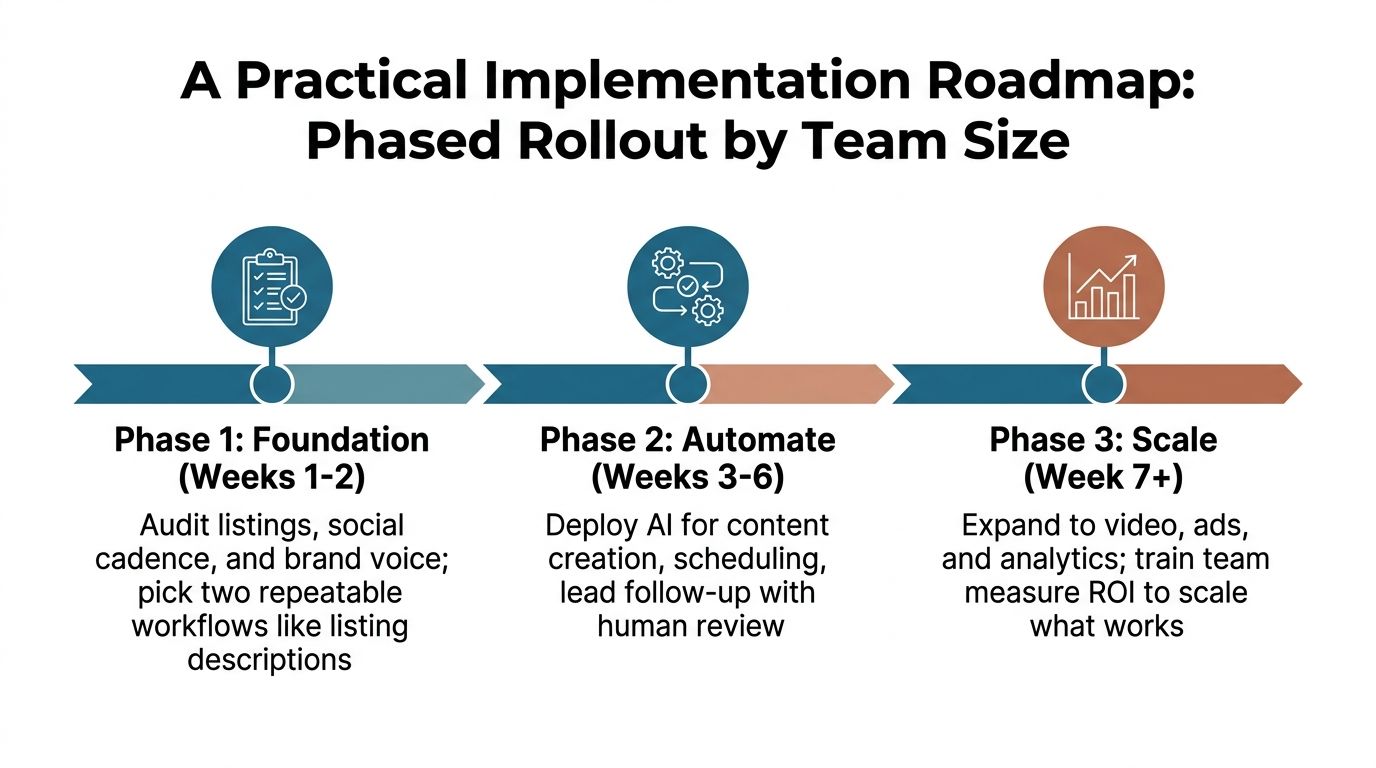
Phase one builds control
During weeks one to two, audit current listings, social cadence, brand voice, and approval habits. Choose two repeatable workflows, such as listing descriptions and neighborhood captions. Store approved prompts, factual field definitions, prohibited language, and brand examples in a shared document.
For a solo agent, this may be one working template and a personal review checklist. For a brokerage, it should become a controlled library with an owner, version history, and a clear escalation path. Don't let every agent invent a separate definition of “on brand.”
Phase two connects the workflow
During weeks three to six, add social carousels, email nurture drafts, and chatbot scripts. Connect the process to your MLS, CRM, and scheduling tools only after the source fields and approval responsibilities are clear.
Every generated asset needs an owner. Require human approval for Fair Housing-sensitive language, neighborhood descriptions, audience targeting, and any claim involving schools, affordability, safety, or lifestyle. The system can prepare the draft, but the responsible licensee decides whether it is accurate and appropriate.
Phase three measures and scales
During weeks seven to twelve, add market-analysis narratives, CMA preparation, and AI-search optimization. Train agents to edit from a reliable draft rather than generate blindly. Watch which prompts create reusable assets and which ones regularly produce corrections.
Use three checkpoints:
- Weekly: Review prompts, recurring errors, and rejected language.
- Monthly: Audit brand voice, disclosures, factual consistency, and compliance records.
- Quarterly: Review business KPIs, lead quality, appointments, and production efficiency.
A useful operational reference is this Opttab proptech visibility guide, particularly for teams documenting how structured content supports broader visibility.
Avoid three predictable failures. Brand drift appears when agents customize every output without shared standards. Stock imagery weakens trust when it doesn't represent the actual property. Unedited copy creates avoidable legal and reputational exposure. Your process should make review easier than skipping it.
Fair Housing Compliance as a Feature, Not a Footnote
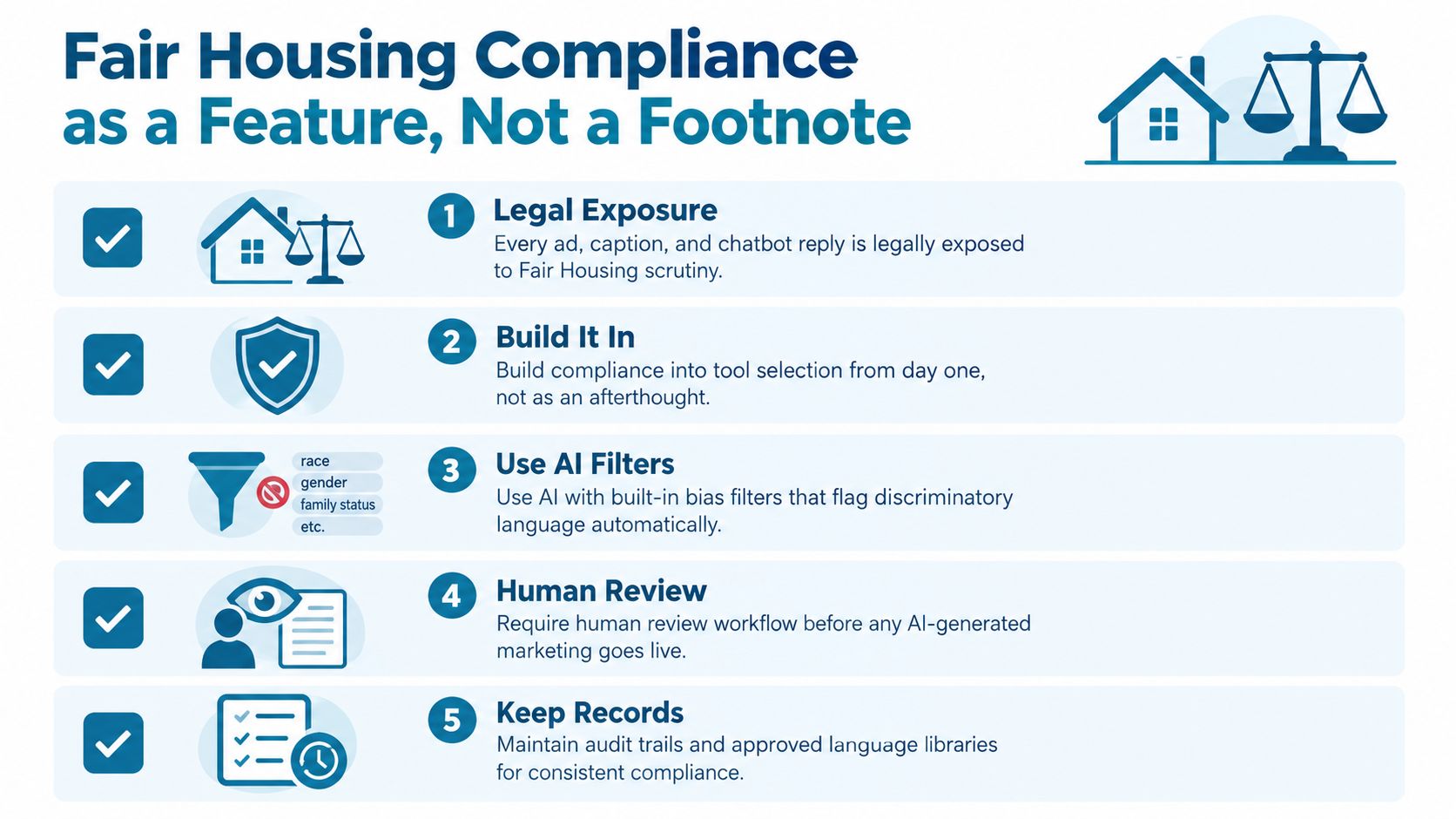
Real estate marketing has a wider compliance surface than most industries. A listing description, social caption, chatbot answer, audience segment, image, or neighborhood guide can create Fair Housing risk. HUD guidance released in May 2024 warned that AI used in housing advertising can create unlawful discrimination risk and advised advertisers to scrutinize audience data and delivery systems so targeting doesn't directly or indirectly rely on protected characteristics. The American Bankers Association Banking Journal summarized that HUD guidance.
California's Department of Real Estate issued a March 2026 advisory stating that AI-generated real estate advertising must still comply with rules prohibiting preferences, limitations, or discrimination based on protected characteristics. The advisory recommends human review, written AI policies, training, and documentation of compliance steps before publication. Read the California DRE advisory on AI in real estate.
Use a pre-publish gate
Your tool and workflow should include:
- A prohibited-language filter: Remove phrases such as “young professionals,” “perfect for families,” “safe,” “quiet,” and “exclusive,” along with religious references and other coded signals. HousingWire's AI Fair Housing checklist provides practical examples.
- Property-focused prompts: Describe rooms, features, access, design, transportation, and services. Don't describe who should live in the property.
- Human approval: Require a named reviewer before anything reaches MLS, social media, advertising, or a chatbot.
- Disclosure and records: Keep the prompt, source facts, final copy, reviewer initials, and publication date where your brokerage policy requires.
- Image review: Confirm that visuals accurately represent the property and don't imply a preference for a particular type of resident.
Read the copy aloud. Scan for exclusionary or directional wording. Check equal housing opportunity branding, verify every factual claim, inspect the image selection, and record the reviewer. Agents can use a specialized resource covering fair housing rules for AI listings when building internal standards.
Compliance is part of the product experience. If a platform makes review, filtering, and audit trails difficult, it isn't ready for brokerage-wide deployment.
Clean output also creates a business advantage. Risk-conscious brokerages and institutional sellers want scalable marketing that demonstrates control, not just creative volume.
The KPIs That Prove AI Marketing Is Working
Measure AI marketing against business outcomes and operating capacity, not the number of captions generated. Establish a baseline before rollout, tag AI-assisted campaigns with UTMs, and use dedicated landing pages when you need to separate traffic from other channels.
Three measurement groups
Listing performance should show whether your properties attract useful attention. Track listing views from AI summaries when the platform exposes that information, referral clicks from AI citations, showing requests, inquiry quality, and the relationship between marketing activity and listing outcomes.
Content performance should show whether authority assets help people recognize your business. Monitor assisted social leads, profile mentions, branded searches after publishing neighborhood guides, and engagement that leads to a conversation rather than passive scrolling.
Operational performance should show whether the system earns its place in the workflow. Track hours saved per listing, production cost per asset, correction rates, response time, and appointment conversion from chatbot conversations.
Review the scorecard on a 30-60-90 day cadence, as recommended by the rollout approach in this playbook. Don't judge a neighborhood guide by reach alone. Judge it by whether the right people find it, understand your expertise, and take a measurable next step.
| Category | KPI | Target Direction |
|---|---|---|
| Listing performance | AI-assisted views and referral clicks | Up |
| Listing performance | Qualified showing requests | Up |
| Social and content | Assisted leads from content | Up |
| Social and content | Branded search after local content publication | Up |
| Operations | Hours saved per listing | Up |
| Operations | Correction and compliance rejection rate | Down |
| Operations | Lead-to-appointment conversion | Up |
A weak result doesn't always mean AI failed. It may mean the source data was incomplete, the call to action was vague, the content wasn't locally specific, or attribution wasn't configured. Fix the measurement system before abandoning the workflow.
Putting It All Together and Your Next Step
The operating loop is simple:
- Audit current content for AI readability, factual consistency, and Fair Housing risk.
- Choose two high-impact workflows, such as listing descriptions and neighborhood guides.
- Feed the system verified property and local facts.
- Require compliance review and human editing.
- Publish with clear structure, consistent business information, and useful answers.
- Measure referral activity, qualified inquiries, appointments, and time saved.
- Expand only after the first workflows produce dependable output.
That loop should run every week. AI search visibility isn't a one-time optimization because listings change, profiles become stale, local pages need maintenance, and models need current, connected information. A team that reviews its content regularly will build a stronger digital footprint than one that generates a large batch and leaves it untouched.
Pick one active listing or one defined farm area this week. Put the verified facts into an appropriate platform, review the resulting description, social assets, or authority content against your current manual work, and decide whether the output saves time without creating compliance risk.
ListingBooster.ai helps agents, teams, and brokerages turn verified listing details into editable MLS descriptions, social content, campaign assets, and authority-building material designed for clearer AI discovery. Visit ListingBooster.ai to evaluate one property workflow and see whether its real estate-specific review process fits your marketing operation.
Walk In With the Campaign Already Built
Listing copy, social posts, sourced Market Insights, growth scheduling, and direct publishing after approval from one real-estate-specific system. 25 free credits to start.
Related Posts
 Uncategorized
Real Estate Content Marketing: The 2026 Playbook
Listings with video can generate 49% more qualified leads, according to a 2026 real estate digital marketing roundup. That figure changes the question. Real estate content marketing isn't about how often you post. It's about whether your listing, expertise, and local knowledge can be found, understood, and cited by people and by the AI tools […]
 Uncategorized
What Is IDX and Why It Still Matters for Real Estate
A new agent usually hears “IDX” during a brokerage onboarding call, nods along, and hopes nobody asks for a definition. Then the questions arrive: Why are listings appearing on the website? Who controls the data? Why did a property remain visible after its status changed? And will the same pages be readable by ChatGPT, Perplexity, […]
 Uncategorized
8 Realtor Bio Examples That Build Trust
The most common advice about a realtor bio is also the least useful: list every credential, service, award, and market you touch, then call the result a complete overview. A bio written that way reads like a résumé because it tries to serve everyone at once. Buyers and sellers aren't looking for an inventory of […]