What Is IDX and Why It Still Matters for Real Estate

A new agent usually hears “IDX” during a brokerage onboarding call, nods along, and hopes nobody asks for a definition. Then the questions arrive: Why are listings appearing on the website? Who controls the data? Why did a property remain visible after its status changed? And will the same pages be readable by ChatGPT, Perplexity, or Google AI search?
The practical answer to what IDX is starts with a distinction. IDX isn't a website, a software product, or a lead-generation guarantee. It's a regulated policy framework and technical delivery layer that lets authorized MLS participants display other participants' listings on public-facing digital channels. That framework still matters because modern AI search depends on accurate, structured, publicly accessible property information.
What IDX Means for Agents and Brokers
IDX stands for Internet Data Exchange. In the United States, it's the policy framework that allows MLS participants to authorize the limited electronic display and delivery of other participants' listings through websites, mobile apps, and audio devices. The MLS controls which records and fields may appear, and the public display has to follow the applicable rules. NAR describes IDX as a controlled display and delivery framework.
That makes IDX different from the password-protected MLS dashboard. The MLS is the working database used by authorized professionals. IDX is the approved path that exposes a permitted portion of that inventory to consumers through a brokerage or agent-controlled experience. A seller may also suppress public Internet display in circumstances allowed by the MLS rules, so not every record automatically belongs on every public site.
The working definition
Think of IDX as three connected layers:
- Permission: The MLS authorizes an eligible participant to display specific listing data.
- Control: MLS rules determine the records, fields, attribution, delivery channels, and other display requirements.
- Presentation: A website, app, or other approved interface turns that data into searchable public pages.
The technology matters, but the policy comes first. A vendor can build an elegant search interface, but it can't authorize data that the MLS hasn't made available. Your system also can't freely combine IDX records with off-MLS information if the resulting display violates MLS rules.
That's why an IDX feed isn't the same thing as scraping a portal. Scraping copies information from a public website without creating the MLS-authorized relationship required for compliant display. IDX gives the participant a defined right to present approved fields under defined conditions.
Practical rule: Treat IDX as a compliance-controlled distribution system first, and a website feature second.
What agents actually get
A correctly implemented IDX site can give an agent or brokerage searchable inventory on its own domain, property detail pages, inquiry forms, and a branded path for buyer engagement. It can also create a dependable foundation for content systems that need accurate listing information. Agents comparing those systems may find this guide to the best AI software for listing agents useful when evaluating marketing workflows.
IDX doesn't replace follow-up, positioning, or local expertise. It gives your audience a legitimate public search experience and gives your brokerage a compliant way to publish listings beyond the MLS interface. That distinction keeps expectations realistic: IDX supplies authorized inventory and presentation infrastructure, not automatic traffic or closed transactions.
How the IDX Policy Took Shape Over Time
IDX became important because MLS data had to move from a professional database into a consumer-facing environment without losing attribution or control. The National Association of REALTORS® approved the IDX policy in May 2000, authorizing MLS participants to display one another's listings on their websites under specific rules and limitations. NAR's IDX background and FAQ records that original adoption and later revisions.
That milestone changed the practical role of an agent website. Before an authorized public display framework existed, a brokerage site couldn't reproduce the broader MLS inventory. After IDX, the website could become a consumer search destination while preserving the listing brokerage's connection to the record.
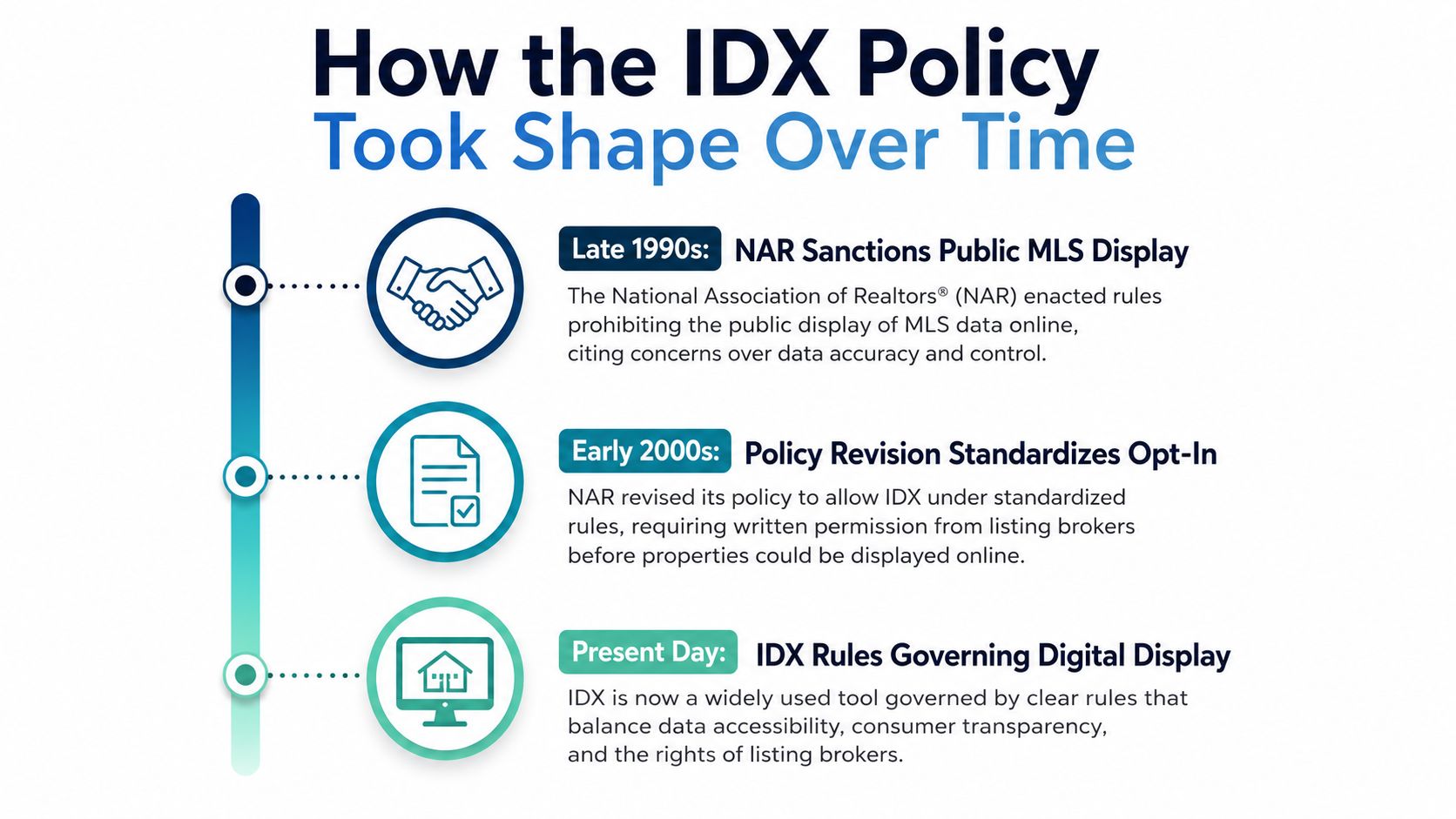
The policy has continued to evolve. NAR's policy materials note multiple revisions, including another round adopted in November 2017. The important point isn't memorizing every amendment. It's understanding that IDX has repeatedly adapted to new delivery methods and new questions about how a listing appears outside the MLS interface.
From websites to machine-readable discovery
NAR places IDX in the Handbook on Multiple Listing Policy as Statement 7.58, and its policy language now covers electronic display and delivery across more than traditional websites. The IDX policy page explains its place in the broader MLS policy structure.
The 2018 revisions expanded authorized delivery channels to websites, mobile apps, and audio devices, while defining display to include delivery under the participant's control. NAR's 2018 revision guidance details those channel changes.
That history now intersects with AI-first discovery. A survey published by Veterans United reported that 52% of respondents use AI to search for homes, while another survey reported 39% use AI tools in home searches. The Veterans United survey provides the 52% figure and its methodology. These figures don't answer whether a particular listing will appear in an AI response, but they do explain why display, attribution, and machine-readable access deserve broker-level attention.
How IDX Data Flows
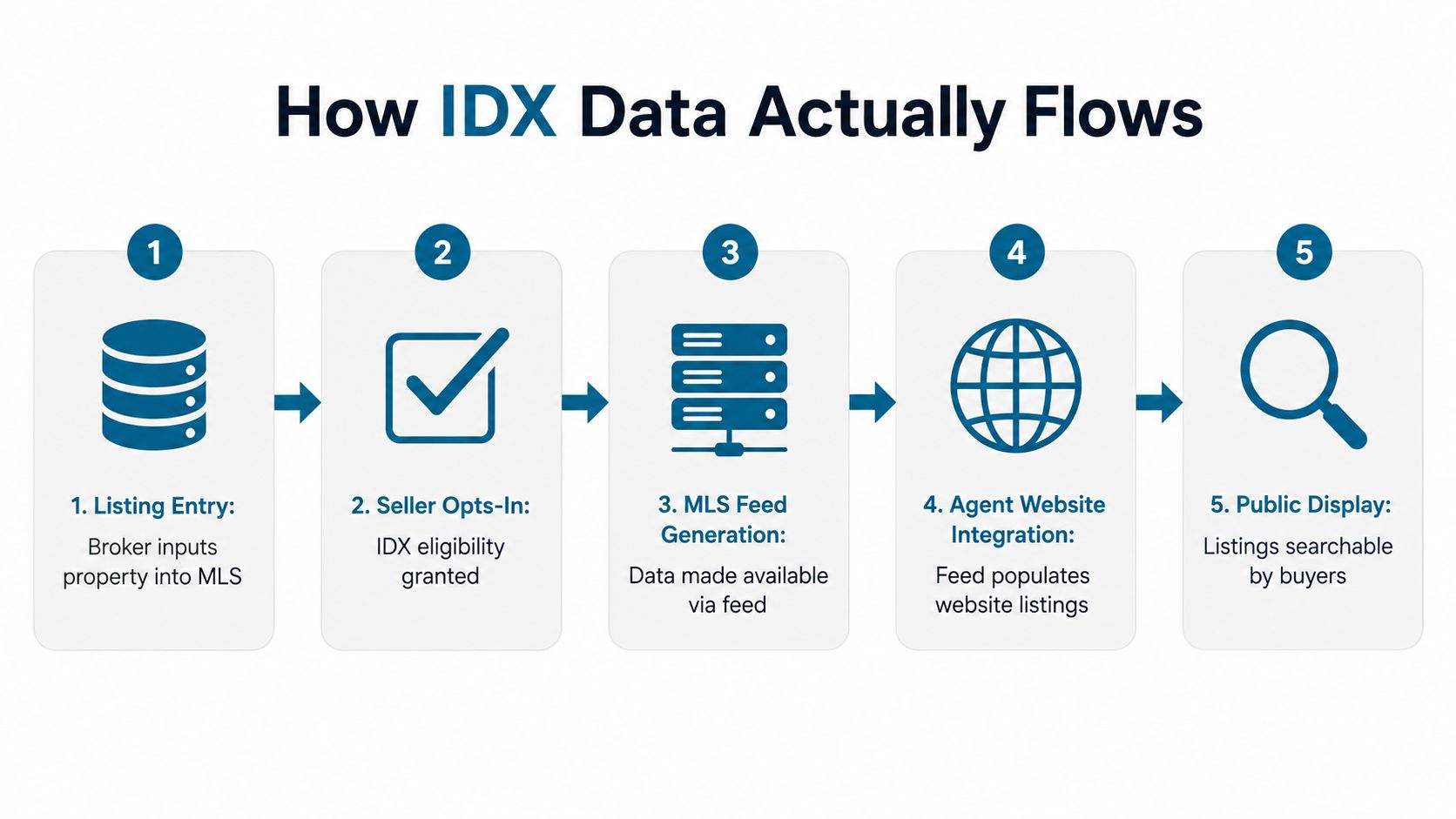
A buyer's property search depends on several systems working in sequence. The listing brokerage enters or updates the record in the MLS. Public IDX display then depends on the applicable authorization, seller instructions, and MLS rules. Once the listing qualifies, the MLS makes approved data available through a feed or another authorized delivery method.
The receiving platform imports fields such as price, bedroom and bathroom counts, square footage, permitted address information, status, and listing-office identifiers. Each MLS sets its own field definitions and delivery rules. A field in the internal MLS record does not automatically belong on a public page. NAR explains how MLS-designated fields and seller suppression affect IDX display.
The five operational stages
- Listing entry: The listing brokerage creates or updates the record in the MLS.
- Eligibility check: Seller instructions and MLS rules determine whether public IDX display is allowed.
- Feed generation: The MLS makes the permitted record and fields available to an approved recipient.
- Field mapping: The receiving system maps MLS names and values into its database and page templates.
- Public rendering: The website or app presents search results, property details, disclosures, and contact paths.
Field mapping causes many implementation problems. One MLS may use different field names, status values, required disclosures, or formatting conventions from another. The receiving system must normalize those differences while preserving the record's meaning. That work affects more than the visible page. Complete, clearly labeled fields give search engines and AI crawlers better material to interpret, while a broken mapping can leave a page looking normal but missing important context.
Where implementations fail
Stale data is the most visible failure. If the feed, vendor, cache, or website does not refresh promptly, a buyer may see an outdated price or status. NAR policy materials describe prompt download access requirements for active listings and address sold data from January 1, 2012 onward, as well as publicly accessible sold information maintained by the MLS. The summary of 2022 MLS changes outlines these access and update-sensitive requirements.
Schema drift is quieter but just as disruptive. An MLS changes a field label or value while the website continues expecting the previous structure. The page may still load, but key information can disappear from the rendered content and the structured data. That weakens the page for both traditional search and AI-first discovery through tools such as ChatGPT, Perplexity, and Google AI search.
For a broader explanation of how listing technology affects brokerage operations, review these technology insights for Florida agents. Feed monitoring, field validation, and compliance checks belong in the operating process, not only in the launch checklist.
Benefits and Limitations for Agents and Brokerages
A buyer lands on an agent's website, searches available homes, opens a property page, and submits an inquiry without being sent to a national portal. That controlled path is IDX's clearest benefit. It connects listing interest to inquiry forms, saved searches, and brokerage lead routing, subject to MLS and vendor rules.
Where IDX earns its place
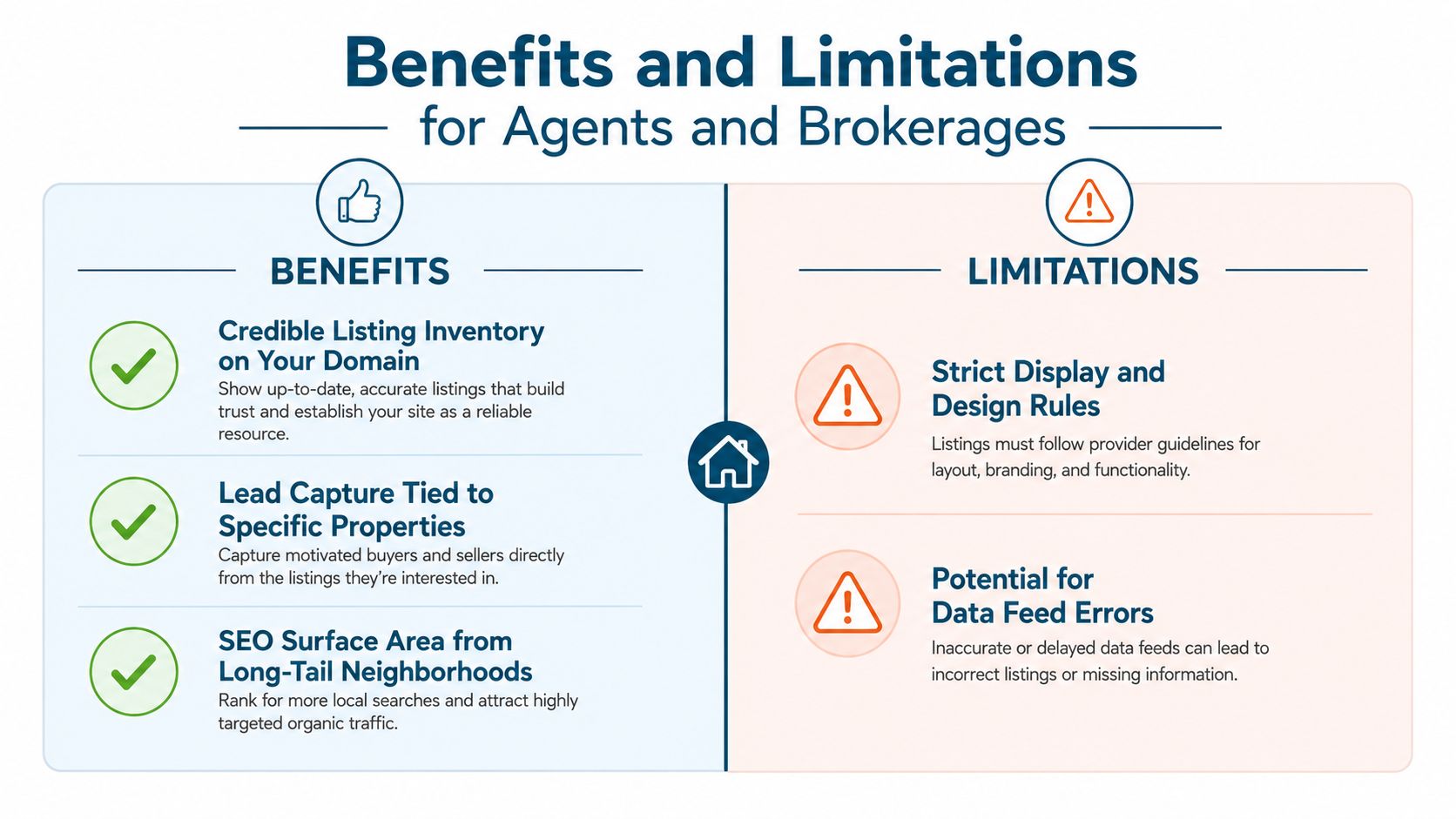
For a solo agent, IDX supplies credible inventory on the agent's own domain. The buyer can search, review listing details, and contact the participant within the same branded environment. The trade-off is that the agent gains a useful destination but does not automatically gain traffic, authority, or a distinct market position.
Teams use the same search experience with more structured routing. Inquiries can go to the appropriate agent while the brokerage maintains shared branding, page standards, and follow-up rules.
A brokerage also benefits from central control. One managed implementation gives the firm a consistent public display instead of leaving agents to copy, paste, or manually maintain property information. That reduces inconsistent descriptions and makes compliance review easier to organize.
Properly structured property, area, and listing pages can expand a site's search visibility. A feed alone creates no authority, and indexing is never guaranteed. It does give Google and AI-first tools such as ChatGPT and Perplexity more accessible material to interpret than a brochure site containing only a homepage and contact form. The same pages must still be accurate, crawlable, and clearly attributed.
The costs that show up later
The drawbacks appear in daily operations:
- Refresh delays: The MLS can record a status change before the public site reflects it.
- Display restrictions: Required fields, brokerage attribution, and contact details limit page design choices.
- Feed errors: Mapping failures can remove fields, mislabel statuses, or produce broken pages.
- Vendor dependence: The brokerage may rely on a provider for hosting, updates, support, and MLS relationships.
- Limited differentiation: Competing firms may display much of the same inventory through similar products.
- Compliance exposure: Problems arise when agents alter, export, or present feed data outside permitted rules.
NAR guidance requires IDX displays to identify the brokerage firm clearly in readily visible color and typeface. They must also provide a consumer contact method, such as an email address or telephone number. The IDX qualification guidance explains these identification and contact requirements.
A useful trade-off: IDX fits a business that needs compliant search, branded engagement, and centralized lead handling. It is a poor investment if the expectation is that a feed alone will create differentiation, traffic, or conversion.
Why IDX Still Matters in AI-Driven Search
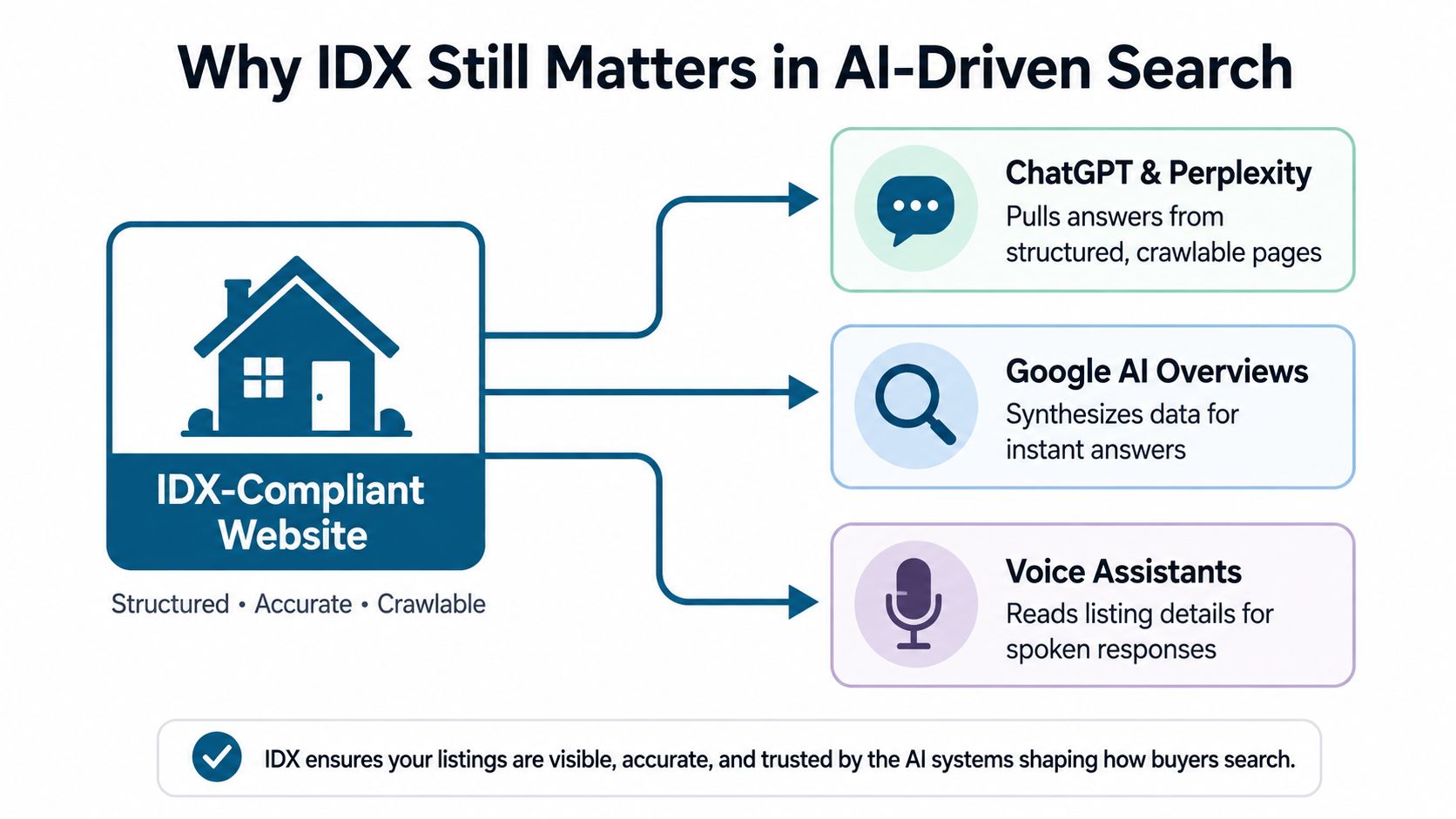
Traditional IDX was built for people browsing websites. AI-mediated search changes the interface, but it doesn't eliminate the need for accessible source material. ChatGPT, Perplexity, Google AI Overviews, and voice assistants need publicly reachable information they can interpret, compare, and summarize.
An IDX page can provide a structured property URL, visible listing details, brokerage attribution, and a relationship to the MLS-authorized record. That gives search systems a clearer source than a listing hidden behind a login or embedded in an inaccessible interface. It still doesn't guarantee inclusion. Crawling, indexing, licensing, freshness, and the AI platform's retrieval process all affect whether a page contributes to an answer.
The unresolved policy questions
Classic IDX rules were written around controlled public display. AI systems introduce harder questions. If an AI tool summarizes a listing, is that a display, a delivery, an advertisement, or another category under the applicable MLS rules? Does an IDX opt-out apply when a third-party system retrieves and summarizes the page? Who is responsible when an AI answer presents stale or incomplete information?
No single technical setting resolves those questions. Brokers should review MLS policy, vendor agreements, and platform terms before intentionally sending listing data into third-party AI services. They should also document which pages are public, which crawlers are permitted, and how listing removal requests are handled.
For agents trying to cut through AI hype, the practical approach is to improve the source pages first rather than chase every new interface.
An AI-readability checklist
- Use structured data: Mark up property details with appropriate schema where the implementation supports it.
- Keep URLs stable: Avoid changing the canonical listing URL every time a feed refreshes.
- Maintain sitemaps: Remove expired URLs and include eligible, current pages.
- Review robots directives: Don't accidentally block legitimate crawlers from pages you want discovered.
- Show attribution clearly: Keep brokerage and participant contact information visible.
- Audit answers: Search property addresses and local listing queries in major AI tools, then compare responses with the current MLS record.
Agents planning a broader 2026 AI optimization for real estate strategy should treat IDX as the data foundation, not the entire optimization plan. Authority content, accurate local context, and consistent entity information still matter around the listing page.
Choosing Your IDX Implementation Path
Most agents have three realistic choices, and each solves a different problem.
MLS-provided widgets and portals are usually the quickest route. They can put a searchable experience on a site without a substantial technical project. The trade-off is limited design control, weaker ownership of page architecture, and less flexibility for SEO, schema, lead routing, and AI-oriented content.
Third-party IDX vendors offer a middle path. Providers such as IDX Broker, iHomefinder, Showcase IDX, and Realtyna typically manage the feed connection and provide search, maps, listing pages, and lead features. The important evaluation point isn't the feature list. Ask whether the vendor produces clean crawlable URLs, supports appropriate structured data, handles your MLS coverage, and gives your brokerage usable control over disclosures and routing.
A custom implementation gives the most control. A developer or AI-powered platform can shape templates, schemas, internal links, and content workflows around the brokerage's operating model. That flexibility comes with more responsibility for maintenance, testing, MLS approvals, and technical support. ListingBooster.ai can fit into the broader marketing side of that decision through its Agent Edge listing campaign engine, while the IDX feed itself still has to follow the applicable MLS requirements.
Compare the practical options
| Option | Setup Cost | SEO Control | Customization | Best For |
|---|---|---|---|---|
| MLS widget or portal | Usually the lightest initial commitment | Low | Low | Agents who need a fast public search presence |
| Third-party IDX vendor | Ongoing vendor commitment with implementation work | Moderate, depending on URLs and markup | Moderate | Agents and teams wanting managed infrastructure |
| Custom build | Higher implementation effort | High | High | Brokerages prioritizing brand, routing, structured pages, and technical control |
The right decision depends on more than budget. Consider your technical comfort, the number of agents who need access, brand consistency, CRM routing, local SEO goals, and whether AI search visibility is a serious priority for 2026.
Decision test: If you can't explain how the system refreshes data, removes expired listings, displays attribution, and routes leads, you aren't ready to choose the interface.
Ask vendors for a live demonstration using a real property page. Check the URL, page source, mobile search, status updates, brokerage attribution, sitemap behavior, and lead notification path. A polished demo can hide weak architecture, while a less flashy platform may provide the controls your brokerage needs.
Next Steps and Common IDX Questions
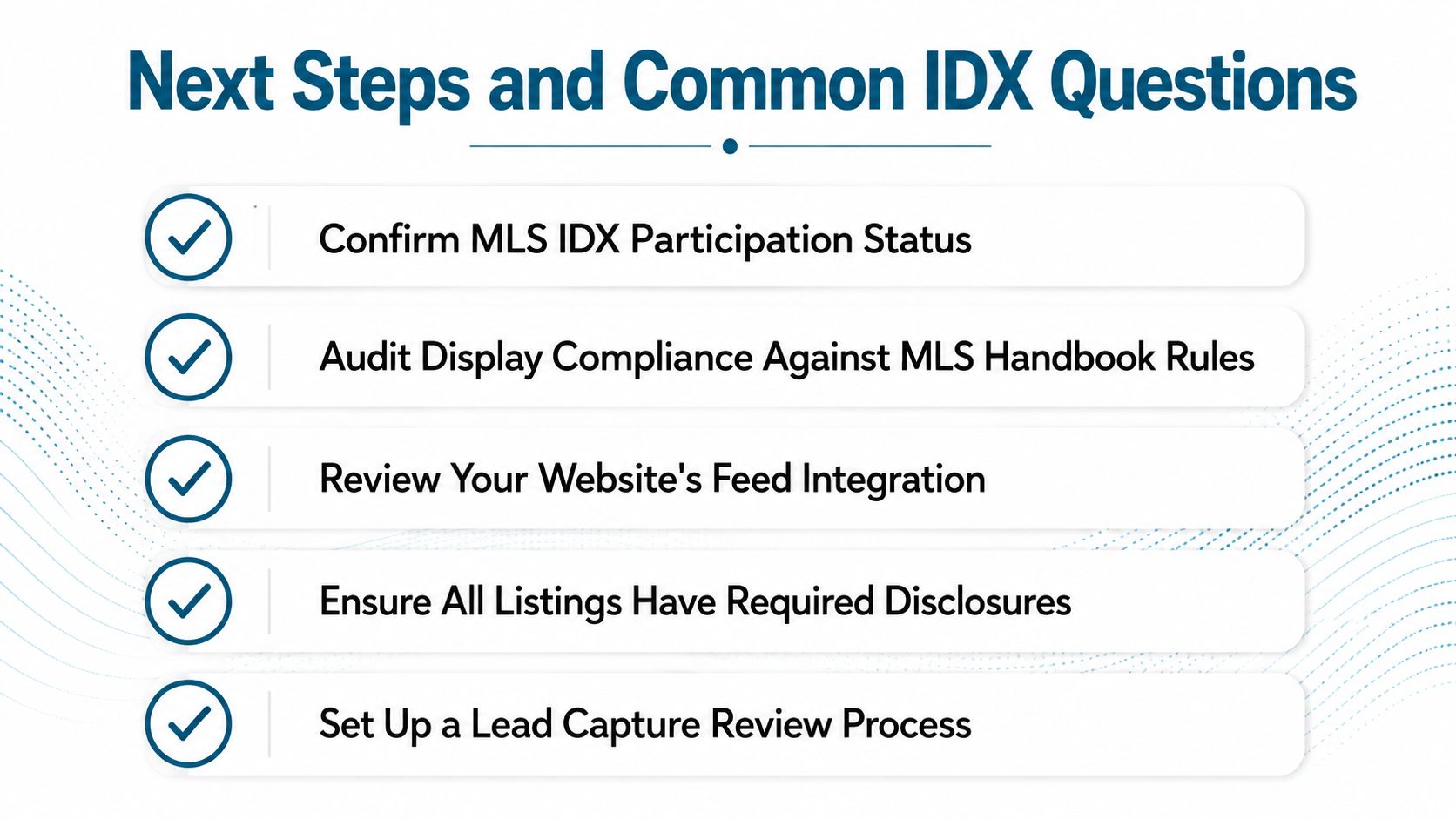
Run this checklist before signing a vendor agreement or rebuilding your website:
- Confirm participation: Verify that your agent or brokerage account is authorized for IDX through the relevant MLS.
- Audit display compliance: Check brokerage identification, participant contact details, required disclosures, field restrictions, and seller-directed suppression.
- Review integration: Test search, detail pages, status changes, photos, mobile behavior, URLs, sitemaps, and lead routing.
- Choose the implementation: Decide whether a widget, managed vendor, or custom build fits your budget and operational goals.
- Schedule reviews: Recheck refresh behavior and display compliance every 30 days, as an internal operating habit rather than a substitute for MLS guidance.
Common questions
How long does MLS approval take?
Timing varies by MLS, participant status, vendor, and required paperwork. Ask your MLS and vendor for the current approval sequence, then confirm the launch date only after authorization is documented.
Does IDX work on social media?
IDX is designed for approved websites, mobile apps, and audio devices, not unrestricted social distribution. Share links to compliant listing pages, and verify that your MLS permits the specific content and destination.
Can I display off-MLS listings through IDX?
Not automatically. IDX authorizes limited display of eligible MLS listings, while off-MLS data may follow different permissions. Separate the sources, document consent, and ask your broker before publishing.
What does an IDX vendor build cost?
Costs vary by provider, MLS coverage, customization, support, and implementation scope. Request an itemized proposal that separates recurring service, setup, development, and any MLS-related charges.
What happens when a listing sells?
The public page should follow the MLS status and retention rules. Test sold-status handling, page updates, redirects, and removal behavior with your vendor instead of assuming the system handles every market identically.
Will IDX listings show in ChatGPT and Google AI Overviews?
They may be discovered if the pages are public, crawlable, structured, and permitted for retrieval, but inclusion isn't guaranteed. Search your own addresses and review crawler, sitemap, and robots settings.
ListingBooster.ai helps agents, teams, and brokerages turn property information into editable, Fair Housing-conscious listing descriptions and social content while supporting a consistent digital presence around their listings. Visit ListingBooster.ai to review how its real-estate-specific workflow can complement a compliant IDX strategy.
Walk In With the Campaign Already Built
Listing copy, social posts, sourced Market Insights, growth scheduling, and direct publishing after approval from one real-estate-specific system. 25 free credits to start.
Related Posts
 Uncategorized
Real Estate Content Marketing: The 2026 Playbook
Listings with video can generate 49% more qualified leads, according to a 2026 real estate digital marketing roundup. That figure changes the question. Real estate content marketing isn't about how often you post. It's about whether your listing, expertise, and local knowledge can be found, understood, and cited by people and by the AI tools […]
 Uncategorized
AI for Real Estate Marketing: A Practical Playbook
A new listing goes live on Tuesday morning. You write the description from memory, schedule three social posts, answer showing requests, and move on to the next client task. By afternoon, the listing has plenty of activity on your side of the business, but the phone still isn't producing the conversations you expected. That gap […]
 Uncategorized
8 Realtor Bio Examples That Build Trust
The most common advice about a realtor bio is also the least useful: list every credential, service, award, and market you touch, then call the result a complete overview. A bio written that way reads like a résumé because it tries to serve everyone at once. Buyers and sellers aren't looking for an inventory of […]