Personal Branding for Real Estate Agents: The 2026 Playbook

Most agents still treat personal branding like a design project. Buyers and sellers don't. According to the National Association of Realtors' 2024 Profile of Home Buyers and Sellers, 76% of buyers contacted only one agent before making a decision (reference). That means your brand does its real work before a call, before a showing, and before a listing presentation.
That's why personal branding for real estate agents has changed. A polished headshot still matters. Consistent colors still matter. But the bigger issue is discoverability and trust. If a prospect sees your name, your listings, your content, and your point of view in enough places to feel confident, you make the shortlist early. If they don't, you often never enter the conversation.
The other shift is less obvious. More buyers are beginning their research inside AI tools, not just search engines or social feeds. So the agents who win aren't always the loudest on Instagram. They're the ones with a clear promise, structured content, a disciplined distribution plan, and compliance habits that keep them out of trouble.
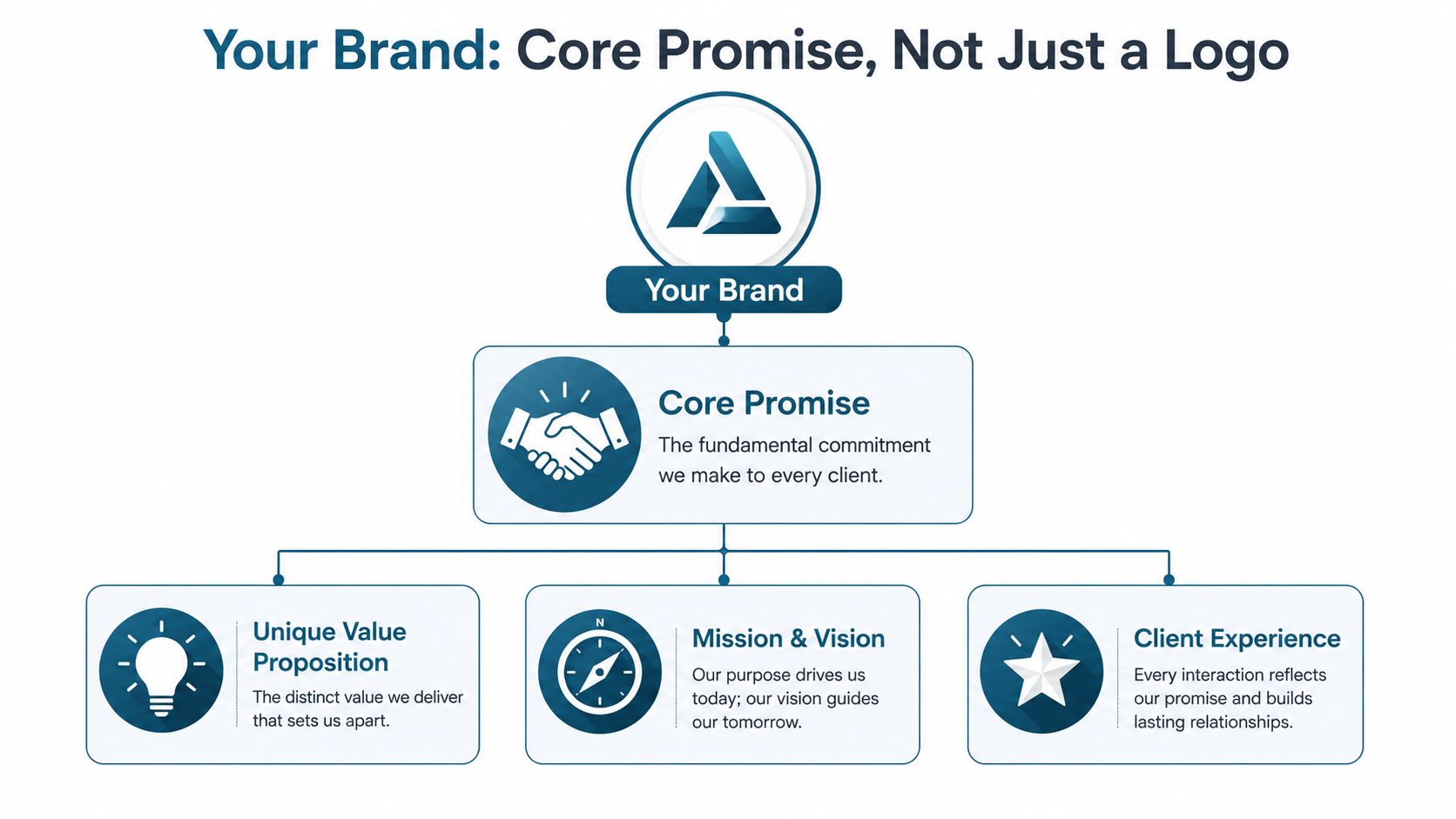
Your Brand Is More Than a Logo It Is Your Core Promise
A real estate brand isn't your logo, your color palette, or the font on your listing flyer. Those are wrappers. Your actual brand is the promise a client believes when they see your name.
For most agents, the fastest way to clarify that promise is to answer three questions in writing:
- Who do you serve best
- What problem do you solve
- How do you solve it differently
If you can't answer those clearly, your content usually turns into the same generic mix everyone else posts. New listing. Open house. Market update. Sold. Repeat. That creates visibility, but not distinction.
Start with a niche that's specific but compliant
A niche does not mean you exclude people. It means you lead with a property type, transaction type, geographic specialty, or process specialty that helps the right clients recognize you.
Strong examples:
- Historic homes specialist in older in-town neighborhoods
- Waterfront and view-property listing strategy
- Condo resale process expert
- Relocation support for clients moving into a specific metro area
- First-time seller education in a changing market
Weak examples:
- I help everyone buy and sell real estate
- Top agent with great service
- Neighborhood expert and trusted advisor
Those aren't false. They're just forgettable.
The brand statement that works is usually narrower than your actual business.
Write the statement clients can repeat
You need one short positioning statement that appears, in adapted form, across your website, social bios, email signature, listing presentation, and portal profiles.
A weak version:
- Experienced Realtor helping buyers and sellers achieve their goals
A stronger version:
- I help condo sellers in central Austin position, market, and present their homes so buyers understand value immediately and act with confidence.
Another strong version:
- I help owners of older homes prepare for market with a clear pre-listing plan, feature-led marketing, and pricing guidance grounded in local buyer behavior.
Notice the difference. The stronger statements define the client, the problem, and the process. They also avoid language that references protected classes.
Trust is the real outcome
A clear brand reduces hesitation. The critical success metric in personal branding is that 73% of homeowners list with the first agent who builds trust (reference). That's why the smartest brand work isn't about sounding clever. It's about accelerating confidence.
Three practical decisions shape that trust:
- Your voice: Are you analytical, calm, direct, educational, design-focused, negotiation-focused?
- Your proof: Do you consistently show listing strategy, process clarity, testimonials, and local expertise?
- Your experience promise: What does it feel like to work with you from consultation to close?
If you want a useful outside framework for tightening your professional presence beyond real estate channels, these actionable LinkedIn personal branding steps are worth adapting to your referral and relocation strategy.
For agents who manage multiple profiles and content formats, it also helps to document simple social media brand guidelines for real estate so your visuals, tone, and message stay consistent across channels.
A simple brand worksheet
Use this fill-in format:
- I work with: property type, transaction type, location, or client situation
- They usually need help with: confusion, timing, prep, pricing, marketing, negotiation, relocation, downsizing
- My process stands out because: staging prep, pricing discipline, communication cadence, off-market sourcing, digital marketing, local content, contractor network
Then turn it into one sentence.
Practical rule: If another agent in your office could copy your brand statement word for word, it's still too generic.
Create AI-Readable Content That Builds Authority
The next branding gap isn't visual. It's structural. Over 40% of homebuyers now start searches in AI chatbots like ChatGPT and Perplexity, where agents without AI-readable content are invisible. Data shows agents using schema markup are 3x more likely to surface in AI search results (reference).
That changes how agents should write online.
A lot of real estate content is emotionally written, visually attractive, and useless to machines. AI systems can't recommend you confidently if your website, listing pages, bios, and market posts don't clearly state who you are, what you specialize in, where you work, and what evidence supports your expertise.
What AI-readable content actually looks like
AI-readable content is structured, specific, and feature-led. It doesn't rely on vague adjectives or lifestyle implications. It makes the property and the agent easy to understand.
A weak listing excerpt:
Stunning home in an amazing neighborhood with tons of charm and the perfect layout for modern living.
A stronger, AI-readable version:
Three-bedroom home with updated kitchen, quartz counters, wide-plank flooring, dedicated home office, fenced backyard, and covered patio. Located near downtown, major commuter routes, and local dining. Recent improvements include roof replacement and HVAC update.
The second version is better for three reasons:
- It names actual features
- It avoids vague filler
- It gives search systems and buyers concrete signals
The same principle applies to your agent bio, neighborhood pages, and social captions. Replace “I love helping clients” with specifics about process, inventory type, prep strategy, or local expertise.
Schema markup is not optional anymore
Most agents don't need to hand-code anything, but they do need content systems that publish structured information in a way machines can interpret. That includes listing details, location context, agent identity, reviews, and service descriptions.
If you're testing broad audience-building tactics, this Narrareach experiment is a useful reminder that repeated, coherent ideas outperform random bursts of content.
In real estate, it helps to review how AI tools for real estate agent branding and visibility approach discoverability differently from general-purpose writing tools.
Generic AI versus real estate-specific systems
Many agents find themselves wasting time. Generic AI tools can draft words. They usually don't understand MLS conventions, listing nuance, local feature emphasis, or Fair Housing risk with enough precision for direct publishing.
That's why purpose-built platforms matter. ListingBooster.ai is one example built specifically for real estate listing descriptions and social content. The practical difference is not magic copy. It's that the workflow starts with property facts, agent positioning, and channel-specific output instead of a blank prompt box.
That matters in day-to-day use because agents don't need another writing toy. They need content that is:
- Editable
- Structured for search visibility
- Usable across listing pages and social
- Less likely to drift into risky language
Build authority with repeatable content formats
The agents who show up in AI-assisted discovery tend to publish a clear pattern of expertise. Not random opinions. Not only listing promos.
Use formats like:
- Feature breakdowns: what drives value in a property type
- Neighborhood explainers: inventory style, commute access, architecture, amenities, development pattern
- Seller prep checklists: repairs, presentation, pricing, timing
- Market interpretation: not raw stats, but what changing conditions mean for buyers and sellers
- Process content: what happens before photos, after inspections, during appraisal, or at contract milestones
This kind of content does double duty. Humans read it and trust you. Machines parse it and understand your relevance.
Execute a Focused Multi-Platform Distribution Strategy
Trying to show up on every platform usually creates a weaker brand, not a bigger one.
For agents, distribution is not a vanity exercise. It is how prospects confirm you are real, how referral partners assess your professionalism, and how AI systems piece together whether you are a credible local expert worth surfacing. If your website says one thing, your portal profiles say another, and your social accounts look abandoned, both people and machines read that inconsistency as low confidence.
Depth beats platform sprawl
I see the same mistake every quarter. An agent opens Instagram, Facebook, LinkedIn, TikTok, YouTube, Zillow, Realtor.com, and a personal site, then updates each one only when there is a new listing or a closing photo. The result is thin bios, mixed positioning, old headshots, and scattered signals.
A tighter setup works better.
An agent with a maintained website, current portal profiles, a disciplined Instagram presence, a polished Google Business Profile, and a referral-focused LinkedIn page usually wins the credibility check. The message matches. The specialties match. The contact path is obvious.
That matters because prospects rarely evaluate you in one place. They search your name, scan reviews, compare profiles, and look for gaps. AI search tools do a version of the same process. They pull from the public web and reward consistency, specificity, and repeated evidence of expertise.
Assign each platform a job
Do not pick channels based on what another agent is bragging about. Pick them based on what role they play in lead generation, referral trust, and AI-search visibility.
A practical setup looks like this:
Your website
This is the source you control. Publish your bio, neighborhood pages, service pages, testimonials, market explainers, and transaction process content here. If you want AI tools to understand your niche and geography, your site needs clear language around both.MLS and syndication portals
These are high-intent surfaces. Buyers and sellers use them when they are already active, and AI models often treat these profiles as credibility signals because they contain structured professional data. Keep your profile complete, accurate, and aligned with your site.Google Business Profile
This supports branded search, reviews, map visibility, and basic trust checks. It also gives AI systems another clean source that confirms your market, business category, and reputation.Instagram
Use it for visual proof and repeated local relevance. Property features, neighborhood clips, before-and-after prep, and short educational posts work better than random personal updates.LinkedIn
This channel helps with referrals, relocation business, vendor relationships, and local professional credibility. It is also one of the easier places to publish market commentary without fighting the entertainment bias of consumer social platforms.
Audit before you expand
Before opening another account, clean up the ones already ranking for your name.
Check five things:
- Headshot consistency: one current photo across major profiles
- Bio alignment: same core promise, adapted for each platform
- Geographic clarity: city, neighborhoods served, and client type stated plainly
- Contact path: one obvious next step, with working links and current info
- Proof of activity: reviews, recent transactions, educational posts, or market commentary
If your LinkedIn profile calls you an advisor, your Instagram bio calls you a lifestyle brand, and your portal profile says luxury specialist, the market has to guess what you do.
AI search has the same problem. Conflicting labels reduce confidence.
Repurpose one idea across channels
A focused strategy does not mean publishing identical posts everywhere. It means building one strong idea, then formatting it for the platforms that matter.
A single listing or client question can turn into:
- A website article about pricing strategy for that property type
- An MLS description built around the features buyers search for
- An Instagram carousel showing presentation choices and market positioning
- A LinkedIn post explaining the negotiation or prep strategy behind the result
- A Google Business Profile update tied to a local market insight
That approach saves time and creates repetition with purpose. It also helps AI systems connect the dots between your site, your profiles, and your expertise. If you need a repeatable system for planning that cadence, use a real estate content calendar for agents instead of choosing topics on the fly.
The goal is not maximum output. The goal is clear, repeated, machine-readable authority in the places that influence decisions.
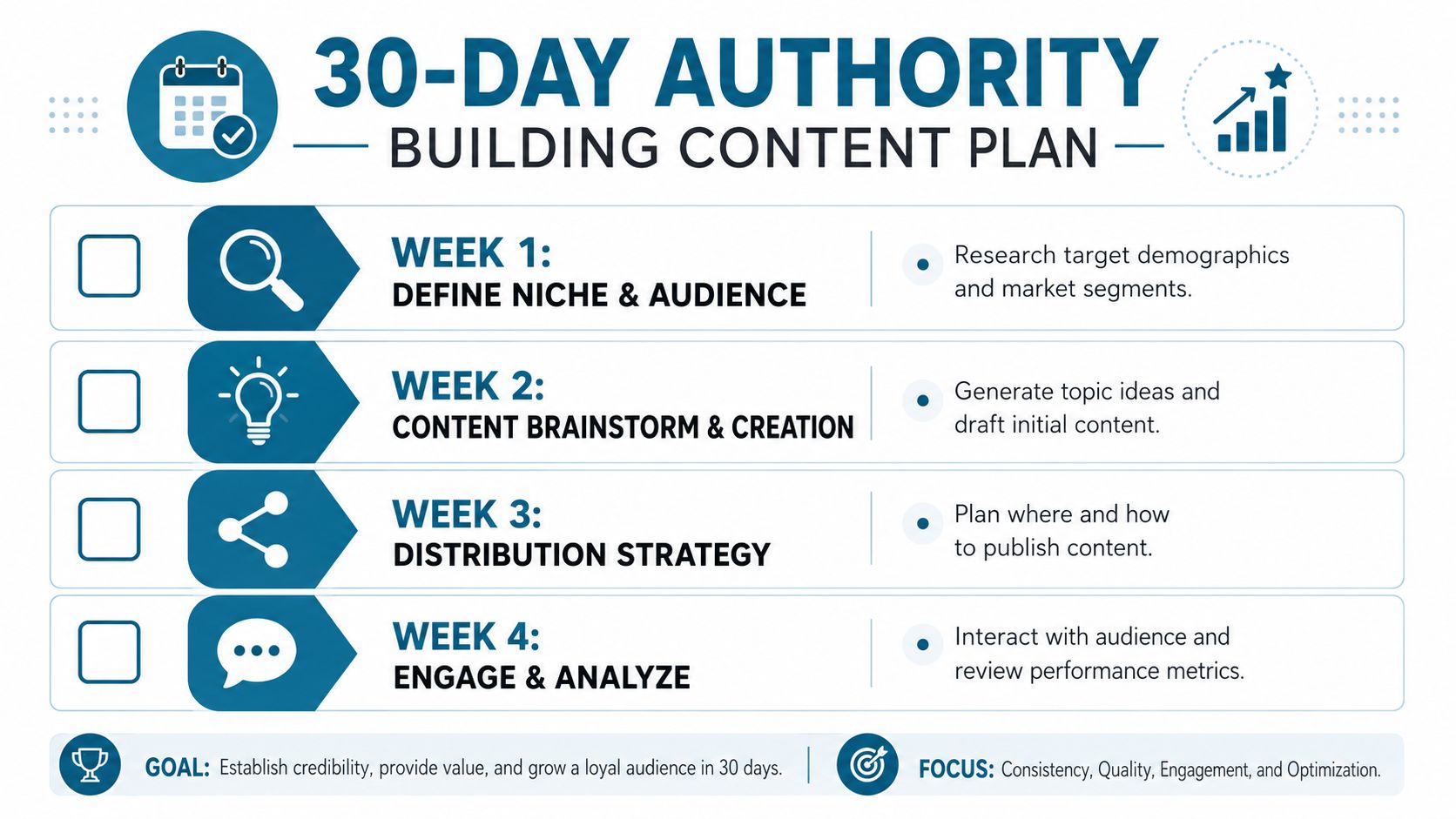
Implement Your 30-Day Authority Building Content Plan
Most agents know they should post consistently. The reason many don't is simpler than people admit. They're busy, they run out of angles, and they don't have a repeatable framework.
A useful content plan has to respect the actual workweek. It should create authority without turning you into a full-time creator. The cleanest way to do that is to rotate four pillars:
- Market authority
- Transaction showcase
- Client education
- Agent positioning
What each pillar does
Market authority proves you understand your area beyond headlines. This includes neighborhood overviews, listing inventory observations, pricing commentary, and feature trends buyers ask about.
Transaction showcase gives social proof without turning your feed into one long victory lap. New listings, price adjustments, under-contract updates, and just sold posts all work better when they explain the strategy behind the outcome.
Client education reduces friction. Answer the questions people already ask during consults. Explain appraisal gaps, inspection negotiations, offer timelines, prep decisions, and what buyers or sellers often misunderstand.
Agent positioning reminds people there is a real professional behind the signs and posts. Show your process, prep standards, vendor coordination, staging walkthroughs, open house setup, or what you're noticing on the ground.
Sample One-Week Content Calendar Framework
| Day | Content Pillar | Example Post |
|---|---|---|
| Monday | Market Authority | Short local market take with one practical implication for buyers or sellers |
| Tuesday | Client Education | Caption starter: “One thing sellers often ask before photos is…” |
| Wednesday | Transaction Showcase | New listing or under contract post focused on positioning, prep, and features |
| Thursday | Agent Positioning | Behind-the-scenes post showing consultation prep, previewing homes, or staging review |
| Friday | Market Authority | Neighborhood feature post centered on housing stock, access, amenities, and style |
| Saturday | Transaction Showcase | Open house or just sold post with a lesson learned from the process |
| Sunday | Client Education | Myth-busting post answering one common question from the week |
A realistic weekly rhythm
You don't need to create seven original masterpieces every week. Batch one hour of writing and one short photo or video session, then spread the output.
A practical rhythm:
- Monday: publish one market or neighborhood insight
- Midweek: post one transaction-related update
- Thursday or Friday: publish one educational post
- Weekend: add one behind-the-scenes or community-facing post
That mix keeps your brand from becoming too promotional or too abstract.
Field note: The content that earns trust fastest is usually the content that explains your thinking, not the content that announces your activity.
If you want a more detailed planning structure, this real estate content calendar for agents gives a useful planning model you can adapt to your market and schedule.
Caption starters that don't sound canned
Try prompts like:
- Before we launched this listing, we focused on three details buyers would notice first
- A pricing conversation got easier this week once we walked through what buyers compare side by side
- One feature that keeps showing up in buyer feedback right now is
- If you're preparing to sell, start with the updates that improve clarity, condition, and first impression
These work because they sound like a practitioner talking, not a template shouting.
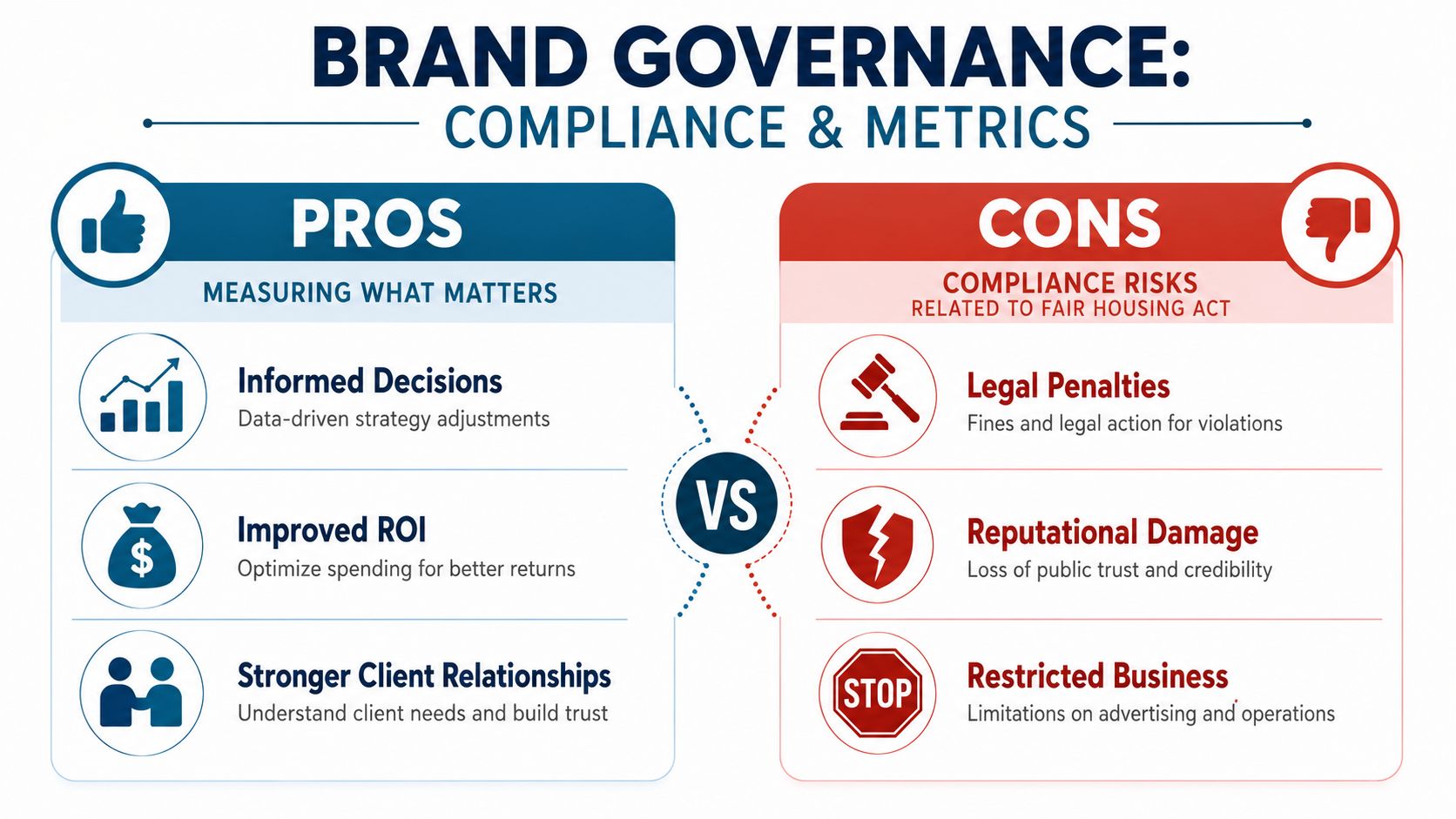
Maintain Compliance and Measure What Matters
A personal brand can help you stand out. It can also create avoidable risk if your marketing gets sloppy.
The federal Fair Housing Act prohibits real estate advertising that indicates any preference based on seven protected classes, including race, color, religion, national origin, sex, disability, and familial status (reference). That applies to web pages, social posts, ads, listing descriptions, and MLS remarks.
A fast compliance check before publishing
Read every post and listing with one question in mind. Are you describing the property, or implying who should live there?
Avoid phrases like:
- Perfect for families
- Safe neighborhood
- Walk to church
- Exclusive
- Ideal for young professionals
Use feature-based alternatives instead:
- Three-bedroom layout with flexible bonus room
- Near parks, trails, retail, transit, or dining
- Private yard, corner lot, gated entry, or controlled access
- Short distance to local amenities
- Home office, first-floor bedroom, elevator access, wide hallways, or step-free entry when those are factual property features
There's another rule many agents miss. All real estate advertising for the sale, rental, or financing of residential housing must prominently display the Equal Housing Opportunity logo or slogan, with the logo placed in a visible location comparable in size to other ad symbols. If an EHO statement is used instead of the logo, the text must be in a type size comparable to the rest of the ad or occupy 3 to 5 percent of the ad's total space (reference).
Don't measure vanity metrics alone
Likes are pleasant. They're not enough.
The numbers worth reviewing are the ones tied to business movement:
- Inbound inquiries that mention a post, video, or market update
- Lead source attribution from your CRM
- Clicks on listing links and contact buttons
- Consultation requests
- Listing presentation conversations that started with digital content
- Repeat profile visits across your key channels
This gives you a working feedback loop. If neighborhood explainers start more conversations than polished listing reels, do more of those. If educational posts bring better seller consultations than generic motivation quotes, the answer is clear.
Brand governance is operational discipline
The agents with the strongest brands usually aren't the flashiest. They review copy, keep profiles updated, document tone and visuals, and check every post for compliance before it goes live.
That discipline matters more than creativity.
Conclusion Building Your Brand Is Building Your Business
Branding decides whether an agent gets skimmed, trusted, or recommended.
In the AI search era, that decision often happens before a prospect ever fills out a form. A buyer asks ChatGPT for agents who know historic homes in a specific neighborhood. A seller asks Perplexity who explains pricing clearly and has visible local proof. If your online presence is vague, inconsistent, or thin, you disappear from that consideration set even if you are excellent in the field.
That is a significant shift. Brand building is no longer just reputation management. It is discoverability infrastructure for your business.
Agents who win in this environment make their expertise easy to parse. Their positioning is specific. Their content answers real client questions. Their bios, listings, reviews, and market commentary support the same promise across every platform where prospects and AI tools can find them.
This work compounds. A clear brand helps people remember you. A structured digital footprint helps AI systems surface you. Together, those two forces create more of the conversations that matter: consultations, referrals, listing opportunities, and repeat visibility in your market.
If your presence still feels pieced together, fix the foundation first. Tighten the promise. Clean up the profiles. Publish useful local content. Make your expertise easier to verify. Then keep showing up with enough consistency that both people and machines know what to associate with your name.
Putting this playbook into action takes discipline and the right tools. For agents who want help turning listing details and day-to-day expertise into structured, compliant marketing content, ListingBooster.ai supports that workflow. It gives agents and teams a practical way to create listing descriptions, social posts, and authority content built for real estate use cases without relying on generic AI prompts.
Walk In With the Campaign Already Built
Listing copy, social posts, sourced Market Insights, growth scheduling, and direct publishing after approval from one real-estate-specific system. 25 free credits to start.
Related Posts
 Uncategorized
Real Estate Content Marketing: The 2026 Playbook
Listings with video can generate 49% more qualified leads, according to a 2026 real estate digital marketing roundup. That figure changes the question. Real estate content marketing isn't about how often you post. It's about whether your listing, expertise, and local knowledge can be found, understood, and cited by people and by the AI tools […]
 Uncategorized
AI for Real Estate Marketing: A Practical Playbook
A new listing goes live on Tuesday morning. You write the description from memory, schedule three social posts, answer showing requests, and move on to the next client task. By afternoon, the listing has plenty of activity on your side of the business, but the phone still isn't producing the conversations you expected. That gap […]
 Uncategorized
What Is IDX and Why It Still Matters for Real Estate
A new agent usually hears “IDX” during a brokerage onboarding call, nods along, and hopes nobody asks for a definition. Then the questions arrive: Why are listings appearing on the website? Who controls the data? Why did a property remain visible after its status changed? And will the same pages be readable by ChatGPT, Perplexity, […]