ChatGPT Real Estate Search Visibility Your Ultimate Guide

The way people hunt for homes is undergoing a seismic shift. They're no longer just endlessly scrolling through Zillow. Instead, they’re firing up conversational AI like ChatGPT and asking, "Show me the best family-friendly neighborhoods in Austin under $700K." This is the single biggest evolution in real estate discovery, and yet, most agents are completely invisible on these new platforms.
The New Frontier of Finding a Home

The gap between old-school search and this new AI-driven conversation is enormous. Think of a traditional search engine as a giant library card catalog. It points you to every book that might match your query, but you're left to do all the heavy lifting. Conversational AI, on the other hand, is like having an expert librarian who listens, understands your needs, and hands you the perfect book.
This "librarian" doesn't just scan for keywords. It's built to understand context, quality, and authority. For real estate agents, this means your online presence can't just be a gallery of listings anymore. It has to be AI-readable—packed with clear, structured, and authoritative information that an AI can confidently recommend to a serious homebuyer.
Why This Shift Matters Now
The scale of this change isn't some far-off prediction; it's happening right now and growing every day. Real estate queries already make up 6% of all ChatGPT conversations, which translates to an eye-watering $66 billion in associated market value. That puts our industry in the top 15 most impacted by the platform. Homebuyers are simply skipping the old ways and asking AI direct questions about neighborhoods, property features, and even the top agents in their city. You can dive deeper into these usage stats and what they mean for the market.
This guide is your roadmap to getting you and your properties found in this new arena. We're going to break down exactly how to earn top-tier ChatGPT real estate search visibility.
The core problem is simple: if your listings and expertise aren't structured for AI, you don't exist in the most important new channel for buyer discovery.
Understanding the Two Search Worlds
To win here, you first have to grasp how differently buyers behave on these platforms. The user's mindset and what they expect are worlds apart, which demands a completely new strategy for how you present your expertise online.
To see this clearly, let's compare the old way versus the new way side-by-side.
Traditional Search vs AI Search At a Glance
| Feature | Traditional Search (e.g., Google, Zillow) | AI Search (e.g., ChatGPT, Perplexity) |
|---|---|---|
| User Input | Keywords like "3 bedroom homes Austin TX" | Natural questions like "What are the pros and cons of living in Zilker?" |
| User Goal | Find a list of links to begin their own research | Get a direct, synthesized recommendation or answer |
| Result Type | A ranked list of websites and portals to browse | A conversational, trusted answer based on synthesized data |
| Key to Visibility | SEO keywords, backlinks, website authority | Structured data, entity authority, and contextual relevance |
The table makes it obvious: one is a directory, the other is a concierge.
This is precisely where a tool like ListingBooster.ai comes into play. It was designed from the ground up to translate your real estate expertise into the language AI understands, making sure you’re the agent that the "librarian" trusts and recommends.
How AI Decides Which Listings to Recommend
To get your listings noticed in a ChatGPT real estate search, you first need to get inside the AI's "head." It doesn't browse Zillow like a person. Think of it more like a brilliant, lightning-fast research assistant with a single mission: find the absolute best, most trustworthy real estate information on the internet.
This AI assistant is constantly scanning the web, hunting for signals that scream "authority," "clarity," and "relevance." It's not just matching keywords anymore; it's piecing together a deep understanding of a property, a neighborhood, and even an agent's expertise. If your online presence sends weak or confusing signals, you might as well be invisible.
To get recommended, your listings and website need to be structured in a way this AI assistant can instantly understand and trust. The goal is to make it incredibly easy for the AI to see not just what your listing is, but why it's the perfect fit for a specific buyer.
The AI's Mental Checklist for Real Estate Content
When ChatGPT looks at your listings or your professional website, it isn't wowed by the beautiful photography first. Instead, it runs a sophisticated analysis to verify the information it finds, much like a diligent researcher cross-referencing multiple sources. It gives top priority to data it can interpret with total confidence.
This entire process is built on a few core pillars that act as its quality filter:
- Structured Data: This is the AI's native language. It’s like putting digital labels on everything, telling the AI, "This number is the price," "This text is the street address," and "This is the square footage."
- Narrative Quality: The AI actually reads your listing descriptions to grasp the story and unique appeal of a home. Vague, cookie-cutter copy gets tossed aside for rich, detailed narratives that paint a vivid picture.
- Agent Authority: It actively looks for proof that you're a real expert in your market. This means finding consistent content about local areas, glowing client reviews, and a professional digital footprint.
Basically, the AI is asking a simple question: "Is this information clear, descriptive, and from a credible source?" If the answer is "no" to any of these, it moves right on to a listing that provides stronger signals. This is a crucial concept to understand, and we dive deeper into it in our guide to AI search optimization for real estate listings.
Turning Technical Jargon into Simple Ideas
Let's break down one of the most important—and often misunderstood—signals: structured data, also known as schema markup. Don't let the technical name scare you off.
Think of schema markup as a universal translator for your listing. Without it, an AI might see the number "750,000" and have no idea if it's the price, a zip code, or part of an address. With schema, you are explicitly telling the AI, "This is the price, in US dollars," which removes all the guesswork.
This kind of clarity is everything. When an AI can understand your data with 100% certainty, it's far more likely to recommend your property. It’s the difference between handing that research assistant a messy pile of notes versus a neatly organized, labeled binder. The binder wins every time.
Agents and teams who put in the effort to provide these clear signals are already seeing the rewards. Recent data shows that real estate domains received 0.47% of all referrals from ChatGPT Search, putting the industry at #15 among all categories. This confirms that AI is already sending motivated buyers to real estate websites that provide structured, authoritative information. You can discover more insights on ChatGPT's impact on web traffic and see why this is a channel you can't afford to ignore.
By focusing on making your content "AI-friendly," you're directly influencing how these powerful new platforms see, understand, and ultimately rank your listings.
The Six Pillars of AI-Powered Real Estate Visibility
Getting your listings noticed by AI search tools like ChatGPT isn't about some single, magic-bullet tactic. It's much more like building a house. You need a solid foundation built on six interconnected pillars. Get these right, and you'll have a stable, impressive structure that AI algorithms will confidently recommend to potential homebuyers.
Mastering these areas ensures your listings—and your professional brand—are not just seen, but deeply understood and valued by conversational AI. Let's break down the framework that will define your success in this new era of search.
This is a great way to visualize how AI actually sifts through your digital footprint. It prioritizes the hard facts (structured data), the human element (your descriptions), and your credibility (your authority).
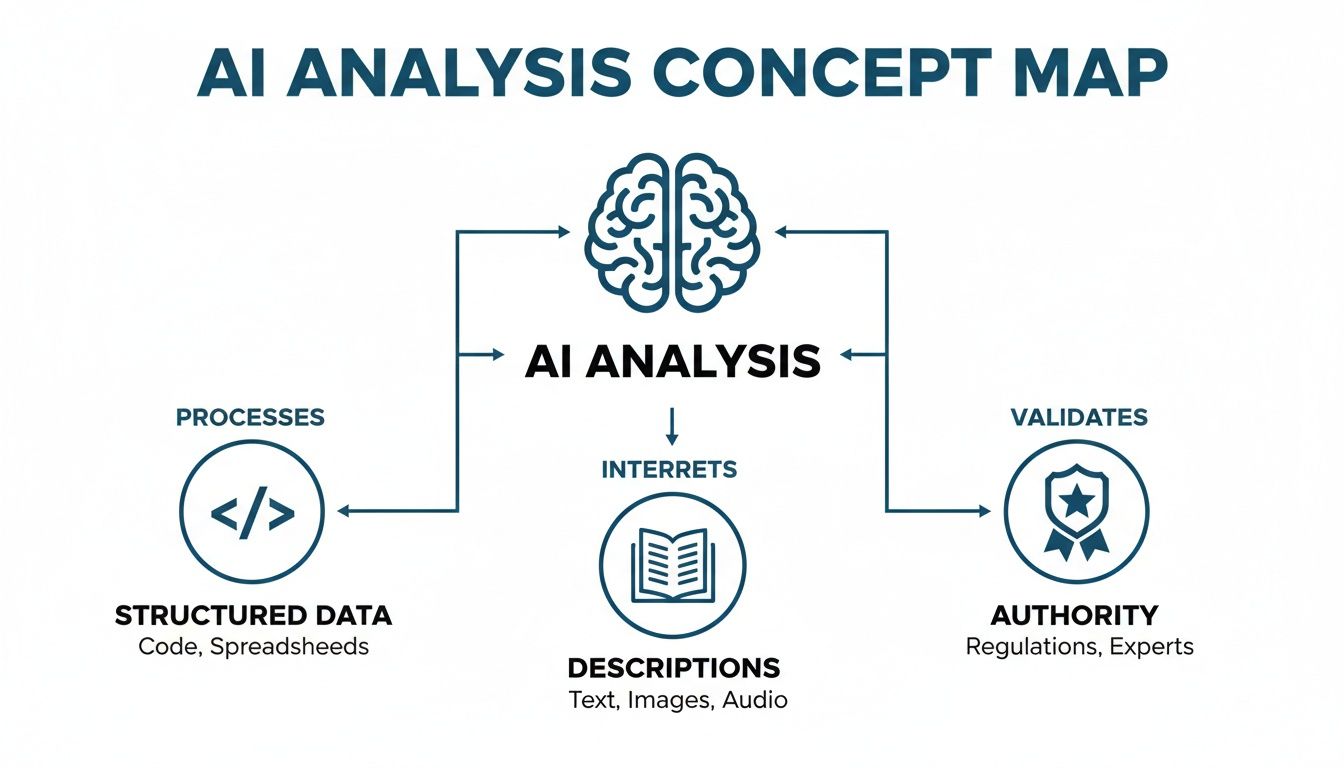
The key takeaway here is that AI visibility is a blend of technical precision, emotional connection, and real-world credibility. You need all three to win.
Pillar 1: Structured Data Markup
Think of structured data, or schema, as the universal language for AI. It’s a set of standardized tags you add to your website's code to explicitly tell an AI what each piece of information means. Without it, the AI is just guessing.
For example, schema can label a number as a listing price, a line of text as a street address, or a date as an open house event. This removes all ambiguity. It’s the difference between handing an AI a messy, handwritten note versus a perfectly organized spreadsheet; the AI will always trust the spreadsheet.
Pillar 2: AI-Optimized Listing Descriptions
The days of writing dry, feature-list descriptions are over. Today’s AI is smart enough to analyze the story and emotional pull of your property descriptions. It's actively looking for content that paints a compelling picture of what it’s like to live in the home.
To get this right, you need to focus on:
- Natural Language: Write for people, not robots. Use descriptive language that sparks emotion and helps a buyer imagine the lifestyle the home offers.
- Hyper-Local Context: Mention the nearby park, that popular coffee shop down the street, or the well-regarded school district. This gives the AI valuable context to match your listing to specific prompts like, "Find me a home near a good elementary school."
- Clear Feature-Benefit Connections: Don’t just list "granite countertops." Instead, explain the benefit: "durable and elegant granite countertops, perfect for entertaining guests."
By enriching your descriptions with narrative detail, you're feeding the AI the exact kind of high-quality, contextual information it needs to make a confident recommendation.
This approach creates copy that connects with both human buyers and the algorithms that are now guiding them.
Pillar 3: Demonstrable Agent Authority
The AI isn't just evaluating your listings; it's evaluating you. It actively scans the web for signals that prove you are a knowledgeable and trusted expert in your specific market. Building this digital authority is absolutely critical for achieving high ChatGPT real estate search visibility.
This means you need to be consistently publishing content that shows off your local expertise. I'm talking about hyper-local neighborhood guides, detailed market analyses, or blog posts answering the questions you know buyers and sellers in your area are asking. This content acts as a digital resume, proving to the AI that you are a credible source.
Pillar 4: Strategic Backlinks and Citations
Think of backlinks as votes of confidence from other websites. When a reputable local news site, a neighborhood blog, or a mortgage broker’s website links to your agent profile or a listing, it sends a powerful signal to AI that your content is trustworthy.
Similarly, consistent citations—mentions of your name, brokerage, and phone number across various online directories—help solidify your digital identity. This web of links and mentions validates your professional presence, making you a much more authoritative figure in the eyes of an AI.
Pillar 5: Consistent Social Media Signals
Your social media activity is a public record of your engagement and expertise. AI systems can and do crawl these platforms to gauge your relevance and influence. Consistently posting about new listings, open houses, market updates, and client testimonials builds a cohesive digital footprint.
Every single post reinforces your specialization and activity in the market. This steady stream of relevant content adds another layer of proof, showing that you are an active and engaged professional who is worthy of being recommended.
Pillar 6: Mastering User Prompts
Finally, you have to understand how people are searching now. They don't just type keywords into ChatGPT; they ask detailed, conversational questions. Your entire content strategy should be designed to directly answer these kinds of prompts.
For instance, instead of just optimizing for "Austin homes for sale," create content that answers, "What are the pros and cons of living in the Zilker neighborhood of Austin?" By anticipating these real-world queries, you position your content as the perfect answer, making it a no-brainer for AI to surface your expertise.
This proactive approach is essential. Consider that a platform like ChatGPT.com attracts 5.6 billion monthly visits, with users who are highly engaged. It's a channel you can't afford to ignore. You can explore more detailed ChatGPT user statistics to get a better sense of the platform's incredible reach.
Putting AI Visibility Strategies into Practice
Knowing the six pillars is one thing, but actually putting them to work in your daily business is where you'll find your competitive edge. Theory is great, but a practical, well-executed strategy is what actually brings in clients. Let's break down how different real estate pros can use these ideas to get a real advantage and boost their ChatGPT real estate search visibility.
These strategies aren't just for big, tech-forward brokerages. Whether you're a solo agent building a name in your neighborhood or a growing team aiming to lead the market, the core principles are the same. It's just the scale and focus that change. Each role offers a unique chance to turn AI visibility from a buzzword into a powerful lead-generation machine.
The Solo Agent in a Competitive Suburb
If you're a solo agent, your goal is to become the go-to expert for a specific community. You can't outspend the big teams, but you can absolutely out-expert them. Your strategy needs to be all about creating deep, hyper-local content that AI sees as the definitive source for your area.
This means you’ll want to lean heavily into pillar three (Agent Authority) and pillar six (Mastering User Prompts).
- Actionable Tactic: Create a series of blog posts or short videos that answer the exact questions people are asking about your suburb. Think things like, "What are the best parks in Northwood?" or "Is the public school system in Lakeview a good fit for young families?"
- Implementation: A tool like ListingBooster.ai's Authority Builder can be a game-changer here. It can automatically draft these hyper-local guides for you. What normally takes hours of research and writing can be done in minutes, giving you a steady flow of content that proves you know your stuff.
By consistently answering these specific, long-tail questions, you build a content library that establishes you as the resource, making it a no-brainer for ChatGPT to recommend you.
The Growing Team in a Major Metro Area
A growing team has a different puzzle to solve: how to scale brand consistency and content creation across multiple agents. Efficiency and a unified voice are everything. Your main focus should be on pillar two (AI-Optimized Descriptions) and pillar five (Consistent Social Signals) to make sure every listing and social media post meets the team's high standards.
A scattered brand message is a weak signal to AI. When every agent on your team shares high-quality, consistently formatted, and AI-optimized content, it creates a powerful, unified digital footprint that AI algorithms can easily recognize and trust.
The key here is automation and having a central hub for content. Manually writing unique, optimized descriptions and social posts for every new listing, open house, and sale across a dozen agents just isn't sustainable. You can get more insights on this by reading our guide on how to optimize listings for AI search.
This is where a tool like ListingBooster.ai’s Listing Commander becomes essential. It takes a single property and generates a complete, on-brand marketing suite for every agent on the team, making sure every piece of content is optimized for AI visibility right from the start.
The Forward-Thinking Brokerage
For a brokerage, the mission is to give agents tools that give them a leg up on the competition. Providing a platform that automates AI optimization is a massive value-add that helps with both recruitment and keeping top talent. This means deploying all six pillars across the entire organization.
The opportunity is huge. Recent data shows that ChatGPT now commands 17.1% of all digital queries globally. On top of that, users spend an average of 13 minutes and 9 seconds per session—more than double the time spent on Google. A brokerage that helps its agents tap into this highly engaged audience is setting them up for massive success. You can discover more insights about these user engagement statistics and what they mean for the market.
By offering a tool like ListingBooster.ai, a brokerage instantly handles the technical headache of schema markup and the time-suck of content creation. It turns what would be weeks of manual work for an agent into a simple, 10-minute setup, creating a system for them to improve their ChatGPT real estate search visibility.
How ListingBooster.ai Does the Heavy Lifting for You

It’s one thing to understand the six pillars of AI visibility, but it’s another thing entirely to put them into practice. Manually creating schema-marked content, writing psychologically compelling descriptions, and consistently publishing neighborhood guides is a full-time job. Let's be honest, who has that kind of time?
This is exactly where ListingBooster.ai steps in. It’s designed to be the practical, hands-on application of everything we’ve talked about in this guide, turning what would be weeks of marketing grunt work into a simple, five-minute setup. The entire system is built to solve the core challenges of getting seen in ChatGPT real estate search without forcing you to become a coder or a content marketing guru.
Instantly Master Your Listing Content
The first hurdle every agent hits is creating genuinely great, AI-readable content for each listing. We're not talking about a few quick sentences for the MLS. This is about crafting unique stories for Zillow, social media, and your own website, all while weaving in the technical signals that AI engines need to see.
ListingBooster.ai’s Listing Commander engine handles this for you instantly. Just feed it the basic property details, and it cranks out a complete marketing suite.
- AI-Ready Descriptions: It writes compelling, emotionally engaging descriptions that capture the attention of both human buyers and AI algorithms.
- Automatic Schema Markup: The platform takes care of all the technical mumbo-jumbo, embedding the right structured data so AI can understand your listing’s details with perfect clarity.
- Multi-Platform Copy: You get tailored copy for the MLS, Zillow, and all your social media channels, making sure your message is consistent and powerful everywhere it appears.
Think of it as your in-house marketing team that never sleeps. It makes sure every single property you list is perfectly positioned to be found and recommended by conversational search tools the moment it goes live.
This system takes care of the first two pillars—Structured Data and AI-Optimized Descriptions—so you never have to touch a single line of code.
Build Unshakeable Agent Authority
The next big challenge is proving your local expertise, day in and day out. AI needs to see a constant flow of authoritative content that cements your status as the go-to expert for your market. But who has the bandwidth to write market updates and neighborhood guides every week?
This is where ListingBooster.ai’s Authority Builder feature comes in. It automates this crucial part of your digital presence by creating a steady pipeline of high-quality, hyper-local content. It generates market updates, buyer tips, and detailed neighborhood guides that directly answer the kinds of questions your future clients are asking AI. You can explore how our broader real estate AI platform helps you build an even stronger brand.
The speed at which people are adopting AI for search makes this kind of automation a necessity. In recent quarters, a staggering 14.68% of users turned to ChatGPT for search, which is a 7.73% jump from the previous year. This massive shift means that using a tool like ListingBooster.ai isn't just an advantage anymore—it's essential for reaching a huge and fast-growing audience of homebuyers. You can dig into more of these ChatGPT usage statistics to see the trend for yourself.
To top it all off, the platform includes built-in Fair Housing compliance checks. This gives you peace of mind, knowing your automated content is not only effective but also completely professional and compliant. It’s simply the fastest, most efficient way to put an advanced AI visibility strategy to work for your business.
Measuring Success in the New AI Search Era
So, you've started optimizing for AI search. That's a huge step. But how do you know if any of it is actually working? Forget vanity metrics like social media likes or a general uptick in website traffic. To really see if you're making an impact in ChatGPT real estate search, you have to track the results that actually grow your business.
The goal here is to look past the old SEO dashboards. We need a new set of key performance indicators (KPIs) built for this new, conversational world. This isn't just about counting clicks; it's about measuring your influence, your authority, and the quality of leads coming from places you've never gotten them from before.
Shifting from Clicks to Conversations
In the world of AI search, success looks different. It's less about being the #1 link for a keyword and more about being the definitive answer to a homebuyer's question. Your measurement strategy has to reflect that big change.
Here are the modern metrics that truly matter:
- Brand Mentions in AI Responses: This is the big one. Are you or your brokerage being mentioned by name when a user asks, "Who are the top real estate agents in Austin?" When an AI names you, that's the ultimate proof of your authority.
- Referral Traffic from AI Platforms: Dig into your website analytics. Can you see visitors coming directly from platforms like ChatGPT? This is hard data showing the AI is sending potential clients right to your digital doorstep.
- Visibility for Conversational Queries: Start tracking your presence for those long, question-based prompts. Are your listings and articles showing up for things like, "What are the best neighborhoods for families with young kids in Scottsdale?"
- Lead Quality Analysis: Pay close attention to the leads that come from these AI-driven sources. Are they more informed? Do they seem more ready to transact? Higher-quality leads are a dead giveaway that your authoritative content is hitting the mark.
The single most important metric in the AI era is how often your expertise is cited as the trusted source. When ChatGPT mentions you by name, you’ve won. It’s the digital equivalent of a powerful word-of-mouth referral, scaled.
Proving ROI and Gaining Your Edge
When you track these specific KPIs, you're no longer guessing. You're making smart, data-driven decisions about where to put your time and marketing dollars. This gives you clear proof of the return on investment from your AI optimization efforts, showing exactly how it’s feeding your sales pipeline.
Everything in this guide has been a roadmap—from getting inside the "mind" of an AI to putting the six pillars of visibility into action. We've talked about how platforms like ListingBooster.ai can automate the most complex parts, turning what would normally be weeks of technical headaches into a simple, streamlined process.
Now you have the framework to not only execute this strategy but also to measure its success. By focusing on these new metrics, you can definitively prove your growing influence and secure a dominant position in the new frontier of real estate. The agents who adapt—and measure what matters—are the ones who will lead the market tomorrow.
Got Questions? We've Got Answers
Let's tackle some of the most common questions agents ask about getting their listings found in AI-powered search.
Is AI Going to Replace Me?
Absolutely not. It's best to think of AI tools like ListingBooster.ai as a super-efficient assistant, not your replacement. It takes care of the tedious work—creating consistent, optimized, and compliant content for every listing.
This frees you up to do what you do best: add your personal market insights, connect with clients, and build the relationships that are the bedrock of this business. The winning formula isn't AI or a human touch; it's AI efficiency plus your authentic expertise.
How Fast Can I Expect to See Results in ChatGPT?
It varies, but it's often much faster than traditional SEO, which can take months to show any movement. Since large language models are always hungry for new information, high-quality, well-structured content can get picked up and start appearing in search results pretty quickly.
The speed really depends on how competitive your local market is and how consistently you're putting out optimized content. Using a tool like ListingBooster.ai gives you a head start by making sure your content is perfectly tuned for AI from the moment you publish it. This gives the AI clear, strong signals about your listings and your authority.
The whole goal is to make it dead simple for AI to understand why you're the expert. The easier you make it for the AI to confirm your authority and the relevance of your listings, the faster you'll show up.
Is It Hard to Add That Schema Markup Thing?
If you try to do it by hand? Yes, it can be a real headache. It’s basically a coding task, which is a huge roadblock for most agents and a big reason why so many listings are completely invisible to AI search right now.
This is exactly the problem platforms like ListingBooster.ai's 'Listing Commander' were built to fix. It generates all the correct schema markup for your properties automatically, behind the scenes. You just enter your listing details like you normally would, and the tool handles the technical heavy lifting, making sure your properties are formatted perfectly for AI without you ever having to touch a line of code.
Ready to stop being invisible and start getting discovered? ListingBooster.ai automates the entire process, turning complex AI optimization into a simple, 5-minute task. Start your free trial and see the difference today.
Walk In With the Campaign Already Built
Listing copy, social posts, sourced Market Insights, growth scheduling, and direct publishing after approval from one real-estate-specific system. 25 free credits to start.
Related Posts
 Real Estate SEO
How to Get More Seller Leads with Real Estate SEO in 2026
Organic search still produces seller leads. The difference is how those leads are discovered, filtered, and trusted before a homeowner ever contacts you. For years, agents treated SEO as a way to rank a few pages and wait for form fills. That approach misses what seller SEO does. It puts your name, market coverage, and […]
 Real Estate SEO
Local SEO for Real Estate Agents with AI: A 2026 Guide
Real estate leads are still won or lost in local search, but the way agents earn visibility has changed. A strong position in search no longer guarantees attention, because buyers and sellers increasingly see AI-generated summaries before they ever click a website. That changes the job. Agents now need a web presence that search engines […]
 Real Estate SEO
How to Build Topical Authority as a Real Estate Agent: 2026
Real estate SEO used to reward volume. Publish enough pages, target enough keywords, and you could usually earn some visibility. That playbook is fading. The stronger model now is a connected authority system, built around pillar pages and supporting clusters that cover the buyer and seller journey in depth, as outlined in this real estate […]