10 Facebook Posts for Real Estate Agents That Build Trust

Beyond “Just Listed,” the modern agent's Facebook strategy starts with one reality. Your feed isn't a digital flyer rack anymore. It's where homeowners decide whether you understand their market, whether buyers see you as credible, and whether your name stays top of mind long before anyone fills out a form.
That matters because Facebook still sits at the center of real estate social media. According to a summary of NAR survey findings, 87% of agents use Facebook for business, and 60% report social media delivers their highest marketing ROI, while 90% of homebuyers begin their search online and often encounter agent content early in that process (real estate social media statistics). If you want a broader framework behind these ideas, it helps to learn social media content strategy with quso.ai.
Generic AI can write a caption. It usually can't write one that sounds local, supports seller conversations, and stays compliant. These 10 Facebook posts for real estate agents do that job better.
1. Open House Countdown Posts with Property Highlights

A single open house post gets ignored fast. A short countdown sequence works better because it gives the same property multiple entry points in the feed without repeating the same message.
Start with one standout feature. Then shift to updates, layout, outdoor space, or maintenance details as the event gets closer. Keep the address in every post so the content is searchable and recognizable when people see it more than once.
What to post during the week
Try a sequence like this:
- Tuesday teaser: “This updated kitchen is worth seeing in person. Quartz counters, stainless appliances, and direct sightlines to the back patio. Open Sunday at 123 Main Street, 1 to 4 p.m.”
- Friday reminder: “Open house this Sunday at 123 Main Street. Hardwood floors, remodeled bath, and a roof replacement the seller already handled.”
- Saturday evening push: “Tomorrow at 1 p.m. First public open house at 123 Main Street. Photos are strong. The natural light is better in person.”
Practical rule: Don't describe the “ideal buyer.” Describe the property. Features are persuasive. Occupant language creates risk.
Meta treats housing as a Special Ads Category, which limits targeting by age, income, and similar filters. That's why your organic post content matters so much, and why visual formats such as carousel posts and video tours usually fit real estate better than text-heavy updates (Meta housing ad restrictions and execution guidance).
ListingBooster.ai is useful here because it can spin several compliant angles from one listing instead of forcing you to rewrite the same open house caption three times.
2. Just Sold Announcements with Comparative Market Context

Most “just sold” posts waste the best part of the story. Sellers don't care that you're busy. They care what the closing says about pricing, timing, and buyer behavior in their neighborhood.
A stronger post turns the sale into a small market lesson. If a home sold quickly because it was move-in ready, say that. If it needed a price adjustment before traction improved, say that too. Honest market context builds trust faster than generic celebration graphics.
Make the post useful to sellers
A good just-sold caption sounds like this:
- Price positioning example: “123 Main Street closed this week. What mattered most was pricing it in line with nearby competition from day one.”
- Condition example: “This sale reinforces a pattern we're seeing locally. Updated kitchens and deferred maintenance already handled tend to attract stronger early interest.”
- Soft seller CTA: “If you're wondering how your home would compete right now, that's a pricing conversation, not a guess.”
If you want to systematize that cadence, this guide on social media automation for real estate agents shows how to keep sold posts tied to broader visibility instead of treating each one as a one-off announcement.
The trade-off is simple. A flashy sold post may get likes. A contextual sold post starts listing conversations.
3. Neighborhood Feature Deep-Dives with Practical Information
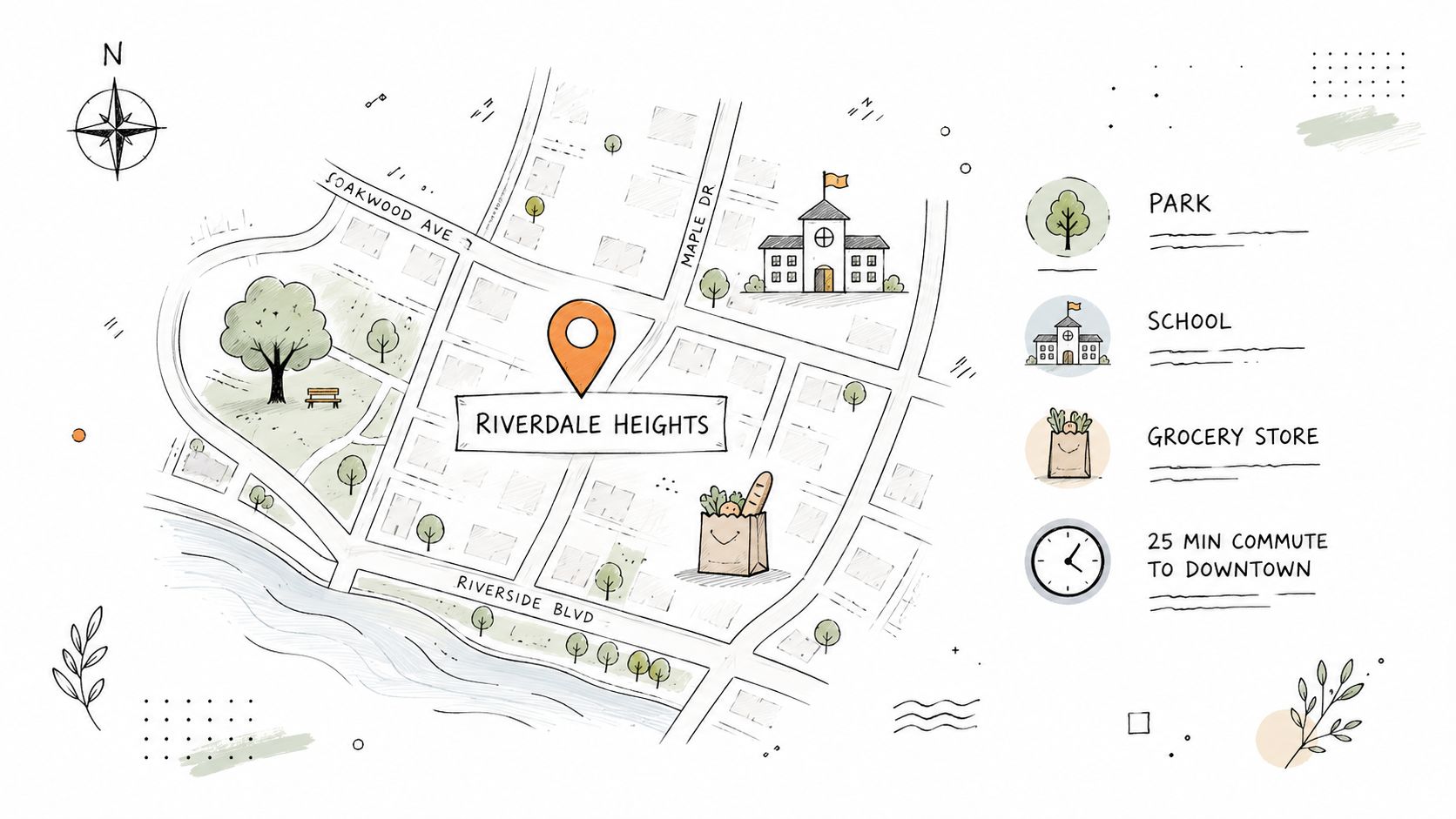
Neighborhood posts build trust when they read like local knowledge, not tourism copy. The safest and strongest angle is practical information people can use right away.
Focus on infrastructure, access, services, parks, trail systems, retail corridors, commute routes, municipal projects, and seasonal events. Those details help both buyers and sellers understand how a location functions without drifting into risky language about who belongs there.
A better neighborhood post formula
Use a simple structure:
- Access: commuting routes, transit points, major intersections
- Convenience: grocery options, pharmacies, dining clusters, service businesses
- Recreation: parks, greenways, public facilities, trail access
- Ownership context: tax information, permitting changes, zoning updates, municipal improvements
A practical example: “Three things to know about the Oak Ridge corridor this month. The trail extension is open, the retail center now includes a new grocery tenant, and the city resurfaced the main connector road.”
Neighborhood authority comes from specifics. “Walkable to coffee, grocery, and a pharmacy within a few blocks” is useful. “Great area” says nothing.
Avoid coded words like “exclusive,” “up-and-coming,” or “desirable.” Under the Fair Housing Act, your language can't express preference or imply discrimination tied to protected classes. Describe the place by features and public facts, not by the type of resident you think it suits (Fair Housing social media advertising rules).
4. Market Update Posts with Actionable Seller Education
Market updates work when they answer one seller question clearly: “What does this mean for my decision to list?”
Most agents already have access to the raw numbers through their MLS. The hard part isn't finding the data. It's translating it into plain English without turning the post into a newsletter nobody finishes.
Turn market data into seller decisions
A useful market update usually includes three parts:
- What changed: inventory, new listings, pending activity, price reductions, or showing volume in your market
- What it means: more competition, less negotiating room, stronger buyer scrutiny, or more importance on condition
- What sellers should do: price tighter, finish repairs, improve photography, or list sooner rather than later
Example: “More listings came on this month, which gives buyers more choice. For sellers, that usually means presentation matters more, and pricing mistakes take longer to recover from.”
Consistency matters more than complexity. A short first-Monday market post is better than a brilliant market essay you only publish twice a year. If you want a repeatable structure, this real estate social media content calendar can help map monthly market updates, seller tips, and listing content without guessing what to post next.
ListingBooster.ai fits this category well because it's built around real estate language. Generic AI often writes broad economic commentary. You need neighborhood-level seller guidance.
5. Client Testimonial Videos and Success Stories
A testimonial video doesn't need studio production. It needs clarity, consent, and one specific reason the client trusted you.
Short clips work best when the client talks about process, communication, pricing guidance, or how you solved a problem. That gives future clients something concrete to compare. “She kept us informed through inspection” is stronger than “She was amazing.”
What to capture on camera
Ask prompts that lead to substance:
- Starting concern: “What were you worried about before we listed?”
- Decision point: “What helped you feel confident during the process?”
- Outcome: “What part of the experience stood out most?”
Keep the edit simple. Add text overlays so the post still communicates with sound off. If you have permission, pair the video with listing photos, a closing photo, or a short written summary below the clip.
Ask for the testimonial right after closing. The relief is fresh, and clients usually remember the details that matter.
For compliance and professionalism, get written permission to use the client's words, name, image, or property photos. Also avoid implying guarantees. A success story should explain what happened in that transaction, not promise the same result for the next seller.
ListingBooster.ai can help script prompts and organize the content sequence around the testimonial, but the trust still comes from a real client saying something specific.
6. Comparative Market Analysis Education Posts
CMA education posts attract homeowners who aren't ready for an appointment yet but are privately trying to understand value. That audience is ideal for Facebook because they'll often watch, compare, and wait before reaching out.
The best version isn't “What's your home worth?” That's too broad. A better post explains why similar homes don't sell for the same price.
Show the variables that move price
A simple post might compare three similar homes and point out differences such as:
- Condition: original kitchen versus updated kitchen
- Systems: older roof or HVAC versus recently replaced
- Lot placement: interior lot versus corner lot
- Timing: stronger launch window versus slower seasonal timing
You don't need to sound like an appraiser. In fact, you shouldn't. The point is education. Explain the pricing drivers in plain language and invite homeowners to ask for a customized analysis if they want one.
A strong example: “Two homes can share the same bedroom count and square footage and still land far apart because buyers price in updates, deferred maintenance, lot layout, and presentation.”
This post type also reinforces your value to sellers. You're not just posting homes. You're interpreting the market. That's a meaningful distinction, especially for newer agents who need authority content that feels grounded and local.
7. Listing Walkthrough and Property Detail Spotlights
Some listings deserve more than a broad overview. Detail spotlights let you slow the scroll and direct attention to the things buyers ask about, such as windows, roof age, flooring quality, plumbing updates, storage design, or outdoor improvements.
This format is especially useful when a property's value isn't obvious in the hero photo. A newer water heater, refinished hardwoods, or updated electrical panel won't always drive clicks on its own, but those details do strengthen buyer confidence.
Focus on what reduces buyer hesitation
Examples that work well:
- Mechanical reassurance: “The seller replaced the HVAC recently, which removes one major near-term project for the next owner.”
- Finish quality: “These hardwood floors were refinished rather than covered, and the condition shows in the close-up shots.”
- Inspection-readiness: “The roof replacement is already done, which often reduces one of the biggest negotiation pressure points.”
A visual format helps here, especially a close-up carousel or short narrated reel. If you want to multiply one listing into a larger content run, this guide on turning one listing into 30 days of content is a practical model.
Later, if you want to expand the same listing into video, you can also generate real estate marketing videos.
The mistake to avoid is writing about details that only the agent cares about. “Designer touches throughout” is vague. “Newer windows, updated plumbing, and a rebuilt deck” gives people a reason to look closer.
8. Local Event and Community Calendar Posts
Not every Facebook post should ask for a showing or a valuation call. Community calendar posts keep your page useful between transactions, and useful pages get remembered.
This post type works well because it broadens your identity. You're not only the person with listings. You're also the person who knows what's happening locally and shares information people can use.
Useful community post ideas
A few formats are reliable:
- Weekend event roundup: farmers market, library programs, park district events, trail access updates
- Seasonal reminders: city leaf pickup schedule, recreation registration deadlines, holiday market calendars
- Municipal updates: road work, public facility openings, town meeting notices that affect homeowners
For compliance, keep these posts about public information and neighborhood function. Don't frame the area around who it's “for.” Frame it around what residents can access and what's changing.
There's also a trust advantage here. When your feed includes market updates, listing content, and practical local information, people see a fuller professional picture. That's more persuasive than a feed made entirely of sold graphics.
If you attend the event yourself, use your own photo or short clip. The post feels more credible, and your local presence becomes visible without forced self-promotion.
9. Before-and-After Renovation Showcases with ROI Context
Renovation posts perform best when you explain the decision, not just the transformation. Sellers want to know what changed, why it mattered, and whether the update improved marketability.
A side-by-side kitchen or bath image is the hook. The caption should do the heavier work by connecting the update to buyer confidence, perceived maintenance, or stronger presentation.
Keep the analysis honest
Use language like this:
- Marketability angle: “The refresh helped the home show as move-in ready rather than project-heavy.”
- Negotiation angle: “Handling this work before listing likely reduced repair objections later.”
- Scope angle: “This wasn't a full reconfiguration. It was a targeted update that improved first impression.”
Before-and-after posts lose credibility when every project is framed as a jackpot. Some updates help positioning more than price. Say that plainly.
This is also where purpose-built real estate AI helps. Generic tools tend to write renovation captions like home décor content. ListingBooster.ai can frame the same update around listing readiness, inspection concerns, and buyer objections, which is far more useful to a seller audience.
If you know the seller chose not to renovate and still sold successfully, that can be a strong post too. Contrast is educational. “We skipped a full remodel and focused on paint, lighting, and staging” is often more believable than dramatic transformation content every time.
10. Seller Education Series Preparing Your Home for Sale
A seller education series is one of the best Facebook post systems because it pre-handles objections before the consultation. It also creates continuity in your feed. People start expecting practical advice from you instead of waiting for the next listing.
Keep each post focused on one decision. Pricing. showings. inspection prep. offer review. moving timeline. Utility records. Small, useful lessons outperform giant “ultimate guide” captions on Facebook.
Strong topics for a recurring series
Use recurring themes such as:
- Pricing: how comparable sales shape strategy
- Preparation: decluttering, repairs, paint, lighting, odor control
- Showings: what sellers should leave out of sight and what should be easy to access
- Inspection: what buyers flag most often and how to prepare documents
- Offers: why price isn't the only term that matters
The smartest version of this content is consultative, not preachy. For example: “A home doesn't need to be fully renovated to hit the market well. It does need to look maintained, clean, and easy to understand.”
This category also lines up with how buyers now discover professionals. One industry source argues that a growing share of buyers start in AI tools and that agents need more AI-readable, specific content rather than vague social captions (AI-readable real estate content trend). Whether someone finds you through Facebook directly or through content that gets referenced elsewhere, detailed local education travels further than generic advice.
10 Facebook Post Types for Real Estate Agents: Comparison
| Strategy | Implementation Complexity 🔄 | Resources & Speed ⚡ | Expected Outcomes 📊⭐ | Ideal Use Cases 💡 | Key Advantages ⭐ |
|---|---|---|---|---|---|
| Open House Countdown Posts with Property Highlights | 🔄 Moderate, repeated posts over 7 days; scheduling discipline required | ⚡ Low–Moderate: quality photos, scheduling tools, time for multiple posts | 📊 Drives foot traffic and short-term engagement; measurable attendance lift | 💡 New listings with planned open houses; competitive local markets | ⭐ Creates urgency; easily repurposed across platforms |
| Just Sold Announcements with Comparative Market Context | 🔄 Low, single timely post per closing; needs verified data | ⚡ Low: public records, one professional photo, simple design | 📊 Builds credibility and long-term social proof; supports referrals | 💡 Agents with steady sales volume; authority-building campaigns | ⭐ Demonstrates results; educates market with factual metrics |
| Neighborhood Feature Deep-Dives with Practical Information | 🔄 High, research-heavy; accuracy is critical | ⚡ Moderate: local data sources, photography, research time | 📊 Long-term SEO and trust; attracts relocation and local research traffic | 💡 Agents aiming to be local experts; relocation-focused marketing | ⭐ Differentiates by deep local knowledge; evergreen value |
| Market Update Posts with Actionable Seller Education | 🔄 Moderate, recurring cadence with fresh data each period | ⚡ Moderate–High: MLS/data access, charting tools, data literacy | 📊 Positions as data-driven advisor; attracts informed sellers | 💡 Regular outreach to sellers and investor audiences | ⭐ Shows market competence; timely authority and shareability |
| Client Testimonial Videos and Success Stories | 🔄 Moderate, scheduling, filming, consent, editing required | ⚡ Moderate: willing clients, smartphone/video tools, editing time | 📊 High engagement and trust; strong conversion from social proof | 💡 Converting fence‑sitters; campaigns focused on credibility | ⭐ Authentic persuasion; outperform static posts on engagement |
| Comparative Market Analysis (CMA) Education Posts | 🔄 High, detailed analysis and anonymization needed | ⚡ High: access to comps, analytic time, clear visuals | 📊 Educates sellers; drives high‑intent listing inquiries | 💡 Pre-listing education and pricing conversations | ⭐ Demonstrates pricing expertise; reduces seller resistance |
| Listing Walkthrough and Property Detail Spotlights | 🔄 Moderate, requires access and thoughtful shot selection | ⚡ Moderate: high-quality close-ups, listing access, captions | 📊 Boosts listing visibility; educates buyers on value drivers | 💡 New or high‑detail listings needing depth | ⭐ Generates multiple posts per listing; highlights saleable features |
| Local Event and Community Calendar Posts | 🔄 Low–Moderate, ongoing event monitoring and timing | ⚡ Low: event info, images, minimal production time | 📊 Builds community connection and shareability; local reach growth | 💡 Brand-building and neighborhood engagement strategies | ⭐ Positions agent as community insider; consistent engagement |
| Before-and-After Renovation Showcases with ROI Context | 🔄 High, needs documented befores, accurate ROI context | ⚡ Moderate–High: before/after photos, cost data, outcome metrics | 📊 Visual proof of renovation impact; informs seller investment choices | 💡 Advising sellers on pre‑listing renovations | ⭐ Demonstrates ROI and reduces seller uncertainty about upgrades |
| Seller Education Series: Preparing Your Home for Sale | 🔄 High, multi-part planning and consistent publishing | ⚡ Moderate: content planning, visuals, batching tools | 📊 Pre-sells expertise; reduces basic objections; builds lead funnel | 💡 Nurturing prospective sellers and long-term lead gen | ⭐ Establishes trust over time; reusable lead magnet and reference |
From Posts to Pipeline Activating Your Content Strategy
A strong Facebook presence doesn't come from posting constantly. It comes from posting with range. Open house reminders create urgency. Just sold posts build proof. Neighborhood and community content build trust. Market updates and seller education posts move people closer to a conversation before they ever contact you.
That approach also fits how agents use the platform. In 2025, Facebook reached 253 million users in the United States, and one industry source states that 92% of real estate agents globally use Facebook as a core part of their strategy, while NAR survey reporting confirms 87% of U.S. agents use it for marketing (real estate Facebook ads and platform reach). The opportunity is still there, but low-quality posting won't capture it.
Compliance has to stay built into the process. Every property ad or service post should include the disclosures required by NAR's Internet Advertising Policy, including your name, brokerage name, office city and state, and licensing jurisdictions (NAR advertising disclosure summary). It's also wise to display the Equal Housing Opportunity slogan, logo, or statement clearly on your social profile and link it to a Fair Housing policy page (Fair Housing social media compliance tips).
Execution is where most agents get stuck. A real-estate-specific tool like ListingBooster.ai can help you build compliant listing captions, neighborhood posts, and seller education content faster than starting from scratch in a generic AI tool. The practical next step is simple. Pick one of the 10 post types above, draft next week's version, and schedule Facebook posts with Mallary.ai. One well-structured post is enough to restart momentum.
If you want a faster way to turn listings, market knowledge, and local expertise into Facebook content that sounds like a real agent, take a look at ListingBooster.ai. It's built specifically for real estate workflows, which makes it more useful than a generic AI writer when you need compliant property posts, seller education content, and a repeatable publishing rhythm.
Walk In With the Campaign Already Built
Listing copy, social posts, sourced Market Insights, growth scheduling, and direct publishing after approval from one real-estate-specific system. 25 free credits to start.
Related Posts
 Uncategorized
Real Estate Content Marketing: The 2026 Playbook
Listings with video can generate 49% more qualified leads, according to a 2026 real estate digital marketing roundup. That figure changes the question. Real estate content marketing isn't about how often you post. It's about whether your listing, expertise, and local knowledge can be found, understood, and cited by people and by the AI tools […]
 Uncategorized
AI for Real Estate Marketing: A Practical Playbook
A new listing goes live on Tuesday morning. You write the description from memory, schedule three social posts, answer showing requests, and move on to the next client task. By afternoon, the listing has plenty of activity on your side of the business, but the phone still isn't producing the conversations you expected. That gap […]
 Uncategorized
What Is IDX and Why It Still Matters for Real Estate
A new agent usually hears “IDX” during a brokerage onboarding call, nods along, and hopes nobody asks for a definition. Then the questions arrive: Why are listings appearing on the website? Who controls the data? Why did a property remain visible after its status changed? And will the same pages be readable by ChatGPT, Perplexity, […]