7 Pro Instagram Captions for Real Estate Agents

Are your Instagram posts generating anything beyond likes from other agents? Most real estate feeds still lean on generic listing copy, broad lifestyle claims, and captions that read like cut-down brochures. That approach fills space, but it rarely builds authority, creates urgency, or gives a serious buyer a reason to act.
Good Instagram captions for real estate agents do more than describe a property. They help a buyer understand what matters, they help a seller see how you market, and they give your audience a reason to reply, click, save, or book a showing. They also need to stay inside Fair Housing rules, which means every word has to be intentional.
In a crowded feed, specificity wins. One source on real estate caption writing notes that Instagram truncates text around 125 characters on mobile devices, so the hook needs to carry the post before the cutoff. The same guide also recommends keeping the overall caption under 220 characters when you want a tight, mobile-first post, and using a 3-3-3 structure to stay concise and readable in-feed through real estate caption best practices for mobile visibility. That matters because buyers skim first.
If you're also producing video, tighten the caption even more. Pairing short copy with a quick property reel often works better than a long, brochure-style paragraph under a static image. If your team is also adding captions for social media, keep the on-screen text and the written caption aligned so the message feels consistent.
Here are the seven caption types every listing pipeline needs.
1. Just Listed

A strong just-listed caption introduces the property with facts a buyer can verify. Beds, baths, square footage, lot size, year built, and dated updates give people something concrete to react to. Vague praise doesn't.
A weak version says the home is “stunning” or “perfect for families.” That second phrase is especially risky. Fair Housing rules require you to describe the property, not the type of person who should live there. If you're writing Instagram captions for real estate agents, this is one of the first habits to fix.
What to lead with
Try this format:
Practical rule: New listing captions work best when the first line contains the most decision-driving facts, not your excitement.
“Just Listed. 4 bed | 2.5 bath | 2,340 sq ft | 0.33-acre lot. Built 2008. Roof replaced 2019. Hardwood on main level. Private showings available.”
That works because it lets the buyer sort quickly. It also helps the seller see that your marketing is precise.
- Use dated updates: “Kitchen renovated 2022” lands better than “updated kitchen.”
- Keep features scannable: Line breaks make specs easy to skim on mobile.
- End with one action: “Schedule a showing” is better than stacking multiple asks.
Here's a simple example:
“New to market. Corner lot. 3 bed, 2 bath, 1,850 sq ft. Electrical panel updated in 2021. Kitchen renovation completed in 2022. Showing appointments available this weekend.”
What to avoid
Don't write copy that sounds like a flyer from fifteen years ago. “Dream home,” “won't last,” and “must see” can still appear occasionally, but they can't carry the whole post.
Also avoid resident-language shortcuts. Under Fair Housing guidance, agents should focus on objective property features such as #openfloorplan, #updatedkitchen, or #walkinglocation and avoid hashtags that imply protected classes or preferences, according to Fair Housing hashtag guidance for real estate professionals.
If you want help systematizing this, a purpose-built social media tool for realtors can help you turn listing facts into channel-ready captions without sounding generic.
2. Open House

What makes someone show up to an open house instead of saving the post and forgetting about it?
Usually, it is clarity. Open house captions perform best when they remove small points of hesitation before the prospect has to ask. Time, date, address, parking instructions, entry details, and one reason to visit in person should all be in the caption. This stage of the listing lifecycle is less about broad awareness and more about attendance conversion.
A practical version looks like this:
“Open House Sunday, 2 to 4 PM at 1247 Oakridge Drive. Street guest parking only. Please enter through the front door. Renovated kitchen, large primary suite, and deck access off the main living area. DM for a private showing if you want a quieter tour.”
That format works because it answers operational questions and gives buyers a low-friction next step. It also sets expectations for the seller. The post is doing real appointment-setting work, not just filling the feed.
Write for attendance, not admiration
Open house captions need a different balance than just listed posts. The goal is not to restate every spec. The goal is to get the right people through the door with fewer back-and-forth messages.
Include the details that affect turnout:
- Time and date first: Put the event window near the front so it is visible before the caption truncates.
- Access instructions: Parking, gate codes, side-entry directions, or elevator notes save time for everyone.
- One or two in-person draws: Use features buyers will want to experience live, such as natural light, yard layout, ceiling height, or a new kitchen.
- One CTA only: “Stop by Sunday” or “DM for a private showing” is enough.
If the logistics are inconvenient, say so plainly. Limited parking, a steep driveway, condo check-in requirements, or shoe covers at entry can all affect turnout. Clear captions filter out casual visitors and reduce no-show follow-up.
Compliance and tone matter here
Open house posts can drift into pressure language fast. Avoid captions that suggest urgency without substance or imply who should live there. Keep the copy focused on property facts, event details, and access.
A stronger open house CTA sounds like this:
- Attend the event: “Join us Sunday from 2 to 4 PM.”
- Request an alternative: “DM to schedule a private tour before or after the open house.”
- Ask for prep material: “Message for the disclosures and feature sheet before you visit.”
Short, conversational sentences usually fit this format best because buyers are scanning on mobile while deciding whether the trip is worth it. If you use AI to draft these posts, build the prompt around five fields: event time, address, access notes, top features, and CTA. That workflow produces faster approvals and fewer edits than asking for a generic “exciting open house caption.”
3. Price Improvement
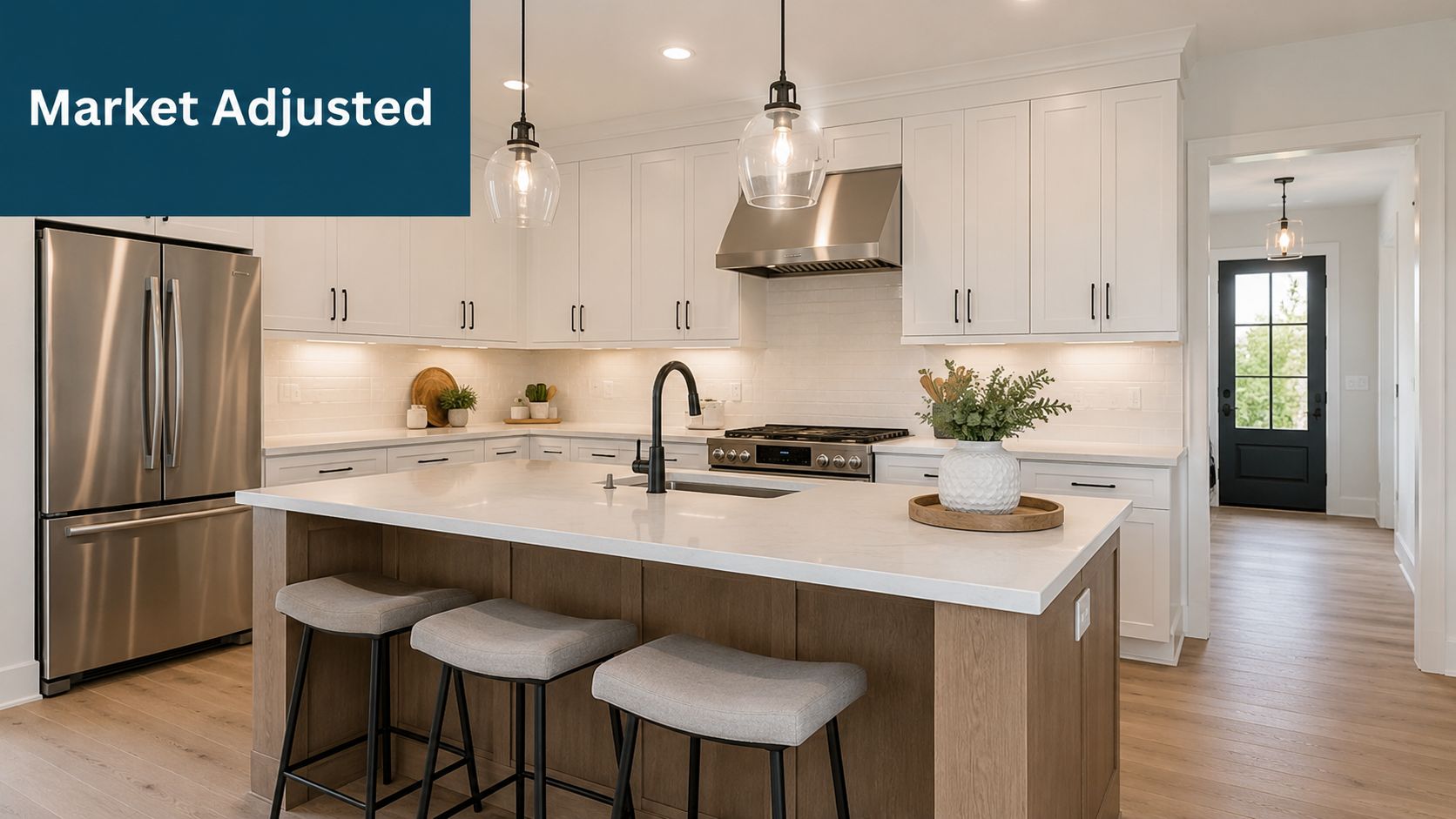
A price improvement post shouldn't read like an apology. It should read like a market-based repositioning. Buyers can feel the difference immediately.
The wrong approach is defensive. “Huge reduction!!! Seller motivated!!!” signals weakness and can drag down perceived value. A better caption frames the change as a strategic move tied to current conditions or feedback.
Reposition the listing without sounding desperate
A cleaner version looks like this:
“Price Improvement. 456 Maple Court is now offered at $389K. After reviewing recent comparable activity and buyer feedback, the home has been repositioned for the current market. Updated kitchen, refreshed systems, and weekend showing times available.”
That keeps the tone steady. It doesn't pretend nothing changed, but it also doesn't create unnecessary concern.
Use words like “market-aligned,” “repositioned,” or “adjusted.” Skip “cheap,” “affordable now,” or anything that sounds like a clearance sale.
- Lead with reason: Mention comparable sales, buyer response, or market alignment.
- Then restate value: Bring the focus back to features and access.
- Finish with one next step: Usually a showing CTA works best.
Status-specific CTA rules
Price improvement captions should push toward renewed consideration. They work best when the CTA invites a fresh look.
Examples:
- For watchers: “If you've been tracking this one, now's the time to take another look.”
- For active buyers: “Schedule a private showing this week.”
- For agents: “Reach out for current details and availability.”
Buyers don't need drama in a repricing post. They need a reason to revisit the listing.
This is also where a real-estate-specific writing workflow helps. Generic AI tools often default to hype language. A focused tool can make repricing copy sound measured, confident, and usable without endless rewriting.
4. Pending
Pending captions are social proof posts disguised as status updates. They tell future sellers that your listings move, but they also require restraint. Oversharing terms, timelines, or negotiation details can create problems.
A pending post should celebrate the milestone while protecting the transaction. That means no appraisal details, no financing commentary, and no play-by-play on contingencies unless the deal is fully closed and disclosure is appropriate.
Build trust without exposing the deal
A clean pending caption might say:
“Pending. 1247 Oakridge Drive is now under contract. Grateful to the sellers for the trust and excited for what's next. If you're thinking about listing this season, reach out for a pricing and prep conversation.”
That works because the message is clear, positive, and controlled. It doesn't turn a private transaction into content bait.
The strongest psychological trigger here is credibility. People scrolling your profile aren't just reacting to the house. They're assessing whether you know how to manage momentum.
The CTA should pivot toward sellers
Pending posts aren't usually the place for aggressive buyer calls to action. The better move is a soft seller-facing prompt.
Use CTA language like:
- Seller conversation: “Thinking about listing? Let's talk timing and pricing.”
- Pipeline builder: “Curious what your property could look like on the market right now?”
- Light inquiry: “Send a message if a move is on your radar.”
Under Section 804(c) of the Fair Housing Act, it is illegal to make, print, publish, or cause to be published any housing notice that indicates a preference, limitation, or discrimination based on protected classes, as outlined in the National Fair Housing Alliance advertising guidance. That applies to status posts too.
So if you're tempted to add language about who this home was “perfect” for, cut it. Pending captions are strongest when they stay factual and restrained.
5. Sold
A sold caption is where you can lean into proof. The deal is closed. The result is real. Your Instagram feed begins functioning like a public track record.
Still, there's a difference between useful proof and noisy self-congratulation. Good sold captions mix outcome, gratitude, and one practical takeaway. Weak ones sound like generic victory laps.
Lead with the strongest result
If the strongest part of the story is speed, lead with speed. If it's price positioning, lead with that. If it's repeat activity in the same area, that can work too.
Example:
“Sold. 1247 Oakridge Drive closed at $505K after 18 days on market. Thankful for the trust from the sellers and glad to help bring this one to the finish line. If you want a realistic pricing strategy for your home, send a message.”
That caption gives a concrete result and a relevant next step. It also stays focused on service, not ego.
Closed deals are your most believable marketing asset. Use them to demonstrate judgment, not just volume.
Make the post do more than celebrate
Sold posts can also educate. If you handled staging, prep, pricing strategy, or negotiation structure well, you can mention that in plain terms without overexplaining.
A few useful angles:
- Process angle: “Strong prep and clean launch materials helped this home present well.”
- Market angle: “Pricing discipline mattered more than overreaching at launch.”
- Client angle: “Clear communication kept the transaction moving.”
This is also a practical place to tighten your workflow. If you're posting multiple listing statuses every week, listing to social media campaign automation can help keep sold posts consistent with the rest of your pipeline.
One caution. Don't overload your feed with sold graphics and identical captions. A steady rhythm works better than repetition, especially if each post adds a slightly different lesson or proof point.
6. Coming Soon
Coming soon is a teaser format, not a full reveal. The goal is to create anticipation without giving away every important detail before launch.
A lot of agents either say too little or too much. Too little and nobody cares. Too much and you've already spent the listing's best attention before it goes live. The sweet spot is a few high-interest details plus a clear release point.
Tease the right details
A useful coming soon caption sounds like this:
“Coming Soon. Launching Friday at 9 AM. 4 bed, 2.5 bath on a corner lot with original hardwoods and a renovated kitchen. Want the full details as soon as it goes live? Message for first-look access.”
That creates a clock. It also gives enough substance to attract the right buyer without turning the post into a full listing sheet.
What works well in this format:
- Three details max: For example, lot position, one major update, and one design feature.
- A real date or launch window: “Soon” by itself is too vague.
- An access CTA: Invite people to request the listing once it's active.
CTA rules for pre-launch posts
The CTA on a coming soon post should center on interest capture, not full transaction steps. Ask for a DM, a waitlist reply, or a request for launch-day details.
Good examples:
- First-look CTA: “Reply for launch-day details.”
- Showing CTA: “Ask about early access if available.”
- Save CTA: “Save this post and check back Friday morning.”
This is one place where your listing content and your social content should work together. If your property description is already strong, the caption becomes easier to write. If it isn't, your teaser post often turns into fluff. Reviewing a few listing description examples that sell can help you identify which details are worth teasing before launch.
Also make sure the launch date is real. Nothing erodes trust faster than a coming soon post that drifts.
7. Market Update

What makes a market update caption worth reading instead of scrolling past?
A strong one gives people context they can use now. For agents, this caption type sits in the trust-building stage of the listing lifecycle. It keeps your name in front of past clients, future sellers, and buyers who are still watching from the sidelines. The post should do three jobs at once: summarize one or two local shifts, explain what changed, and translate that into a practical next step.
The mistake I see often is simple. Agents post a chart, add "market update," and stop there. That rarely drives saves, replies, or listing conversations because the audience has to do the analysis themselves.
Use a structure that moves from fact to implication to action.
A practical example:
“Market update for [Your Area]: inventory is up from this time last year, and homes are taking longer to go under contract. Sellers need sharper pricing and stronger presentation to stand out. Buyers have more room to compare options before writing. Want a custom read on your street, condo building, or price range? Send a message.”
That format works because it answers the question behind the metric. A buyer does not care about inventory in the abstract. A seller does not care about days on market unless you explain how it affects pricing, prep, or negotiation strategy.
For market captions, a simple framework helps:
- Fact: Share one current local stat or trend
- Meaning: Explain what changed in plain language
- Action: Give buyers or sellers one clear next step
That is also where AI can save time without making the post sound generic. Feed your monthly local numbers into your workflow, ask for three audience versions, one for buyers, one for sellers, and one for homeowners considering a move, then edit for accuracy and tone. The draft gets faster. The judgment still needs to be yours.
Keep it compliant and useful
Market updates usually carry less risk than listing promotion, but they still need Fair Housing discipline. Avoid language that suggests who belongs in an area or what kind of resident a property or neighborhood is for.
According to Fair Housing compliant copywriting guidance for real estate marketing, agents should describe physical features and amenities such as ground-floor units, elevator access, or ADA-compliant features rather than implying who the ideal resident is.
Apply that same standard to market commentary. Focus on inventory levels, price movement, housing stock, commute access, development activity, and built amenities. Leave out claims like “great for families,” “safe neighborhood,” or references to religious institutions and demographic assumptions.
Done well, market updates are not filler content. They are one of the few caption types that can build authority between listing announcements and keep your pipeline warm without sounding promotional.
7-Scenario Instagram Caption Comparison
| Post Type | Implementation Complexity 🔄 | Resources & Timing ⚡ | Expected Outcomes 📊 | Ideal Use Cases 💡 | Key Advantages ⭐ |
|---|---|---|---|---|---|
| Just Listed: Feature-Forward Property Introduction | Low–Medium, template-driven; requires factual verification | Fast to produce; post within 24 hours; needs photos + MLS link | High immediate reach, saves, and shares; algorithm-friendly | New listings, bulk-posting, broad buyer/investor audiences | Urgency + compliance-focused facts; scalable with templates |
| Open House: Time-Sensitive Invitation with Logistics | Medium, logistics and live monitoring required | Time-sensitive (post 3–4 days prior + day-of); needs signage and staff | Highest engagement; drives foot traffic and on-site leads | Event-driven listings, local buyer markets, high-visibility homes | Converts online interest into in-person visits and referrals |
| Price Improvement: Repositioning Without Appearing Desperate | Low, tone-sensitive messaging and market rationale | Quick after MLS price change; may require CMA or chart | Re-engages previously interested buyers; revives listing activity | Underperforming listings or to target saved-search buyers | Data-led framing that maintains credibility and trust |
| Pending: Building Social Proof While Protecting Deal Integrity | Low, brief status update with cautious tone | Post promptly after status change; minimal assets required | Builds social proof with moderate engagement; lower risk content | High-transaction agents needing frequent proof of activity | Credibility builder without revealing sensitive deal terms |
| Sold: Leveraging Closed Transaction for Maximum Credibility | Medium, requires closed escrow and permission to publish | Post within 24 hours of close; needs final metrics/photos | Highest trust and lead-generation; strong social proof results | Demonstrating track record to attract future sellers | Definitive proof of results; converts referrals and listings |
| Coming Soon: Creating Anticipation Without Premature Launch | Medium, coordination with seller/MLS and controlled disclosure | Timing-sensitive (3–7 day window); use landing page to capture leads | Generates pre-launch interest and VIP lead lists | High-value, unique, or low-inventory listings where buzz matters | Builds anticipation and early buyer lists before MLS launch |
| Market Update: Positioning Authority Through Data-Driven Insights | Medium, requires accurate data sourcing and regular cadence | Recurring effort (weekly/monthly); infographic preparation helpful | Builds long-term authority and shareable engagement | Thought leadership, nurturing passive audience, cross-platform use | Positions agent as expert; content repurposable for email/LinkedIn |
Your AI-Powered Content Command Center
These seven caption types cover the full listing lifecycle. If you can write each one clearly, your Instagram feed starts doing real work. It introduces inventory, drives event attendance, reframes price changes, builds social proof, and reinforces your market authority.
The challenge isn't understanding the categories. It's executing them consistently while you're handling listings, clients, contracts, and showings. That's where most agents fall back into generic copy. They don't need more ideas. They need a faster system for turning listing facts into usable content.
There's also a real trade-off between speed and compliance. Generic AI tools can produce a decent-sounding caption quickly, but they often miss the details that matter in real estate. They may default to broad lifestyle wording, overstate urgency, or use phrasing that creates Fair Housing risk. A purpose-built workflow is more useful because it starts with the structure of the listing itself and the actual status of the property.
That's where a platform like ListingBooster.ai fits naturally. It's built around real estate use cases such as just listed, price changes, open houses, pending updates, sold posts, and market content, rather than trying to force a general writing tool into a specialized compliance-heavy workflow. For agents and teams, that means less time rewriting and less guesswork about what to post next.
There's a bigger efficiency gain too. Once you know what each caption type should accomplish, you can batch decisions. Which feature leads. Which CTA belongs to that listing status. Which details are safe and useful. Which posts are better short because mobile users skim before they click “more.” If your team is also integrating AI into your social media workflow, the win isn't just speed. It's consistency.
Start small. Pick one live or upcoming listing and write the full lifecycle: coming soon, just listed, open house, price improvement if needed, pending, sold, plus one market update tied to the same area. Review each caption for clarity, compliance, and next-step logic. You'll see quickly which posts move conversations forward.
If you want a simpler way to turn listing details into compliant social posts, explore ListingBooster.ai. It's designed for real estate agents, teams, and brokerages that want listing descriptions and social content built around actual property status, real workflow needs, and Fair Housing-aware messaging.
Walk In With the Campaign Already Built
Listing copy, social posts, sourced Market Insights, growth scheduling, and direct publishing after approval from one real-estate-specific system. 25 free credits to start.
Related Posts
 Uncategorized
Real Estate Content Marketing: The 2026 Playbook
Listings with video can generate 49% more qualified leads, according to a 2026 real estate digital marketing roundup. That figure changes the question. Real estate content marketing isn't about how often you post. It's about whether your listing, expertise, and local knowledge can be found, understood, and cited by people and by the AI tools […]
 Uncategorized
AI for Real Estate Marketing: A Practical Playbook
A new listing goes live on Tuesday morning. You write the description from memory, schedule three social posts, answer showing requests, and move on to the next client task. By afternoon, the listing has plenty of activity on your side of the business, but the phone still isn't producing the conversations you expected. That gap […]
 Uncategorized
What Is IDX and Why It Still Matters for Real Estate
A new agent usually hears “IDX” during a brokerage onboarding call, nods along, and hopes nobody asks for a definition. Then the questions arrive: Why are listings appearing on the website? Who controls the data? Why did a property remain visible after its status changed? And will the same pages be readable by ChatGPT, Perplexity, […]