AI Search Optimization for Real estate Listings: How It Works and Why It Matters
The old way of thinking about online real estate marketing is officially over. It's no longer about just stuffing keywords into a listing. Instead, the focus is now on creating structured, descriptive, and consistent property information. This shift in strategy is a direct response to a fundamental change in how people find homes. As AI systems increasingly summarize information for buyers asking real, conversational questions, they need to clearly understand a home's features to surface it accurately. This guide explains the mechanics of AI search optimization for real estate listings and what actually affects visibility.
What AI Search Means for Real Estate Listings

The way people find their next home is changing. For years, it was a simple keyword game. A buyer would type "3 bed 2 bath Boston" into a search bar, and the system would pull up listings matching those exact terms. Success depended on having the right words in the right places.
Today, AI-driven home search works on a different level. It’s about understanding what a buyer really wants, often expressed through natural language.
Natural Language vs. Keyword Search
Think about how people actually talk. A modern home search sounds less like a computer command and more like a conversation. A buyer might now ask, “Find me a home with a large backyard for entertaining near good schools.”
This kind of query isn't just a string of keywords; it expresses a lifestyle, a specific need, and a set of priorities. This is where old search methods fall apart.
- Traditional Keyword Search: This was about matching words. If a buyer searched for "fenced yard," a listing had to contain that exact phrase to appear.
- AI-Driven Discovery: This is about interpreting natural language and context. An AI understands that a description mentioning "a perfect space for summer barbecues" and "fully enclosed for privacy" likely satisfies the buyer's need, even if the exact keywords are missing.
AI Summarization vs. Traditional Ranking
This evolution is happening because AI doesn't just deliver a list of links anymore. It aims to provide direct, synthesized answers. It pulls information from the MLS, major portals, your website, and neighborhood data to construct a complete, coherent summary of a property for the user.
Why are listings increasingly discovered through questions? Because modern search tools are designed to provide immediate, comprehensive answers, not just links. Your goal is no longer just to rank in a list; it's to be understood so deeply that an AI can confidently summarize your listing as the perfect answer to a buyer's question. Vague or incomplete information simply gets lost in translation.
How AI Systems Interpret Listing Information

To make a listing visible to AI, you have to think like the machine. Modern AI search acts like a meticulous research assistant, pulling together every scrap of information it can find to build a complete profile of a property. Its purpose is to understand a listing so deeply that it can confidently recommend it as the perfect answer to a buyer's complex, conversational question.
These systems are hungry for clarity and structure. If your information is jumbled—contradictory, vague, or incomplete—the AI can't form a clear picture, and the listing gets lost.
The key idea is simple: AI systems summarize what they can clearly understand.
Clarity and Structure of Listing Descriptions
The public remarks in the MLS are the heart of a property’s story. AI doesn't just scan for "granite countertops." It analyzes sentence structure and how different ideas connect to paint a picture.
- Old way: "3 bed, 2 bath, granite counters, new roof."
- AI-friendly way: "Enjoy morning coffee at the spacious granite-topped kitchen island in this updated 3-bedroom home. With the peace of mind of a brand-new roof, this home is ready for its next chapter."
The second example gives the AI context. It connects features with real-life activities and tangible benefits, which is gold for an AI trying to answer a query like, "find me a move-in ready home with an updated kitchen."
Consistency Across Platforms
An AI doesn't just look at the MLS. It’s a detective, cross-referencing information with what it finds on Zillow, Realtor.com, your own website, and anywhere else the listing appears. It’s searching for a single source of truth.
When the price on one site doesn't match another, or the square footage is different, it creates data conflicts. To an AI, these inconsistencies are red flags signaling unreliable information. That confusion can cause the system to demote the listing in favor of one with clean, consistent data.
Contextual Signals and Structured Data
Beyond the words you write, AI systems analyze contextual information to understand the lifestyle a home offers.
- Neighborhood Context: It cares about proximity to popular cafes, parks, and schools. Mentioning "a short walk to Elm Street Park" provides invaluable local context.
- Lifestyle Qualities: Photos and descriptions that highlight specific uses are key. A "perfect home office with abundant natural light" or a "backyard designed for entertaining" gives the AI tangible data points.
- Structured Data and Metadata: Behind the scenes, details like property type, year built, and specific amenity checkboxes provide structured data that AI systems can easily process and compare. Ensuring this information is complete and accurate is crucial.
Ultimately, it’s not just about what you say about the property; it’s about how that information connects to a web of external data to create a compelling picture for a buyer.
How Agents Are Adapting Their Listing Content for AI Search
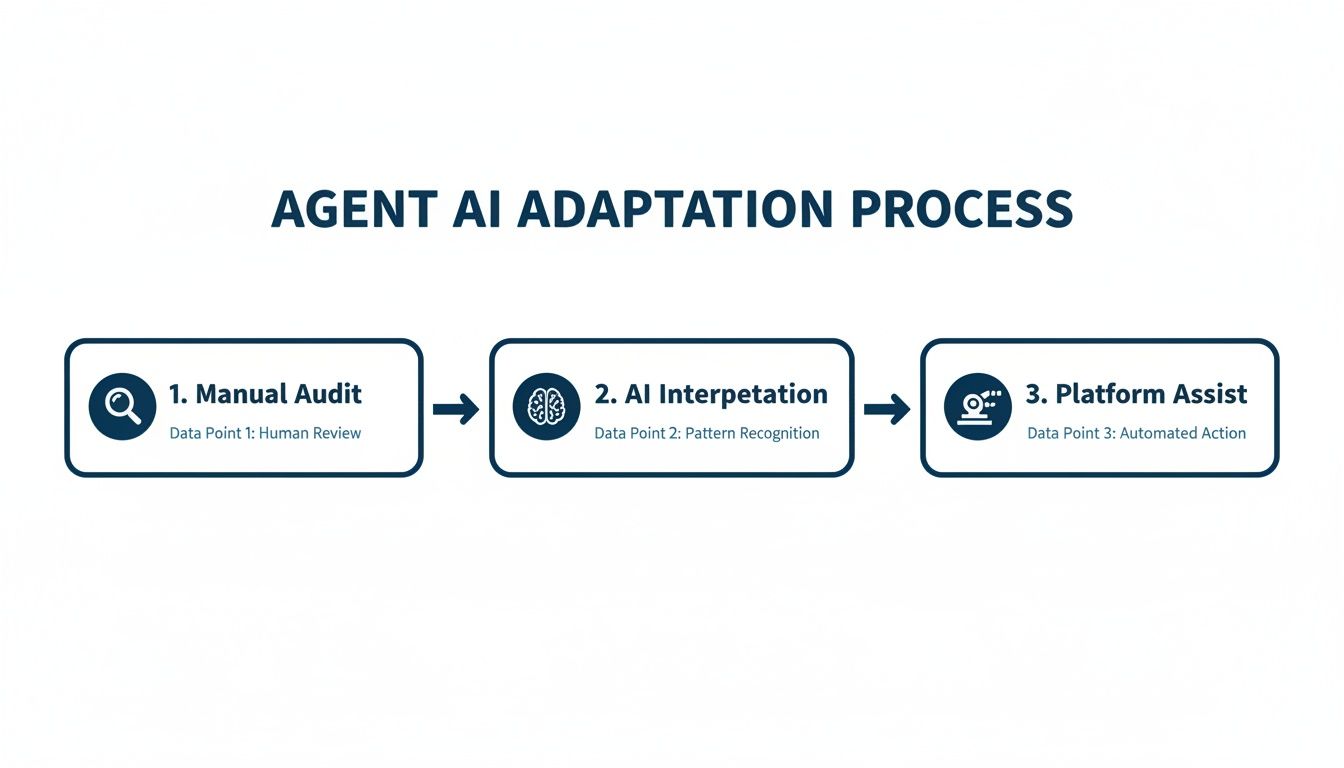
The shift from simple keyword searches to AI-powered discovery is already changing real estate marketing. It’s no longer about just listing features; it’s about telling a story that an AI can easily understand, summarize, and recommend. Agents approach AI search optimization in different ways. Some manually audit and rewrite listing content to improve clarity and structure, while others rely on real estate–specific platforms to standardize descriptions and marketing materials. The common thread is improving how listing information is presented and understood, regardless of the tools used.
As AI-driven search becomes more common, some agents are changing how they prepare listing content. Instead of relying only on traditional MLS descriptions, they focus on clearer structure, platform-specific wording, and consistency across channels. Industry-specific platforms such as ListingBooster.ai are sometimes used to help agents generate structured, MLS-compliant listing descriptions and supporting marketing materials designed to be more easily interpreted across search engines and AI-driven discovery tools.
The goal is always better clarity and structure, whether you're doing it by hand or using a tool to help. For a deeper dive into these strategies, you can explore the ListingBooster.ai blog or learn more about how AI is reshaping real estate marketing. For agents ready to explore platform-driven solutions, information is available on services like ListingBooster.ai.
Core Principles for Creating AI-Ready Real Estate Listings
Getting your listings to show up in AI-powered search isn't about learning secret code. It’s about clarity, consistency, and great storytelling. This is your playbook for making a property’s story so clear that both buyers and AI pay attention.
Ditch the Feature List, Tell a Story
Today’s AI understands context and sentiment. A dry, fact-only description gives it little to work with when a potential buyer asks, "Find me a home with a great backyard for parties." Your job is to paint a picture with words, describing the experience of living there.
- What we used to do: "Large backyard, deck, mature trees."
- What we do now: "The expansive backyard is an entertainer's dream, featuring a multi-level deck perfect for summer barbecues. Mature oak trees provide ample shade for relaxing afternoons."
The second example gives the AI contextual clues like "entertainer's dream" and "summer barbecues," directly connecting features to a buyer's desires.
Your Data Must Be Consistent. Everywhere.
AI constantly cross-references your listing details across the MLS, Zillow, and your own website. When it spots a discrepancy—a different price or square footage—it sees a red flag. This data conflict signals unreliability, which can cause an AI to push your listing down in favor of one with a clean data trail. Think of your MLS entry as the single source of truth.
Go Hyperlocal to Add Authenticity
A house is part of a community. AI looks for hyperlocal signals to build a complete lifestyle profile. Simply mentioning specific, named locations adds a powerful layer of verifiable detail.
- Instead of "close to parks," try "just a five–minute walk to the Elm Street Park playground."
- Instead of "near coffee shops," write "around the corner from The Daily Grind, a local favorite."
These specific names are data points an AI can verify, allowing it to confidently recommend your listing.
Structure for Scanners (Both Human and Robot)
Nobody likes a wall of text. Both people and AI prefer information that is well-organized and easy to scan.
- Short Paragraphs: Stick to 2-3 sentences per paragraph.
- Bullet Points: Use bullets to call out key features or recent upgrades.
- Subheadings: If your listing portal allows, break up your description with simple headings like "Gourmet Kitchen" or "Outdoor Oasis."
Good structure helps an AI parse your listing efficiently, ensuring your property's best assets are instantly identifiable.
The Future of AI Discovery for Real Estate Listings
The future of getting your listings found by AI isn't about a secret tech hack; it's about going back to basics. The listings that will rise to the top are the ones that are structured, consistent, and full of rich detail. Why? Because that’s not only what an AI can easily understand and summarize, but it’s also what a human buyer finds most compelling.
Adopting this mindset is about building a more trustworthy digital footprint for your entire business.
- Better Conversations with Clients: When you can explain how AI finds property listings, you can articulate your marketing strategy to sellers in a new way, building confidence and setting yourself apart.
- A Stronger Brand: Consistency across your website and major portals builds a brand that looks reliable and professional to both potential clients and AI systems.
- Future-Proof Your Business: The core principles of clarity, structure, and consistency are timeless. Building them into your workflow now sets you up for success no matter what technology comes next.
As AI-driven home search gets smarter, the agent's role becomes more important, not less. You're the human expert who makes sure the story of a home is told right. AI can crunch data, but it can't replicate your deep neighborhood knowledge.
Conclusion: Clarity Is the New Optimization
AI search optimization in real estate is less about gaming algorithms and more about clarity. As AI tools increasingly summarize information for buyers and sellers, listings that are structured, consistent, and descriptive are easier to understand and surface. Agents who understand how AI interprets listing information are better positioned to explain modern marketing strategies—regardless of which tools they choose to use. When you focus on making your listings easy to understand, you automatically make them more discoverable.
Frequently Asked Questions
Does this mean I need to write my listings for robots instead of people?
Absolutely not. It's the opposite. These AI search tools are built to think more like humans. The best thing you can do is write clear, compelling, and well-organized descriptions that a real buyer would love. A description that paints a picture resonates with both people and the AI trying to understand them.
What is the single most important thing I can do for AI search optimization for real estate listings right now?
If you do only one thing, make it consistency. Go through your listings and make sure the core data—price, square footage, bed/bath count—is 100% identical everywhere it appears online. When an AI sees conflicting information, it raises a red flag that can hurt your listing's visibility.
Do I need to be a tech whiz to do this?
Not at all. This is about effective communication and organization—skills you already use every day. The foundation is built on things you control: writing high-quality copy, taking great photos, and ensuring your data is consistent. It’s about being more intentional with the content you’re already creating.
Article created using Outrank
Walk In With the Campaign Already Built
Listing copy, social posts, sourced Market Insights, growth scheduling, and direct publishing after approval from one real-estate-specific system. 25 free credits to start.
Related Posts
 Real Estate SEO
How to Get More Seller Leads with Real Estate SEO in 2026
Organic search still produces seller leads. The difference is how those leads are discovered, filtered, and trusted before a homeowner ever contacts you. For years, agents treated SEO as a way to rank a few pages and wait for form fills. That approach misses what seller SEO does. It puts your name, market coverage, and […]
 Real Estate SEO
Local SEO for Real Estate Agents with AI: A 2026 Guide
Real estate leads are still won or lost in local search, but the way agents earn visibility has changed. A strong position in search no longer guarantees attention, because buyers and sellers increasingly see AI-generated summaries before they ever click a website. That changes the job. Agents now need a web presence that search engines […]
 Real Estate SEO
How to Build Topical Authority as a Real Estate Agent: 2026
Real estate SEO used to reward volume. Publish enough pages, target enough keywords, and you could usually earn some visibility. That playbook is fading. The stronger model now is a connected authority system, built around pillar pages and supporting clusters that cover the buyer and seller journey in depth, as outlined in this real estate […]