The 10 Best AI Tools for Realtors in 2026
You're probably already feeling the split in the market. Clients still expect the human parts of the job. Pricing judgment, negotiation, local context, showing strategy, deal management. But the admin load keeps growing, online attention keeps fragmenting, and buyers are starting discovery in places that didn't matter a few years ago. If your tech stack still depends on manual follow-up, one-off listing posts, and generic AI prompts, you're doing too much low-value work by hand.
That's why the best AI tools for realtors aren't just “writing tools” or “chatbots.” The useful ones fit a workflow. They help you win the listing, price it better, respond faster, publish consistently, and stay inside compliance lines while you do it. In real estate, that compliance piece matters just as much as speed. Generic AI can draft fast, but if it creates risky language or needs constant cleanup, it's not saving you much.
The market is moving quickly, but adoption is still early. In real estate, AI is mostly changing jobs rather than replacing them, and direct generative AI skill replacement in 2025 covered only 0.7% of the 2,900 skills analyzed across the sector, according to PwC and ULI's real estate AI analysis. That lines up with what most agents are seeing on the ground. AI is strongest when it handles recurring work so you can spend more time on clients and closings.
If you want a broader playbook beyond software, this guide to modern real estate marketing tactics pairs well with the stack below.
1. ListingBooster.ai

A listing goes live at 9 a.m. By noon, you still need MLS remarks, social posts, a flyer, and a version the seller will approve. That production work steals hours from prospecting and follow-up. ListingBooster.ai is useful because it starts with the property and turns it into a full set of marketing assets in one workflow.
That matters more than another generic writing tool. Agents do not need more draft text. They need faster throughput, fewer revisions, and copy that stays inside Fair Housing lines. ListingBooster.ai is built for real estate tasks, so the output is closer to publishable on the first pass, especially for listing descriptions, social variations, multi-photo posts, and print materials.
Its strongest fit is the content layer of a realtor AI stack. If your workflow is lead generation, listing launch, nurture, and reporting, this tool sits in the listing launch and content production stage. It helps solo agents cut context switching, and it gives teams a more consistent brand voice across agents and assistants.
Best use case
ListingBooster.ai works best for agents and brokerages that publish at volume and want one system to produce approval-ready listing marketing fast.
- Property-first workflow: Start from a property URL or MLS data, then generate listing copy, channel-specific social posts, visuals, and print assets from the same source.
- Compliance support: Built-in Fair Housing checks reduce the risk of publishing language that creates avoidable compliance exposure.
- Editable output: The content usually needs review, but the edits are lighter than what generic AI tools often require.
- Operational payoff: You spend less time rewriting the same property story for five different channels.
If you want to evaluate the listing copy side in more detail, their guide to an AI real estate listing description generator shows how that part of the workflow is structured.
The trade-off is straightforward. Native publishing does not cover every channel, and heavier use can push you into extra credits. Personalization also improves after the system sees enough approvals and edits from your team. That is a normal ramp period, but it means the ROI is better for agents who will use it consistently, not once or twice a month.
From a compliance standpoint, the value is practical. Speed only helps if the copy is safe to send. A tool that saves 20 minutes but creates risky phrasing is not saving much. ListingBooster.ai earns its place by helping agents produce more content from each listing while keeping review time and Fair Housing risk under better control.
2. RPR
RPR is one of the easiest AI wins for REALTORS because it starts with data agents already trust. If you're doing CMAs, pricing conversations, seller presentations, or market update content, RPR gives you parcel-level property data, comps, and standardized reports in one ecosystem.
Its AI layer is useful because it turns market stats into usable client-facing language. That includes scripts and captions for social, video, and presentations. For agents who know the numbers but don't want to spend extra time packaging them, that's a practical shortcut.
Best use case
RPR is strongest when you need pricing support that looks polished and credible without reinventing the wheel. The mobile workflow also helps when you're talking through value in the field and need a faster path to a CMA.
- Included value: Many agents already have access through NAR membership.
- Pricing conversations: Good fit for quick, data-backed prep before listing appointments.
- Client-ready reports: Standardized outputs reduce formatting time.
The downside is usability. Newer agents sometimes find the interface heavier than it needs to be. But experienced agents usually care more about reliability than elegance, and RPR has that.
For compliance, the benefit is indirect but important. When you market with actual market stats and property facts instead of demographic-coded language, your messaging gets safer and more defensible. That's where RPR helps. It keeps the focus on property, pricing, and trends.
Website: RPR
3. Ylopo
Ylopo is for agents and teams who already understand one truth about lead gen. Speed matters, but persistence closes more business than speed alone. If you have website traffic, paid leads, IDX traffic, or an aging database, Ylopo's AI text and voice tools help you keep follow-up running when your day gets pulled into showings and contracts.
What makes it useful is the behavioral trigger layer. Outreach can react to IDX activity instead of sitting on a fixed drip schedule. That gives the conversations more relevance, especially when a lead comes back to browse after going quiet.
Where Ylopo earns its keep
Ylopo isn't a lightweight add-on. It's a funnel system. You're paying for lead nurturing, branded IDX experiences, remarketing, and conversation automation together, so it makes the most sense when you already have enough volume to justify a systemized approach.
Good lead automation doesn't replace agent follow-up. It makes sure the right lead gets to you before interest fades.
A few trade-offs are worth calling out:
- Strong fit for team workflows: AI text and voice outreach can reduce missed opportunities from delayed response.
- Behavior-aware follow-up: IDX signals make conversations feel less random than standard drips.
- Less transparent pricing: You'll usually need a demo, and package costs can rise with add-ons.
- Requires process discipline: If your CRM hygiene is weak, no AI layer will fix that.
For teams evaluating voice AI more broadly, this CMO's guide to conversational AI is a useful strategic companion. And if you're an independent agent trying to decide whether this kind of automation is too much or just enough, ListingBooster.ai's take on an AI marketing assistant for independent realtors helps frame the decision well.
Website: Ylopo
4. Structurely
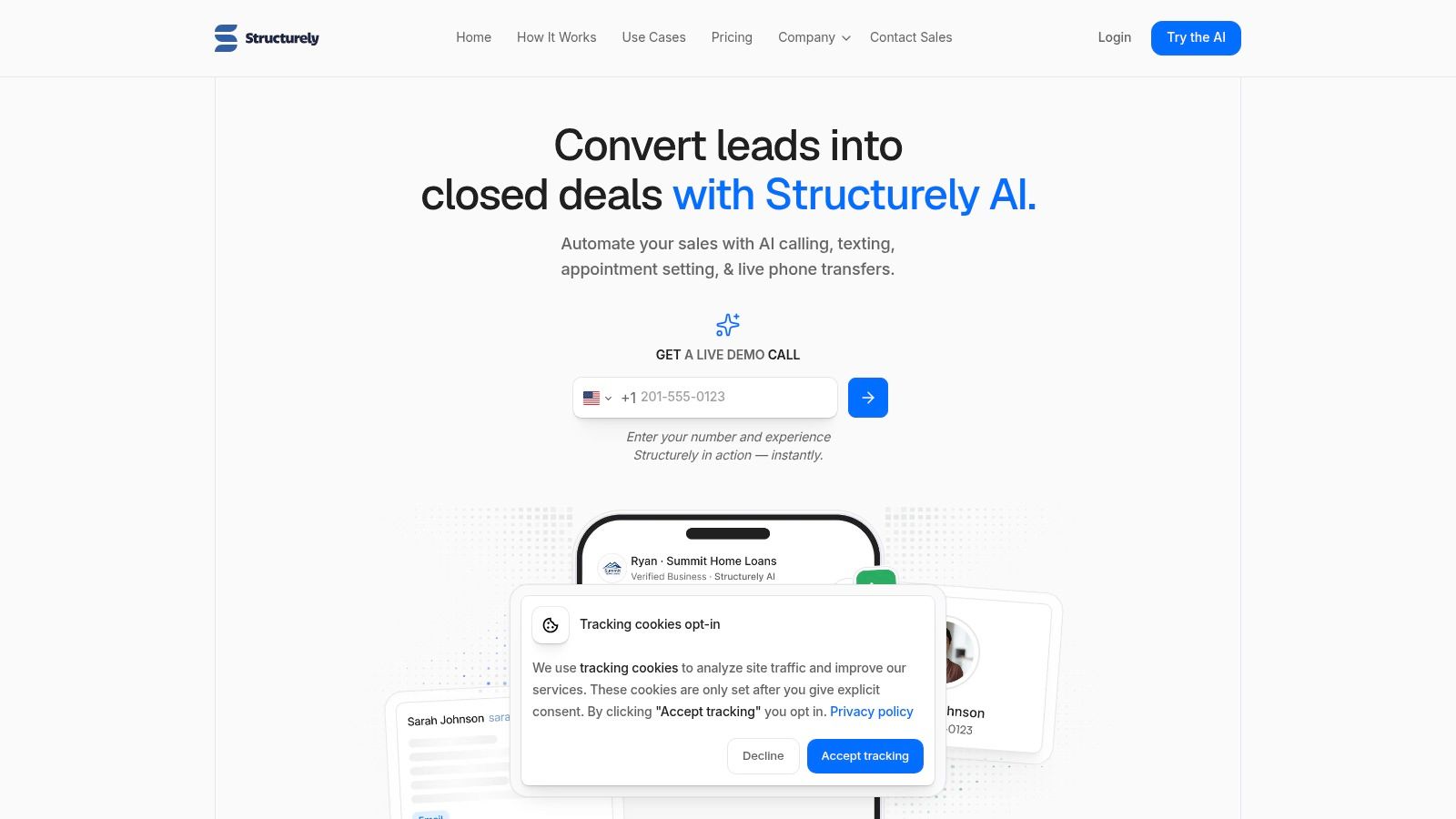
Structurely's Aisa Holmes is one of the better-known real estate AI assistants for lead qualification. It handles two-way conversations across SMS, email, and chat, with a clear job: gather intent, timeline, financing details, and hand back the lead when a human should take over.
That handoff point is what matters. Plenty of tools can answer the first message. Fewer can keep a conversation going long enough to separate casual browsing from actual readiness. Structurely is built for that middle layer.
What it does well
This tool is strongest for teams dealing with a lot of inbound leads, portal inquiries, or old database contacts that still need qualification before they reach an agent. It reduces the amount of time agents waste on people who aren't ready, while still catching the ones who become ready at odd hours.
- Multi-channel coverage: SMS, email, and chat give you more than one path to engagement.
- Real estate-specific qualification: Timeline and financing questions are central to useful triage.
- CRM integrations: Better when your ops team wants cleaner handoff and tracking.
The trade-offs are familiar in this category. Pricing usually isn't transparent, and annual agreements are common. That makes it a stronger choice for teams with lead volume than for solo agents with a smaller, more relationship-driven book.
As of 2026, AI calling in real estate has advanced to the point where tools such as Structurely can directly call leads, hold human-sounding voice conversations, qualify prospects, answer basic questions, and schedule appointments, as noted in V7 Labs' market overview of real estate AI tools. That's useful, but it also raises the bar for supervision. You still need clear escalation rules, message review, and compliance oversight.
Website: Structurely
5. Roof AI

Roof AI is a site-level assistant, not a broad business operating system. That narrower focus is its strength. If your brokerage or team site gets traffic but visitors don't convert because they don't want to fill out a form, Roof AI can create a lower-friction path into a conversation.
It's built to answer property-specific questions like price, features, availability, and open house details. That keeps the interaction useful instead of generic. A consumer asking about a property wants immediate, concrete answers. They don't want a chatbot that sounds like a customer service script.
Best fit for teams and brokerages
Roof AI makes the most sense when you manage multiple listings, multiple agents, or enough site traffic that missed chats turn into missed opportunities. Solo agents can use it, but many won't need this level of on-site automation unless they have a strong website traffic engine.
Website chat only helps if it answers real listing questions and routes people cleanly to the next step.
The practical upside:
- Property-aware conversations: Better than generic chatbot logic.
- Lead capture and routing: Useful for brokerages assigning inquiries across agents.
- Always-on coverage: Helpful outside business hours when consumers are still browsing.
The limitation is scope. If your core problem is content creation, database nurture, or pricing analysis, this won't solve it. It's a conversion-layer tool. Used in the right place, that's valuable. Used in the wrong place, it's just another dashboard.
Website: Roof AI
6. LocalizeOS
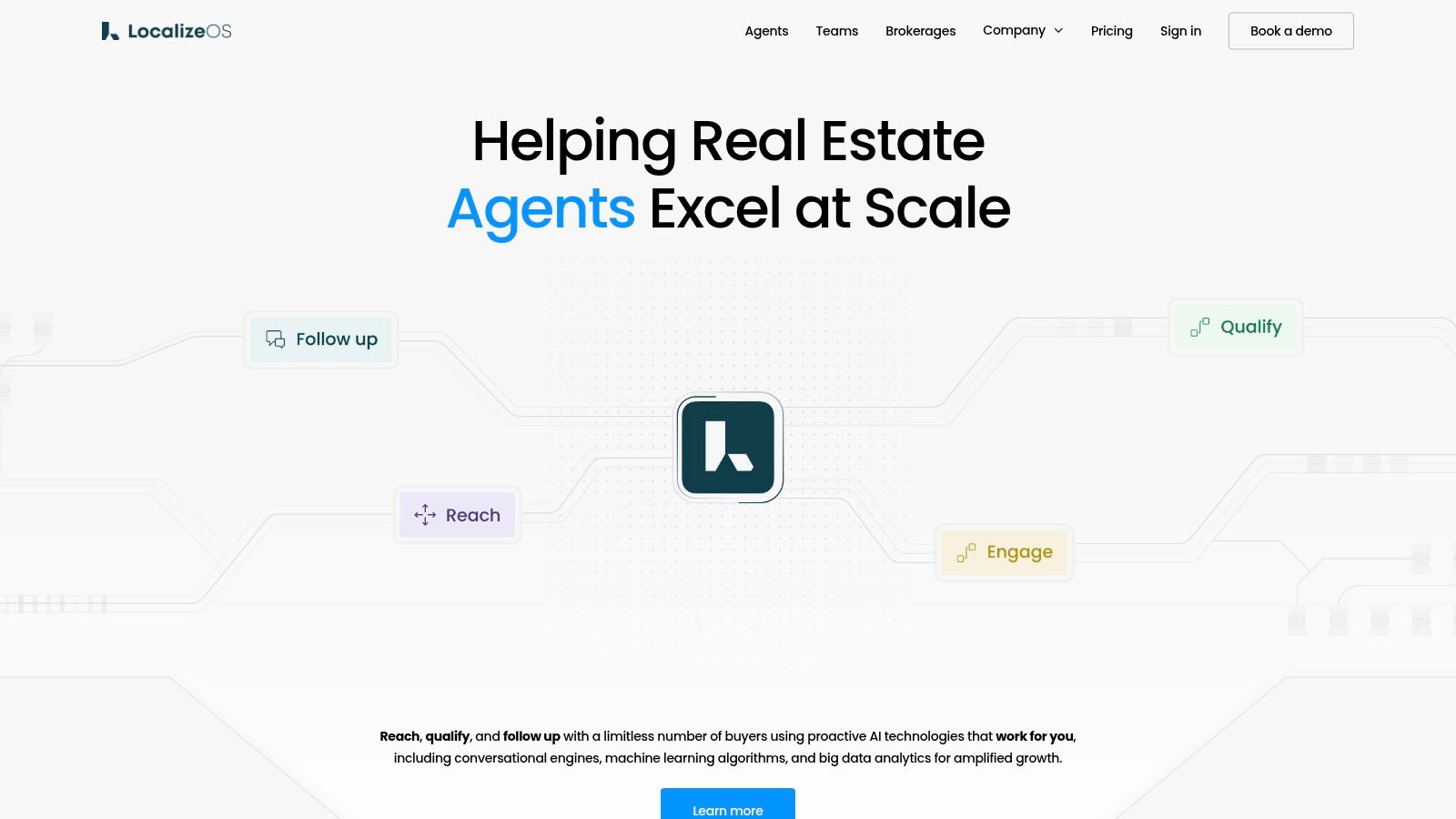
LocalizeOS, through Hunter, is built for a very specific pain point. Old buyer leads that never got properly worked, or were worked once and then ignored. This is a common issue. They have a large CRM, a lot of names, and no realistic way to follow up consistently without assigning someone to a task nobody enjoys.
Hunter handles ongoing texting, profiling, and listing matching to bring high-intent prospects back into the pipeline. That's not glamorous, but it's useful. Database reactivation often produces better conversations than cold lead generation because the contact already knows your brand.
Where it belongs in the stack
This is mostly a team and brokerage tool. If you're a solo agent with a smaller sphere-based business, it may be too much. If you're sitting on a large buyer database, it can become a steady source of resurfaced opportunities.
- Good for aged leads: It keeps the conversation going without manual effort every week.
- CRM-connected outreach: Better when your existing database is already segmented reasonably well.
- Brand continuity: Outreach can feel more consistent than ad hoc ISA work.
The caution is that this kind of system only works if your team responds when Hunter identifies a live opportunity. AI can reopen the door. It can't walk through it for you.
Website: LocalizeOS
7. HouseCanary
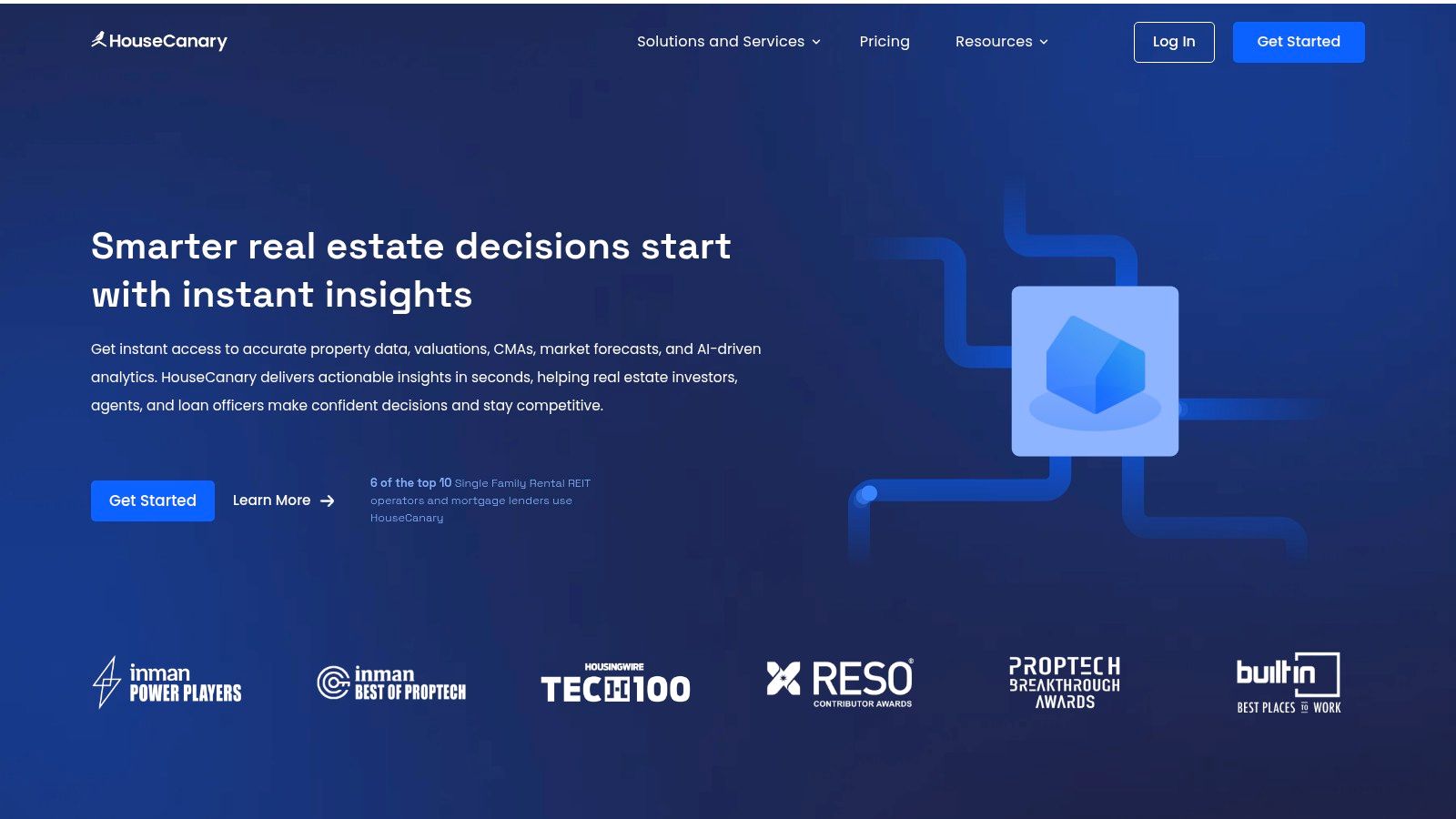
HouseCanary sits in the valuation and analytics bucket, and that's where many of the best AI tools for realtors create immediate credibility. A good pricing conversation is still one of the highest-value moments in the business. If your data support is weak, you're relying too much on confidence alone.
HouseCanary offers machine-learning AVMs, valuation ranges, confidence scores, market analytics, and an agent-facing path through CanaryAI. According to Re-Leased's overview of vertical AI in real estate, purpose-built vertical AI tools tend to outperform general AI tools because they connect directly to proprietary real estate data sources and can support tasks like audit-ready citations and extraction that generic models can't handle well. HouseCanary is a good example of why that matters.
What to expect in practice
For listing agents, this is most useful as a support layer for pricing rationale and market positioning. For investor-facing agents or analytically minded teams, it also helps with broader forecasting and opportunity spotting.
- Valuation support: Useful when you want a more defensible starting point.
- Agent access: The CanaryAI layer lowers the barrier compared with enterprise-only tools.
- Stronger than generic AI: Because the model is tied to real estate data and valuation workflows.
The main caution is cost creep. Usage-based components and add-ons can change the economics if you use the platform heavily. Also, no valuation tool replaces local judgment. It strengthens your pricing discussion. It doesn't substitute for neighborhood-level expertise, condition nuance, or live feedback from actual buyers.
Website: HouseCanary
8. Restb.ai

Restb.ai handles a part of the listing workflow that agents often underestimate. Images. Specifically, tagging rooms and features, checking image-related compliance, and generating photo captions or alt text through MLS and vendor integrations.
That sounds administrative, because it is. But admin work is exactly where AI has gained traction in real estate. PwC notes that firms are deploying AI heavily in repeatable tasks with consistent deliverables, including extraction and analytics work inside real estate operations, which fits this category well in day-to-day practice.
Why image intelligence matters
If your media workflow depends on manually labeling features, checking standards, and writing image support text, this can save real effort. It also improves consistency, especially across higher listing volume.
- Photo tagging: Reduces repetitive MLS prep work.
- Compliance support: Helpful when image metadata and standards matter.
- Accessibility support: Alt text and captions help make marketing more usable.
For solo agents, access is the main issue. Restb.ai often comes through MLS or vendor relationships rather than direct lightweight subscriptions. So the question usually isn't “Should I buy Restb.ai?” It's “Do I already have access through a platform I use?”
Website: Restb.ai
9. CubiCasa
CubiCasa is one of the easiest tools on this list to explain to a seller. It creates 2D and 3D floor plans from a quick phone walkthrough, without requiring laser hardware. That makes it a practical add-on for listings where layout clarity helps buyers understand the home quickly.
This tool isn't trying to be a full AI marketing suite, and that's a good thing. It solves one problem well. Buyers often struggle to piece together room flow from photos alone, and floor plans remove that friction.
Why agents keep using it
CubiCasa is useful because it's simple, visual, and operationally realistic. You can add floor plans to your listing media stack without introducing a complicated production process.
- Fast mobile capture: A short walkthrough can generate usable plans.
- Useful output formats: Works for branded listing media and presentation material.
- Clear consumer value: Helps buyers understand space without guessing from photos.
The downside is execution quality. Like most scan-based tools, results depend on the scan itself. Large or complex properties may require extra care, and not every home scans equally cleanly. Still, for many listings, this is one of the easier AI-assisted upgrades to justify.
Website: CubiCasa
10. REimagineHome

REimagineHome is built for virtual staging and redesign. That makes it attractive for vacant listings, dated interiors, and properties where buyers need help seeing potential. It can generate photorealistic staged or redesigned images for interiors and exteriors, and it supports batch processing, which matters if you handle listing volume.
Used carefully, this is a strong presentation tool. Used carelessly, it creates trust issues. That's the central trade-off with all AI image enhancement in real estate. The better the output looks, the more disciplined you need to be about disclosure and MLS rules.
Compliance matters more here than almost anywhere
Experienced agents must remain sharp. Image edits can improve marketing, but they can also create problems if they imply features, finishes, or conditions that aren't present. Every market has its own standards, and broker review still matters.
Generic AI tools also create risk in copy that accompanies staged visuals. CL Skills Hub's note on realtor AI tools points out that ChatGPT Plus is priced at $20 per month and does not include Fair Housing guardrails by default, so agents need to manually audit listing descriptions before publishing. That's exactly why many agents are better off pairing image tools like REimagineHome with a real-estate-specific content tool rather than relying on a generic text generator alone.
- Best use: Vacant, outdated, or visually flat listings.
- Main advantage: Faster and lower-cost than physical staging in many situations.
- Main risk: Disclosure failures and over-edited imagery.
If your work leans heavily toward listings, this roundup of the best AI tools for listing agents is a useful complement.
Website: REimagineHome
Top 10 AI Tools for Realtors, Feature Comparison
| Product | Core features ✨ | UX & Quality ★ | Price & Value 💰 | Target audience 👥 | Unique selling points ✨ |
|---|---|---|---|---|---|
| ListingBooster.ai 🏆 | Campaign-first: MLS-optimized copy, platform-native socials, print assets, Authority Builder ✨ | Fast setup (5–10 min), editable, Fair Housing checks ★★★★☆ | From ~$35–$40/mo, credit-based, 30-day trial 💰 | Solo agents, teams, brokerages 👥 | AI-optimized for ChatGPT/Google AI discovery, scalable campaigns, compliance-focused 🏆 |
| RPR (Realtors Property Resource) | Nationwide parcel data, AI Market ScriptWriter, CMA tools ✨ | Standardized client-ready reports, enterprise UI ★★★★ | Included with NAR membership (no extra sub for many) 💰 | NAR REALTORS, listing/pricing specialists 👥 | Recognized, standardized reports and deep U.S. coverage ✨ |
| Ylopo (RAIYA AI Text + Voice) | AI text + voice outreach, IDX triggers, branded IDX sites ✨ | Purpose-built funnel tools, multi-channel nurture ★★★★ | Package-based pricing; demos often required 💰 | Teams/agencies focused on lead conversion 👥 | Full-funnel automation with AI voice/SMS and IDX-driven triggers ✨ |
| Structurely (Aisa Holmes) | Two-way AI conversations via SMS, email, chat; CRM integrations ✨ | Strong lead-qualification, reduces unqualified leads ★★★★ | Annual contracts common; pricing via sales 💰 | Teams, high-volume agents, enterprises 👥 | Deep qualification logic and white-label/enterprise options ✨ |
| Roof AI | Property-aware Q&A, lead capture, MLS/property lookups ✨ | 24/7 on-site engagement, reduces form friction ★★★★ | Custom pricing via sales; scales by volume 💰 | Brokerages and teams with heavy web traffic 👥 | Pre-trained real-estate intents and seamless lead routing ✨ |
| LocalizeOS (Hunter) | Ongoing AI texting, profiling, listing-matching ✨ | Persistent re-engagement that lifts ROI ★★★★ | Custom/demo pricing; sold via sales 💰 | Teams/brokerages with large databases 👥 | Scales long-term follow-up and returns high-intent prospects ✨ |
| HouseCanary | ML AVMs, CMAs, propensity-to-list, APIs ✨ | Defensible valuations and analytics for pricing talks ★★★★ | Usage/add-on costs; agent tier available (from ~$19/mo promoted) 💰 | Agents needing valuation & analytics, developers 👥 | Machine-learning AVMs + developer APIs for deep integration ✨ |
| Restb.ai | Computer vision: room/feature tagging, photo compliance, alt-text ✨ | Cuts manual tagging, improves image metadata ★★★★ | Enterprise/MSL-level pricing; partner access common 💰 | MLS vendors, brokerages, listing platforms 👥 | Automated photo tagging, compliance checks, SEO/ADA boosts ✨ |
| CubiCasa | Mobile 2D/3D floorplans from phone scans, fast turnaround ✨ | Quick 5–10 min scans, per-order UX ★★★★ | Per-scan pricing; free/LITE and PLUS options 💰 | Agents/photographers needing floorplans 👥 | No-hardware mobile scans with branded exports and fast delivery ✨ |
| REimagineHome | Photorealistic virtual staging, bulk processing, design presets ✨ | Affordable, fast virtual staging with batch workflow ★★★★ | Credit-based plans; extra credits for high volume 💰 | Agents, photographers, listing marketers 👥 | High-quality virtual staging at scale with batch workflows ✨ |
Final Thoughts
Monday at 8:15 a.m., three leads came in overnight, a seller wants pricing support before noon, and a new listing still needs remarks, visuals, and a floor plan. The right AI stack should reduce that pileup, not add another dashboard to babysit.
A useful setup usually follows the work itself. Use one tool for listing content and visibility, one for lead response or nurture, one for pricing and market support, and a visual tool only if it solves a real marketing problem in your listing mix.
Keep the adoption test simple. A tool should save noticeable time each week, connect to the systems you already use, let you fully edit anything client-facing, and support Fair Housing safe workflows, according to Build Inc.’s criteria for viable agent adoption. If it creates extra review work, weakens message control, or leaves compliance questions unanswered, skip it.
A practical stack by workflow
- Content and visibility: ListingBooster.ai
- Pricing and market support: RPR or HouseCanary
- Lead qualification: Structurely, Ylopo, Roof AI, or LocalizeOS, based on lead volume and team setup
- Visual enhancement: CubiCasa, Restb.ai, and REimagineHome, if they support your listing process
Start with the bottleneck that costs you time or deals. If listings drive your business, fix content production and campaign execution first. If internet leads go cold, start with response speed and long-tail nurture. If sellers push back on price, invest in stronger valuation support and reporting.
Use fewer tools well.
Compliance still sits over all of it. AI-written copy, image edits, and automated text follow-up still run through your license and your brokerage. Keep language focused on the property, measurable features, condition, layout, lot, and location facts that are safe to describe. Do not describe the type of buyer, tenant, family, or lifestyle the home is "for."
The broader pattern is clear. Firms use AI well for repeatable tasks, data-heavy analysis, and first-draft production. Agents still need to own judgment, advice, negotiation, and final review. That is the profitable split, and it is also the safer one.
For many agents in 2026, a purpose-built real estate platform is the cleanest first step. Add specialized tools only when they solve a defined workflow problem and fit your compliance process.
If you want a straightforward starting point, ListingBooster.ai is a practical first test. It is built for real estate listing and authority content, and it keeps final editing in the agent's hands. For agents, teams, and brokerages trying to publish consistently while keeping compliance in view, it deserves a close look.
Walk In With the Campaign Already Built
Listing copy, social posts, sourced Market Insights, growth scheduling, and direct publishing after approval from one real-estate-specific system. 25 free credits to start.
Related Posts
 Uncategorized
Real Estate Content Marketing: The 2026 Playbook
Listings with video can generate 49% more qualified leads, according to a 2026 real estate digital marketing roundup. That figure changes the question. Real estate content marketing isn't about how often you post. It's about whether your listing, expertise, and local knowledge can be found, understood, and cited by people and by the AI tools […]
 Uncategorized
AI for Real Estate Marketing: A Practical Playbook
A new listing goes live on Tuesday morning. You write the description from memory, schedule three social posts, answer showing requests, and move on to the next client task. By afternoon, the listing has plenty of activity on your side of the business, but the phone still isn't producing the conversations you expected. That gap […]
 Uncategorized
What Is IDX and Why It Still Matters for Real Estate
A new agent usually hears “IDX” during a brokerage onboarding call, nods along, and hopes nobody asks for a definition. Then the questions arrive: Why are listings appearing on the website? Who controls the data? Why did a property remain visible after its status changed? And will the same pages be readable by ChatGPT, Perplexity, […]