Your AI-Powered Real Estate Listing Marketing Plan for 2026

You've probably lived this week already. A listing agreement gets signed, photos are getting scheduled, the seller wants to know exactly how you'll promote the property, and your team starts assembling the usual stack: MLS copy, social posts, an email blast, an open house graphic, a flyer, and maybe a video if someone has time.
That scramble used to be normal. It's still common. But it's no longer efficient, and what's more, it's no longer enough.
A modern real estate listing marketing plan has to do two jobs at once. It has to persuade human buyers on the channels they already use, and it has to make your listing and your brand understandable to AI-driven search tools that summarize, recommend, and filter options before a buyer ever clicks through. If your workflow still depends on disconnected vendors, manual copywriting, and last-minute posting, you're losing time, consistency, and visibility.
The agents getting traction now aren't necessarily creating more content by hand. They're building systems that turn one listing into a month of compliant, channel-specific marketing assets that stay on brand and support measurable ROI.
Why Your Current Listing Marketing Plan Is Becoming Invisible
Most agents still build a listing campaign for platforms they can see. Instagram. Facebook. The MLS. An email newsletter. Maybe a property website. That checklist feels productive because it's familiar.
The problem is that buyer discovery has changed faster than most listing workflows. Existing marketing plans often focus on traditional SEO and social posts, but they miss the schema markup, natural-language descriptions, and digital footprint work that help agents appear in AI search results. That gap matters because AI search engines now dominate 40% of buyer searches, according to Marq's discussion of AI search visibility in real estate marketing.
AI search doesn't behave like old search
Google used to reward the page that ranked. AI tools reward the source they can interpret with confidence.
When a buyer asks ChatGPT or Perplexity a question like “Which agents market homes well in North Dallas?” or “Show me a renovated three-bedroom home near downtown with a yard and modern kitchen,” the answer isn't a page of blue links. It's a summary. A recommendation set. A narrative response built from structured signals across the web.
That changes what a real estate listing marketing plan has to accomplish.
- Your listing copy must be readable by AI. That means clean property facts, natural descriptions, and consistent wording across channels.
- Your digital footprint has to match. If your website says one thing, social captions say another, and portal descriptions are thin or generic, AI has less confidence in surfacing you.
- Your content has to exist beyond launch day. One “just listed” post isn't a marketing plan. It's a moment.
If you want a useful refresher on channel-level execution, these actionable real estate marketing tactics are worth reviewing. The missing piece is connecting those tactics into a system that also works for AI discovery.
Practical rule: If your marketing only works when someone scrolls directly onto your post, it's too fragile for the current search environment.
Old checklists are still busy. They're just less effective
A lot of listing plans still look polished on paper and underperform in practice. They rely on a burst of activity at launch, then fade into inconsistent follow-up. They generate assets manually, which means quality depends on how busy the agent is that week. They're built for platforms, not for discoverability.
That's why so many otherwise capable agents feel like their effort isn't compounding. They are working. Their content just isn't being assembled in a way that machines can interpret and buyers can keep finding.
A real estate listing marketing plan for the current market has to be built as a repeatable content engine, not a launch checklist.
The Blueprint for an AI-First Marketing Plan
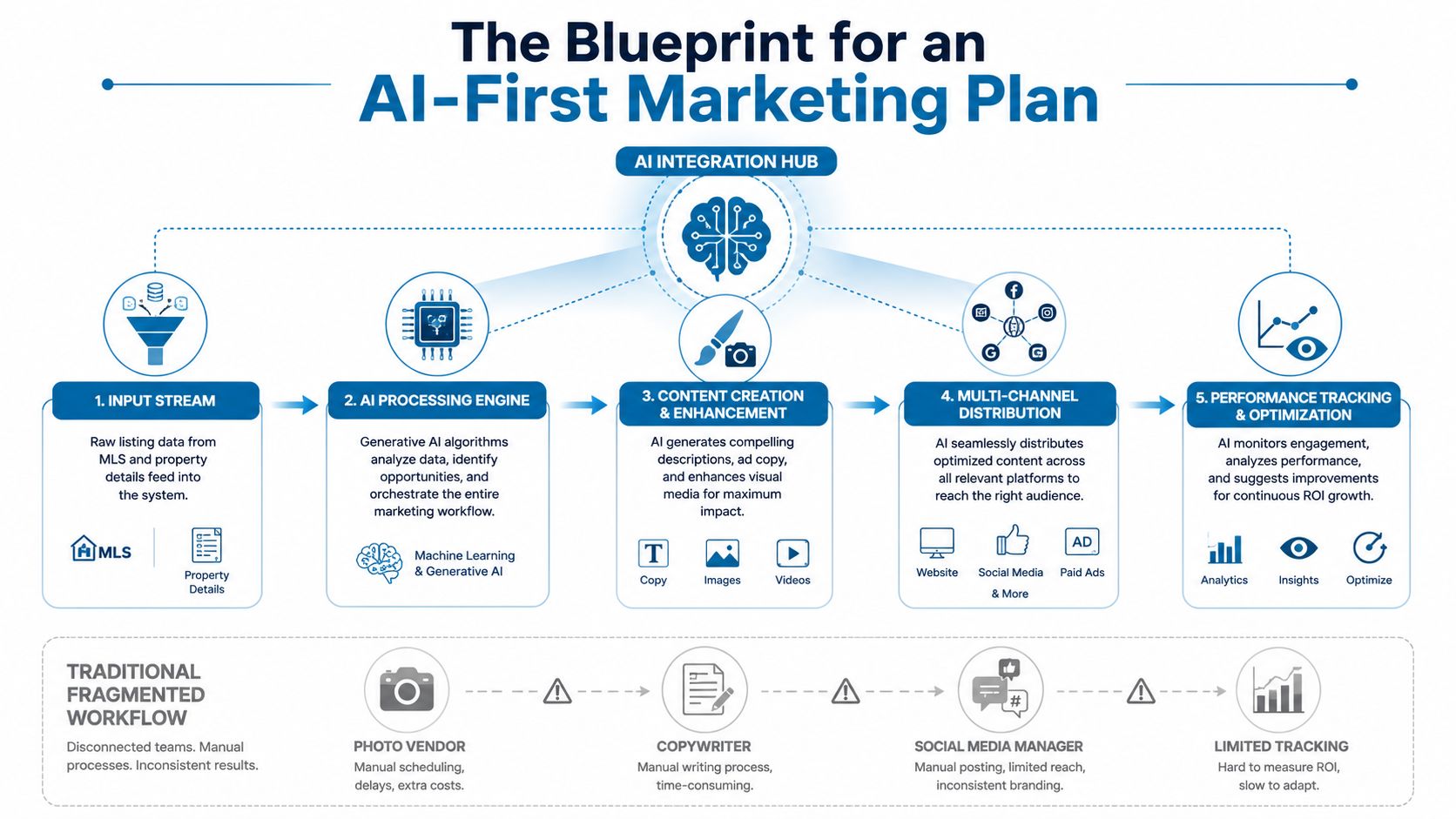
The old workflow is fragmented. You book a photographer. You draft MLS remarks. You ask someone on the team to make social graphics. You rewrite the same property story three times for different platforms. Then you try to remember what was posted, what still needs an email, and whether the property page is doing any heavy lifting.
An AI-first workflow starts from a different assumption. The listing is the core asset. Everything else should be generated, adapted, distributed, and tracked from that source.
Start with assets that actually matter
No AI tool can rescue weak inputs. The foundation is still visual quality, accurate property data, and a dedicated destination page for the listing.
Listings with high-quality professional images sell 68% faster than listings without them, according to Matterport's real estate marketing plan guidance. That isn't a nice-to-have. It's the baseline.
A strong listing asset stack usually includes:
- Professional photography. Not just enough photos, but the right photos, edited consistently and sequenced well.
- Structured property details. Address, bed and bath count, lot details, major upgrades, room highlights, school or location facts stated carefully and factually, open house times, and showing instructions.
- A dedicated property page. The page should hold the full story with rich media such as virtual tours, floor plans, and high-resolution visuals, rather than sending traffic to a generic homepage.
- Image metadata. Clear file names and alt text help search engines and accessibility tools understand what each image represents.
Build once, adapt many times
This shift is operational. Instead of writing separate pieces from scratch, you create one source package and let AI produce channel-specific variants.
That source package should feed:
| Core listing input | AI output |
|---|---|
| Property facts | MLS-ready description |
| Photo set | Social captions and graphic prompts |
| Listing page copy | Email teaser and website content |
| Open house details | Event posts and reminder copy |
| Status changes | Pending and sold announcements |
Purpose-built real estate tools differ from generic chatbots. A generic tool can produce text. It usually doesn't understand MLS tone, Fair Housing boundaries, listing status transitions, or the need to turn one property into a coordinated campaign. ListingBooster.ai is one example of a real-estate-specific system built around that workflow, generating listing descriptions and social content from property inputs rather than requiring agents to invent every asset manually.
The operating model matters more than the prompt
Agents often ask whether they can do this with ChatGPT plus a few templates. Technically, yes. Operationally, it gets messy fast.
You still need to control brand voice, route approvals, keep required disclosures in place, and make sure each format is suited to the platform. If you're evaluating how AI should publish and manage content safely across channels, Mallary.ai's AI social media guide is a practical read because it focuses on workflow discipline instead of novelty.
The winning setup isn't “AI writes a caption.” It's “the listing generates a complete campaign without forcing the agent to rebuild the story every time.”
What an AI-first plan includes
A workable real estate listing marketing plan now has five connected layers:
Capture the listing cleanly
Pull in property facts, visual assets, status, dates, and any seller-approved notes.Generate a master narrative
Create the central property story in natural language, grounded in features, finishes, layout, and location details.Transform that narrative into channel variants
Produce social captions, email copy, listing descriptions, ad copy, open house promos, and follow-up status posts.Publish to multiple destinations
Send traffic to the dedicated property page, not a catch-all homepage.Track response by source
Attribute inquiries, appointments, and downstream outcomes to the content and channel that produced them.
Agents who adopt this model don't just save time. They get consistency. Their seller presentations improve because they can show a complete plan. Their team execution gets tighter because everyone works from the same source material. And their listings become easier for both buyers and AI tools to understand.
How One Listing Becomes a 30-Day Content Campaign
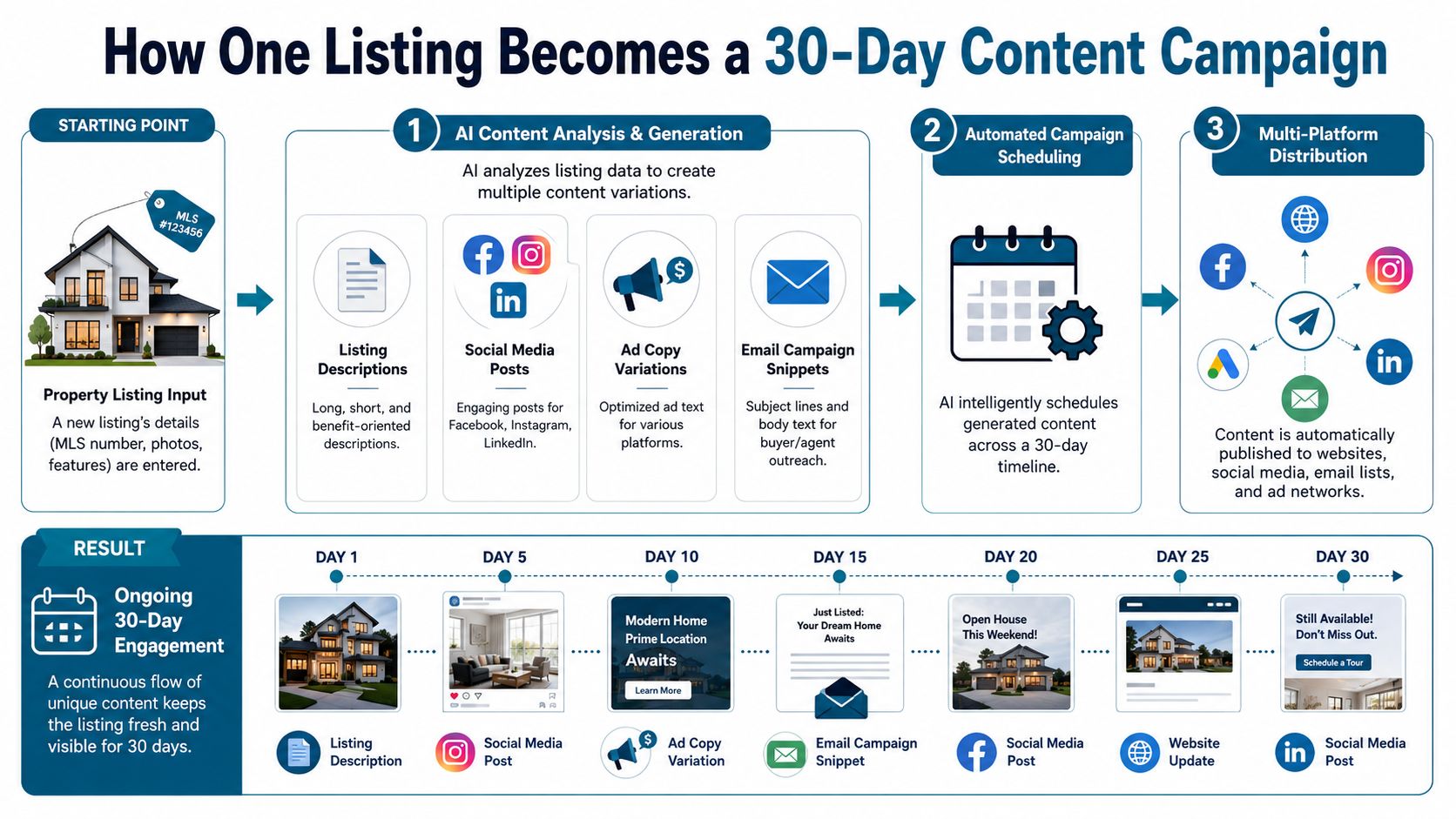
The easiest way to understand a modern real estate listing marketing plan is to stop thinking in assets and start thinking in campaign arcs. One property should create enough raw material to support launch, engagement, reminders, event promotion, status updates, and post-sale authority content.
That doesn't mean posting the same photo with a different caption over and over. It means extracting distinct angles from the same listing and assigning each angle to a different moment in the month.
Start with the property record, not a blank page
Take a newly signed listing. You upload the address or MLS details, the photo set, the core features, any notable upgrades, showing notes, and the open house schedule if you have it.
From there, the campaign should branch into six practical content streams.
1. The listing description
This is the anchor piece. It has to work for the MLS, for portal syndication, for your property page, and for AI search interpretation.
Good listing copy does three things well:
- It describes the property by features. Layout, materials, updates, light, outdoor space, storage, and functional details.
- It avoids audience assumptions. No language about who should live there.
- It creates scan-friendly structure. Buyers and AI systems both respond better to clear, factual, natural phrasing.
A compliant example angle might read like this:
Renovated kitchen with quartz surfaces, updated lighting, and an open connection to the main living area. The primary suite includes a reworked bath and improved storage. Outdoor features include a covered patio, fenced yard, and recent landscaping.
Nothing in that copy relies on hype or protected-class implications. It provides useful information.
Turn launch week into multiple stories
The first mistake agents make is treating “Just Listed” as a single post. It should be a sequence.
Short-form video is especially important here. In the pre-listing phase, mobile-first vertical short-form video drives 403% more inquiries and can lead to 6% higher sale prices compared to static listings, according to Reel Estate AI's real estate marketing statistics roundup. That's why launch content should be designed for phones first.
A practical launch week might look like this:
Day 1 just listed post
A broad introduction with the hero exterior image and a clear CTA to view the full property page.Day 2 room highlight post
Focus on the kitchen, living area, or primary suite. One feature, one visual story.Day 3 short-form video
A vertical walk-through teaser with text overlays that surface key facts immediately.Day 4 email teaser
A tight subject line, a short body, one image, and a direct link to the property page.Day 5 market-angle post
Position the home within current local inventory, carefully and factually, without making future-value claims.Day 6 open house announcement
Event details, parking or access notes if relevant, and a simple invitation to tour.Day 7 reminder post
A last call before the open house with a different image and a different angle.
What the content actually looks like
Agents need output, not theory. One listing can produce varied content such as:
| Content type | Example angle |
|---|---|
| Just listed caption | New to market with updated interiors and a flexible floor plan |
| Email teaser | New listing with refreshed kitchen, outdoor living space, and weekend tour times |
| Open house copy | Tour the home in person and review updates, layout, and outdoor features |
| Pending post | Under contract with continued demand in the area |
| Sold post | Closed successfully with a tailored launch-to-close campaign |
| Market insight post | What buyer response to this listing says about current demand for updated homes |
Each piece should sound different because each serves a different purpose. Launch content creates awareness. Open house content drives attendance. Pending and sold content build authority and neighborhood visibility. Market insight content helps sellers understand how you think.
For agents who want a planning template for spacing these posts across the month, this real estate content calendar for agents is a useful companion.
Post variety matters more than post volume. Buyers tune out repetition quickly, but they respond to new angles on the same property.
Use strategic omission when the platform calls for it
Not every platform should get the full information set upfront. Standard advice says more photos create more interest. In practice, some channels reward restraint.
On Facebook Marketplace, many agents find that teaser-style presentation creates stronger inquiry behavior than fully revealing every decision-making detail in the preview. One useful tactic is to hold back a major image, such as the kitchen or primary bedroom, and let the initial Marketplace preview lead with exterior shots and a clear value hook. The goal isn't to be vague. It's to create enough curiosity to move a buyer into a message, click, or tour request.
That's the kind of judgment a good campaign needs. Distribution shouldn't be robotic. It should be adaptive.
The middle of the month is where automation pays off
Once launch week passes, most listings go quiet. That's a mistake. The middle stretch is where consistent content keeps a property discoverable and keeps your brand in front of future sellers.
A single listing can generate mid-cycle posts like:
- Feature spotlight posts that rotate through kitchen, outdoor area, bath updates, floor plan flexibility, and storage
- Behind-the-scenes posts showing preparation, staging details, or photography day notes
- Open house countdown posts with different visuals and short, direct copy
- Agent insight posts about how the listing was positioned and marketed
- Status-change copy ready to publish the moment the listing moves to pending
A product-led workflow saves real time. Instead of inventing content after each showing or schedule change, the campaign already exists. You edit, approve, and deploy.
Don't waste the post-sale moment
Many agents stop marketing when the contract is signed. That leaves a lot on the table.
The post-sale stage should include:
Pending announcement copy
Useful for social proof and seller confidence in nearby homeowners.Just sold content
Framed around execution, presentation, and process, not exaggerated claims.Market insight commentary
A short post on what buyer engagement revealed about demand for similar homes in that area.Neighbor-facing follow-up
Clean, factual communication that invites nearby owners to ask what's moving in the current market.
Done well, one listing doesn't just sell one home. It fills your pipeline, supports your authority, and gives you a reusable content engine.
Mastering Compliance and AI Search Optimization
Most AI marketing mistakes in real estate don't happen because the tool wrote awkward copy. They happen because the tool wrote risky copy.
Generic AI systems don't understand the pressure points of real estate advertising unless the user catches them. They'll often mirror bad prompts, amplify subjective claims, or produce language that creates Fair Housing exposure. That's not a minor editing issue. It's a workflow flaw.
Feature-based writing keeps you out of trouble
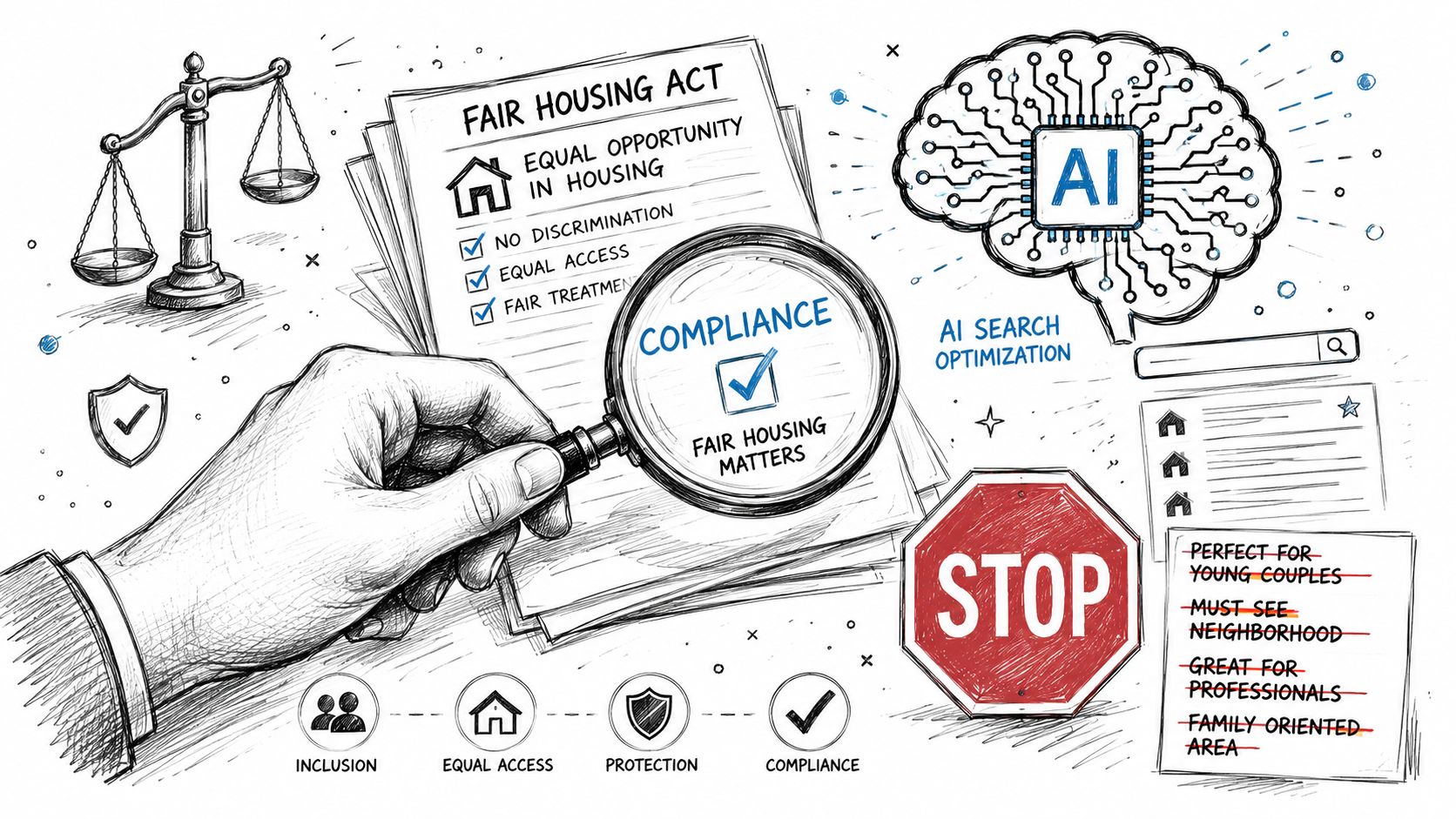
The fastest way to create compliance risk is to write for a person instead of for the property.
“Perfect for families.” “Ideal for young professionals.” “Safe area.” “Walk to church.” Those phrases are common. They're also exactly the kind of language agents need to remove from an AI-assisted process.
A compliant system should generate copy around:
- Property features such as layout, finishes, lot size, storage, views, and outdoor elements
- Objective location details such as proximity to transit, parks, dining, or major routes, stated factually
- Verifiable upgrades such as new roof, updated kitchen, or renovated bath, if documented
- Event and access information such as open house timing or tour instructions
California's advertising guidance also requires claims to be accurate and verifiable, and it specifically warns against unsupported statements about value or future market performance. In Texas, advertising rules require the broker's name to appear clearly and at a specific size relationship in ads. State-level requirements vary, which is another reason generic AI needs supervision before anything goes live.
Disclosure requirements have to be built into the workflow
For REALTORS®, disclosure isn't optional or platform-specific. Under the NAR Internet Advertising Policy, every page marketing properties or services must disclose the agent's full name, the brokerage name, the office city and state, and the jurisdictions where the agent holds a license, as outlined in NAR's Internet Advertising Policy.
That matters for websites, landing pages, listing pages, and any AI-generated property marketing that lives on a page of its own.
A lot of agents remember to add this on their main site and forget it on standalone listing pages or campaign pages. AI-generated content needs those fields wired in automatically, not added manually when someone remembers.
If your AI can generate a property page but can't reliably place required advertising disclosures on that page, it isn't ready for production use.
For a practical reference on where AI-generated content can drift into Fair Housing risk, this Fair Housing guide for AI-generated real estate content is worth keeping handy for your team.
AI search optimization is really structured clarity
A lot of “AI optimization” talk gets abstract fast. In practice, it's straightforward.
AI systems surface content they can classify confidently. That means your property marketing should tell the machine, clearly and consistently, what the page is, who it's from, and what facts it contains.
That usually includes:
| Element | Why it matters |
|---|---|
| Clear property page title | Helps identify the listing and location |
| Natural-language description | Gives context in readable form |
| Consistent agent and brokerage information | Reinforces authorship and trust |
| Rich media on the listing page | Expands the page beyond thin text |
| Schema markup | Signals that the page represents a property for sale or related real estate content |
Many generic tools fall short; they can draft text, but they don't help you create the full package that supports AI discoverability. A specialized real estate workflow is better suited to handling property context, disclosures, and structured output together.
Compliance and visibility are linked
Agents often treat compliance as the brake and marketing as the gas. In reality, clean compliance improves visibility because it forces clearer language, cleaner structure, and more consistent attribution.
The same discipline that keeps you from writing a risky caption also helps AI systems understand your content better. Feature-based copy is easier to classify. Required disclosures strengthen trust signals. A dedicated property page with rich media gives search systems more context.
That's why the right setup isn't just “AI plus review.” It's AI trained and structured for real estate from the start.
Evaluating AI Solutions and Measuring True ROI
The AI tool market is crowded, and most demos look better than real daily use. The useful question isn't whether a platform can generate text. Nearly all of them can. The question is whether it fits the way a real estate listing marketing plan runs.
A buyer's checklist for AI marketing tools
When agents evaluate AI tools, I recommend ignoring the flashy output for a minute and checking the workflow requirements first.
Ask these questions:
Is it built for real estate?
A general writing assistant may help with rough drafts, but it usually won't understand listing statuses, portal copy, open house promotion, or brokerage-level compliance needs.Does it support compliant content creation?
Real estate marketing needs guardrails around audience language, subjective claims, and disclosures.Can it create a full campaign from one listing?
If the system still forces you to rebuild every caption, email, and status update from scratch, the time savings won't hold up in practice.Does it support AI-readable output?
Your workflow should help create property pages and content structures that machines can interpret, not just people.Can your team use it under pressure?
The right tool has to work when a listing goes live, price changes, or an open house gets added late.
A lot of brokers are also asking a broader business question right now, not just a marketing one. This overview on understanding AI's profitability is useful because it frames AI as an operational investment, not just a novelty purchase.
Stop measuring likes as if they're the goal
A weak AI setup can still produce posts that look active. That doesn't mean it's producing business.
The average real estate sector conversion rate is 2.8% to 4.7%, and success should be measured by tying every lead and appointment directly to the marketing spend that generated it, as noted in SearchLab's real estate marketing statistics. That standard changes how you judge a listing campaign.
A useful scorecard looks more like this:
| Measure | Why it matters |
|---|---|
| Inquiries by source | Shows which channels produce real response |
| Appointment bookings | Tells you whether content is moving people to action |
| Showing requests | Reflects listing-level intent better than likes |
| Lead-to-appointment path | Exposes friction in follow-up or landing pages |
| Cost tied to each inquiry and appointment | Reveals what spend is actually productive |
| Closings attributed to campaign source | Validates ROI at the business level |
What to track inside the campaign
Real estate marketing gets blurry when all traffic lands in one place and everything shows up as “direct.” That's why disciplined attribution matters.
At minimum, your workflow should answer:
- Which post or email produced the click?
- Which landing page produced the inquiry?
- Which inquiry became a conversation, showing, or appointment?
- Which appointments closed?
If you can't answer those four questions, your reporting is too shallow. You're measuring activity, not outcomes.
For teams refining this process, these real estate marketing ROI tools can help shape a cleaner tracking setup.
The metric that matters isn't “Did people engage with the content?” It's “Which content produced the next business step?”
Budget discipline still matters
AI can lower the time cost of marketing, but it doesn't remove the need for budget decisions. Many agents still use the general rule of thumb to allocate around 10% of annual revenue to marketing, which gives structure to choices around media, campaigns, and support tools. What changes with AI is how much output you can produce from the same input and how consistently you can execute it.
That's the ROI case. Better throughput. Better consistency. Better attribution. Fewer bottlenecks around launch week.
Building Your Automated Marketing Machine
A real estate listing marketing plan used to be a checklist. Schedule photos. Write the description. Post the listing. Send the email. Promote the open house. Update the status. Repeat.
That manual model still works in the narrowest sense. Homes still get marketed. But it doesn't scale well, it breaks under volume, and it leaves too much to memory and improvisation.
What the better system looks like
An automated marketing machine does a few things differently:
- It centralizes the listing story so your MLS copy, property page, social posts, and email all come from the same source.
- It keeps compliance close to the workflow so disclosures and feature-based language don't depend on last-minute edits.
- It turns one listing into sustained visibility rather than a burst of launch-day activity.
- It makes ROI review possible because your content, pages, and campaigns are built with attribution in mind.
The bigger shift is strategic. When your system creates a month of content from one listing, your marketing stops being reactive. Sellers feel that difference immediately. Teams feel it in consistency. Brokerages feel it in lower content chaos and fewer compliance surprises.
Audit the process you're running now
If you want to improve your current plan, start with simple questions:
- Where are you rewriting the same property story repeatedly?
- Which assets get created late because no one owns them?
- Which pages or posts go live without complete disclosures?
- What happens after the “just listed” moment passes?
- Can you connect content output to appointments and closings?
Those answers usually reveal the bottleneck quickly. It's rarely a lack of effort. It's usually a lack of system design.
The agents who stand out now aren't just better at posting. They're better at building a repeatable machine that makes every listing more discoverable, more consistent, and easier to market without starting from zero each time.
If your current workflow still depends on scattered drafts, rushed captions, and manual follow-up, it's worth taking a close look at ListingBooster.ai. It's built specifically for real estate agents, teams, and brokerages that want to turn one property into a full set of compliant listing descriptions, social posts, and campaign assets without rebuilding the marketing plan from scratch every time.
Walk In With the Campaign Already Built
Listing copy, social posts, sourced Market Insights, growth scheduling, and direct publishing after approval from one real-estate-specific system. 25 free credits to start.
Related Posts
 Uncategorized
Real Estate Content Marketing: The 2026 Playbook
Listings with video can generate 49% more qualified leads, according to a 2026 real estate digital marketing roundup. That figure changes the question. Real estate content marketing isn't about how often you post. It's about whether your listing, expertise, and local knowledge can be found, understood, and cited by people and by the AI tools […]
 Uncategorized
AI for Real Estate Marketing: A Practical Playbook
A new listing goes live on Tuesday morning. You write the description from memory, schedule three social posts, answer showing requests, and move on to the next client task. By afternoon, the listing has plenty of activity on your side of the business, but the phone still isn't producing the conversations you expected. That gap […]
 Uncategorized
What Is IDX and Why It Still Matters for Real Estate
A new agent usually hears “IDX” during a brokerage onboarding call, nods along, and hopes nobody asks for a definition. Then the questions arrive: Why are listings appearing on the website? Who controls the data? Why did a property remain visible after its status changed? And will the same pages be readable by ChatGPT, Perplexity, […]