What Is DOM in Real Estate and How It Shapes Pricing

DOM in real estate is the number of days a listing stays publicly active in the MLS, from Active to Pending, Under Contract, or another removal status. Lower DOM usually points to stronger demand, while higher DOM usually signals pricing friction or softer buyer urgency.
A seller asks why the listing feels stale after a few weeks. A buyer wonders what they're missing when a home keeps sitting. That's when DOM becomes more than a number, it becomes the language everyone in the deal is already speaking.
When a listing starts to linger, the market starts asking questions. Agents who can translate DOM clearly tend to protect pricing power better, set expectations earlier, and avoid the trap of treating a timing signal like a verdict on the property itself.
Why Days on Market Feels Like a Report Card for Your Listing
A home goes live, the first weekend comes and goes, and the seller starts asking why the phone isn't ringing. Buyers notice the same thing from the other side, because a listing with a longer run time starts to feel like it has a story attached to it. In practice, DOM becomes the first public clue that tells people whether the market is leaning in or backing away.

That's why experienced agents treat DOM like a report card, even though it's really a timing signal. A shorter clock usually gives you more room to hold price and frame urgency. A longer clock means the conversation changes, because buyers start asking whether the home is overpriced, under-marketed, or out of sync with the current pace.
The story buyers read into the clock
DOM shapes perception before it shapes negotiation. A fresh listing signals momentum, while an older one invites comparison shopping and conditional offers. That shift happens fast, and it often has less to do with the home's absolute quality than with how long it has been exposed to the market.
Buyers don't need a full inspection report to form an opinion. A long visible market time can be enough to make them slow down, ask more questions, and push harder on terms.
For sellers, that means the first impression isn't only photos and remarks. It's also the speed at which the listing appears to be moving. For agents, the job is to control the narrative early, so DOM reflects strategy instead of sounding like an after-the-fact excuse.
What DOM Means and How the Clock Works
DOM is a listing-level clock, not a property biography. It tracks how long a home is publicly active in the MLS, starting when the listing goes live and stopping when the status changes to sold, pending, under contract, or when it's taken off the market. A clean way to think about it is a stopwatch, not a lifetime record.
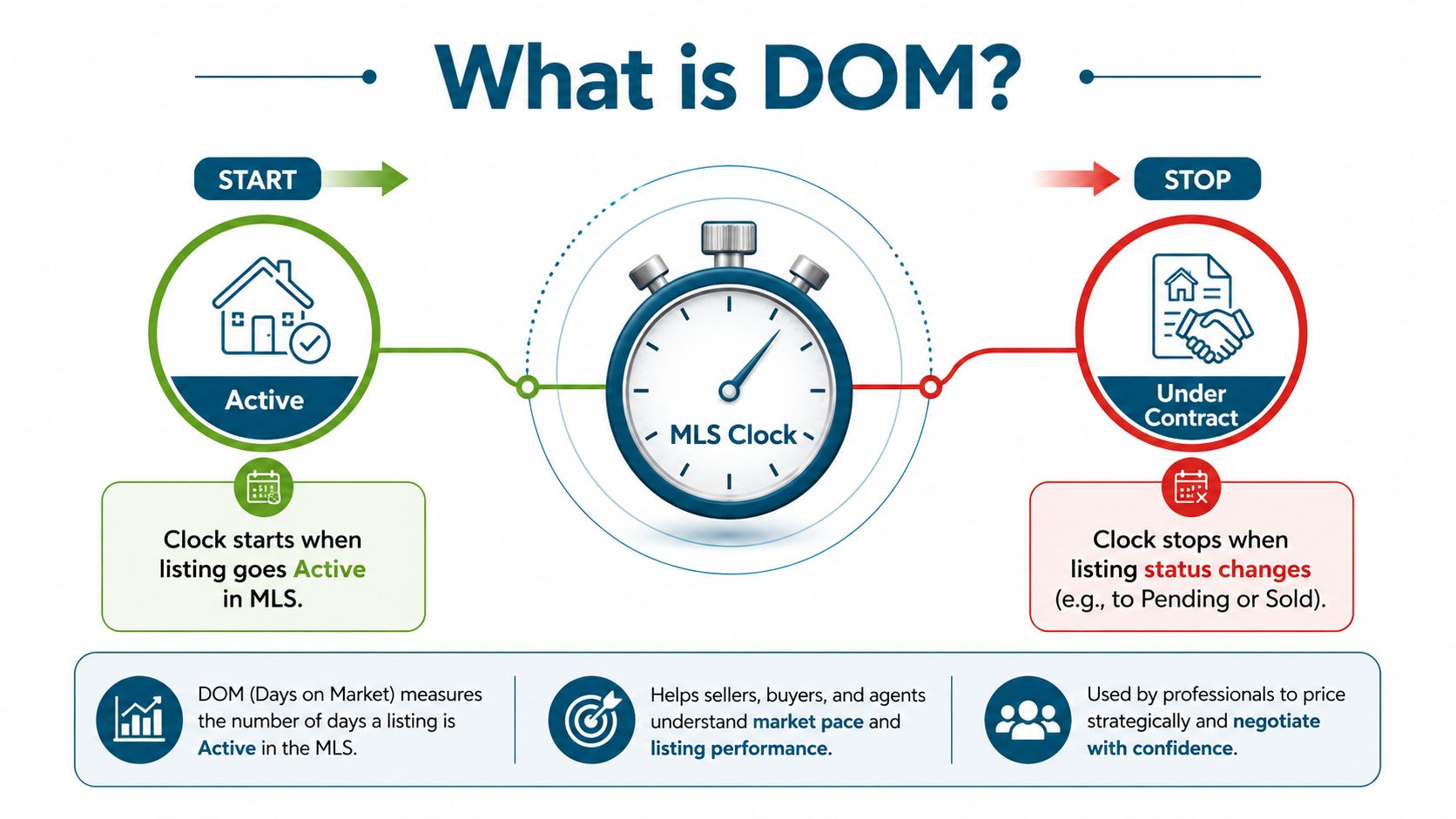
That distinction matters because agents sometimes talk about DOM as if it tells the whole story. It doesn't. A property can be listed, withdrawn, relisted, and marketed again, and the public-facing DOM may not show what happened in between unless you look at the MLS history and the local rules behind the number.
DOM versus CDOM
Cumulative DOM, or CDOM, is the stronger historical measure because it keeps track of market exposure across relistings, while simple DOM can reset when a new listing starts. DOM is the current lap, CDOM is the full race.
Practical rule: When a seller asks why the number changed after a relist, check the MLS history before you answer. The public clock may have restarted, but the market memory often hasn't.
A useful analogy is a traffic light. DOM tells you how long the current signal has been green. CDOM shows how long the property has really been visible to buyers across multiple stops and starts. The actual question is whether buyers saw a materially different offer the second time around. That's why seasoned agents don't stop at the headline number. They look for how long the home has been exposed to the market, and whether the relaunch changed the price, presentation, or positioning enough to reset buyer attention.
What DOM Signals to Buyers and Sellers in Any Market
A home with short DOM usually catches buyer attention quickly, which often points to healthy demand or pricing that matches the market. Long DOM usually gives buyers more room to negotiate, especially when a listing has sat visible for a while without meaningful movement. That is market behavior, not a moral verdict.
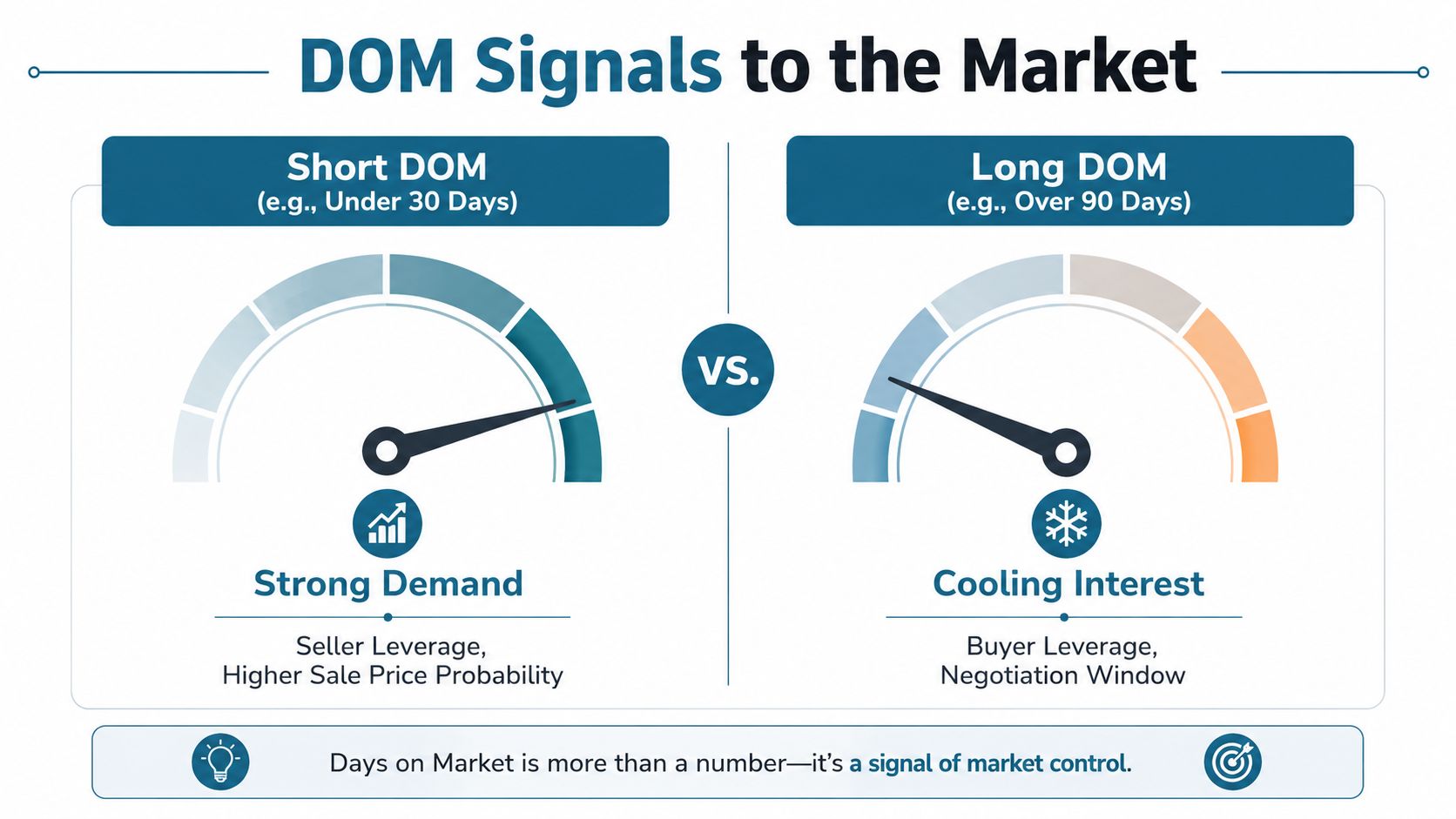
DOM matters because it changes how each side approaches the deal. A short clock gives sellers more room in the conversation, since urgency is still in place. A longer clock shifts more patience to buyers, and patience often becomes part of the strategy.
How urgency changes the conversation
Fresh listings draw the most attention because they still feel new. As the days add up, buyers often assume other shoppers have already passed on them, and that assumption lowers urgency. Even when a property is strong on paper, the market can start treating time on market as a clue that the price, condition, or timing deserves another look.
For sellers, the best response is clear-eyed, not defensive. If showings are thin and feedback is lukewarm, the next conversation should focus on price alignment, presentation, and whether the listing is being compared against the right comps.
What buyers infer from long market time
A long DOM does not always point to a weak property. It can mean the listing opened too high, hit the market at the wrong moment, or needed stronger presentation. Buyers still read DOM as a signal, though, and they use it to judge whether they can ask for more, wait longer, or tighten their terms.
Industry guidance outside the U.S. also treats market time as a pricing signal, with one glossary describing 30 to 90 days as a typical selling range when pricing is aligned, under 60 days as a sign of strong demand or correct pricing, and over 180 days as a possible pricing or property issue. The labels change by market, but the logic stays the same.
How MLS Rules and Relistings Can Distort Your DOM
A listing can look clean on paper and still have a messy path through the market. A seller may switch agents, update photos, or relist under a fresh record, and the public number can seem better even though buyers have already seen the home, compared it, and moved on. Agents have to read beyond the surface and separate the headline DOM from the home's actual market history.
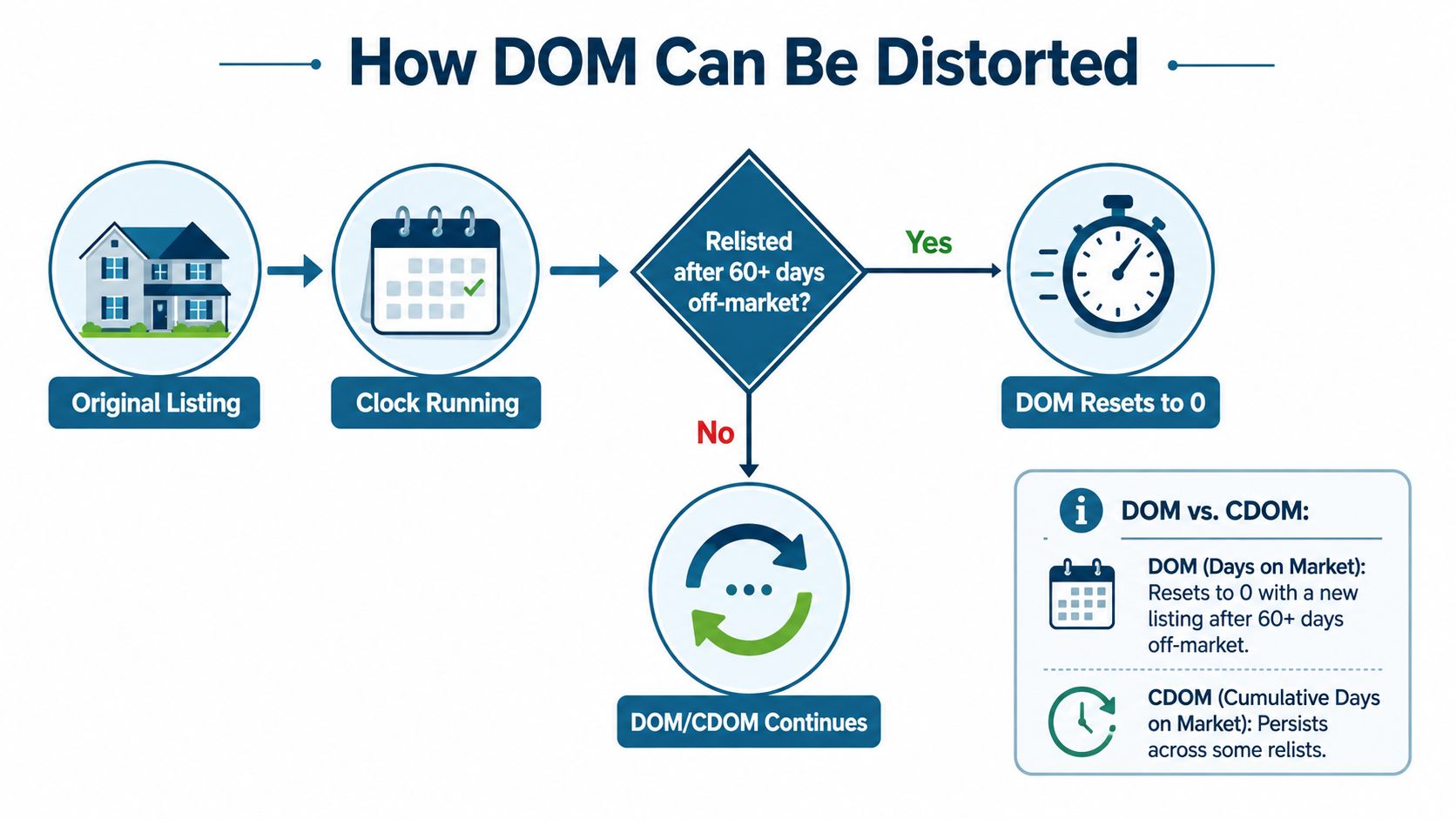
Some MLS systems require a property to stay off-market for at least 60 days before DOM can restart after relisting, even when a different agent takes over. That rule is meant to keep the clock honest, but the exact handling varies enough that a quick read can still mislead experienced agents.
Why relisting isn't the same as resetting market exposure
A relist can improve the presentation, but it does not erase the earlier market response. Buyers who watched the home before the relist may still remember the price, the photos, and how long it sat. Even if DOM restarts, the listing can still carry the weight of that earlier exposure.
CDOM is the steadier number because it captures the combined time across multiple listing periods. For pricing decisions, that tells you more than whether the current MLS record looks fresh.
What to check before you trust the headline number
Review the status changes, the listing history, and whether the property was relisted under a new MLS number. If the clock restarted, ask why. If the listing was withdrawn for a short period, ask whether the pause was long enough to support a genuine reset or only long enough to make the home look new again.
A fresh MLS number does not automatically mean fresh demand. The actual question is whether buyers saw a materially different offer the second time around.
When DOM climbs but the presentation keeps changing, the market is usually pointing to fit, not just freshness. That is normal friction rather than a signal of a deeper problem, and it is the reading agents should use before recommending another relaunch.
Benchmarking DOM Against Local Medians and Market Cycles
A DOM number can look alarming in one neighborhood and ordinary in another. A home that has sat for a while in a fast-moving area may deserve attention, while the same number in a slower submarket may reflect how that segment behaves. If you do not compare the listing with nearby comps, you are only reading half the story.
| DOM Scenario | Local Median | What It Likely Signals |
|---|---|---|
| A listing at 45 DOM | 29 days | Possible overpricing, weaker presentation, or a slower than normal response |
| A listing at 45 DOM | A much higher local median | Could be normal market pace rather than a problem |
| A new listing with very low DOM | Nearby homes are moving quickly | Stronger demand or sharp launch pricing |
| An aging listing after a reduction | Recent comparable homes are still moving faster | The original price likely missed the current market |
That kind of comparison is where agents add real value. A number that looks high by itself may fit the neighborhood, the price band, and the property type once you set it against the local median. A bad benchmark creates unnecessary urgency. A good benchmark gives the seller a real decision point.
Why the cycle matters
National pace shifted after the pandemic-era surge. The U.S. national median DOM rose to approximately 56 to 66 days in early 2026, compared with the sub-20-day frenzy of 2021 to 2022. That spread shows how quickly the same metric can mean something very different across market cycles, even before you drill down to the local level.
For agents, the first question is not just, “Is DOM high?” The better question is whether the current number is high relative to the market's recent absorption speed. A home can have a higher DOM because the market cooled, because sellers launched too aggressively, or because the relaunch strategy did not create a meaningful change in demand.
Reading DOM after a price reduction
A price change can draw more attention without wiping out the earlier exposure. If a listing opened too high, a reduction may help it re-enter the conversation, but buyers may still treat it as aged inventory. That is normal friction, not proof that the home has a deeper problem.
A cleaner way to track that pattern is through automated Market Insights for real estate agents, which helps compare timing, price movement, and listing behavior without hand-building every report. The point is not to replace judgment. It is to make the benchmark discussion faster, clearer, and more consistent.
Proven Tactics Agents Use to Prevent and Reduce High DOM
The best way to manage DOM is to treat launch day like the start of a campaign, not a passive upload. Pricing, presentation, and distribution all need to work together from day one. If one of those pieces is weak, the clock starts working against you fast.

Industry guidance cites 30 to 90 days as a typical selling range when pricing is aligned, under 60 days as a sign of strong demand or correct pricing, and over 180 days as a signal that the home may be overpriced or have a property-specific issue. That doesn't mean every well-priced home sells inside a fixed window, but it does give agents a practical frame for pressure testing the listing.
Start with launch readiness
Get the home ready before it hits the MLS. That means polished photos, accurate remarks, clean feature language, and a showing plan that doesn't rely on improvisation. If the first week underperforms, you don't get that first impression back.
Price to the market you actually have
Use the current median, not the seller's memory of last spring. If traffic is light, the market is telling you the launch price may be out of step. A quick correction is usually easier to defend than weeks of explaining why the listing keeps aging.
Fix the friction buyers can see
Condition issues, clutter, poor lighting, and unclear feature descriptions all add drag. The more friction a buyer feels, the more time the listing tends to spend sitting. That's especially true when similar homes nearby are cleaner, easier to understand, or better presented online.
For a deeper tactical comparison, Bounti Labs real estate market analysis is a useful reference when you want to check how timing and market conditions are being interpreted across listings.
When it's time to sharpen your marketing workflow, AI tools for realtors can help you scale the content side without losing control of the message. The key is choosing tools that support your pricing and presentation strategy instead of distracting from it.
Turning Low DOM Into Lasting Visibility With Smarter Marketing
Low DOM is good, but only if it comes from a repeatable system. The listing still needs strong descriptions, consistent branding, and clear feature language across portals and social channels, because buyers don't only find homes in the MLS anymore. They discover them through search, shares, short-form video, and increasingly through AI-driven recommendations.
If you're building that system, using RemotionAI for listings can help with video workflow, while listing description examples that sell can sharpen how the property is framed in writing. The goal isn't volume for its own sake, it's a listing presence that stays coherent wherever the search starts.
Keep the message consistent
Generic AI tools can spit out a paragraph. Real estate-specific marketing needs more than that. It needs fair housing-aware language, MLS-friendly phrasing, and a voice that sounds like your team every time a new listing goes live.
That's where a purpose-built system like ListingBooster.ai fits. It's designed to help agents and teams produce AI-optimized descriptions, social content, and authority assets without turning every listing into a one-off scramble, which makes it easier to keep the story consistent even as market time changes.
The practical win is simple. When your listing content stays fresh, specific, and compliant, you reduce the chance that DOM becomes the only thing people notice.
If you want a faster way to turn market time into better listing strategy, visit ListingBooster.ai and see how its real-estate-specific content system helps agents write stronger listings, keep social content consistent, and stay visible as homes move through the market. It's a practical fit for teams and brokerages that want clearer marketing without adding more manual work.
Walk In With the Campaign Already Built
Listing copy, social posts, sourced Market Insights, growth scheduling, and direct publishing after approval from one real-estate-specific system. 25 free credits to start.
Related Posts
 Uncategorized
Real Estate Content Marketing: The 2026 Playbook
Listings with video can generate 49% more qualified leads, according to a 2026 real estate digital marketing roundup. That figure changes the question. Real estate content marketing isn't about how often you post. It's about whether your listing, expertise, and local knowledge can be found, understood, and cited by people and by the AI tools […]
 Uncategorized
AI for Real Estate Marketing: A Practical Playbook
A new listing goes live on Tuesday morning. You write the description from memory, schedule three social posts, answer showing requests, and move on to the next client task. By afternoon, the listing has plenty of activity on your side of the business, but the phone still isn't producing the conversations you expected. That gap […]
 Uncategorized
What Is IDX and Why It Still Matters for Real Estate
A new agent usually hears “IDX” during a brokerage onboarding call, nods along, and hopes nobody asks for a definition. Then the questions arrive: Why are listings appearing on the website? Who controls the data? Why did a property remain visible after its status changed? And will the same pages be readable by ChatGPT, Perplexity, […]