Real Estate Video Marketing: A Practical Playbook for Agents
Listings with video receive 403% more inquiries than listings without video, which is why real estate video marketing has moved from a nice extra to a real acquisition channel. That number matters because it changes the job of video, from brand polish to lead generation, seller attraction, and listing presentation. In practice, the agents who treat video as part of the listing workflow, not an optional add-on, tend to have a cleaner pipeline and a stronger story when a seller asks what they'll do to market the home. That's also where compliance starts, because the best video strategy in the world won't help if the language drifts into Fair Housing trouble.
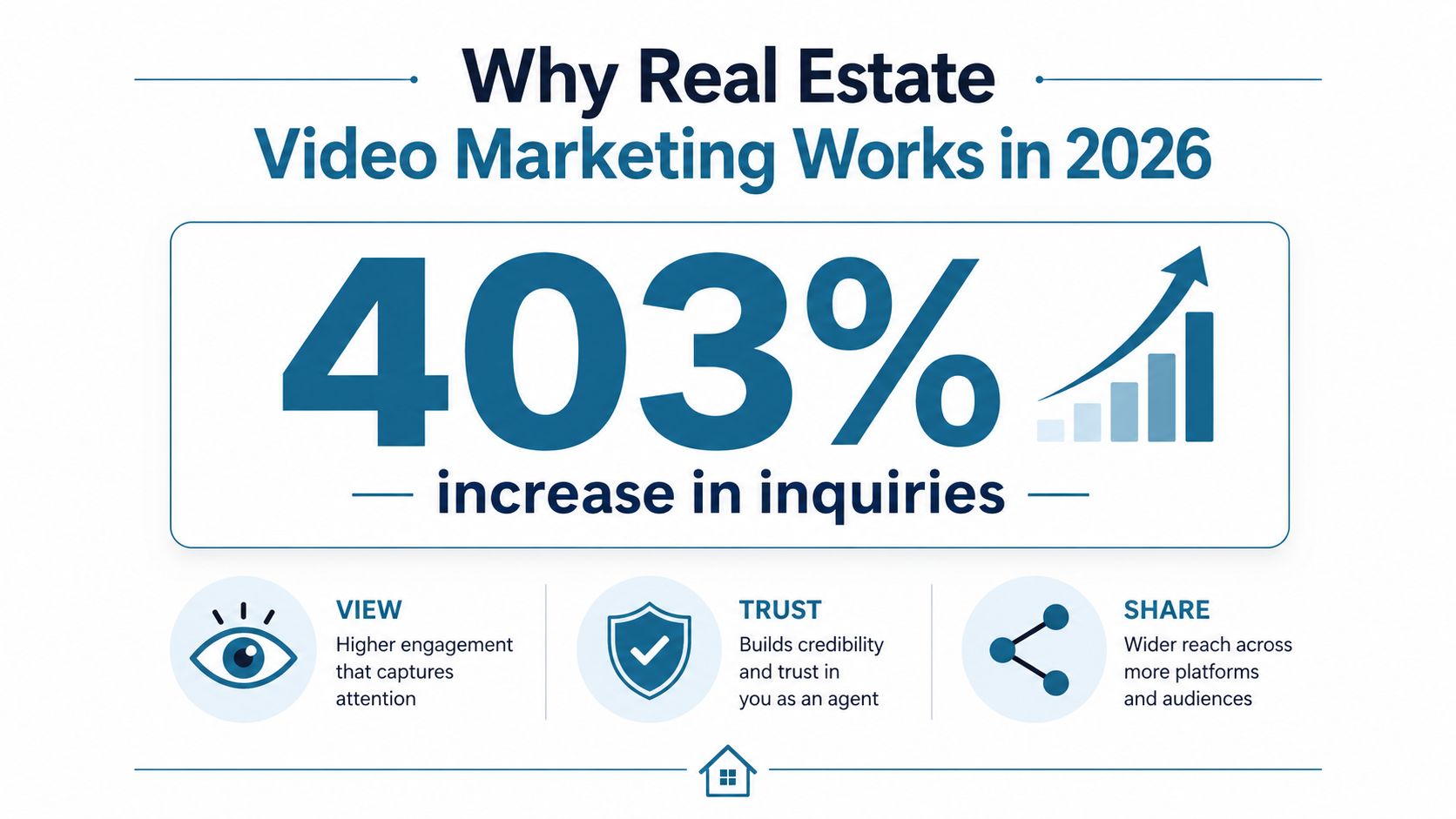
Why Real Estate Video Marketing Works in 2026
The clearest reason video keeps winning is still measurable performance. Listings with video get 403% more inquiries than listings without it, according to the most consistently cited real estate video benchmark in the industry real-estate marketing statistics. That is a lead-generation signal, not a vanity number. Buyers use video to sort themselves before they click, so the conversations that reach your inbox are usually warmer and more informed.
Sellers respond to that same proof. Research cited by real estate video statistics says 73% of homeowners are more likely to list with an agent who offers video marketing. In a listing appointment, that changes the conversation. Video stops being a line item and becomes something you can show, including a clean tour, a feature clip, and a follow-up asset that proves you have a marketing process, not just a camera.
Why the adoption gap creates opportunity
The market is still uneven. One source says only 38% of agents use video for their listings, while another says only 26% consistently use video on every listing real estate video statistics. That gap creates room for agents who are willing to present the property with motion, pacing, and context instead of static photos and a short caption.
Practical rule: use video to make the property easier to understand, not to make it look like something it isn't. Feature-driven language wins. Demographic targeting language creates compliance risk.
That compliance piece matters more than many guides admit. For US agents and brokers, Fair Housing-safe wording should be built into the first script, not cleaned up after the edit. Lead with property features, layout, light, finishes, storage, view corridors, and location descriptors that stay factual. Avoid language that suggests who should live there, even if it sounds harmless in a casual voiceover.
For a useful outside breakdown of the mechanics, see how video boosts property listings. It matches what shows up in day-to-day production. Video improves attention on the buyer side and strengthens trust on the seller side at the same time, which is why it works as an acquisition channel instead of just a branding asset.
Who should care most
Solo agents need video to stand out in listing presentations. Team leads need it to keep a repeatable message across producers. Brokerage marketing directors need it because a visible video system becomes part of the brand, not just a one-off asset. For teams that want a workflow shortcut, ListingBooster.ai can help standardize the process without turning every listing into a custom production project.
Choosing the Right Video Format for Each Goal
The mistake most agents make is trying to make one video do everything. A listing tour, a social clip, an authority video, and a testimonial all solve different problems, so they need different lengths, hooks, and calls to action. Once the goal is clear, the format usually becomes obvious.
Match format to outcome
A 90 to 120 second walkthrough works best when the goal is listing engagement. Keep the hook grounded in what the viewer can see, then move straight into the flow of the home, the key features, and the cleanest path to a showing request. A direct CTA such as “Request the full property package” or “Ask for the private tour link” keeps the next step specific.
For quick reach, use 10 to 15 second Reels. These work as highlight snippets, not full tours. The hook needs to land immediately, so open with the strongest visual or one feature moment, then point to a more complete tour or listing page.
For authority and SEO, 7 to 15 minute videos fit market updates, neighborhood commentary, or educational content. Those videos are less about the property itself and more about making you the person sellers and buyers remember when they need local context. YouTube fits that role better than a short-form feed because the content has a longer shelf life and stronger search utility.
Testimonials sit in the middle at 60 to 90 seconds. They work when you need social proof without making the viewer sit through a long segment. The hook should be simple and human, then the CTA should move toward a consultation, listing meeting, or buyer conversation.
| Video Format | Primary Goal | Ideal Length | Best Platform |
|---|---|---|---|
| Walkthrough | Listing engagement | 90 to 120 seconds | MLS, listing page, YouTube |
| Reel | Reach | 10 to 15 seconds | Instagram Reels, TikTok |
| Market update | Authority and SEO | 7 to 15 minutes | YouTube, website |
| Testimonial | Conversion | 60 to 90 seconds | Email, landing page, social |
Two traps to avoid
The first trap is posting the same cut everywhere. A long walkthrough can work on a listing page, but it usually drags in a Reel feed. The second trap is skipping the CTA entirely. If a viewer watches the video and doesn't know what to do next, the content may get attention without producing a lead.
A strong video doesn't need to be cinematic. It needs to answer one question fast, then tell the viewer where to go next.
The right format is the one that matches the business result you need this week. A new listing needs a walkthrough. A seller pitch needs proof. A market position needs long-form authority. Once you stop asking “What video should I make?” and start asking “What outcome do I need?”, production gets a lot easier.
A Simple Production Workflow That Fits an Agent's Week
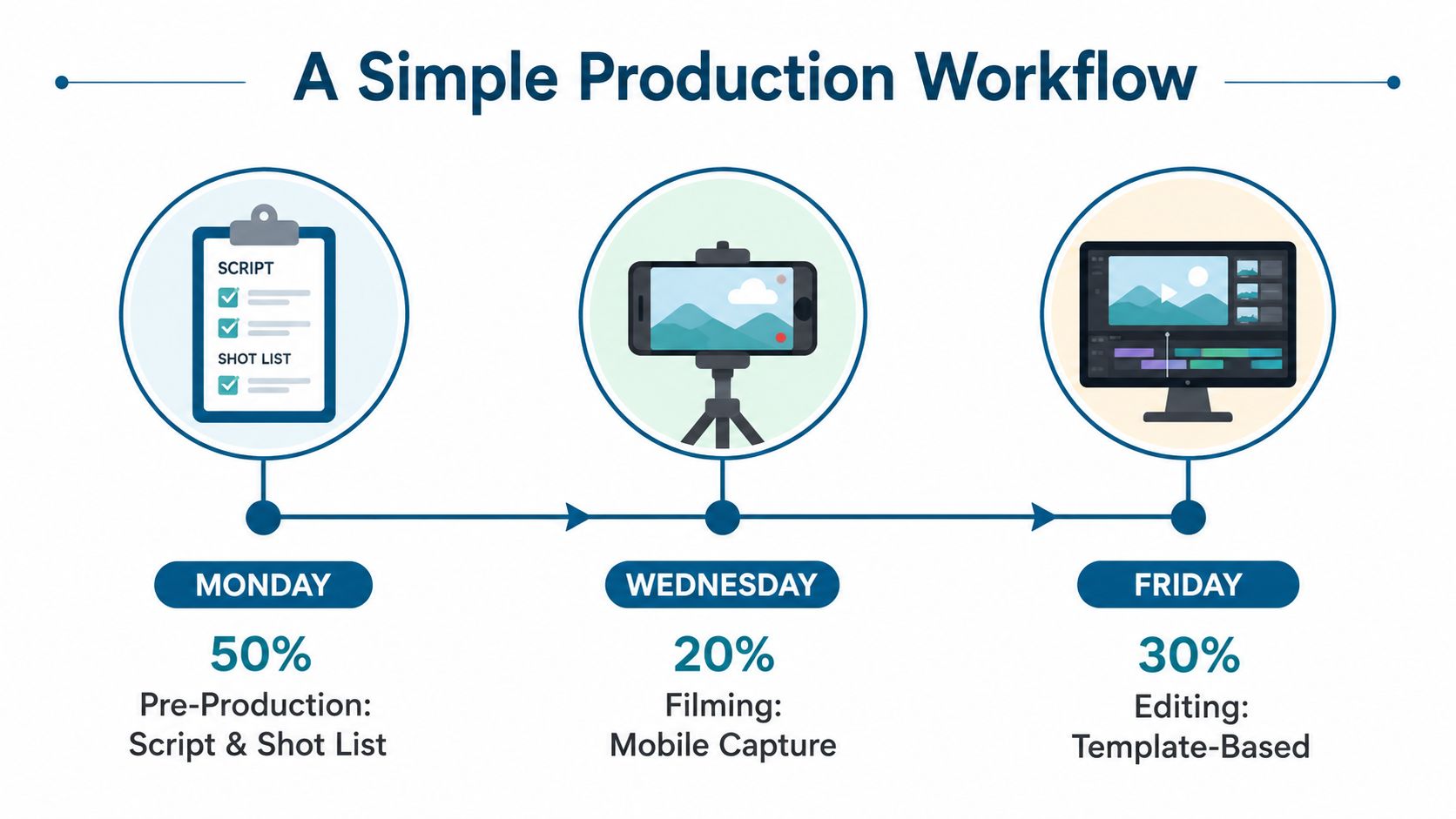
The cleanest production systems are boring in the best way. A practical real estate video workflow should put about 50% of total effort into pre-production, 20% into filming, and 30% into editing real estate video marketing. That split works because bad planning costs more time than bad camera work. If the sequence is clear before you film, the shoot gets shorter and the edit gets faster.
A Monday to Friday rhythm
Monday is for decisions. Define the audience and the CTA, then decide whether the video needs to drive showings, seller interest, or social reach. Build the shot list around the home's flow, natural light, key features, and room connections. If you start with the property URL, tools like ListingBooster.ai can turn that into a description, social copy, and a usable script outline without making you rebuild the same asset by hand.
Wednesday is for filming in one clean walkthrough pass. A recent smartphone, a $30 to $60 gimbal or stabilizer, a clip-on lavalier mic, and basic editing software are enough for most agents. Expensive gear is usually overkill unless you're producing luxury brand content at scale. The point is consistency, not a film set.
Friday belongs to editing and distribution prep. Keep the first version short and platform-specific. One guide recommends walkthroughs stay around 90 to 120 seconds and be sped up 1.2 to 1.3x to keep pacing tight, while another notes that viewers often drop off sharply after roughly 2 minutes, with about 60% stopped beyond that point real estate video marketing. That means trimming dead time matters more than adding effects. It also helps to know why viral videos spread, because the same retention and hook discipline that drives social reach also keeps listing videos from feeling slow.
Operational rule: if the shot doesn't help a buyer understand the layout, the light, or the next step, cut it.
A realistic 30-day cadence
Week 1 is setup. Week 2 is your first three videos. Week 3 is editing and posting cadence. Week 4 is review and reuse. That pace fits around showings and contracts without turning content into a second full-time job. If you want a practical way to squeeze more material out of each property, this guide on turn one listing into 30 days of content shows how one shoot can support multiple assets.
Batch the work instead of waiting for inspiration. Film when the property is ready, then repurpose the footage into listing clips, open-house teasers, social posts, and follow-up assets. That is the difference between a one-off video and a workflow that can be measured as part of acquisition, not just branding.
Distributing Video Across MLS, Social, and AI Search
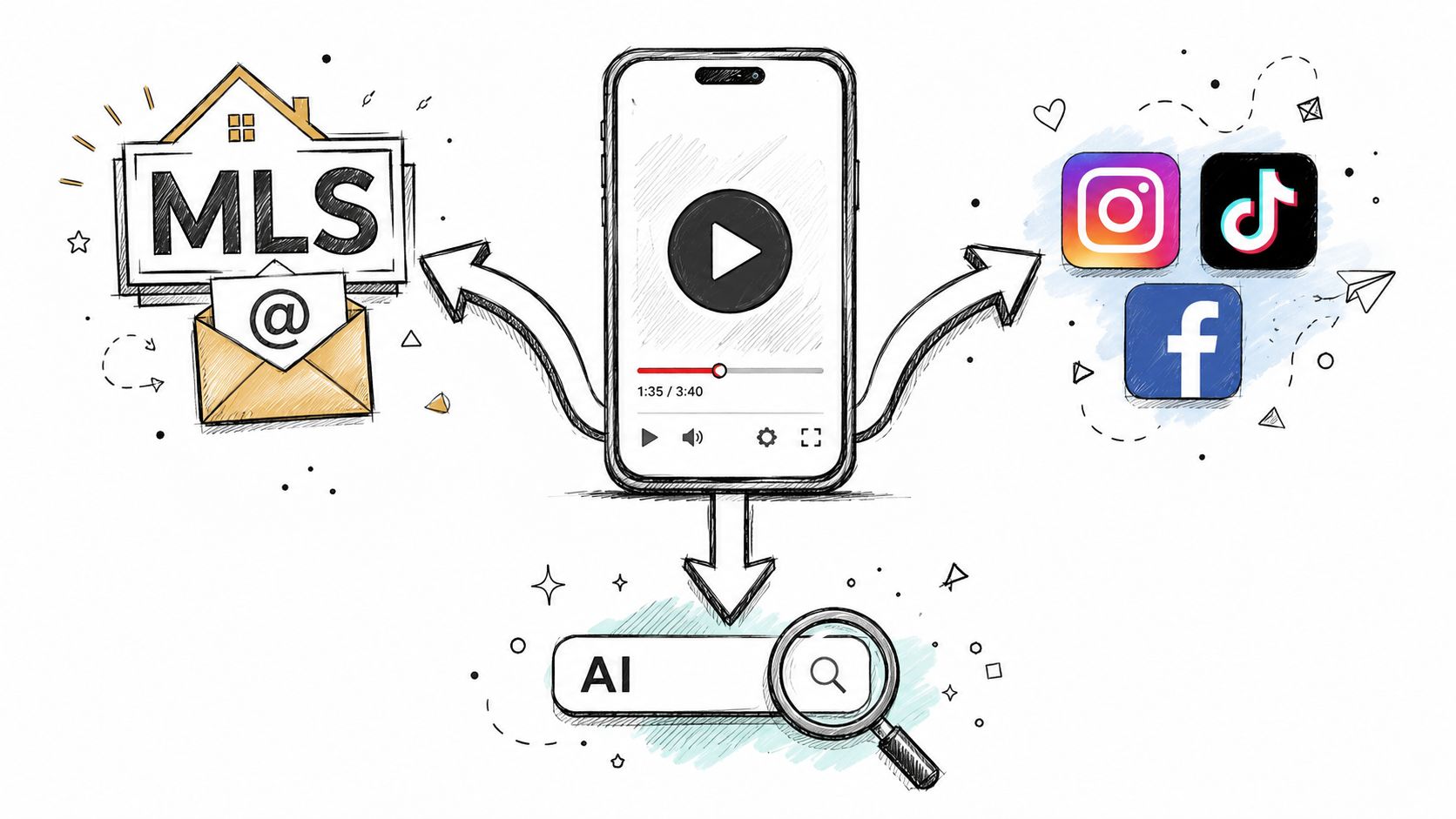
Distribution is where a good video either compounds or disappears. The same asset can support MLS visibility, YouTube search, email follow-up, social reach, and AI search discoverability, but only if each channel gets a version built for its own intent. A single upload rarely does that job well.
Use each channel for what it's good at
MLS should host the core tour where allowed, because that's where the listing journey starts. YouTube should carry the long-form version with keyworded titles and descriptions, because that's the channel most aligned with search and long-term discoverability. Email and listing-page embeds should carry shorter clips that move prospects toward a click, a showing, or a reply. The distribution logic is simple. Put the full story where people search, and put the short version where people decide quickly.
Social needs a different cut. Instagram Reels and similar short-form placements should show a single feature, a strong first frame, or a quick property highlight. That format supports reach, but it doesn't replace the listing page or the tour. If you try to make one video serve every platform, the feed usually punishes the length and the message gets diluted.
Make AI systems able to read the content
AI discovery is now part of the distribution job. Your business context notes that over 40% of homebuyers now start in ChatGPT, Perplexity, and Google AI, which means the content needs to be structured so machines can understand it. The practical move is to write descriptions that use clear property features, add transcripts, and keep the wording specific enough that an assistant can quote it cleanly. For a useful operational example, ListingBooster.ai's real estate AI search visibility guidance shows why readable, structured content matters.
Fair Housing compliance matters most at the caption stage. Every caption should be checked before publish. Describe the home by features, room layout, finishes, lot characteristics, and geographic identifiers that are factual, not by who the home is for. That keeps the marketing useful and the risk low.
If the caption starts sounding like a lifestyle filter, rewrite it. If it sounds like a property spec, you're usually on safer ground.
A connected distribution system gives you more than impressions. It creates a path from listing to inquiry to follow-up to search visibility, which is where the value sits.
Measuring ROI and Lead Quality From Video
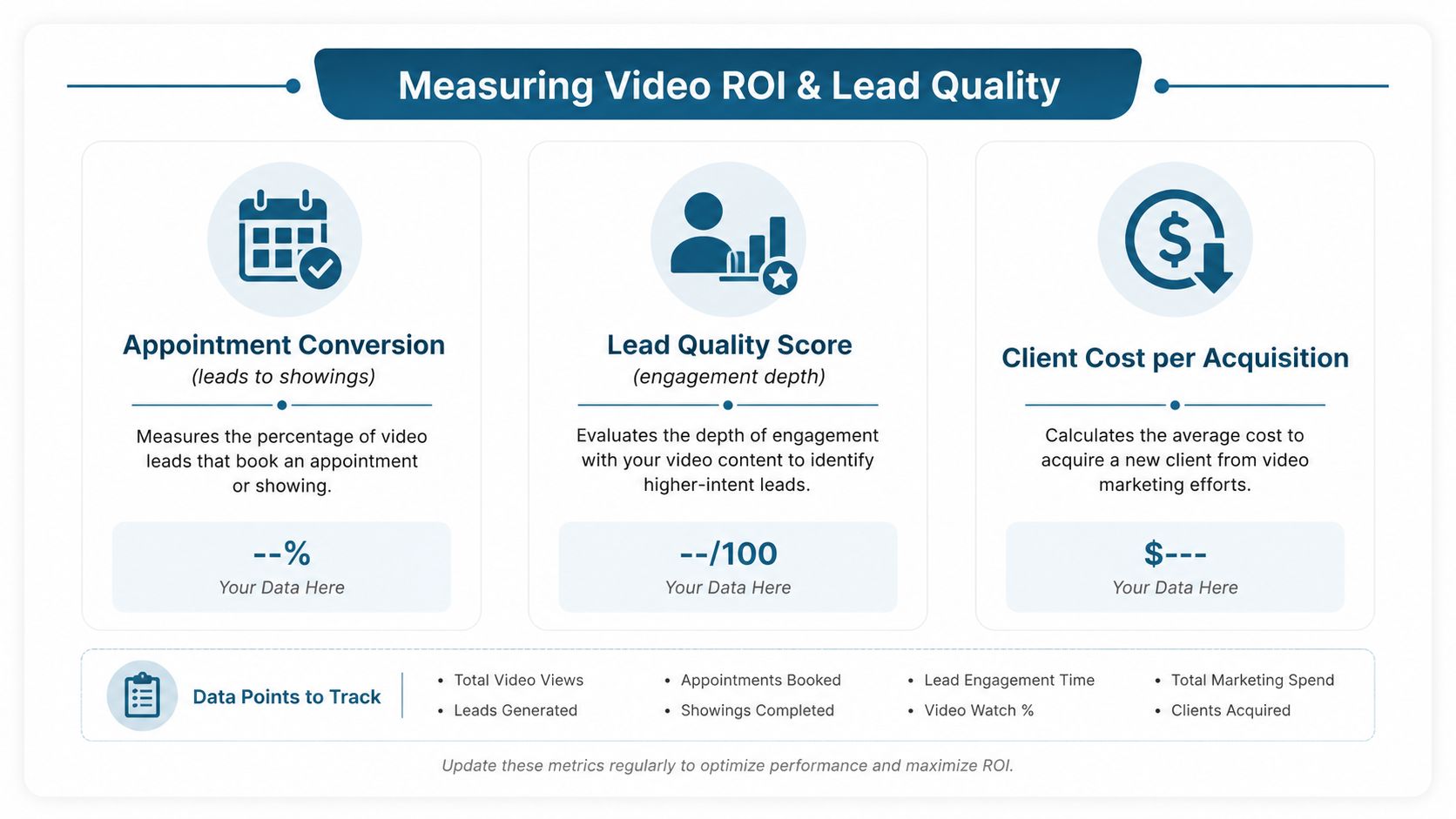
Views are easy to collect and hard to trust. A real measurement system has to tell you whether video is getting attention, keeping attention, triggering responses, and producing revenue. That's the point where video stops being content and becomes a channel you can manage.
Track four metrics, not one
Reach tells you whether the video got in front of people. Retention tells you whether the opening and pacing worked. Response tells you whether viewers took the next action, such as clicking, replying, or booking. Revenue tells you whether the content helped generate appointments or signed clients. A simple scorecard built around those four buckets is more useful than a dashboard full of likes.
Measurement work happens with attribution. Use UTM-tagged links, trackable phone numbers, and CRM fields that show which video a lead came from. Then set a 90-day baseline so you're comparing honest patterns instead of one strong week against one weak one. That's the only way to tell whether a video format is pulling its weight.
Treat lead quality like an operating metric
BatchData's real estate lead scoring tips are useful context here because lead quality is usually where video outperforms cold traffic. A person who watches a walkthrough, clicks the listing page, and then replies is more useful than a random view count. That's why “engaged lead” should mean more than someone who saw the thumbnail.
Here's the mistake to avoid. Raw view count and follower growth look good in reports, but they don't tell you whether a seller appointment is coming in. If a video helps generate a listing meeting, a buyer consultation, or a signed listing, that matters more than a spike in impressions.
The most useful business question is still simple. Which video type produces real conversations? Once you can answer that, you can defend the budget without leaning on anecdotes or brand language.
Scaling Video for Teams and Brokerages Without Compliance Risk
At the team and brokerage level, the work shifts from making one good video to making the process repeatable. The main risk is inconsistency. One agent writes compliant captions, another improvises, and a third posts a polished reel with wording that creates avoidable Fair Housing exposure. That is how brand value gets diluted, and why video starts to produce mixed results instead of predictable leads.
Build one system, not 50 different habits
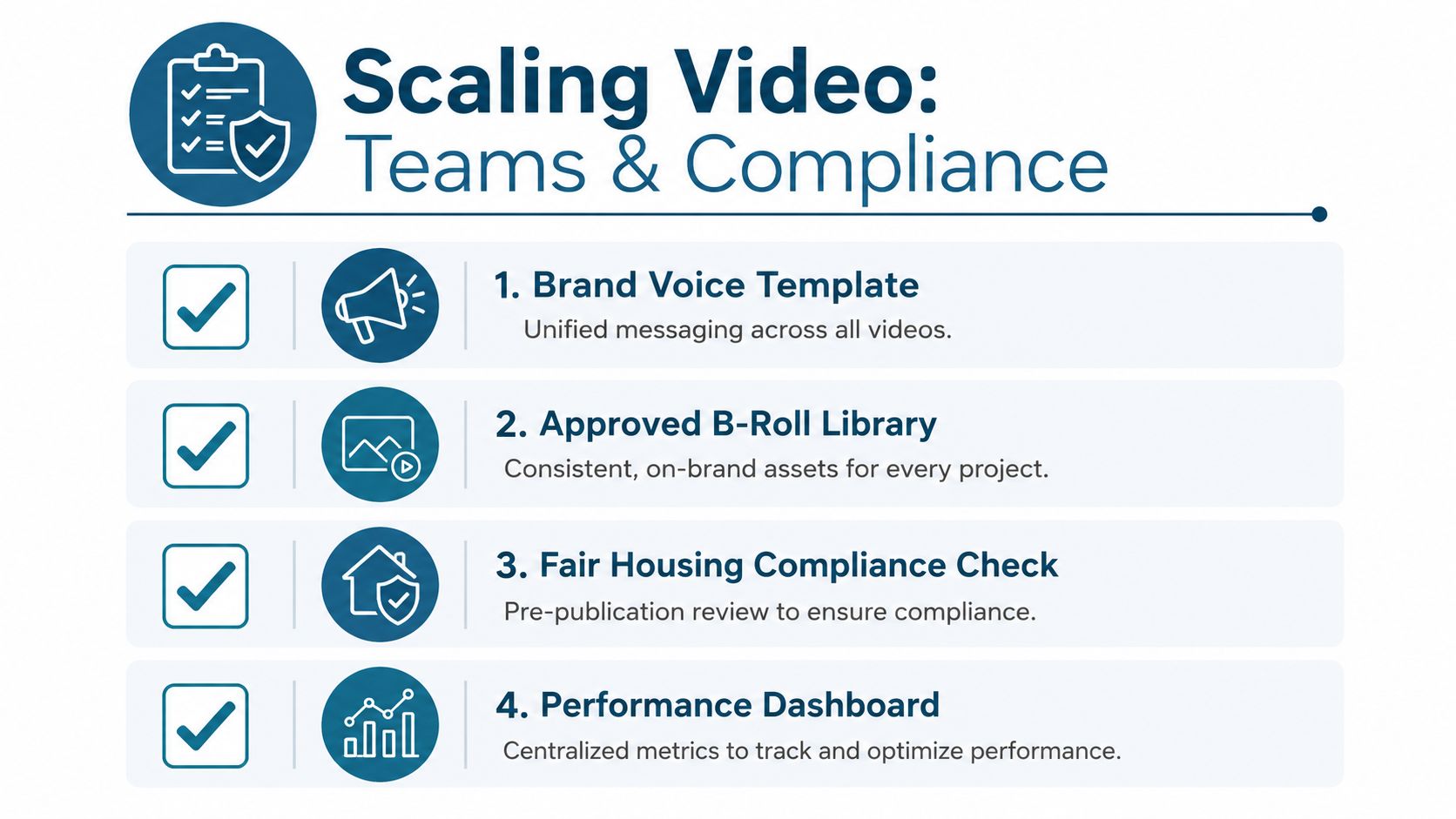
Start with a shared asset library. Intros, outros, lower thirds, logo treatments, and approved b-roll should all live in one place. That keeps the brand recognizable without forcing every agent to design from scratch. Then add an approval workflow that flags captions before they go live, especially anything that could drift into protected-class language.
A content calendar helps too. Reserve slots for listing content and authority content so the feed does not go quiet between closings. A dashboard that rolls up performance by agent and by market gives leadership a way to see what is getting traction without asking everyone to report in different formats. If your team needs a broader workflow reference, automated social media for real estate teams is a useful companion guide because it shows how publishing, review, and scheduling can be handled at brokerage scale.
Make compliance part of the brand
Fair Housing compliance should feel like a standard. Template language should describe finishes, layout, square footage, lot characteristics, and neighborhood facts without implying who belongs there. That keeps the message consistent across agents and reduces the chance of a sloppy caption making it to public channels.
For larger teams, a tool like ListingBooster.ai can serve as a workflow shortcut when the bottleneck is content volume, not strategy. It is useful when one marketing director has to support many agents and still keep the output aligned. The point is not to replace judgment. It is to keep the approval process from breaking under volume.
The brokerage that scales video best usually is not the one with the fanciest gear. It is the one with the clearest rules, the fastest approval path, and the fewest surprises.
There is also the human side. Reluctant agents usually participate once they see the process is simple. High producers cooperate when the system saves time and does not force them into a generic voice. If the workflow is easy, compliance becomes a selling point instead of a complaint.
Your Next Step and a 30-Day Action Plan
Start with one property and one repeatable workflow. Week 1 is for templates, a shot list, and CTA decisions. Week 2 is for filming your first three videos. Week 3 is distribution, tracking, and follow-up. Week 4 is review, which means looking at response quality, not just views.
If you're camera-shy, start with property-first content instead of face-to-camera content. If you're worried about Fair Housing, keep every description tied to features and location facts, then remove any line that implies who the home is for. If you're waiting to “feel ready,” you'll probably stay stuck. The first three videos teach you more than planning ever will.
For solo agents, the goal is simple. Ship one listing video, one short clip, and one authority post within 30 days, then compare what produced actual conversations. For teams and brokerages, the goal is consistency. Get the template approved, the review path clear, and the reporting visible so agents can use the same system without rewriting it every week.
Pick one property, run the process for 30 days, and measure what happens. If you want a faster setup, ListingBooster.ai turns listing details into the kind of property descriptions and social content that keep the workflow moving, so you spend less time building assets and more time shipping them.
If you want to turn listing details into compliant video-adjacent content faster, visit ListingBooster.ai and use it as a workflow shortcut for property descriptions, social content, and repeatable listing marketing. It's built for agents, teams, and brokerages that want a cleaner process without adding more manual work.
Walk In With the Campaign Already Built
Listing copy, social posts, sourced Market Insights, growth scheduling, and direct publishing after approval from one real-estate-specific system. 25 free credits to start.
Related Posts
 Uncategorized
Real Estate Content Marketing: The 2026 Playbook
Listings with video can generate 49% more qualified leads, according to a 2026 real estate digital marketing roundup. That figure changes the question. Real estate content marketing isn't about how often you post. It's about whether your listing, expertise, and local knowledge can be found, understood, and cited by people and by the AI tools […]
 Uncategorized
AI for Real Estate Marketing: A Practical Playbook
A new listing goes live on Tuesday morning. You write the description from memory, schedule three social posts, answer showing requests, and move on to the next client task. By afternoon, the listing has plenty of activity on your side of the business, but the phone still isn't producing the conversations you expected. That gap […]
 Uncategorized
What Is IDX and Why It Still Matters for Real Estate
A new agent usually hears “IDX” during a brokerage onboarding call, nods along, and hopes nobody asks for a definition. Then the questions arrive: Why are listings appearing on the website? Who controls the data? Why did a property remain visible after its status changed? And will the same pages be readable by ChatGPT, Perplexity, […]