Real Estate Marketing Automation: A 2026 Guide for Agents
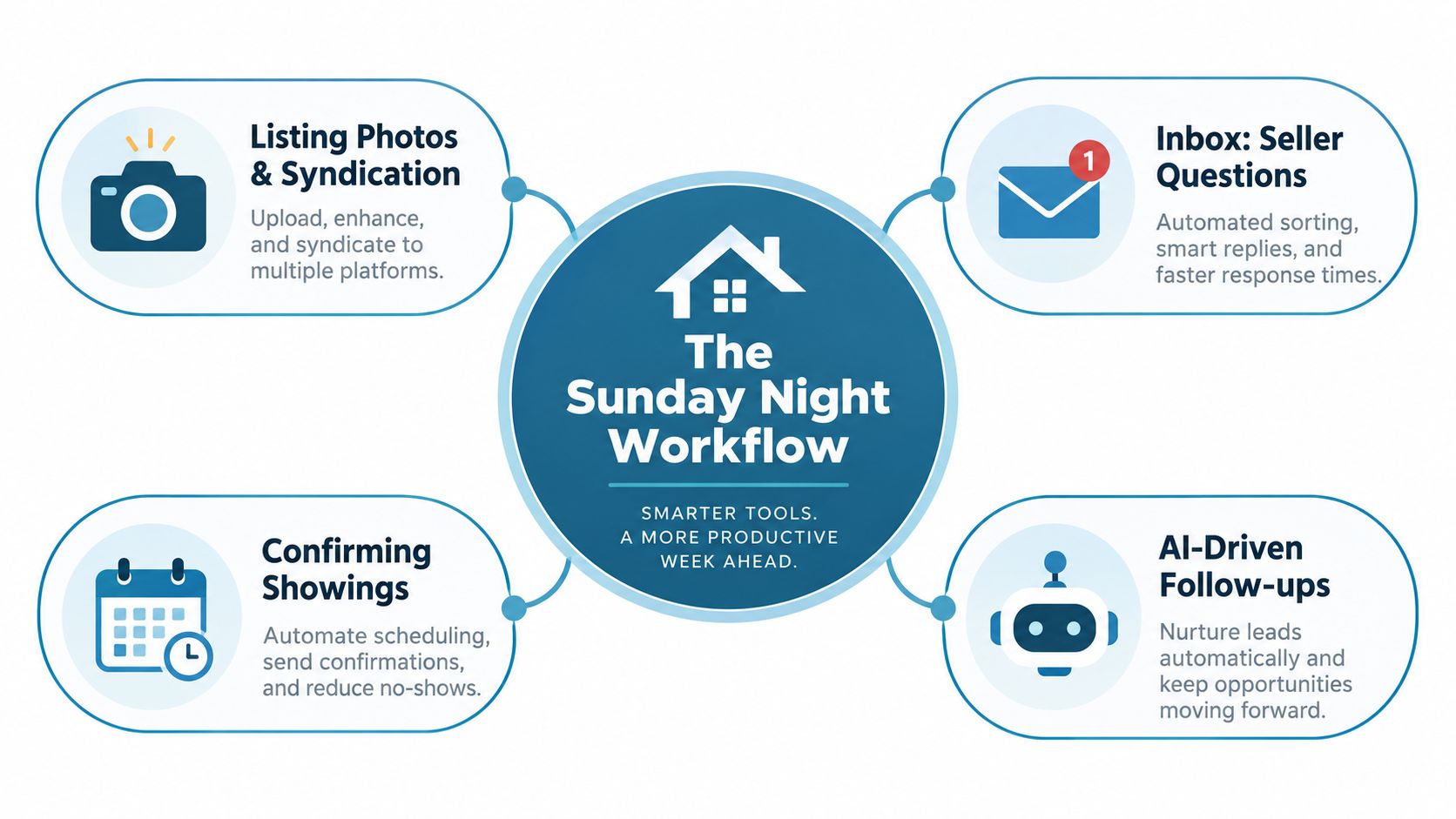
Sunday night, the listing photos are finally finished. Zillow is already syndicating the property, your inbox is filling with seller questions, and tomorrow's showings still need confirmation. You can either spend the next few hours copying details between platforms and chasing follow-ups, or build a system that handles the repeatable work while you protect the parts of the job that require judgment.
That system is real estate marketing automation. Done properly, it isn't a software purchase or an excuse to replace personal communication with robotic messages. It's a measurement-first operating model that connects lead response, listing promotion, content, compliance, and revenue attribution.
What Real Estate Marketing Automation Actually Means Today
Real estate marketing automation has three connected layers.
The first layer is triggers, the events that start a workflow. A new lead form submission, a showing request, a price change, a listing moving to Active status, or a transaction closing can all trigger an action. If your system can't reliably recognize the event, everything downstream becomes manual again.
The second layer is the workflow, a sequence of conditional steps that sends the right message to the right contact at the right time. A buyer inquiry might receive an immediate acknowledgment, a calendar link, a personal follow-up task, and a nurture sequence if the buyer doesn't respond. A seller might receive listing activity updates that change based on showings, feedback, and status.
The third layer is AI-readable content. This includes listing descriptions, neighborhood guides, buyer FAQs, seller FAQs, and market explanations published on crawlable pages with clear structure. The purpose isn't merely to produce more posts. It's to create useful, attributable information that can be understood and cited by ChatGPT, Perplexity, Google AI Overviews, and traditional search.
Operating principle: Automation should remove delay and inconsistency, not remove accountability.
This guide isn't a roster of apps, a pitch for one CRM, or a shortcut that replaces the agent. It gives you a mental model you can map onto the stack you already own or plan to buy. For a broader look at how automation can support efforts to dominate 2026 home sales, focus on the same question I use with brokerages: which workflow creates measurable pipeline, and which one only creates activity?
The distinction matters because the market is moving beyond simple CRM reminders. One market estimate values real estate marketing automation software at USD 685.0 million in 2025, USD 757.27 million in 2026, and a projected USD 1.382 billion by 2032, implying a 10.6% CAGR. A second estimate places the market at USD 1.31 billion in 2025, rising to USD 1.53 billion in 2026 and USD 2.87 billion by 2030, with a 17.3% near-term CAGR. The estimates differ, but both point to the same operational conclusion: brokerages increasingly treat automation as core infrastructure, not an experiment. (Market estimate)
The Business Case Agents Can Defend in a Team Meeting
A managing broker reviewing Q3 pipeline data will ask which workflows brought response time below the under 5 minutes target, increased follow-up coverage, and lowered cost per closed transaction. Automation earns approval when the team can answer those questions with CRM records, not screenshots of a modern interface.
Start with speed-to-lead. One benchmark reports that median teams take 8 to 30 minutes to make first contact, while top-quartile teams target under 5 minutes. It also reports 4 to 7 touches per lead for median teams compared with 14 to 21 touches for top-quartile teams. Triggered SMS, email, routing, and task creation reduce the delay between an inquiry and human action. (2026 benchmark report)
Use those figures as a comparison point, not a forecast. Pull timestamps from your CRM, separate automated acknowledgments from personalized agent contact, and compare outcomes by lead source. A quick generic reply does not equal a useful conversation, and every workflow still needs an owner, a clear handoff, and Fair Housing review for audience rules and message content.
A defensible benchmark table
| Metric | Manual Baseline | With Automation | Source |
|---|---|---|---|
| First contact timing | 8 to 30 minutes for median teams | Under 5 minutes for top-quartile teams | Real estate automation benchmark report |
| Leads touched per week | 22 | 90 | Automated email sequence benchmark |
| Average response time | 4.2 hours | Instant trigger-based delivery | Automated email sequence benchmark |
| Lead-to-appointment rate | 11% | 19% | Automated email sequence benchmark |
| Sequence completion | 38% | 94% | Automated email sequence benchmark |
The financial mechanism is straightforward. Automation lets a team contact more leads and prevents follow-up from stopping when agents are handling inspections, negotiations, or showings. It does not guarantee a closing. It creates more chances for a qualified conversation that may lead to an appointment.
Finance rule: Present cost per closed transaction, not cost per lead. A cheap lead source that produces no contracts is expensive, while a costly source that produces closings may be efficient.
Build the team-meeting case from lead source, response timestamp, appointment outcome, contract date, closing outcome, and total campaign cost. Add campaign-level checks for compliant targeting and whether content is understandable to AI-search systems. If the workflow cannot connect those fields, it is not ready for a serious ROI conversation.
Core Workflows Every Agent Should Automate First
Automation works best when the trigger is unambiguous and the next action is easy to audit. Start with workflows that happen often, create delay when handled manually, and have a clear human handoff.
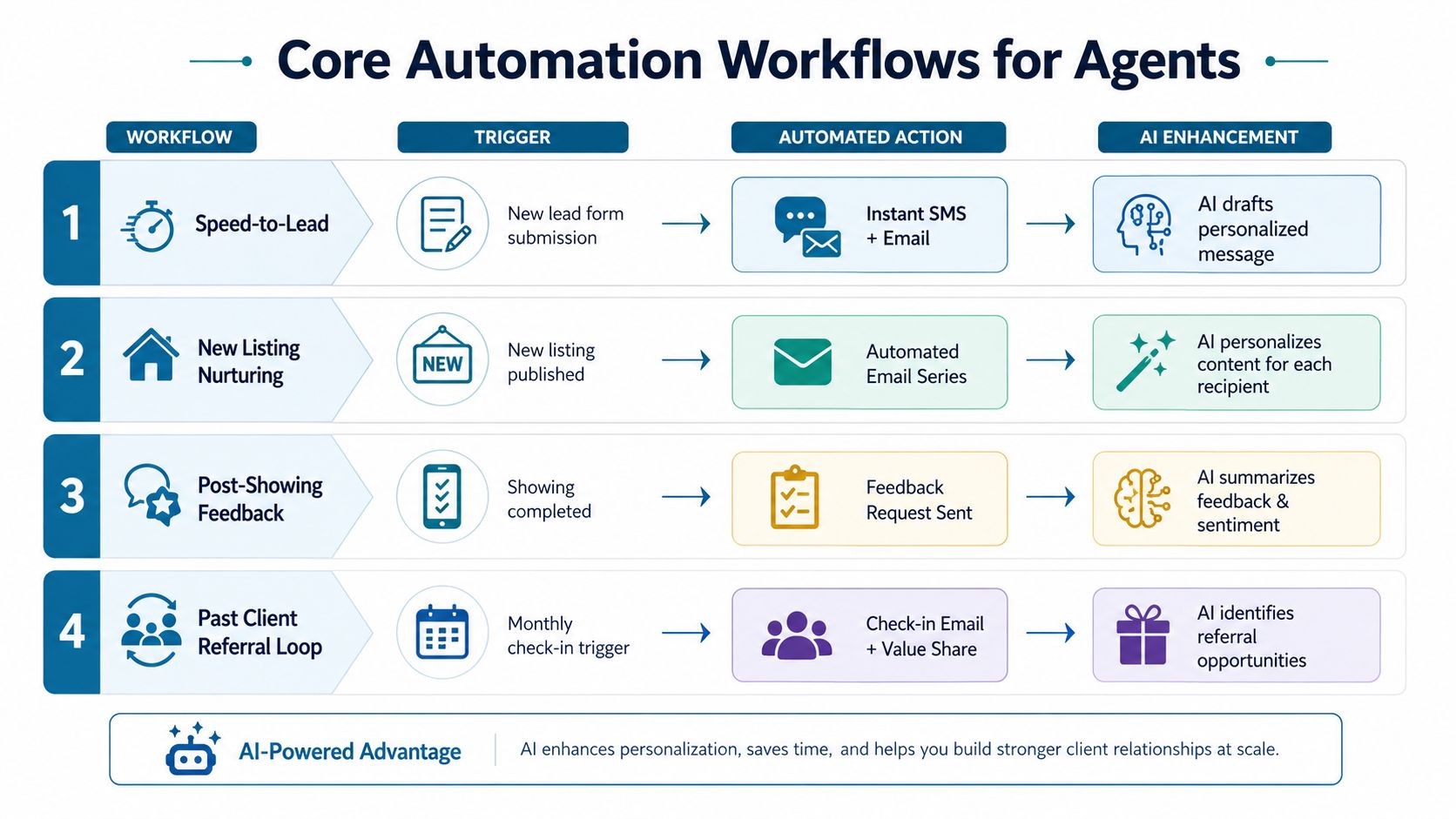
Speed-to-lead
Trigger: A buyer or seller submits a form, sends an inquiry, or requests a showing.
Sequence: Send an immediate acknowledgment, deliver a short email within the same workflow, create a CRM task for personal follow-up, and route the contact to the right agent. Keep the first automated message factual. Confirm receipt, identify the property or service requested, and offer a clear next step.
AI role: Draft a personalized response using verified fields, but don't let AI invent property details, financing terms, availability, or market claims.
Teams often need a tighter process rather than another tool. A useful resource on faster prospect follow-up with CRM should be evaluated against your current routing, response, and ownership rules.
Listing to social
Trigger: A listing changes to Active.
Sequence: Refresh the listing description, create a social carousel, draft a Just Listed email for the sphere, generate a neighborhood article, and assign every item to an approval queue. The workflow should pull from approved MLS fields, not from an unverified prompt or a disconnected spreadsheet.
AI role: Adapt the same verified property facts to each channel. The MLS version should stay precise and compliant. Social copy can be more conversational. The neighborhood article should answer real questions about property features, local services, transportation, amenities, and buying or selling steps without making claims about who belongs in an area.
For a deeper implementation example, see how to automate social media content from property listings. The important point is that one source of truth should feed several drafts, followed by one deliberate review.
Long-term nurture
Use a sequence that mixes educational email, retargeting where permitted, and market updates. The exact timing should reflect your sales process and consent rules. A cold lead shouldn't receive the same message as someone who requested a showing.
The workflow needs exit conditions. Stop or change the sequence when someone replies, books an appointment, opts out, becomes a client, or enters a transaction pipeline. A message that keeps promoting a property after it's unavailable damages trust quickly.
Post-close loyalty
Trigger: The CRM marks a transaction closed.
Sequence: Send a service follow-up, request feedback through an approved process, provide useful ownership or selling information, and move the contact into an anniversary and referral pipeline. Keep the communication useful rather than turning every interaction into a referral request.
Human review remains mandatory at each high-risk point. Check facts, property status, pricing, links, images, permissions, and Fair Housing language before publication. Automation without review is a faster way to distribute mistakes.
Authority Content as the Underused Automation Engine
Most agents automate production before they automate proof. They schedule more posts, generate more captions, and publish more listing variations, but they can't answer which content creates buyer or seller inquiries.
That is a measurement failure. The 2026 State of Real Estate Marketing Report found that 60% of agents either don't track listing-source attribution or estimate that less than 10% of deals come from content. It also reported that 13 of 21 channels delivered zero leads to more than 70% of agents in a typical month. (State of Real Estate Marketing Report coverage)
The practical response isn't to publish everywhere. It's to build a small authority system and measure whether it generates identifiable inquiries.
What AI-readable content requires
A page that an AI search system can use should be:
- Crawlable: The page is accessible to search engines and doesn't hide its main answer inside an image or script.
- Structured: Clear headings, concise answers, relevant schema, and organized facts help systems interpret the page.
- Consistent: Your name, brokerage, service area, credentials, and contact details should match across your site and profiles.
- Specific: Write about real local questions, not generic filler that could apply to any market.
A useful monthly system includes a neighborhood guide, a buyer FAQ, a seller FAQ, and a market-update template. Redistribute each piece into email snippets, LinkedIn carousels, social posts, and conversations with prospects. Every article should have an owner, an approval status, a publish date, and a source record in the CRM.
Content volume alone won't create authority. Thin, spun copy can weaken differentiation and spread inaccurate claims. Use AI to organize verified information and adapt formats, while the agent remains responsible for local accuracy, tone, and judgment. Agents who want a structured framework to build topical authority as a real estate professional should begin with questions clients ask, then connect each answer to a measurable conversion path.
Compliance and Brand Consistency Built Into the Workflow
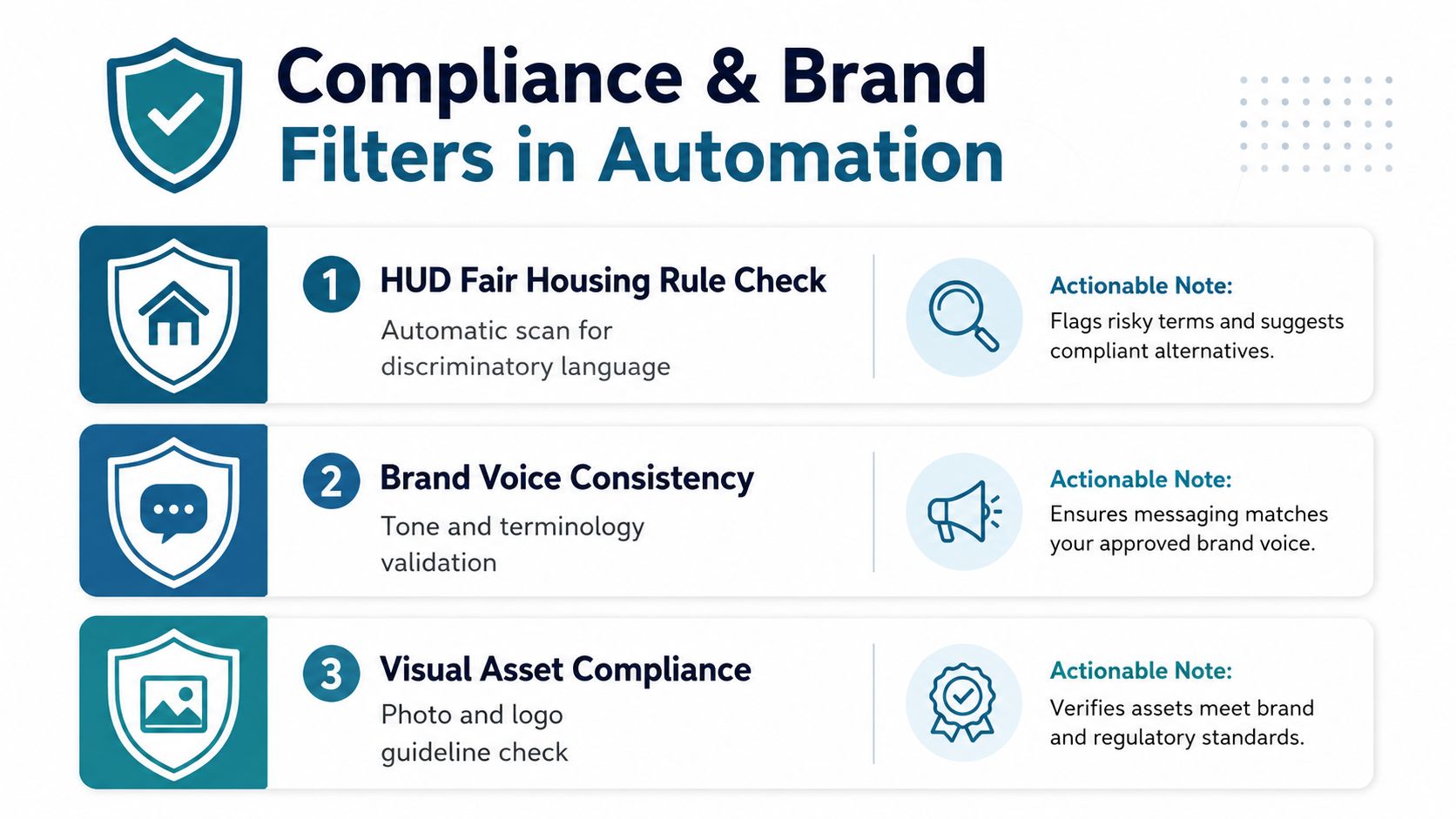
Fair Housing compliance belongs inside the automation, between the trigger and the publish step. It shouldn't sit in a quarterly checklist that nobody opens until a complaint arrives.
HUD states that the Fair Housing Act applies to housing advertising on digital platforms. HUD guidance also prohibits words, phrases, photographs, illustrations, symbols, or other forms that convey a dwelling is available or unavailable to a particular group based on a protected characteristic. (HUD digital advertising guidance)
That rule applies to automated social posts, listing descriptions, email campaigns, landing pages, and audience targeting. Avoid language such as “perfect for families,” “safe neighborhood,” “walk to church,” “exclusive,” or “ideal for young professionals.” Describe the property and location through verifiable features instead, such as room dimensions, parking, transit access, building amenities, nearby services, or stated property policies.
HUD further explains that advertising can't state a preference, limitation, or discrimination based on race, color, religion, sex, familial status, disability, or national origin. The prohibition reaches both publishers and the people or entities placing the ad. (HUD advertising memorandum)
Build the gate into every workflow
Place these controls before publication:
- Template lock: Require approved layouts, disclosures, logos, and field mappings.
- Phrase library: Maintain approved descriptive language and a list of prohibited or risky phrasing.
- Required fields: Confirm property status, price, address, contact information, availability details, and required disclosures.
- Human approval: Route AI-generated copy to an agent, broker, or compliance reviewer before it goes live.
- Asset review: Check photos, graphics, audience settings, and logos against brokerage policy.
HUD guidance for affirmative fair housing marketing calls for detailed, clear, and consistent information about amenities, eligibility criteria, application timing, submission procedures, and selection processes. It also says advertising must include the Equal Housing Opportunity logo, slogan, or statement. (HUD affirmative marketing guidebook)
For new construction and substantial rehabilitation projects, HUD guidance says advertising must begin at least 90 days before occupancy. (HUD multifamily marketing guidance)
Keep an audit trail of the source data, generated draft, reviewer, approval, and publication. A broker should be able to understand what shipped and who approved it without reconstructing the process from memory.
Measuring What Matters Without Drowning in Dashboards
An agent sees 10,000 Instagram impressions but zero CRM-sourced appointments. That result should trigger a measurement review, not a congratulatory report. Your weekly review needs a short list of metrics tied to contact, appointment, contract, and closing outcomes.
Start with speed-to-lead, measured from form submission to the first personalized response. Track pipeline velocity, the time between a meaningful touch and a contract. Measure lead-to-appointment rate by source, rather than hiding differences inside one team average. Add AI-search visibility only when you can verify which page, mention, or campaign produced it. Finish with cost per closed transaction, including media, software, labor, and content.
The weekly five-box review
- Response: Which sources received the slowest first contact, and where did automation fail?
- Appointments: Which sequence produced booked conversations, not just opens or clicks?
- Pipeline: Which contacts moved from nurture to active opportunity?
- Attribution: Can the CRM connect the inquiry to a campaign, page, channel, or AI-search reference?
- Cost: What did each closed transaction cost across media, software, labor, and content?
Use the benchmark table from Section 2 for external performance comparisons. This section should answer a different question: whether your own workflows create profitable pipeline. For each rollout stage, divide total workflow cost by closed transactions attributed to that stage. Include staff review time, platform fees, content production, advertising, and any rework caused by compliance or data errors. If the calculation cannot be reproduced from CRM and transaction records, the number is not ready for a team meeting.
Platform reports show activity, not business impact. An Instagram dashboard can report 10,000 impressions while the CRM records no inquiry or appointment from that audience. The CRM and transaction record remain the operating source of truth. Review the channel report to diagnose reach, then use CRM records to judge whether that reach produced contact, appointment, client, or closing outcomes.
Review weekly, then run a deeper attribution analysis monthly. Tie each workflow to a defined KPI and a 90-day decision point. If it has not improved the metric by then, revise the trigger, audience, message, or handoff. Retire workflows that generate activity your records cannot connect to revenue, and document Fair Housing review failures as operating costs rather than hiding them outside the dashboard.
Choosing Tools That Fit How Agents Actually Work
Buy for workflow fit, not feature count. The tool must match how agents capture leads, update listings, communicate with clients, and approve content. If it requires a weekend of manual patches just to keep MLS and CRM data synchronized, the operating cost is higher than the subscription.
Three filters for the buying decision
First, adoption. Agents won't use a system that forces every conversation into an unfamiliar process. The best stack supports mobile work, clear task ownership, practical templates, and simple approval steps.
Second, data movement. A new listing should not require duplicate entry across the CRM, social scheduler, email platform, and content system. Look for dependable integrations and clear error handling.
Third, real estate context. Generic AI tools can draft almost anything, but they don't automatically understand your MLS fields, listing status rules, platform formatting, brokerage approvals, or Fair Housing review requirements.
| Criterion | Generic AI, ChatGPT, Canva, Notion AI | Real Estate Vertical, such as ListingBooster.ai |
|---|---|---|
| General productivity | Strong for brainstorming, drafting, design, and organization | Focused on real estate marketing workflows |
| Listing fields | Requires careful prompting and verification | Built around property and listing information |
| Channel formatting | Usually manual adaptation | Supports property-specific content variations |
| Compliance controls | Depends on the user and workflow | Can place real estate review requirements closer to publication |
| Brand consistency | User maintains templates and standards | Templates and approved voice can be applied within the workflow |
| AI-search content | Requires the user to design the structure | Can support listing and authority-content workflows |
ListingBooster.ai is one option for agents who want listing descriptions and social content generated inside a real estate-specific workflow. It's designed to turn listing details into editable marketing material, while teams still need to verify facts, apply brokerage rules, and approve publication.
Use horizontal tools for broad productivity. Use vertical tools for listing content, nurture, and brokerage-specific review. Be cautious with “all-in-one” suites that charge brokerage-level pricing for functionality a solo agent won't use. For a wider comparison of the top AI real estate marketing tools, evaluate workflow fit, data ownership, approvals, and attribution before looking at cosmetic features.
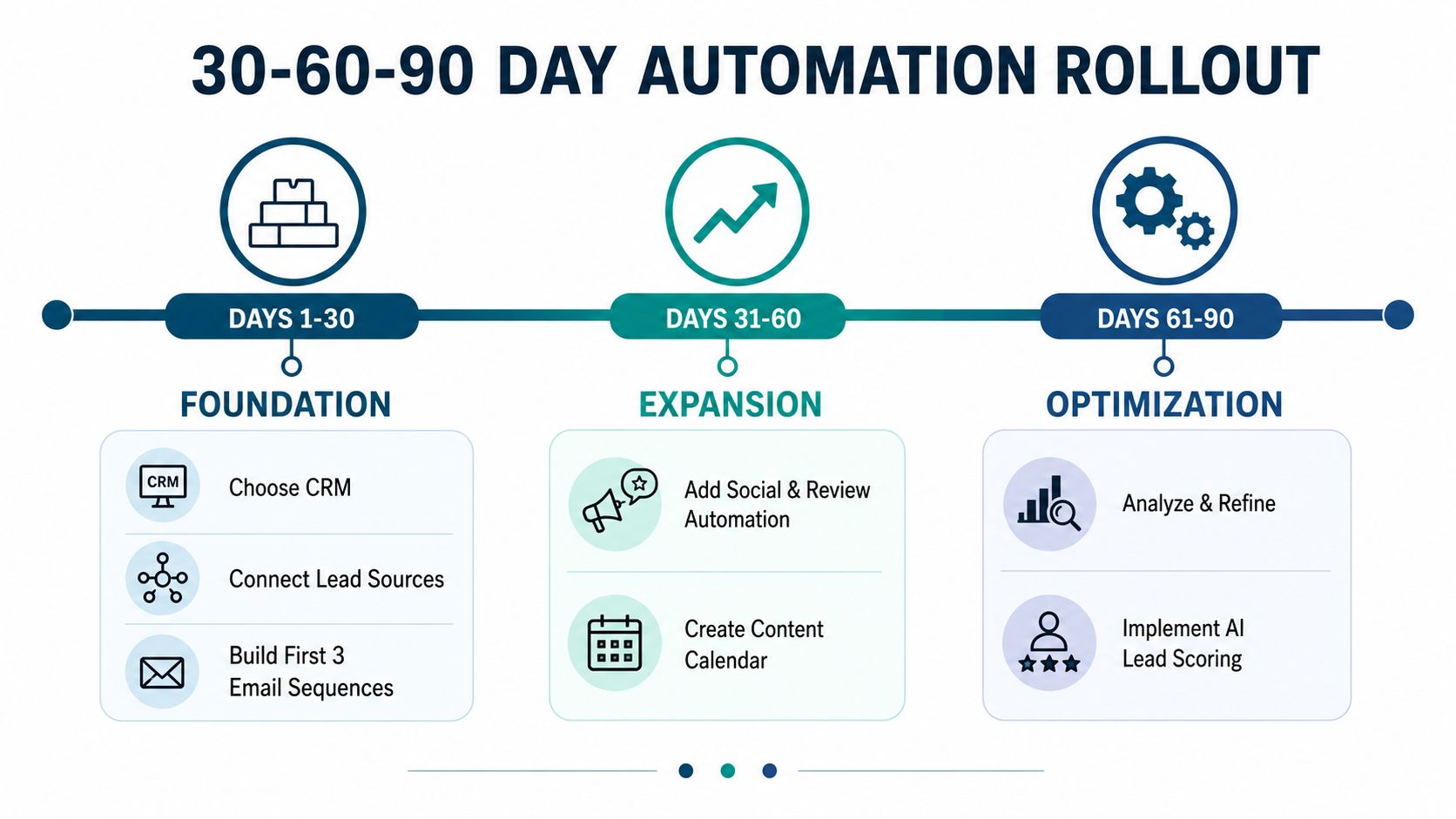
A Practical 30-60-90 Day Rollout Plan
A rollout should start narrow. Pick the workflow with the clearest trigger and the most obvious operational waste.
Days 1 to 30
Choose one CRM, connect the lead sources you already use, and launch one listing-to-social workflow. Add one five-step nurture sequence with clear exit rules. Record the source, response time, appointment outcome, and owner for every new lead.
Days 31 to 60
Add authority content. Publish buyer, seller, neighborhood, or market-update pieces that answer real local questions, then distribute approved excerpts through email and social channels. Add a Fair Housing review step before any AI-generated copy reaches the public.
Days 61 to 90
Define your baseline metrics and review attribution for a full 30-day period. Compare source-level appointments, pipeline movement, and closed-transaction cost. Remove workflows that create noise or cannot be tied to a business outcome.
At the end of the rollout, ask one practical question: does your current stack save meaningful administrative time each month and produce measurable pipeline? If it does neither, simplify it before adding another integration.
ListingBooster.ai turns listing details into editable MLS-ready descriptions, social content, and authority marketing assets that can fit into an approval-based automation workflow. Visit ListingBooster.ai to see whether its listing and content tools fit your current CRM, compliance process, and measurement plan.
Walk In With the Campaign Already Built
Listing copy, social posts, sourced Market Insights, growth scheduling, and direct publishing after approval from one real-estate-specific system. 25 free credits to start.
Related Posts
 Uncategorized
Real Estate Content Marketing: The 2026 Playbook
Listings with video can generate 49% more qualified leads, according to a 2026 real estate digital marketing roundup. That figure changes the question. Real estate content marketing isn't about how often you post. It's about whether your listing, expertise, and local knowledge can be found, understood, and cited by people and by the AI tools […]
 Uncategorized
AI for Real Estate Marketing: A Practical Playbook
A new listing goes live on Tuesday morning. You write the description from memory, schedule three social posts, answer showing requests, and move on to the next client task. By afternoon, the listing has plenty of activity on your side of the business, but the phone still isn't producing the conversations you expected. That gap […]
 Uncategorized
What Is IDX and Why It Still Matters for Real Estate
A new agent usually hears “IDX” during a brokerage onboarding call, nods along, and hopes nobody asks for a definition. Then the questions arrive: Why are listings appearing on the website? Who controls the data? Why did a property remain visible after its status changed? And will the same pages be readable by ChatGPT, Perplexity, […]