Multi-platform real estate marketing: Master Local Domination with Proven Tactics
Spreading the word about a new listing used to be so simple.An ad in the paper, a sign in the yard, and maybe a spot in the MLS. Today, a successful marketing strategy means showing up everywhere your clients are—all at once. This is what multi-platform marketing is all about: a unified push across MLS portals, social media, email campaigns, and paid ads to make sure your listings and your brand are impossible to miss.
Your Marketing Playbook Needs a Major Overhaul
Let's be real. The old "post and pray" approach on Facebook just doesn't cut it anymore. Your potential buyer’s journey is all over the place. They might start on Zillow, get distracted by a video tour on Instagram, and even ask an AI chatbot for agent recommendations in their area. If you're not visible at every one of those stops, you're effectively invisible.
Trying to manage this with a scattered strategy—a random post here, a sporadic email there—is a recipe for a weak, forgettable brand. It fails to build the kind of momentum you need. To truly compete, you need a cohesive, multi-platform real estate marketing plan that delivers a consistent message at every single touchpoint.
From Manual Chaos to an AI Command Center
Instead of juggling a dozen different platforms and feeling constantly behind, top agents are shifting to a centralized "command center." This isn't just about saving time; it's about being more strategic. Imagine having a system that takes one property listing and instantly spins up a month's worth of compliant, engaging content for every channel you use. That's the power we're talking about.
This is what a modern marketing hub looks like. Tools like ListingBooster.ai create a single dashboard to plan, launch, and track everything from social media posts to email blasts.
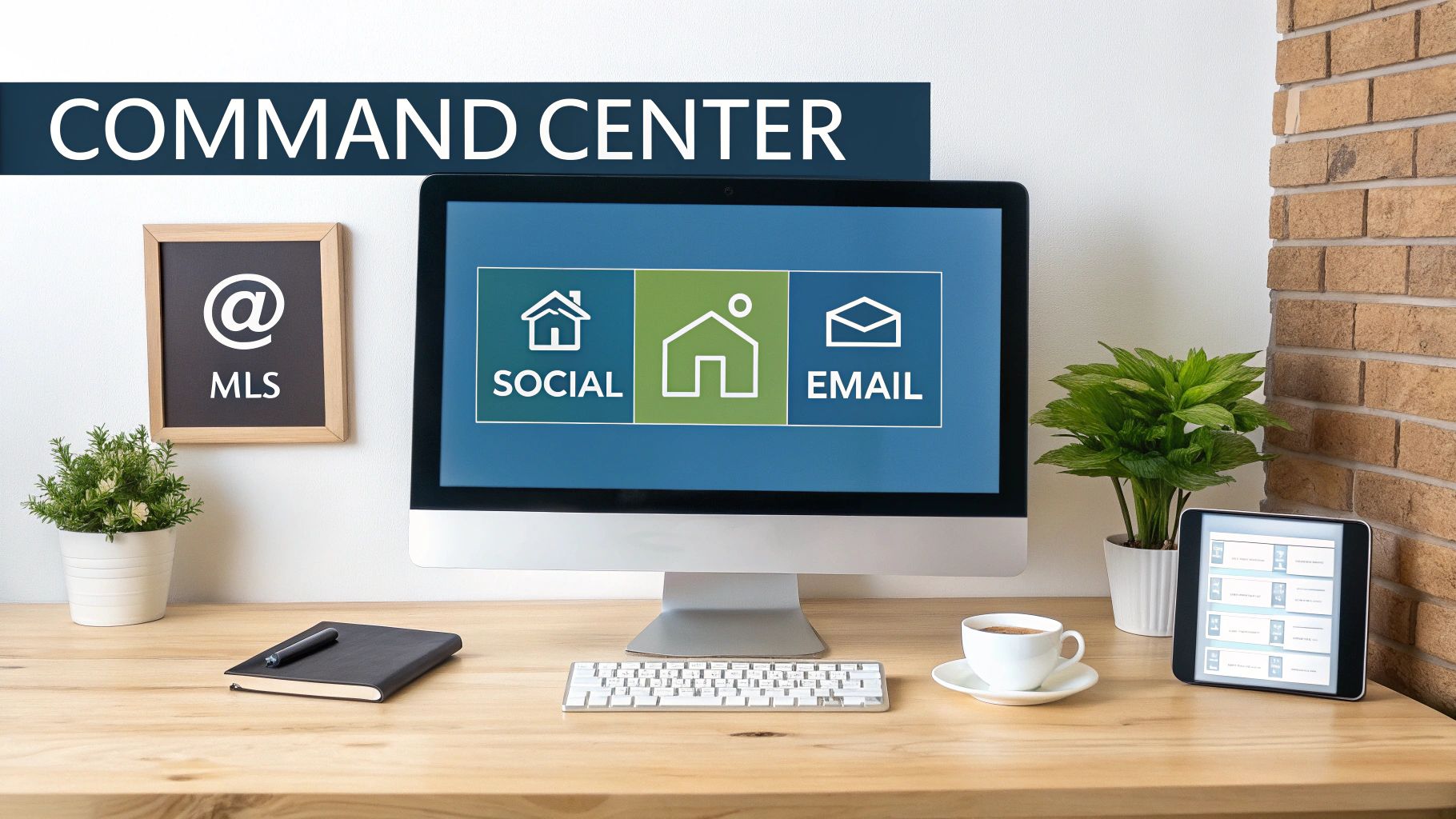
The big win here is radical efficiency. You can manage your entire online presence from one spot, keeping your brand message tight and saving yourself dozens of hours every month. This isn't just about posting more; it's about moving from disjointed tasks to an automated, psychology-driven system that actually attracts and converts today's buyers and sellers. For a deeper dive, our complete guide on building a real estate agent content strategy is a great place to start.
The industry is already pouring money into this approach. In fact, 54.2% of real estate agents' marketing budgets are now earmarked for digital channels. This isn't just about spending; it's about spending smarter. Consider that organic and paid search combined drive 57% of all website traffic, and organic search alone converts at a solid 3.2%.
The goal is to create a seamless client journey. A potential buyer might discover your listing on Redfin, see an engaging video tour on your Instagram Story, and then receive a targeted email about an open house—all parts of a single, orchestrated campaign.
This modern approach goes way beyond just being seen. It's about building an automated engine that establishes your authority, consistently generates leads, and ultimately frees you up to do what you do best: connect with clients and close deals.
To stay competitive, agents need to master a diverse set of platforms, each with its own purpose and content style. The table below outlines the core components every modern real estate marketing strategy should include.
Core Components of a Modern Real Estate Marketing Strategy
| Platform | Primary Goal | Key Content Type | AI-Powered Advantage |
|---|---|---|---|
| MLS Portals | Maximum Visibility | High-quality photos, detailed descriptions | AI-generated, MLS-compliant property descriptions that highlight key features. |
| Social Media | Community Building | Behind-the-scenes videos, client testimonials | Automated post scheduling and generating platform-specific captions (e.g., Reels vs. LinkedIn). |
| Email Marketing | Nurture Leads | Market updates, new listing alerts | Personalized email sequences triggered by client behavior, like viewing a specific property. |
| Paid Ads | Targeted Reach | Lead generation forms, video ads | Optimizing ad spend by targeting audiences most likely to convert based on data analysis. |
By integrating these channels with a smart, AI-driven workflow, you create a marketing machine that works for you around the clock, ensuring no opportunity is missed.
Building a Powerful Omnichannel Content Foundation
Every great multi-platform marketing campaign starts with a solid foundation of core assets. Your property photos, videos, and descriptions aren't just details—they're the engine driving your entire strategy. Before you even think about posting on Instagram or sending an email blast, you need standout content that stops the scroll and holds attention.
The good news? You don't need a full-time creative team for every new listing. Modern platforms can take a single property URL and spin up a whole suite of high-quality, AI-optimized marketing materials. This way, your visuals and descriptions are not only compelling but also perfectly formatted for every channel, from MLS portals to social media feeds.
Non-Negotiable Visuals: Drone and Pro Photography
Let's be blunt: grainy smartphone photos are a liability. In a market where buyers make snap judgments based on what they see, professional photography isn't an optional expense—it's a fundamental investment. High-resolution images that make a home’s best features pop are the absolute minimum to even compete on platforms like Zillow and Redfin, where listings are judged side-by-side in seconds.
But to really stand out, you need to go a step further with aerial imagery. The data on this is crystal clear. Properties with professional photography already sell 32% faster than those without. The real kicker, though, comes from that bird's-eye view. Homes with drone or aerial images sell an astounding 68% faster than similar properties that skip them. These numbers tell a simple story about modern home buying: first impressions are everything. You can learn more about what's next by checking out the future trends in real estate marketing.
The bottom line is this: if your visuals don't immediately stop the scroll, your perfectly crafted description and clever social media caption will never even get read. High-impact imagery is the gatekeeper to everything else.
Crafting Descriptions That Speak to Humans and AI
Once you've grabbed a buyer's attention with stunning visuals, the property description is what seals the deal. A great description pulls double duty: it tells a story that connects emotionally with a person, and it’s packed with the right keywords and structure for search algorithms to understand. This dual purpose is crucial for getting found on traditional search engines and the new AI-powered recommendation systems.
This is where an AI-enhanced approach really shines. It can analyze a property's features and instantly weave them into a narrative that hits on proven psychological triggers—like scarcity, aspiration, or the desire for a specific lifestyle. It turns a boring list of features into a compelling vision of what life in that home could actually feel like. You can dive deeper into how this works in our guide on real estate content marketing automation.
Let's look at a real-world comparison to see just how big the difference is.
Generic vs. AI-Enhanced Property Descriptions
| Generic Description | AI-Enhanced Description |
|---|---|
| "3 bed, 2 bath home with a nice backyard. Updated kitchen with granite countertops. Good for a family. Close to schools." | "Imagine hosting summer barbecues in your private, sun-drenched backyard. This beautifully renovated 3-bedroom, 2-bathroom home offers the perfect blend of comfort and style, just steps from top-rated schools. The chef's kitchen, complete with gleaming granite countertops, is ready for your next culinary adventure. This is more than a house; it’s the backdrop for your family's best memories." |
See the difference? The second example doesn't just list facts; it paints a picture. It uses evocative language ("sun-drenched," "culinary adventure") and connects features to real-life benefits ("backdrop for your family's best memories"). This is exactly the kind of powerful content that performs well everywhere, from a detailed MLS listing to a short-and-sweet Instagram caption. By starting with a strong, AI-optimized foundation, you're creating assets that can be effortlessly repurposed for every single stage of your campaign.
Running Your Multi-Platform Content Calendar
You've got the gorgeous photos and a killer property description. That's a great start, but those assets aren’t doing you any good just sitting in a Dropbox folder. The real trick is getting them out into the world strategically—without turning into a full-time social media manager. This is where a multi-platform content calendar stops you from just posting randomly and starts building a real, lead-generating campaign.
A good calendar lets you tell a story about a listing over 30 days. Instead of just one "Just Listed" blast, you create a narrative that unfolds across different channels. Think daily Instagram Stories, in-depth Facebook posts, a professional breakdown on LinkedIn, and even quick, eye-catching TikToks.
Getting this foundation in place used to be a massive time-sink, but it’s gotten a lot simpler. The process can now start with just a single property URL, which acts as the seed for all your core marketing materials.
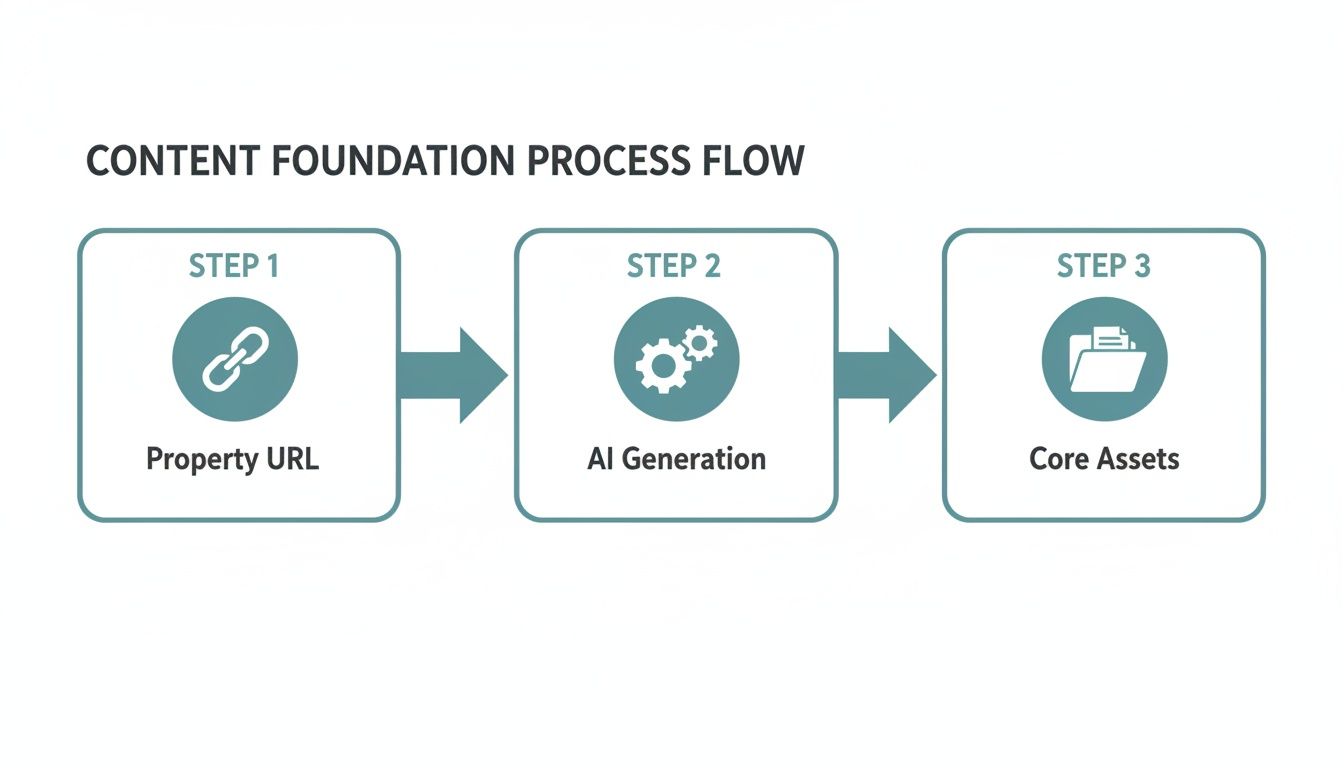
This workflow shows how modern real estate marketing works: you take one piece of data, let AI amplify it, and end up with a full suite of assets ready to go.
Smart Repurposing for Maximum Impact
The secret to a manageable calendar that actually works is smart repurposing. You don’t need to create brand-new content for every single platform. The goal is to adapt your core assets to fit the vibe and audience of each channel.
Take a professional drone video, for example. It can live as a full two-minute feature on your YouTube channel. But you can also chop that same video into a punchy 15-second Reel for Instagram, a vertical slice for a TikTok, or even a looping GIF for your next email newsletter. The original asset is the same, but you're presenting it in a way that feels native to each platform.
The most successful agents don't work harder on content; they work smarter. They create one great piece of content and find five different ways to share it, ensuring their message reaches the widest possible audience with minimal extra effort.
This mindset works just as well for your written content. That detailed, AI-generated property description for the MLS can be stripped down to a few compelling bullet points for a Facebook post, a single hooky sentence for an Instagram caption, and a professional summary for a LinkedIn article.
Here's a quick look at how that repurposing strategy plays out for a single listing.
Content Repurposing Workflow for a New Listing
| Platform | Content Format | Key Message / CTA | Frequency |
|---|---|---|---|
| MLS | Long-form description, professional photos, virtual tour | Full property details, agent contact info | One-time upload |
| High-quality photo carousel, short video Reel (15-30s) | "Just Listed! ✨ Tour this dream kitchen…" DM for info. | 2-3 posts/Reels first week | |
| Detailed post with multiple photos, event for Open House | Highlight unique features, drive traffic to Open House | 1-2 posts per week, plus event promo | |
| YouTube | Full video walkthrough (2-3 min) | In-depth virtual tour experience. Subscribe for more listings! | One-time upload per listing |
| Newsletter feature with hero image, key details, and link | Exclusive first look for subscribers. Schedule a private tour! | 1-2 emails (Just Listed, Open House) | |
| Professional update/article | "Proud to represent this stunning property…" Market insight. | 1 post at launch |
This table is just a starting point, but it shows how you can get so much mileage out of your initial set of assets by tailoring the format and message.
Crafting Copy for Key Campaign Moments
Your content calendar should map out the entire life of a listing, from "Coming Soon" to "Just Sold," with specific copy ready for each milestone. This keeps your messaging timely and relevant, pushing people toward the right action at the right time.
This is another area where an AI tool like ListingBooster.ai is a game-changer. It can generate all of this platform-specific copy for you. Even more importantly, it ensures everything automatically adheres to Fair Housing guidelines—a critical compliance step that’s incredibly difficult and time-consuming to manage manually across dozens of posts.
Here are a few real-world examples of what that platform-specific copy looks like:
- Open House Announcement (Instagram Story): "Your weekend plans just got an upgrade! 🏡✨ Swipe up to see the tour times for 123 Maple Street and find out why this kitchen is a home chef's dream. See you Saturday!" (Uses interactive elements and a casual tone.)
- Price Improvement (Facebook Post): "Great news for anyone watching 123 Maple Street! The sellers are motivated, and we have a new price that makes this stunning home an even better value. If you've been on the fence, now is the time to act. DM me for the new price and a private showing!" (Creates urgency and encourages direct engagement.)
- Just Sold (LinkedIn Article): "Successfully closed on 123 Maple Street for my clients! This transaction was a perfect example of navigating a competitive market to secure a fantastic outcome. A big thank you to everyone involved. If you're considering your next move in this market, let's connect." (Positions you as a competent professional for your network.)
When you plan these posts ahead of time, you're not just selling a house. You're building a consistent narrative that generates buzz and solidifies your reputation as the go-to agent in your market.
Building Your Authority Beyond the Listing

A truly powerful marketing strategy does more than just sell your current listings; it sells you. I’ve seen time and again that the top agents in any market understand their brand is their single most valuable asset. It needs to be nurtured long before a potential client is even thinking about a contract.
The goal is simple: become the definitive, go-to expert in your market.
This means you have to shift a portion of your content calendar away from just "Just Listed" or "Open House" posts. Yes, those are essential for attracting active buyers, but what about future sellers? To capture their business, you need to build authority by consistently providing real value to your community. You need to build a digital footprint that screams expertise.
Think about the questions rattling around in a homeowner's head: Is now a good time to sell? What’s the market doing in my specific neighborhood? How do I even get my home ready for the market? Your content should be the answer to those questions before they even think to Google them.
Automating Your Expert Voice
Consistently creating insightful market updates, detailed neighborhood guides, and helpful tips for homeowners sounds like a full-time job in itself, right? This is where having the right systems gives you a massive advantage. Instead of spending hours digging through data and writing blog posts, you can use a tool that does the heavy lifting.
This is exactly what the Authority Builder feature in ListingBooster.ai was designed for. It generates hyper-local, market-specific content that positions you as a knowledgeable guide, not just another salesperson. This automated content becomes the foundation of your authority-building campaigns.
Your digital presence should be a resource, not just a highlight reel. When a homeowner thinks, "I wonder what my house is worth," your name and your content should be the first thing that comes to their mind.
This approach builds trust over time. By freely offering valuable information, you create a real relationship with potential clients before they're actively looking for an agent. When the time comes for them to sell, you’re not a stranger—you’re the trusted expert they’ve been following for months.
Content That Builds Your Brand
So, what does this authority-building content actually look like? It's a healthy mix of different formats and topics, all designed to showcase your local expertise and genuine helpfulness.
- Monthly Market Updates: A quick video or blog post breaking down the latest stats for your area is gold. Talk about the average sale price, days on market, and inventory levels. The key is to make it easy for people to understand what those numbers mean for them.
- Neighborhood Spotlight Guides: Do a deep dive into the communities you serve. Talk about the best parks, the local schools, your favorite coffee shops, and unique community events. This shows you’re truly embedded in the area, not just working there.
- Homeowner Maintenance Tips: This is such an easy win. Offer seasonal advice like "5 Tips to Winterize Your Home" or a "Spring Curb Appeal Checklist." It provides immediate, actionable value.
- Buyer and Seller FAQs: Answer common questions you get all the time. "What's the difference between pre-qualified and pre-approved?" or "Common mistakes to avoid when selling your home."
This kind of content is evergreen—it stays relevant for a long time. It also performs exceptionally well with search algorithms, both traditional search engines and newer AI assistants. When someone asks an AI, "Who is the best agent in my town?" the system looks for agents who have a rich history of creating helpful, locally-focused content.
This strategy becomes even more crucial as markets heat up. With transaction volumes on the rise, agents who maintain a consistent, multi-platform presence will gain a huge advantage over those who only market when they have an active listing. The agents who will capture market share are the ones demonstrating professional authority across multiple channels at once. If you want to dive deeper, you can find more insights on global real estate investment trends and their impact on agents.
By building your authority beyond the listing, you’re not just marketing for your next deal; you’re building a sustainable business that attracts clients directly to you.
Optimizing for AI Search and Measuring What Matters
Pushing a multi-platform marketing campaign out the door is a great start, but it’s only half the job. If you really want to make an impact, you have to make sure your content is actually being found by modern search tools and then rigorously track what’s working. This is the crucial pivot from just being a content creator to becoming a strategic marketer who makes decisions based on hard data.
It's no longer enough to just have a website or a social media profile. Your online presence needs to be structured in a way that AI can understand. Think about platforms like ChatGPT or Google's AI Overviews—they are increasingly the first stop for buyers and sellers. If your content isn't "AI-ready," you're basically invisible to a huge and growing chunk of your potential audience.
Making Your Content AI-Ready
So, what does “AI-ready” even mean in practice? It really comes down to structure and clarity. Imagine giving a search engine a perfectly organized blueprint of your listing instead of just a pile of bricks. That's what we're aiming for.
The secret weapon here is schema markup. It’s a bit of code you add to your website that acts like a set of labels, telling search engines exactly what each piece of information is—this is the price, this is the address, here are the bedrooms, and so on. It sounds technical, and doing it manually can be a headache, which is why platforms like ListingBooster.ai are so valuable. They automatically embed all the necessary schema into the property websites they create for you.
It’s the difference-maker. When a user asks an AI assistant, "Find me a three-bedroom home with a pool under $500,000 in Austin," schema markup is what allows the AI to instantly see that your listing is a perfect match and serve it up.
Beyond the code, being AI-ready is also about substance. Writing genuinely helpful, keyword-rich property descriptions and deep-dive neighborhood guides gives AI the context it needs to recognize you as a local authority. For a deeper look at this, check out our guide to real estate AI search optimization.
Tracking the Metrics That Actually Drive Business
Once your marketing is live, it’s time to see how it’s performing. It's incredibly easy to get distracted by "vanity metrics" like likes and follower counts. They feel good, but they don't pay the bills.
Instead, you need to zero in on the numbers that signal real client interest and are tied directly to business growth. The goal is to shift your focus from broad, fuzzy awareness to specific, measurable actions. That’s how you create a feedback loop that makes every campaign better than the last.
Here are the key metrics to watch on each platform:
Social Media:
- Engagement Rate: Forget just likes. Look at comments, shares, and especially saves. This tells the algorithm your content is valuable, which means more organic reach.
- Click-Through Rate (CTR): Of all the people who saw your post, how many actually clicked the link to your property website? This measures how compelling your content really is.
- Direct Messages (DMs): In real estate, a DM is a hot lead. Keep a close eye on how many serious inquiries are coming through your inbox.
Email Marketing:
- Open Rate: This is your first hurdle. It tells you how good your subject lines are and how much your audience trusts you.
- Click-Through Rate (CTR): This is arguably the most important email metric. It shows who was interested enough to take the next step and click on your link.
- Conversion Rate: Of those who clicked, how many actually scheduled a showing or downloaded your homebuyer guide? This is where the money is.
Creating Your Performance Feedback Loop
Data doesn't do you any good if you don't act on it. The final, critical step is to use these insights to constantly tweak and refine your strategy. This is how you build a powerful feedback loop where every campaign teaches you something for the next one.
For example, you might notice that your Instagram Reels of video walkthroughs get double the engagement of static photo carousels. That’s a crystal-clear signal: make more video. Or maybe an email with the subject line "Price Update on 123 Maple Street" gets a whopping 45% open rate, while your generic monthly newsletter hovers around 15%. The lesson? Your audience craves urgency and specificity.
This cycle of tracking, analyzing, and iterating is what separates the top producers from everyone else. When you optimize for AI search and measure what truly matters, you stop just "running campaigns" and start building a predictable, scalable marketing engine for your business.
Your Questions, Answered
Jumping into a multi-platform marketing strategy can feel overwhelming. Let's tackle some of the most common questions I hear from agents who are ready to ditch the scattershot approach for a smarter, more unified system. My goal here is to give you straight, practical answers and show how the right tools make these challenges disappear.
How Can I Possibly Manage All These Platforms Without It Taking Over My Week?
I get this one a lot. The secret is to stop thinking of yourself as a manual content creator and start acting like a campaign manager. You have to move away from the grind of creating every single post, email, and ad from scratch.
Think about it: instead of spending hours brainstorming, writing, designing, and then triple-checking compliance for every platform, you need a system. A tool like ListingBooster.ai, for example, can take a single property's details and spin up a complete, compliant 30-day content calendar in minutes.
This “create once, distribute everywhere” model is how top agents maintain a powerful, consistent presence across Instagram, Facebook, MLS, and more—often in the time it takes to finish their morning coffee. It frees you up to focus on what actually makes you money: talking to clients and closing deals.
The real mindset shift is moving from a time-based model (how many hours did I spend on marketing?) to an outcome-based one (how many results did I get in minutes?). Let automation handle the grunt work so you can focus on strategy and relationships.
What Exactly Is "AI-Ready" Content, and Why Should I Care?
AI-ready content is simply information that's structured so that AI—think ChatGPT or Google's new AI-powered search—can easily understand and recommend it. For real estate agents, this is quickly becoming a must-have, not a nice-to-have.
Here’s why it matters:
First, it’s about schema markup. This is a bit of code that works like a label, telling search engines exactly what your data means (e.g., "this number is the price," "this is the square footage"). ListingBooster.ai automatically bakes this into your listings so AI can read them perfectly.
Second, it’s about creating content that directly answers the questions buyers and sellers are now asking AI. When a potential client asks an AI, “Who is the best real estate agent in my neighborhood?” you want your content to be the reason your name pops up. If your marketing isn't AI-ready, you’re invisible to a huge and growing group of people starting their search with these new tools.
How Do I Make Sure My Marketing Content Is Fair Housing Compliant?
Staying on the right side of Fair Housing laws is a massive headache when you're creating content manually. This is especially true for teams and brokerages, where one agent’s innocent mistake on a social media post can create a serious legal mess. Manually reviewing every caption and ad is not only a drag, but it's also wide open to human error.
The only truly reliable way to handle this is to use a system with built-in guardrails.
- Automated Scanning: Platforms like ListingBooster.ai automatically scan every piece of generated copy against Fair Housing guidelines before it ever sees the light of day.
- Uniform Standards: This ensures every single agent in a brokerage is working from the same compliant playbook, which dramatically lowers the company's risk.
- Total Peace of Mind: It just removes the constant guesswork and legal anxiety from your workflow.
This kind of automated check protects you from accidental slip-ups and lets brokers empower their teams with powerful marketing tools without taking on a huge compliance burden. It turns a major liability into a simple, automated step.
Can I Still Sound Like "Me" If I'm Using an AI Tool?
Absolutely. One of the biggest myths about AI is that it spits out generic, robotic content that makes every agent sound identical. The truth is, modern tools are designed to be a powerful launchpad, not a rigid template that erases your personality.
While a tool like ListingBooster.ai generates content based on 23 proven psychological frameworks to get the best engagement, every single word it produces is fully editable. You have 100% control to tweak the tone, drop in a personal story, or change the call-to-action to sound exactly like you.
The AI does the heavy lifting—the structuring, the optimization, the compliance check, and the first draft. It hands you a 90% finished, high-quality piece of content that you can then personalize in seconds, not hours. It’s the best of both worlds: the speed and power of AI, combined with the authenticity that only you can bring.
Ready to stop juggling platforms and start dominating your market? ListingBooster.ai is the AI-powered command center that generates a complete, compliant 30-day marketing campaign from a single listing in minutes. See how top agents are saving time and winning more listings by visiting https://listingbooster.ai.
Walk In With the Campaign Already Built
Listing copy, social posts, sourced Market Insights, growth scheduling, and direct publishing after approval from one real-estate-specific system. 25 free credits to start.
Related Posts
 Social Media Marketing
8 Real Estate Quotes for Social Media That Convert in 2026
Social media didn't become optional branding for agents and brokers. It became buyer discovery. Canva cites a Facebook report showing that 79% of homebuyers use online resources, including mobile, at some point in their property search. That single shift explains why so many “Just Listed” graphics now disappear into the feed without doing much for […]
 Social Media Marketing
How to Create Social Media Content From a Property Listing
You've got a new listing. Photos are back. The walkthrough video is sitting in your camera roll. The MLS copy is approved. And then the bottleneck shows up. You still need Instagram posts, a Reel, Facebook copy, open house promos, a LinkedIn angle, stories, maybe an email, and something you can keep publishing next week […]
 Social Media Marketing
Real Estate Content Calendar for Agents: A 30-Day Plan
Recent industry coverage points to a clear shift. Homebuyers are starting their search inside AI tools such as ChatGPT, Perplexity, and Google AI, which changes the job of a real estate content calendar for agents. A content calendar now has to do more than keep Instagram or LinkedIn active. It needs to create a body […]