Master Real Estate AI Search Optimization to Rank Higher
Real estate AI search optimization is all about making sure AI-powered tools like ChatGPT and Google AI Overviews see you as the go-to expert. It’s a fundamental change in thinking. We're moving away from simply targeting keywords and instead focusing on building a rich, trustworthy digital presence that an AI can confidently recommend.
The goal is to show up when a buyer asks a natural, conversational question, like, "Who is the best agent for first-time buyers in my city?"
Why Your Old SEO Strategy Is Failing in AI Search
For years, the game was simple: master Search Engine Optimization (SEO). If you could nail the right keywords, build some backlinks, and climb the search rankings, you were golden. But that playbook is quickly becoming a relic. The way people find real estate agents is changing right under our feet, and it's all because of conversational AI.
This isn't just a minor tweak to the algorithm. It's a complete shift from what we knew as SEO to something new: Answer Engine Optimization (AEO). AI platforms don't just find websites anymore; they pull information from all over the web to give a direct, synthesized answer. They're looking for genuine authorities, not just pages stuffed with keywords.
To put it simply, the strategies that got you here won't get you there. Let's look at the key differences.
| Factor | Traditional SEO (What Used to Work) | AI Search Optimization (What Works Now) |
|---|---|---|
| Core Goal | Ranking #1 on a search results page. | Becoming the AI's recommended answer. |
| Primary Tactic | Keyword targeting and backlink building. | Building a verifiable digital entity and authority. |
| Content Focus | Blog posts optimized for specific search terms. | In-depth, helpful content that demonstrates real expertise. |
| Technical Focus | On-page SEO, site speed, mobile-friendliness. | Structured data (schema), consistent information across platforms. |
| Success Metric | High search engine ranking and organic traffic. | High-quality leads from direct AI recommendations. |
The table really drives home the point: what worked yesterday was about being findable. What works today is about being verifiable and recommendable.
The New Search Landscape
Picture a potential client asking their AI assistant, "Who is the best real estate agent for first-time buyers in Austin?" The AI isn't just looking for an agent who has "Austin first-time buyer agent" plastered all over their site. It's smarter than that. It scans and connects the dots across an agent's entire digital footprint to figure out who truly knows their stuff.
The AI is looking for specific signals of expertise, like:
- Helpful, Niche Content: Do you have articles or videos breaking down the home-buying process in specific Austin neighborhoods?
- Structured Data: Is your professional profile and are your listings tagged with schema markup? This is the technical language that clearly tells an AI about your services, locations, and specialties.
- Consistent Authority: Do your Google Business Profile, Zillow reviews, and personal website all paint the same picture of a successful, specialized agent?
An agent whose online presence is robust, consistent, and built for this kind of deep, contextual understanding is the one who will get the AI's recommendation every time. Standing still is no longer an option if you want to stay visible.
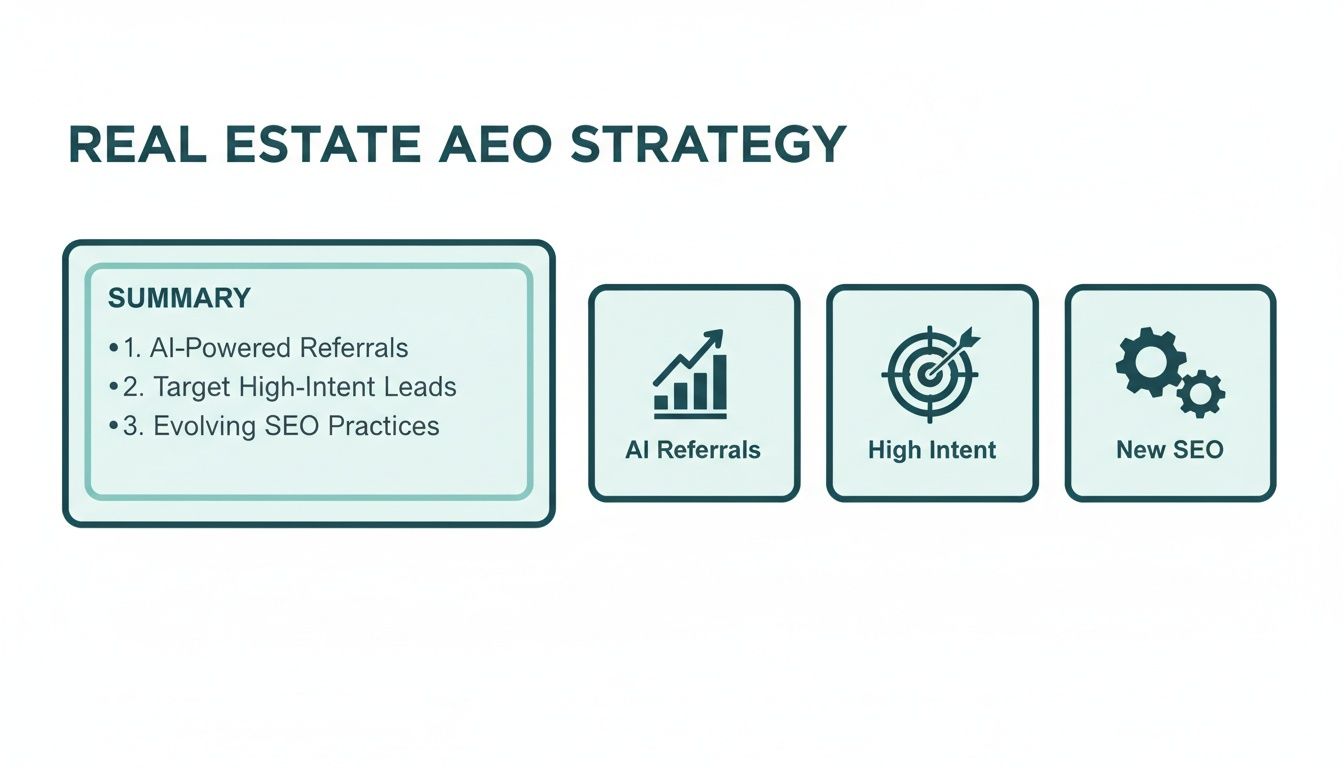
This is about playing the long game. AEO is a holistic strategy designed to prove your authority to AI systems, which in turn delivers highly motivated clients right to your doorstep.
The Growing Impact of AI Referrals
This isn't just theory—it's already happening. We're seeing a measurable impact on website traffic. Across the real estate industry, AI referral traffic now accounts for 1.01% of all website traffic. That number might seem small, but it represents a powerful and rapidly growing source of high-intent leads.
These aren't just casual browsers. These are people who have asked a specific question and been pointed directly to you. This is why optimizing with structured data and a clear, entity-based strategy is so critical. You can dig into more of the data on these AEO benchmarks to see just how much of an impact this is having.
The goal isn't just to rank on a search results page anymore. The goal is to become the answer when a potential client asks a question. This requires a deeper level of content and data consistency than ever before.
Ultimately, it comes down to this: Traditional SEO was about making your website findable. Real estate AI search optimization is about making your expertise verifiable and recommendable. The agents who get this and adapt now are the ones who will own the market in this new era of property search.
How to Optimize Your Digital Assets for AI Discovery
To get noticed in this new world of AI-driven search, your online presence needs a serious rethink. It's time to stop thinking of your website, business listings, and social profiles as static brochures. Instead, see them as dynamic data sources that AI can read, understand, and, most importantly, trust. The mission is to make every piece of your digital footprint so clear and authoritative that AI engines can't help but recommend you.
This whole process starts by changing how you present information online. We're moving away from old-school keyword stuffing and toward building data-rich, structured assets that an AI can easily digest. Let's get tactical and break down how to make your digital presence AI-ready.

Speak the AI's Language with Structured Data
Structured data, usually implemented using Schema.org's vocabulary, is essentially a Rosetta Stone for AI. It’s a way of labeling the information on your website so that search engines and AI models instantly know what everything means. Without it, you’re forcing the AI to guess. With it, you're handing over a perfectly organized file that says, "Here's exactly what this is."
For real estate agents, this is a massive advantage. You can go way beyond just writing "3 beds, 2 baths" and use specific schema tags that an AI can parse in a heartbeat.
Here’s where to start:
- RealEstateListing Schema: Tag your properties with explicit details like
numberOfRooms,floorSize,yearBuilt, andamenityFeature. This gives an AI the specific data points it needs to match a listing to a very specific user query. - LocalBusiness Schema: Use this on your contact and about pages. It clearly defines your business name, address, phone number (NAP), and the areas you serve, leaving no room for interpretation.
- Person Schema: Apply this to your agent bio to cement your professional identity. You can include your affiliations, specialties, and years of experience—all in a format an AI understands.
Think of schema as the behind-the-scenes work that makes your listings and profile incredibly easy for an AI to process and confidently recommend.
Turn Your Google Business Profile into a Local Powerhouse
Your Google Business Profile (GBP) is way more than just a map pin. It’s one of your most powerful tools for local real estate AI search optimization. AI models lean heavily on GBP for verified, local information. If you've been letting your profile gather dust, you're missing a huge opportunity.
It's time to transform your GBP into a beacon of local authority.
- Fill Out Everything: And I mean everything. Go through your business details, service areas, hours, Q&A, and services with a fine-toothed comb.
- Get Hyper-Local: Don’t just say you serve a city. Naturally weave neighborhood names, local landmarks, and community-specific terms into your business description, updates, and Q&A responses.
- Post Weekly Updates: Seriously, this is non-negotiable. Share new listings, open house schedules, local market stats, or community news. This constant activity signals to AI that you are an active, relevant expert.
- Champion Your Reviews: Actively ask for reviews and respond to every single one. Reviews that mention local keywords (like "she was the best agent for finding our home in the Northwood neighborhood") are pure gold, providing social proof that an AI can easily interpret.
You Are the Primary Source
In this new landscape, you have far more control than you might think. Recent research analyzing millions of AI citations from tools like ChatGPT and Gemini found something fascinating: a business's own website and its business listings are the most dominant sources. In fact, first-party websites and business listings command 44% and 42% of citations, respectively. This gives you direct influence over what AI systems learn about you.
You can read the full research about these AI and local search findings to see just how critical your own digital properties have become. The data is clear: by optimizing your own assets with consistent, authoritative information, you get to shape what AI recommends.
By focusing on your own website and GBP, you are directly feeding AI the exact story you want it to tell about you. You become the source of truth for your brand and your market.
Keep It Consistent Everywhere
Inconsistency is the enemy of AI trust. If your business name, address, and phone number (what we call NAP) are different across your website, GBP, Zillow profile, and social media accounts, you're creating confusion. AI algorithms see this inconsistency as a red flag for reliability, which can tank your chances of getting recommended.
Take the time to do a digital audit. Make sure your core business information is identical everywhere it lives online. It's a simple step, but this consistency builds a cohesive digital identity that AI can easily verify and trust. For agents looking to manage this more efficiently, exploring different AI tools for real estate agents can be a huge help in maintaining consistency and building authority.
Ultimately, every platform you're on should reinforce the exact same message: you are the definitive expert for your market.
Writing Content That AI Actually Understands and Promotes
In the end, great content is what fuels any smart real estate AI search optimization strategy. If you want to show up in these new AI-powered search results, your property descriptions, market guides, and neighborhood deep dives need to do double duty. They have to grab the attention of human readers and make perfect sense to the algorithms recommending you.
This means we have to move past the fluff. Vague, overused adjectives aren't going to cut it anymore. It's time to get descriptive and specific, focusing on the details that an AI can actually process. Your content needs to be the definitive answer when an AI looks for local expertise—not just listing features, but telling a story that an AI can easily break down and match to a buyer's real-life needs.

From Generic to Entity-Rich Descriptions
The difference between a standard MLS description and one written for AI discovery is night and day. Most descriptions are full of empty phrases like "charming home" or "nice backyard." Honestly, these terms mean very little to an AI trying to answer a specific question like, "Find me a home with a large yard for kids in a good school district."
AI thinks in terms of entities—concrete, definable things like school districts, park names, architectural styles, and even brand-name appliances. Your job is to feed it these details.
Let's look at a real-world before-and-after.
Before (The Standard MLS Description):
- "Beautiful 3-bedroom home with an updated kitchen and a nice backyard. Great for a family. Close to schools and parks. Must see!"
This is vague. It gives an AI almost nothing specific to work with, and frankly, it doesn't do much to excite a human buyer either.
After (The AI-Optimized Description):
- "Discover this stunning 3-bedroom, 2-bathroom Craftsman-style home in the highly sought-after Northwood school district. The completely remodeled kitchen features GE Monogram stainless steel appliances, quartz countertops, and a subway tile backsplash. Step outside to a spacious, fully-fenced backyard with a mature oak tree and a custom-built stone patio, perfect for summer entertaining. Located just a 5-minute walk from the popular Meadowbrook Park and its new playground."
See the difference? This version is packed with entities. It doesn't just say "updated kitchen"; it specifies the appliance brand. It doesn't just say "nice backyard"; it describes its features and what you can do there. This is how you make your content not just discoverable, but truly persuasive.
Answering Questions Before They're Even Asked
Today’s buyers aren't just typing "homes for sale in [City]." They're asking conversational questions, and your content strategy needs to be built around answering them directly. Put yourself in their shoes and create content that solves their biggest problems and curiosities.
This is the core idea behind Generative Engine Optimization (GEO)—creating content in a natural Q&A format that AI can easily pull from to build its answers.
Think about creating blog posts or dedicated website pages that answer questions like:
- What are the best neighborhoods in Miami for young professionals?
- How are the public schools rated in Scottsdale, AZ?
- What's the average commute time from the suburbs to downtown Seattle?
When you use clear headings (like H2s and H3s) that actually pose these questions, you're making it incredibly easy for an AI to see your content as a valuable, authoritative source.
Your goal is simple: Become the go-to source an AI references when it answers questions about your local market. When your content is clear, genuinely helpful, and written for people, AI tools are far more likely to trust and feature it.
Weaving in Hyper-Local Details
Long-tail keywords are just longer, more specific search phrases. In real estate, these are golden. They're often hyper-local and signal that a buyer knows what they want and is ready to act. AI algorithms love this level of detail because it helps them deliver much more accurate results.
So, instead of only targeting a broad term like "Austin homes for sale," you need to get more granular. Weave these descriptive, local phrases naturally into your content.
Here are a few examples of hyper-local entities you can work in:
- Neighborhood Amenities: "a short walk to the Trader Joe's on 2nd Street"
- Local Landmarks: "enjoying views of Camelback Mountain from the patio"
- Community Features: "access to the community pool and tennis courts in the Glenwood HOA"
- School Information: "zoned for the award-winning Lincoln High School"
Sprinkling these specific, local details throughout your property descriptions, neighborhood guides, and blog posts shows deep local expertise. It proves to both potential clients and the AI systems they're using that you're the agent who truly knows the area. This is the heart of effective real estate AI search optimization.
Building the Authority That AI Recommends
AI doesn't just skim for keywords; it actively looks for trusted, authoritative sources to recommend. To really stand out today, you need to become the definitive expert in your market—so much so that when AI needs an answer, it points directly to you. This isn't about writing a few blog posts. It's about weaving together a rich tapestry of content that consistently proves your expertise.
Think about the questions buyers are asking: "Who's the best agent for families moving to Austin?" or "What are the pros and cons of the Oak Hill neighborhood?" For an AI to recommend you, it needs to find more than your business name; it needs to find a history of you providing real value on those exact topics.
Go Hyper-Local with Your Content Strategy
Let's be honest: generic content gets lost in the noise. To build real authority that AI can recognize, you have to own a niche. The most powerful niche you have is your own backyard. This means shifting from broad real estate advice to creating hyper-local deep dives that only a true local expert could write.
Your content calendar should look less like a general real estate blog and more like a local community guide. Here are a few ideas to get you started:
- Detailed Neighborhood Guides: Don't just list stats. Talk about the best local coffee shops, the parks with the best playgrounds, commute times to downtown, and what makes the architecture unique. Tell the story of the neighborhood.
- Monthly Market Analyses: Grab data from your MLS and add your professional take. Explain what the numbers actually mean for someone trying to buy or sell in your town right now.
- Genuine Buyer and Seller Guides: A "First-Time Homebuyer's Guide to Denver" is infinitely more useful—and more discoverable—than a generic one.
Every piece of helpful, local content you create adds another brick to your foundation of digital authority. It's exactly what AI algorithms are built to find and reward.
Consistency Is Your Greatest Asset
Posting once in a while just won't work. Authority is built with a steady, consistent rhythm over time. This consistent drumbeat of valuable content sends a clear signal to AI that you're an active and reliable source of information.
And it’s not just about how often you post. It's about maintaining a cohesive message everywhere you have a presence. Your blog, Google Business Profile, and social media should all tell the same story: you are the go-to expert for this market. This consistency is crucial for real estate AI search optimization because it makes your digital identity solid, verifiable, and trustworthy for algorithms.
The real power of a consistent content strategy is that it pre-sells your expertise. By the time a potential client finds you through an AI recommendation, they already see you as the authority because your content has proven it.
This approach has never been more critical. Data shows AI-driven search traffic has exploded by 527% year-over-year, completely changing the game. This high-intent traffic also leads to a 27% lower bounce rate and 38% longer sessions than non-AI visitors. You can dig into more of these AI SEO statistics on Elementor.com to see just how much this can impact your lead generation.
Interlink Your Expertise
Here's a small step that makes a huge difference: connect your content. When you publish a new neighborhood guide, link back to your recent market updates or active listings in that area. This internal linking strategy does two powerful things:
- It helps AI understand relationships. You're essentially drawing a map for the algorithms, showing them how different topics connect and creating a more complete picture of your expertise.
- It keeps users engaged. It naturally guides visitors to other relevant content on your site, which increases the time they spend there and signals to AI that you're providing real value.
Think of each blog post or guide as a single point in a network. The more you connect them, the stronger your authority signal becomes. You can dive deeper into these strategies by exploring AI-powered real estate marketing tactics that help automate and scale these efforts.
Ultimately, building authority is about proving your value long before a client ever picks up the phone. When you consistently create deep, hyper-local content, you're feeding AI the exact signals it needs to confidently recommend you as the answer.
How to Optimize Your Listings on Zillow and Realtor.com
Let's face it, your listings aren't just living on your personal website. They’re being sent out across a huge network of property portals. A massive number of buyers start their journey on sites like Zillow, Realtor.com, and Redfin, and each one has its own algorithm deciding who sees what. If you really want to master real estate AI search optimization, you have to get strategic about how you present your properties on these crucial third-party platforms.
Simply treating each portal as a generic data dump from your MLS is a huge missed opportunity. Zillow's algorithm, for instance, goes nuts for rich media and incredibly detailed descriptions. Realtor.com, on the other hand, seems to put a lot of weight on how responsive an agent is and how complete their profile is. To get ahead, you have to play by their specific rules.
Tailoring Your Strategy for the Big Portals
Think of each portal as its own little search engine. It has its own quirks and preferences. A one-size-fits-all strategy is a surefire way to get your listings buried on page five. The goal is to spoon-feed each platform exactly the kind of content its algorithm loves, which gets you maximum visibility right where the buyers are looking.
Here’s a look at how you can adapt your game for the two biggest players:
- For Zillow: Go all-in on visuals and descriptive text. Zillow absolutely rewards listings that are loaded with high-resolution photos, 3D home tours, and detailed, story-driven descriptions. Their AI literally checks for completeness, so fill out every single field—from the type of flooring to the specific brand of the kitchen appliances.
- For Realtor.com: Here, the focus shifts a bit towards professionalism and speed. Yes, great content matters, but their algorithm also cares a lot about your agent profile. Make sure your bio is complete, you have recent reviews, and your response time to inquiries is lightning-fast. They want to connect buyers with agents who are active and ready to engage.
This kind of portal-specific tweaking is what separates the listings that get all the clicks from the ones that just sit there. It signals to the algorithms that your property is a high-quality, relevant result for their users.
A classic mistake I see all the time is agents uploading the bare minimum from the MLS and just hoping for the best. To actually win on these sites, you have to go in and manually enhance each listing on every major portal. Treat each one as its own unique marketing campaign.
The Anatomy of a Perfectly Optimized Portal Listing
Getting a listing to perform well isn't just luck; it's a system. It’s about more than just snapping good photos. You need to provide structured, comprehensive data that both people and AI can digest easily. A simple checklist can be a lifesaver, ensuring you never miss a critical optimization step.
Let's break down the essential pieces of a listing that’s truly ready for AI discovery.
Portal Listing Optimization Checklist:
- Descriptive Photo Filenames: Before you even think about uploading, rename your image files. Ditch
IMG_1234.jpgand use something like123-main-street-kitchen-with-granite-island.jpg. This is pure metadata gold that the portal search engines can read and understand. - Complete All Data Fields: I can't stress this enough. Fill in every single available field, no matter how tiny it seems. Name the brand of the Sub-Zero fridge, specify that the countertops are Carrara marble, and list the type of flooring in every room. AI feeds on this granular data.
- Embed a Video Tour: Listings with embedded video tours almost always rank higher. Seriously, even a simple, well-shot walkthrough you filmed on your phone is infinitely better than no video at all. It tells the platform's AI that this is a rich, informative listing.
- Write a Portal-Specific Description: Don’t just copy-paste from the MLS. Write a compelling narrative that sells the lifestyle. Mention local spots by name, like "just a short walk to Meadowbrook Park" or "zoned for the award-winning Northwood School District." If you need some help with this, you can learn more about how to optimize your listings for AI search with powerful, data-rich copy.
- Tag Rooms in Photos: Get into the portal's back-end tools and label each photo. Tag the "Primary Bedroom," the "Kitchen," and the "Living Room." This helps the AI categorize your visuals and show your listing in more specific search results.
By running through this checklist for every single property, you're positioning your listings to grab the most attention on the platforms that matter. You’re effectively turning each portal into a powerful and consistent lead-generation machine.
Seeing if Your AI Optimization Is Actually Working
So, you've put in the work. You’ve tweaked your listings, beefed up your bio, and started creating content with AI search in mind. Great. But how do you know if any of it is actually making a difference?
Flying blind is a recipe for wasted effort. You need to know what’s working and what isn’t. Tracking your performance isn’t about chasing vanity metrics; it’s about connecting your efforts to what really matters: your bottom line.
This is how you ensure all that work translates into more qualified leads and, ultimately, more closed deals.
What to Actually Keep an Eye On
To see the real impact, you need to look at a few specific numbers. These metrics will paint a clear picture of whether your strategy is attracting the right kind of attention from both AI platforms and serious clients.
Here’s what I recommend tracking in your analytics tools:
AI Referral Traffic: Get into your Google Analytics 4 (GA4) and create a segment to isolate visitors coming from known AI sources like Perplexity or ChatGPT. Is that number ticking up month over month? That’s your first sign you’re on the right track.
Conversational Query Rankings: You’ll need a good rank tracking tool for this. Are you starting to appear for those long, question-based searches? Think queries like, "what are the best school districts in North Austin?" or "how much are property taxes for a three-bedroom in Williamson County?" This shows you're answering the questions real people are asking.
Lead Quality from AI: This is the big one. Of the leads that come through an AI referral, how good are they? Do they close faster? Are they more serious buyers? If the answer is yes, you've hit the jackpot. This is the ultimate proof that your strategy is paying off.
Turning Data Into Smarter Decisions
Just looking at the numbers isn’t enough. The real magic happens when you use that data to refine what you’re doing.
Did you notice that new neighborhood guide you wrote is bringing in a ton of AI traffic? That’s your cue. It’s a clear signal to double down and create more content just like it for other popular areas you serve.
Think of your analytics as a direct line of feedback from the AI models. The data tells you exactly what content they see as authoritative and which queries you're winning. Listen to it.
On the flip side, if a piece of content is a dud, don’t be afraid to change course. Maybe that market update was too bland, or a listing description was missing those crucial, entity-rich details. Use these insights to constantly tweak your approach. It’s a continuous cycle of test, measure, and refine that keeps you ahead of the game.
Got Questions About AI Search? I've Got Answers.
As an agent, you're probably hearing a lot about AI search. It's natural to have questions. Here are some straightforward answers to the most common ones I hear.
What's the Real Difference Between SEO and AEO?
It's a common point of confusion, but the distinction is critical.
Think of traditional SEO as trying to get your website a top spot on a Google search results page. You're competing to be on the list.
Answer Engine Optimization (AEO), sometimes called Generative Engine Optimization (GEO), is completely different. Your goal isn't just to be on a list; it's to have the AI point directly to you as the definitive answer. SEO helps people find you. AEO makes you the recommended authority.
So, How Does This AI Stuff Actually Affect Me as an Agent?
This is where it gets personal. AI search completely flips the script on how buyers and sellers find an agent.
They aren't just typing "Austin realtor" anymore. They're asking their AI assistant conversational questions, like, "Who is the best agent for a young family moving to Austin, Texas?" The AI then scans the digital world for an agent who has consistently demonstrated expertise in that specific niche and location. If your online presence doesn't scream "family-focused Austin expert," you're simply not in the running. You'll be invisible.
The big shift is this: You're no longer just competing for a ranking. You're competing to become the single, AI-verified answer for your slice of the market. The goal is to be referenced, not just listed.
Okay, I'm In. What's the Single Most Important First Step?
Don't overcomplicate it. Start with the two assets you control completely: your Google Business Profile (GBP) and your own website.
Why these two? Because they are the primary sources AI models pull from to learn about who you are and what you do. In fact, they account for a combined 86% of citations.
Your mission is to make these profiles airtight. Every detail needs to be complete, consistent across both platforms, and loaded with hyper-local keywords and content. This builds a rock-solid foundation of trust that AI algorithms can easily understand and rely on when they're deciding who to recommend. Honestly, it's the fastest path to building real authority.
Ready to stop guessing and start dominating AI search? ListingBooster.ai is your command center for creating the authority-building content that gets you noticed. Generate a full month of AI-optimized social posts, property descriptions, and market updates in minutes. Start your 30-day free trial today.
Walk In With the Campaign Already Built
Listing copy, social posts, sourced Market Insights, growth scheduling, and direct publishing after approval from one real-estate-specific system. 25 free credits to start.
Related Posts
 Real Estate SEO
How to Get More Seller Leads with Real Estate SEO in 2026
Organic search still produces seller leads. The difference is how those leads are discovered, filtered, and trusted before a homeowner ever contacts you. For years, agents treated SEO as a way to rank a few pages and wait for form fills. That approach misses what seller SEO does. It puts your name, market coverage, and […]
 Real Estate SEO
Local SEO for Real Estate Agents with AI: A 2026 Guide
Real estate leads are still won or lost in local search, but the way agents earn visibility has changed. A strong position in search no longer guarantees attention, because buyers and sellers increasingly see AI-generated summaries before they ever click a website. That changes the job. Agents now need a web presence that search engines […]
 Real Estate SEO
How to Build Topical Authority as a Real Estate Agent: 2026
Real estate SEO used to reward volume. Publish enough pages, target enough keywords, and you could usually earn some visibility. That playbook is fading. The stronger model now is a connected authority system, built around pillar pages and supporting clusters that cover the buyer and seller journey in depth, as outlined in this real estate […]