Proptech Meaning: A Practical Guide for Real Estate Agents

Proptech means property technology, software, data, and automation applied across the property lifecycle, and the category is already a USD 53.24 billion market in 2026, according to Mordor Intelligence. That scale matters because proptech isn't a trendy label for apps, it's the operating layer behind how agents search, market, transact, manage, and keep deals moving.
For brokers and teams, the useful question isn't whether proptech exists. It's which parts of your workflow it can improve without creating more noise, more compliance risk, or another tool nobody uses.
What Proptech Means in Real Estate
Proptech is short for property technology, and the working definition is simple, software, data, and automation that improve how real estate is bought, sold, rented, managed, and operated. The term has been in use since the late 1990s, moving beyond its initial association with startup culture, and the market context backs that up, with Mordor Intelligence estimating USD 53.24 billion in 2026 and USD 120.74 billion by 2031 for the PropTech market, plus a separate projection of USD 185.31 billion by 2034 in another market report. Mordor Intelligence's PropTech market outlook makes the point clearly, this is a large commercial category, not a side project.
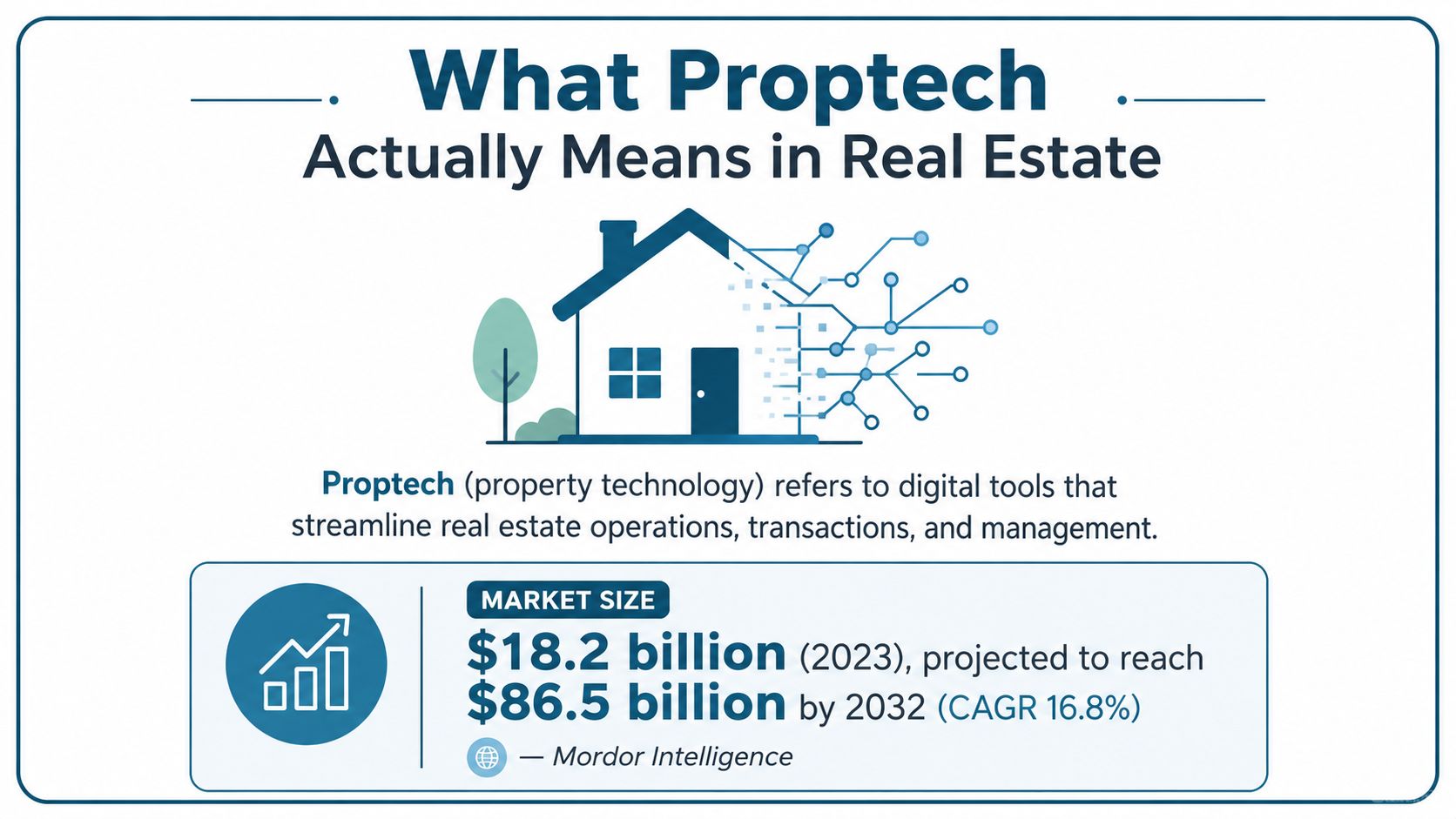
For brokerage operations, the useful way to judge proptech is by workflow, not by product labels. A tool matters when it removes friction from a repeatable step, such as listing creation, lead routing, rent collection, maintenance triage, or portfolio reporting. Oxford research describes proptech as part of the broader digital transformation of the property industry, and other neutral definitions place it across the full property lifecycle, not just search sites or home apps. That matters because a brokerage stack is more like an assembly line than a storefront, every handoff, delay, and manual re-entry creates drag. using AI assistants in property management is a useful example of how automation can sit inside operations rather than on top of them.
Proptech at a Glance
| Dimension | Detail |
|---|---|
| Core meaning | Property technology |
| What it includes | Software, data, automation, digital platforms |
| Where it shows up | Search, transactions, management, smart buildings, construction |
| Who uses it | Agents, brokers, teams, property managers, lenders, developers |
| Practical value | Faster workflows, clearer visibility, less manual coordination |
A practical test helps separate real operational value from surface-level tech. If a tool only makes a task look modern but does not reduce manual handoffs, it is probably decoration, not proptech.
That is why broad definitions matter. Proptech is not just listing websites, and it is not just AI for agents. It is the infrastructure that sits under the work your team already does, until a workflow becomes fast enough, visible enough, and consistent enough to scale.
A Brief History of Property Technology
Proptech's roots go back to the late 1990s, long before AI tools became a common talking point. The category has been evolving for nearly three decades, starting with basic listing and transaction software and then expanding into a broader operating stack for real estate teams. A historical overview from MIT Executive Education's proptech overview helps show why this is a mature category, not a passing trend.
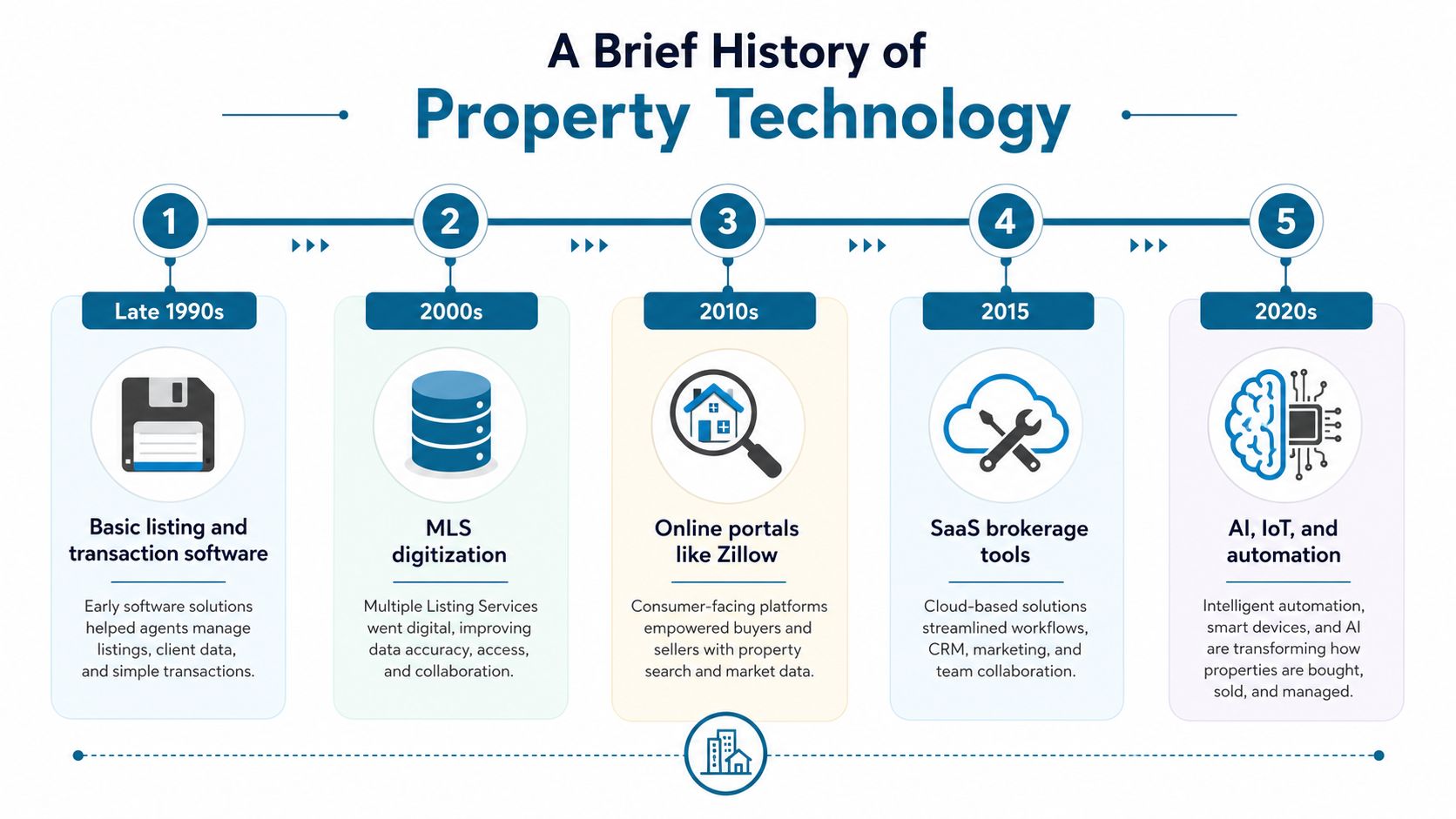
The first wave was about turning paper and phone-based work into digital work. Listings moved online. Transactions became less manual. Then MLS systems, portals, and brokerage software matured, and that changed how agents published inventory, managed contacts, and coordinated follow-up. The focus shifted from whether software could help to which part of the process software should own.
What changed in practice
Once cloud-based SaaS tools became normal in brokerage operations, teams began to expect software to handle more than file storage or contact lists. CRM, document handling, lead management, and reporting moved into the same workflow layer. MIT Executive Education's overview of proptech use cases includes smart building management systems, analytics platforms, digital marketplaces, and newer tools like smart contracts and virtual property tours, which shows how the category kept expanding beyond listing tools into operational infrastructure. That broader shift is easier to see if you compare it with real estate AI and agent workflows, because the value shows up when tools are tied to daily tasks.
The industry did not jump from paper to AI overnight. It added new capability on top of old workflows until the stack became digital end to end.
For agents, that history matters in a practical way. A lot of what people now call proptech started as basic operational software, then became workflow software, then became intelligence software. That is the same lens you should use when evaluating real estate marketing automation tools, because the question is not whether a tool sounds modern, it is whether it improves speed, visibility, and consistency inside the brokerage process.
The Six Core Categories of Proptech
If you want a clean mental model, break proptech into six buckets that show up across credible definitions. The labels matter less than the jobs they perform, because most brokerages touch several categories already, even if nobody on the team uses the word proptech. A useful outside reference is real estate AI and agent workflows, since it reinforces the idea that tech is most useful when it's tied to daily tasks.
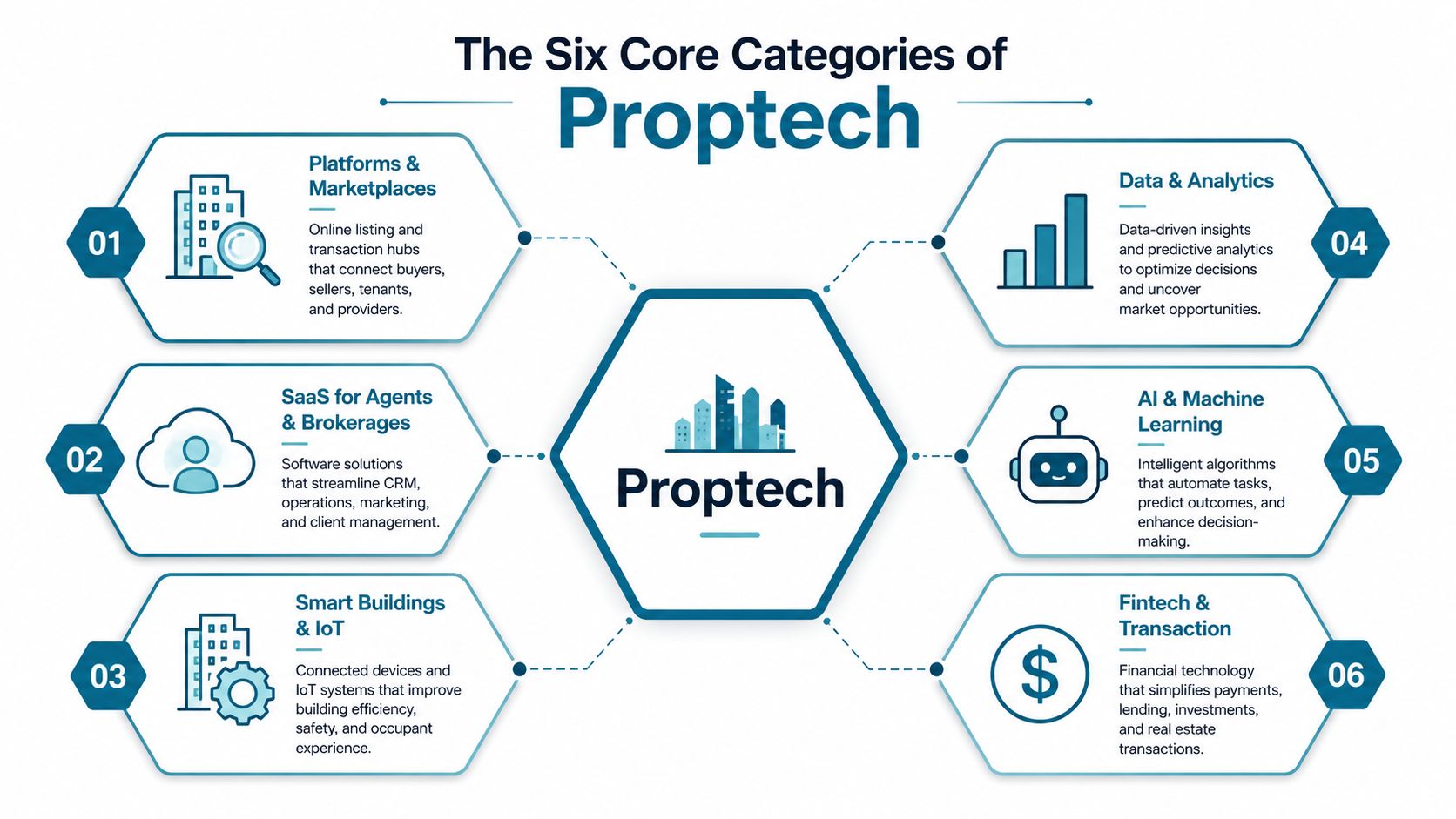
1. Platforms and marketplaces
These are the search and discovery engines of the industry. Zillow and Redfin are the obvious examples, and the practical question is simple, does this help a buyer or seller find inventory faster, or help my team present inventory better?
2. SaaS for agents and brokerages
This is the software layer for contacts, tasks, marketing, and office workflows. A brokerage CRM is the typical example, and the key question is, does this reduce follow-up drag or create another dashboard nobody opens?
3. Smart buildings and IoT
These tools live in the physical asset, not just the front office. Smart thermostats and building management systems belong here, and the operational question is, can this platform give me real-time visibility into building conditions or usage?
4. Data and analytics
This category includes pricing tools, market dashboards, and portfolio reporting systems. The question agents should ask is, does this improve pricing judgment or help me explain a recommendation with more confidence?
5. AI and automation
Classification, drafting, routing, and anomaly detection occur here. The key question is, what repetitive step does this tool take off my plate without making the output generic?
6. Transaction and construction tooling
These are the tools that handle signatures, approvals, and project workflows. DocuSign is the familiar example on the transaction side, and the agent question is, does this shorten the distance between accepted offer and completed paperwork?
The useful shift here is operational, not academic. Once you can name the bucket, you can evaluate the tool. If it doesn't support a real workflow, it probably doesn't belong in your stack.
Real Examples of Proptech in the Wild
The easiest way to spot proptech is to look at the job it does. Zillow and Redfin help with search and property discovery, while DocuSign handles digital signatures and contract management. Smart home tools like Nest sit in the building layer, and purpose-built marketing tools fit where listing prep and authority content need to be produced consistently.
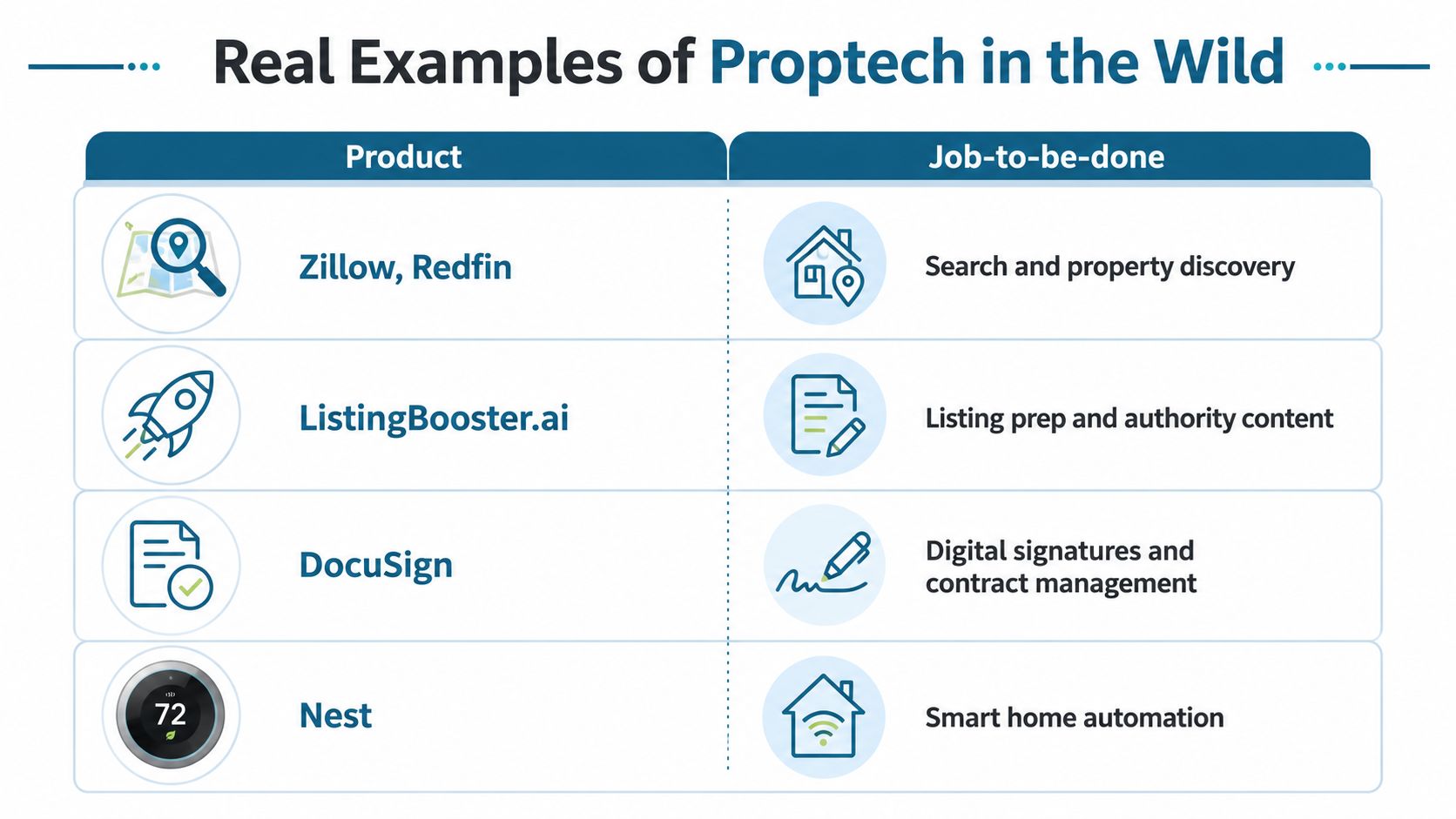
A lot of agents confuse “AI tool” with “real estate tool.” That's where the differences matter. A generic writer can draft text, but it doesn't know the difference between a listing description, a social caption, and a compliance-sensitive remarketing post, which is why purpose-built tools tend to fit brokerage work better than general ones.
Proptech Tools Agents Actually Touch
| Category | Representative Tool | Workflow It Supports |
|---|---|---|
| Search and discovery | Zillow, Redfin | Property discovery and lead intake |
| Listing marketing | ListingBooster.ai | Listing prep and authority content |
| Transaction management | DocuSign | Digital signatures and contract handling |
| Smart home layer | Nest | Device-based property control |
For lead generation, it helps to think about forms and capture points, not just ads. Best real estate lead capture templates is a good companion resource if you're mapping where inquiries enter your pipeline and how they get routed.
Operational test: if two tools produce similar copy, choose the one that understands your real estate workflow, your compliance constraints, and the way your team actually sells.
That's also where purpose-built real estate AI stands apart from generic AI writers. One is trained around your actual asset type, listing language, and brokerage use case. The other is a general writing engine that still needs heavy human cleanup before it's ready for MLS, social, or client-facing use.
Benefits and Real Risks for Agents and Teams
Proptech can make a brokerage feel more organized fast, but only if the tool fits the process. The upside is real, faster listing prep, more consistent brand voice, better lead routing, and less manual follow-up. The downside is just as real, training overhead, vendor lock-in, and the risk of publishing copy that sounds polished but misses compliance nuance.
What usually improves first
The first gain is usually time. When listing descriptions, social posts, and basic workflow reminders are automated, agents spend less effort on repetitive writing and more on client conversations, pricing decisions, and showing coordination. Teams also get a more consistent public voice, which matters when multiple agents post under the same brand.
The second gain is control. Digital systems create a clearer record of who did what and when, which helps with handoffs and reduces the “who was supposed to send that?” problem. For brokerages, that record can also support internal review before content goes live.
What can go wrong
The biggest mistake is assuming every AI tool understands real estate compliance. It doesn't. Generic writers can produce content that sounds plausible but slips into language that doesn't belong in MLS copy or social posts, which is why a fair housing guide for listingboosters is worth reading before any team rolls out AI-generated captions.
Another risk is tool sprawl. If your CRM, marketing tool, and transaction platform don't connect cleanly, your team ends up copying the same information into several places. That slows adoption and creates errors. Training matters too, because a great system that nobody uses is just another subscription.
Compliance rule: when content will be public, use tools and review steps that avoid protected-class language and keep the focus on property features, location attributes, and process details.
The right way to evaluate proptech is to ask two questions at the same time. What does it save, and what does it expose? If it saves time but increases compliance risk, it's not a win. If it improves consistency and keeps the workflow clean, it probably earns a place in your stack.
How Agents Can Start Using Proptech This Week
Start with the stack you already have. Pull together your CRM, marketing tools, transaction platform, and any AI software your team is using now, then identify where the most manual copying happens. That usually tells you which workflow is the best first candidate for automation.
1. Audit the current workflow
Map one listing from appointment to close and write down every handoff. Where does data get retyped, where does copy get rewritten, and where do approvals stall? That list gives you the actual problem, not the one a vendor pitch deck describes.
2. Pick one workflow to automate first
Don't start with everything. Start with the step that creates the most friction, often listing prep, follow-up, or lead routing. If your pain point is content production, a category-specific tool like ListingBooster.ai fits there because it generates listing descriptions and social content from property details, which is different from a generic AI writer.

For adjacent research, AI tools for realtors is a useful way to compare where a specialized tool belongs versus a general-purpose platform.
3. Pilot with one measurable result
Choose one KPI that you can observe, like turnaround time for a listing draft, number of follow-up tasks completed, or how quickly a lead gets routed. Keep the pilot small enough that your team can see whether the tool fits the workflow.
4. Put it inside the pipeline
A tool works best when it lives where the work already happens. If it's for listing prep, use it before the listing goes live. If it's for CRM follow-up, connect it to the exact stage where the lead enters your system.
5. Review after 30 days
Ask the team what saved time, what caused friction, and what still needs manual cleanup. That's the point where you decide whether to keep, replace, or expand the tool.
A practical 7-day plan is enough to get started. Day one, map the workflow. Day two, choose the tool. Day three, pilot on one listing or one pipeline segment. By the end of the week, you'll know whether the category belongs in your operation.
Where Proptech Is Headed and What to Do Next
Proptech is best understood as infrastructure, not hype. The long arc runs from basic listing software in the late 1990s to today's AI, analytics, and smart-building systems, and the agents who benefit most are the ones who treat technology as a workflow decision, not a novelty. That means the smartest move isn't buying more tools, it's choosing fewer tools that do more for the specific part of your business that slows down most.
For brokerage operations, the decision usually comes down to one of three questions. Where is the manual rework? Where is the compliance exposure? Where does your team lose time on work that doesn't directly move a listing or a client relationship forward? Once you answer those, the category choice gets much clearer.
If you want to test a purpose-built option for listing prep and content, a simple next step is to audit one workflow and try a focused tool for that single use case. ListingBooster.ai fits best when the problem is MLS-ready descriptions, social content, and repeatable listing marketing, not a full replacement for your CRM or transaction stack. You don't need a full technology overhaul to learn something useful.
Pick one workflow this week, listing prep is usually the cleanest place to start, and see whether automation helps your team move faster without losing control.
A CTA for ListingBooster.ai.
Walk In With the Campaign Already Built
Listing copy, social posts, sourced Market Insights, growth scheduling, and direct publishing after approval from one real-estate-specific system. 25 free credits to start.
Related Posts
 Uncategorized
Real Estate Content Marketing: The 2026 Playbook
Listings with video can generate 49% more qualified leads, according to a 2026 real estate digital marketing roundup. That figure changes the question. Real estate content marketing isn't about how often you post. It's about whether your listing, expertise, and local knowledge can be found, understood, and cited by people and by the AI tools […]
 Uncategorized
AI for Real Estate Marketing: A Practical Playbook
A new listing goes live on Tuesday morning. You write the description from memory, schedule three social posts, answer showing requests, and move on to the next client task. By afternoon, the listing has plenty of activity on your side of the business, but the phone still isn't producing the conversations you expected. That gap […]
 Uncategorized
What Is IDX and Why It Still Matters for Real Estate
A new agent usually hears “IDX” during a brokerage onboarding call, nods along, and hopes nobody asks for a definition. Then the questions arrive: Why are listings appearing on the website? Who controls the data? Why did a property remain visible after its status changed? And will the same pages be readable by ChatGPT, Perplexity, […]