Open House Flyer Ideas: 8 Proven Formats
The most popular open house flyer advice is also the least useful: add a hero photo, address, price, bedrooms, bathrooms, date, time, and phone number, then print a stack. That format may identify the property, but it doesn't give the recipient a reason to take the next step.
The strongest open house flyer ideas start with the conversion goal. Do you want a buyer to scan for a tour, understand the renovation work, see the location objectively, trust your expertise, share the event, evaluate the price, or absorb the home's features in seconds? A flyer built around one action usually works harder than a crowded brochure trying to answer every question at once.
For US agents, brokers, and teams, the right format also depends on the property type, the available evidence, the audience, and the distribution channel. This roundup organizes eight practical formats by the marketing job they perform, with headline formulas, reusable copy blocks, visual hierarchy, CTA decisions, print and mobile specifications, distribution tactics, and Fair Housing-safe wording.
Keep property and location descriptions factual. Tools such as ListingBooster.ai can help turn verified listing details into consistent, editable MLS, social, and print copy, but the agent remains responsible for checking facts, disclosures, brokerage requirements, and final compliance.
1. QR Code Integrated Flyer With Digital Property Tour
A printed flyer has limited space. A QR code gives the recipient a clear path to richer property information without forcing every detail onto the page. Use this format when the listing has strong visual material, a 3D tour, a video walkthrough, a floor plan, or a digital property page that supports the open house experience.
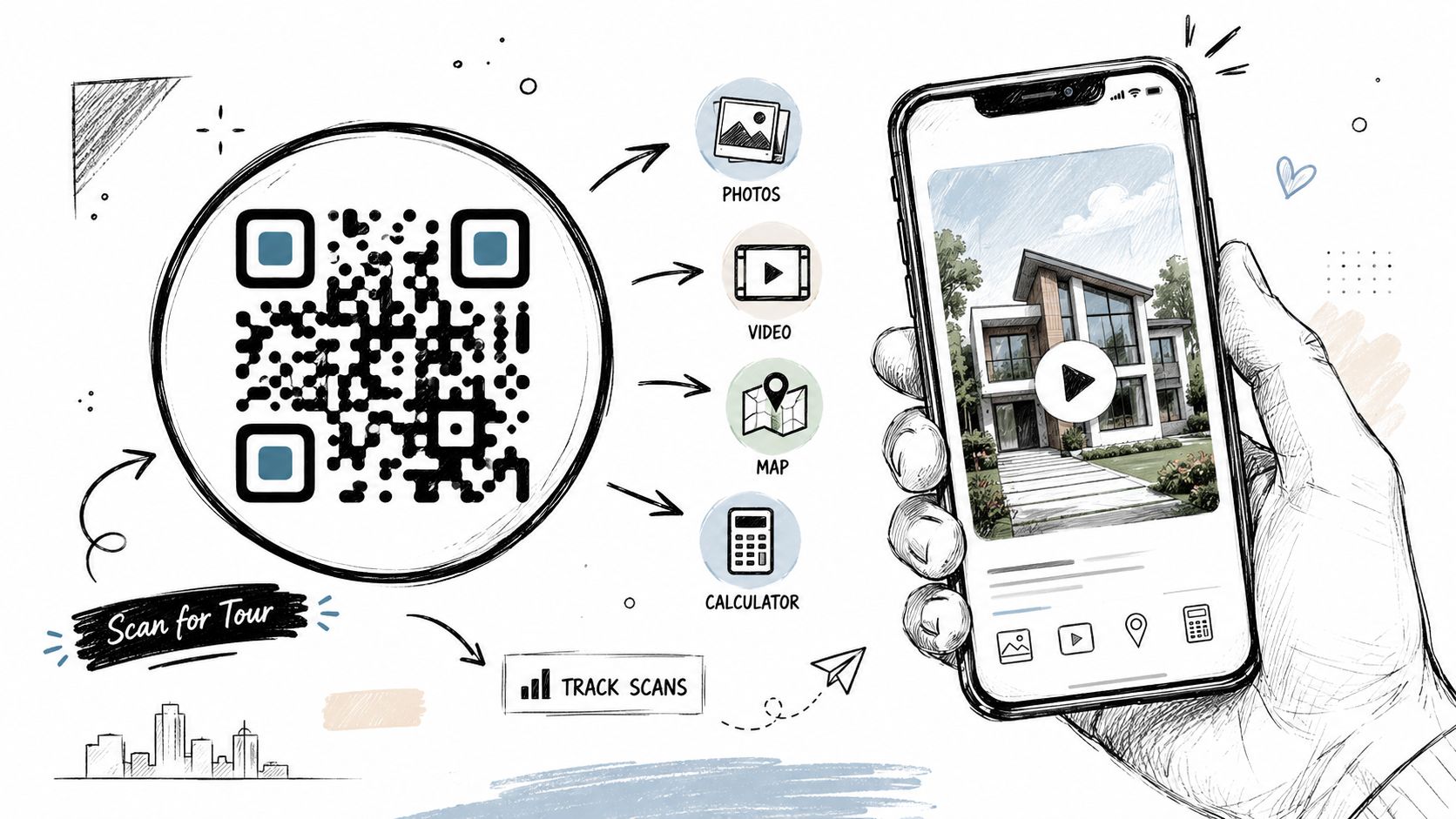
A useful headline should describe the reward, not the technology:
Scan to explore the full property tour, floor plan, and verified updates.
Place the QR code in a clean corner near the main property image or beside a short CTA. Don't bury it over a busy photograph, and don't label it only “Scan here.” Use copy such as “Scan to view the 3D tour”, “Scan for the complete photo gallery”, or “Scan to request a private tour.” Include a text alternative, such as “Unable to scan? Visit [short URL].” That makes the handoff more accessible and gives people another route if their camera struggles.
Build a landing page that earns the scan
The destination should load quickly on a mobile network and show the promised information immediately. A practical page can include high-resolution photos, a video walkthrough, a floor plan, driving directions, neighborhood facts, and a short contact form. Mortgage calculators can be useful, but label them clearly and avoid presenting an estimate as a loan offer or financial advice.
Test the QR code on multiple devices, in indoor and outdoor light, and from the distance at which someone will hold the flyer. Use a trackable destination when your system supports it, then review scan activity by flyer version or distribution area. The QR code best practices for hosts can help with placement and testing considerations.
For agents comparing tools, ListingBooster.ai can fit into a workflow that turns verified property details into the landing-page description and supporting social copy. Its top AI real estate marketing tools resource is a relevant starting point for evaluating that production layer. Keep every neighborhood statement factual, and review AI-generated language before publishing.
2. Before and After Renovation Showcase Flyer
Renovation marketing fails when it relies on adjectives. “Beautifully renovated” tells a buyer almost nothing about what changed, who completed the work, or what documentation may be available. A before-and-after flyer earns attention by showing the condition change and naming the work precisely.
Use a split layout with the original image on one side and the updated image on the other. Photograph both views from similar angles and under comparable lighting whenever possible. A kitchen renovation might use the headline “Updated Kitchen, Documented Improvements”, followed by a compact list such as “New plumbing,” “Energy-efficient windows,” and “Updated electrical systems.”
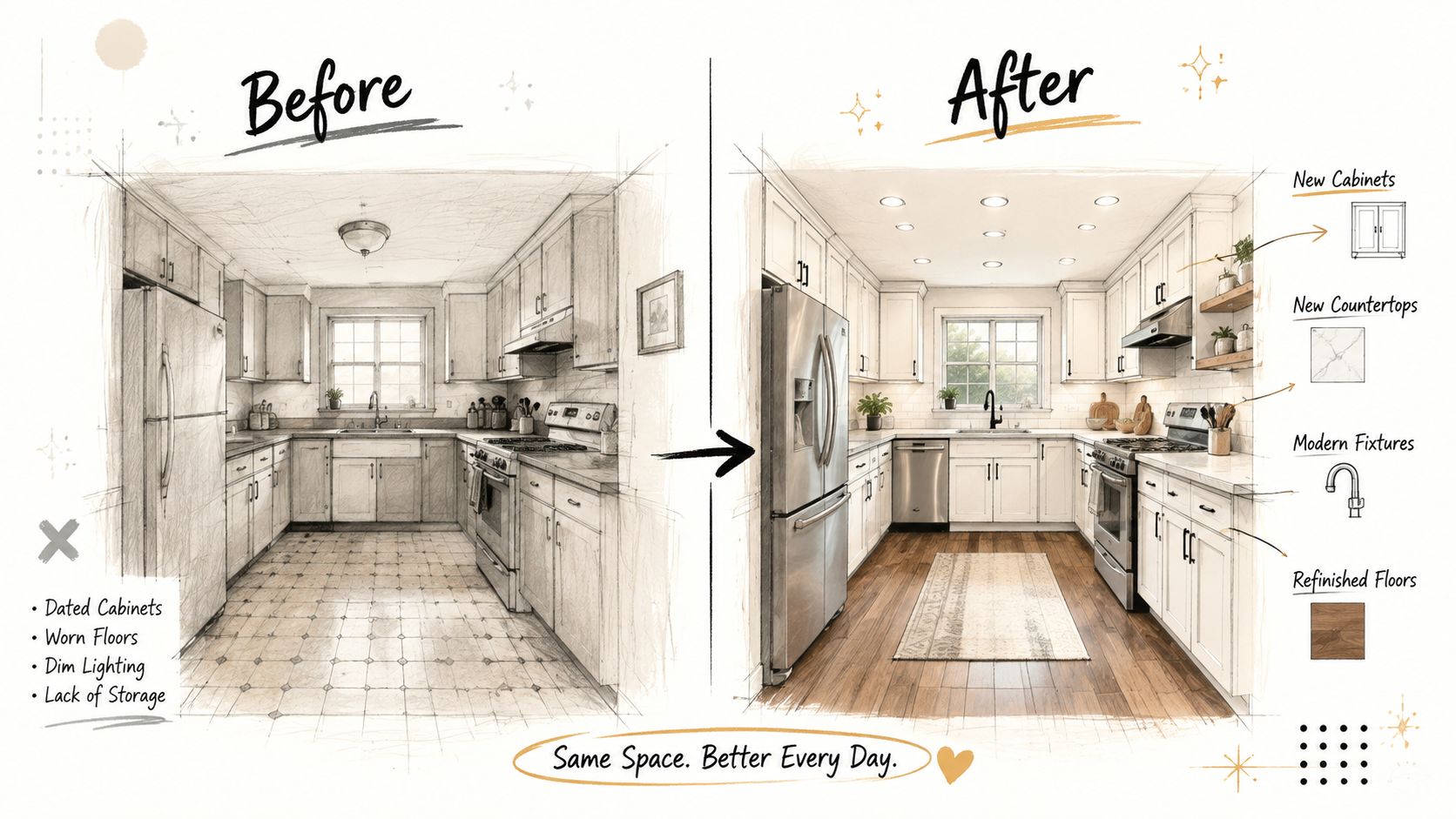
The copy should distinguish completed work from planned or proposed work. If contractor names, permits, invoices, or warranty information are available and approved for disclosure, add them in a small “Project details” panel. If a feature is described as energy efficient, use the verified product or project documentation rather than assuming performance from appearance.
Show evidence, not just polish
A strong reusable block might read:
Recent improvements
Updated electrical systems, replacement windows, refreshed kitchen finishes, and documented plumbing work. Buyer to verify measurements, permits, warranties, and remaining useful life through appropriate inspections and disclosures.
That final sentence is practical protection. The flyer shouldn't imply that a renovation eliminates the need for inspection or guarantees future maintenance costs. It should also avoid unverified claims about value, savings, or construction quality.
Distribute the flyer at the property, through approved neighborhood outreach, and digitally as a swipeable social post. The same before-and-after photos can support MLS remarks, email, and social content. ListingBooster.ai can help convert verified improvement notes into consistent property descriptions, captions, and print copy, but the listing team must confirm every feature and date before publication. Use a renovation-specific CTA such as “Scan for the improvement summary” or “Request available project documentation.”
3. Interactive Neighborhood Map Flyer
A map flyer helps buyers evaluate location context without relying on vague lifestyle language. It works particularly well when the property's appeal depends on access to transit, shopping, parks, services, employment centers, or other objectively identifiable destinations.
Make the property address the visual anchor. Use a restrained map with a limited set of categories, such as transit, parks, grocery stores, medical services, and major roads. Consistent colors make the piece easier to read, but every legend needs a plain-language label. If you include commute information, identify the destination, route assumptions, date checked, and whether the travel time reflects typical or peak conditions.
A useful headline could be “See the Property in Its Local Context”. Supporting copy might say:
Nearby reference points
Review distances to selected services, transit stops, parks, shopping, and employment centers. Routes and travel times can vary. Verify current conditions independently.
That wording provides context without implying who should live in the area. Avoid phrases such as “safe neighborhood,” “perfect for families,” “walk to church,” “exclusive,” or “ideal for young professionals.” Fair Housing guidance prohibits advertising that indicates a preference, limitation, or discrimination based on protected characteristics, and that standard applies to flyers and brochures as well as digital advertising. The Fair Housing advertising guidance offers a useful compliance reference.
Make the map readable at letter size
The standard US Letter flyer size is 8.5 x 11 inches, while half-sheet pieces measure 5.5 x 8.5 inches and compact postcard formats include 4 x 6 inches. These print dimensions are identified in real-estate flyer design guidance from Made Good Designs. Test the map at its final size. A detailed map that looks impressive on a desktop may become unreadable in a handout.
Use actual map data from a dependable service, check routes at relevant commute periods, and include a date for the verification. A QR code can lead to an interactive map or neighborhood guide, but the printed flyer should still communicate its essential context without requiring a scan. For supporting listing imagery, HDR blending for listing photos provides relevant production guidance.
4. Dual Purpose Open House and Market Report Flyer
This format turns one handout into two useful assets. The exterior promotes the event, while the reverse or interior panel provides a dated market snapshot and a clear invitation to discuss pricing or buying conditions.
Use the open house side for the property image, address, date, time, parking or entry instructions, agent contact details, and one specific property hook. The market side should not become a dense data dump. Select a small number of relevant figures from consistent sources, such as the MLS or county records, and state the geographic area, property segment, methodology, and date collected.
A copy block might look like this:
Open house details
Tour [property address] during the scheduled open house. Review the floor plan, recent improvements, and property information at the sign-in table.
Local market snapshot
This report reflects the selected market area and property segment as of [date]. Data is provided for general information and should be verified against current records.
Don't switch methodologies from one edition to the next. Consistency makes the flyer more useful for door-to-door distribution and follow-up. Real estate flyers distributed door-to-door have been reported at about a 2% response rate, while flyers placed at local grocery stores have been reported at about 3.5%, according to the benchmark source compiled by ZipDo. Those figures support a hyperlocal, repeatable distribution strategy, not a promise of performance.
Position expertise without overclaiming
A bifold can open logically, with event details on the outside and market context inside. Add a separable QR code or response panel offering “Request the full market report” or “Ask for a pricing consultation.” Keep market claims tied to the stated dataset. Don't turn a short period of activity into a prediction about future prices or returns.
ListingBooster.ai can help maintain a consistent voice across property copy, market updates, buyer guidance, email, and social posts. Its automated Market Insights for real estate agents resource is relevant for teams building a repeatable authority-content workflow. The agent still needs to verify every market figure and disclosure before printing.
5. Testimonial Driven Social Proof Flyer
A testimonial flyer should prove how you work, not merely announce that clients liked you. Use it when the listing team has authentic reviews that address communication, inspection guidance, negotiation, preparation, or market knowledge.
Lead with one specific client statement, then support it with shorter reviews. A detailed comment about navigating an inspection process is more useful than “Great agent!” because it answers a concern a prospective client may already have. Obtain permission for the wording, name, image, transaction details, and publication channel. Don't edit a testimonial into a meaning the client didn't approve.

A practical layout might include a large quote, a client identifier, a short transaction context, and a verification link:
Client experience
“[Approved client wording about communication, inspection guidance, or preparation.]”
Transaction context
[Approved property type or service detail]. Results vary by property, market conditions, and client circumstances.
The last line matters when a review mentions timing, price, or another outcome that may not transfer to the current listing. Keep the social proof focused on the service you control. Link to approved Google, Zillow, Facebook, or brokerage review pages if those links are current.
Balance trust with property information
Social proof shouldn't replace the address, event details, primary property image, and one clear CTA. A flyer that becomes an agent biography may build recognition but fail the immediate open house job. Use a modest panel such as “See the property details” or “Request a private consultation.”
Refresh the featured reviews periodically so the piece doesn't look abandoned. Teams can coordinate testimonials across agents, but each statement must remain attributable and permissioned. Avoid language that suggests the agent serves or prefers a particular protected class, and don't use client photos to imply who the property is intended for. Describe the service, the transaction, and the verified experience.
6. Mobile Responsive Event Style Flyer
Some flyers are printed. Others are photographed at the property, texted to a contact, attached to an email, or shared in an Instagram story. An event-style design handles all of those contexts by making the date, time, address, and action obvious even when the original page is reduced or viewed on a phone.
Start with a short event headline such as “Open House This Sunday”, followed by the property address and a prominent time block. Use one strong photo, a clean information panel, and a single CTA. Don't let decorative graphics compete with the event details. A modular template lets a team change the address, date, time, image, and agent identifier without redesigning the entire piece.
Design for the photographed version
Print the flyer and photograph it with a smartphone before approving the final file. Check whether the address and event time remain legible in the image, whether the phone number can be identified, and whether the CTA survives common social cropping. Test the design at 50% and 25% of its original size, as recommended in the production plan for this format.
Use no more than 2 to 3 colors, and make sure the layout still works in grayscale. A matte finish is usually easier to photograph than a glossy one because glare can obscure text and codes. Include the agent name, company logo, and phone number in a stable location so a shared image still identifies the source.
A practical copy block is:
Open house
[Property address]
[Date] | [Time]
Tour the home, review verified property details, and request a private showing.
Questions?
[Agent name] | [Company] | [Phone] | [Email]
ListingBooster.ai can generate property-specific copy and social captions that match this modular structure. Review the output for factual accuracy, brokerage rules, and Fair Housing compliance before adapting it for print, email, text, or social distribution.
7. Comparative Market Analysis Listing Flyer
A CMA flyer answers the pricing question directly, but it must explain its method. Buyers and sellers can challenge a number that appears without context. A one-page version should present the subject property, selected comparable sales, the date collected, and the main adjustments in language a non-specialist can follow.
Use true comparables rather than visually similar homes from a distant area. Consider neighborhood, square footage, condition, features, and sale timing. The production plan for this format recommends reviewing comparable sales within the most recent 30 to 60 days, where appropriate to the market and available data. Any quantitative claim must be tied to the underlying MLS, county assessor, or other approved source.
A clear comparison block might read:
How this property is positioned
The subject property is compared with selected nearby sales based on location, size, condition, and notable features. Adjustments reflect the stated differences and are not an appraisal or guarantee of value.
Adjustment example
Subject property includes an updated kitchen. Comparable A was adjusted by [verified amount] to reflect that difference.
Don't hide the data collection date. Don't present price per square foot as a complete valuation method, and don't imply that a recent sale determines the current listing's value. The flyer should educate, not manufacture certainty.
Create two levels of detail
Give general open house visitors a simplified one-page overview. Offer a more detailed analysis to serious prospects who request it. This keeps the handout readable while giving qualified conversations a useful next step. A CTA such as “Request the supporting comparable detail” is more appropriate than a vague “Contact me.”
A market report should provide detailed, clear, and consistent information to prospective applicants in housing advertising, including property information and procedures where applicable, as emphasized in HUD's Fair Housing guidebook. For a sales flyer, apply the same discipline to the facts you choose to publish. ListingBooster.ai can help create consistent property and positioning copy around the CMA, but the agent must verify the data and avoid unsupported conclusions.
8. Visual Feature Highlight Flyer With Icon System
An icon flyer serves the fastest scanner. It works well for new construction, turnkey properties, and listings with a concise set of verified features that can be understood at a glance.
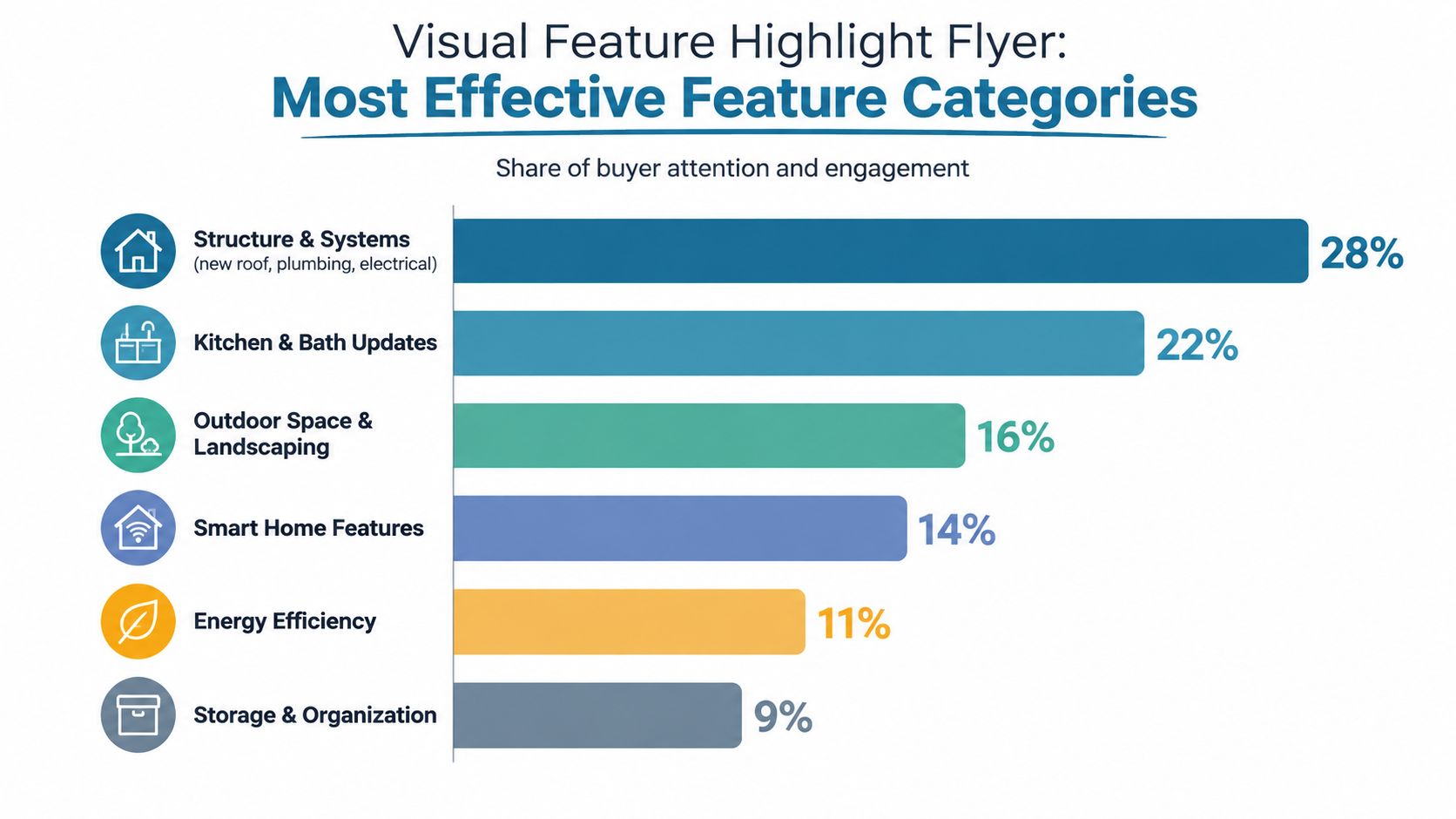
Build a consistent icon system around labeled features, not symbols alone. A kitchen icon should say “Recently Updated Kitchen”. A roof icon should say “New Roof, [verified year]” only when that year is documented. Pair the icon grid with one or two photographs that verify the most important claims.
A reusable feature block could include:
- Kitchen: Recently updated finishes and fixtures.
- Roof: New roof, [verified year].
- Technology: Smart home system, [verified device or system details].
- Layout: Floor plan available by QR code or request.
- Outdoor area: [Specific verified feature], such as patio, deck, or fenced yard.
Keep the grid limited to the strongest features. The plan for this format recommends a maximum range of 8 to 12 features, because a longer list weakens hierarchy and forces small type. Use one icon style throughout, label ambiguous symbols, and reserve color for meaningful categories.
Let the visual system support searchable copy
Icons help humans scan, but they don't replace substantive text. Include a short factual property description in normal text so the material remains useful when photographed, indexed, or passed through digital tools. ListingBooster.ai's real estate listing copy examples can help teams develop editable descriptions that complement the visual flyer.
Use “Scan for full property details” or “Request the floor plan and improvement summary” as the CTA. Don't make an icon imply a warranty, certification, energy performance, security condition, or accessibility feature unless the claim is verified and approved for advertising. For a related example of structured property reporting, see these sample confidence score reports.
8-Option Open House Flyer Comparison
| Flyer | 🔄 Implementation Complexity | ⚡ Resource Requirements | ⭐ Expected Effectiveness | 📊 Expected Outcomes | 💡 Ideal Use Cases |
|---|---|---|---|---|---|
| QR Code-Integrated Flyer with Digital Property Tour | Medium–High 🔄: QR + landing pages + CRM tracking | Moderate ⚡: QR platform, mobile landing, video hosting, analytics | ⭐⭐⭐ High | Trackable scans, automated lead capture, richer digital tours 📊 | Luxury listings, open houses, high-volume agents 💡 |
| Before-and-After Renovation Showcase Flyer | Low–Medium 🔄: coordinated photo shoot and layout | Photo shoot, staging, designer ⚡ | ⭐⭐⭐ High | Demonstrates value-add, justifies price, attracts investors 📊 | Renovated homes, property turnarounds, investor outreach 💡 |
| Interactive Neighborhood Map Flyer | Medium 🔄: map design + data verification | Mapping data (Google/GIS), designer, updates ⚡ | ⭐⭐⭐ High | Better buyer fit assessment; fewer neighborhood questions 📊 | Relocations, transit-focused buyers, developing areas 💡 |
| Dual-Purpose Open House + Market Report Flyer | Medium 🔄: bifold layout + market data updates | MLS/data access, designer, periodic printing ⚡ | ⭐⭐⭐ High | Builds authority, captures subscribers and follow-ups 📊 | Market-positioning, open-house lead capture, neighborhood farming 💡 |
| Testimonial-Driven Social Proof Flyer | Low 🔄: collect permissions and format content | Client approvals, photos/videos, light design ⚡ | ⭐⭐⭐ High | Increases trust and conversion via third‑party validation 📊 | New agents, credibility campaigns, listings needing trust signals 💡 |
| Mobile-Responsive Event-Style Flyer | Low–Medium 🔄: mobile-first design and legibility testing | Designer, mobile QA, optimized images ⚡ | ⭐⭐ Medium–High | High shareability; boosts immediate attendance and RSVPs 📊 | Short-notice opens, social-first distribution, broad outreach 💡 |
| Comparative Market Analysis Listing Flyer | High 🔄: data collection, comps selection, valuation method | MLS access, analytic time, designer ⚡ | ⭐⭐⭐ High | Justifies pricing, educates prospects, strengthens negotiations 📊 | Price-sensitive listings, luxury pricing discussions, savvy buyers 💡 |
| Visual Feature Highlight Flyer with Icon System | Medium 🔄: icon library + polished layout | Professional design, icon set, photography ⚡ | ⭐⭐ Medium–High | Rapid feature comprehension, stronger recall and brand consistency 📊 | New construction, turnkey properties, multilingual or visual markets 💡 |
Turn One Flyer Into a Repeatable Open House System
The best flyer isn't necessarily the most elaborate. Choose the format that matches the listing's strongest evidence and the action you want the recipient to take. A renovation showcase needs documented project details and comparison photography. A location flyer needs verified destinations and readable mapping. A testimonial piece needs permissioned client language. A QR flyer needs a working mobile destination. A CMA flyer needs a defensible methodology and current, clearly dated data.
Before publishing, verify every property fact, measurement, feature description, improvement claim, market figure, testimonial, image permission, QR destination, phone number, and event detail. Review the flyer for Fair Housing risk as carefully as you review the MLS remarks. Federal guidance prohibits advertisements that indicate a preference, limitation, or discrimination based on protected characteristics, and industry best practices recommend including an Equal Housing Opportunity logo, statement, or slogan so the public understands the property is available to all persons regardless of protected characteristics. The responsible advertising guidance from the National Fair Housing Alliance provides practical direction on that standard.
Distribution should match the format. Door-to-door delivery, approved local placements, open house tables, email, text, social posts, and follow-up messages can all use the same core asset, but they shouldn't all use the same crop or CTA. A letter-size handout may need a mobile version with larger type. A QR code should lead to a page designed for a phone. A market report may deserve a separate follow-up link. Keep the brand structure consistent while adapting the content to the moment.
ListingBooster.ai is an optional production layer for creating editable property descriptions, social captions, market-oriented content, and print materials from verified listing information. It can help teams maintain a consistent voice across channels, but it doesn't remove the need for agent review. Confirm disclosures, approvals, brokerage requirements, data sources, and final Fair Housing language before anything goes live.
At the open house, make the next step explicit. Invite visitors to request the full property details, receive the floor plan, review supporting documentation, schedule a private tour, or arrange a consultation. After the event, tag responses by source and property so the next flyer reflects what people asked about. The system improves when each format produces both a useful buyer experience and a clear follow-up path.
ListingBooster.ai helps real estate agents turn verified property details into editable listing descriptions, open house copy, social posts, flyers, and property report materials. Visit ListingBooster.ai to explore a practical way to keep your open house marketing consistent across print, mobile, social, and follow-up channels.
Walk In With the Campaign Already Built
Listing copy, social posts, sourced Market Insights, growth scheduling, and direct publishing after approval from one real-estate-specific system. 25 free credits to start.
Related Posts
 Uncategorized
Real Estate Content Marketing: The 2026 Playbook
Listings with video can generate 49% more qualified leads, according to a 2026 real estate digital marketing roundup. That figure changes the question. Real estate content marketing isn't about how often you post. It's about whether your listing, expertise, and local knowledge can be found, understood, and cited by people and by the AI tools […]
 Uncategorized
AI for Real Estate Marketing: A Practical Playbook
A new listing goes live on Tuesday morning. You write the description from memory, schedule three social posts, answer showing requests, and move on to the next client task. By afternoon, the listing has plenty of activity on your side of the business, but the phone still isn't producing the conversations you expected. That gap […]
 Uncategorized
What Is IDX and Why It Still Matters for Real Estate
A new agent usually hears “IDX” during a brokerage onboarding call, nods along, and hopes nobody asks for a definition. Then the questions arrive: Why are listings appearing on the website? Who controls the data? Why did a property remain visible after its status changed? And will the same pages be readable by ChatGPT, Perplexity, […]