How Often Should Real Estate Agents Post?
Real estate agents should post 3 to 5 times per week on primary platforms like Instagram and Facebook, with 2 to 3 posts per week on LinkedIn and 5 to 7 posts per week on X. The real lever isn't posting every day. It's maintaining a steady cadence that platforms can trust and that you can sustain without burning out.
A lot of agents still hear the same advice: post daily or disappear. That advice creates rushed content, inconsistent quality, and a feed full of listing graphics nobody stops to read. A better standard is simpler. Consistency beats bursts, and 3 to 5 times a week is the sweet spot for visibility without turning your marketing into a second full-time job.
Defining Your Real Estate Posting Strategy
The better question isn't how often should real estate agents post. The better question is: what schedule can you keep for the next six months?
Most agents don't struggle because they lack ideas. They struggle because they try to do everything at once. Instagram, Facebook, LinkedIn, Stories, video, market updates, listing promotions, client wins. Add Fair Housing compliance on top of that, and it's easy to freeze or fall into last-minute posting.
A workable strategy starts with restraint. Pick your primary channels, commit to a repeatable rhythm, and build around content you can produce without scrambling every morning. If you need a broader planning model, this guide to content strategy for small business growth is useful because it frames content as an operating system, not a pile of random posts.
What usually fails
Agents tend to lose momentum for three reasons:
- They overcommit early: Daily posting sounds disciplined until listing appointments, inspections, and negotiations pile up.
- They treat every post like a campaign: Not every update needs custom design, long captions, and perfect video editing.
- They ignore compliance until the last minute: That slows production and increases risk.
Practical rule: Build a schedule around your busiest week, not your most motivated week.
The agents who build authority online aren't always the loudest. They're the ones who show up on a reliable schedule with content that helps people understand the market, the process, and the value of working with them.
The Consistency Principle Why Cadence Beats Volume
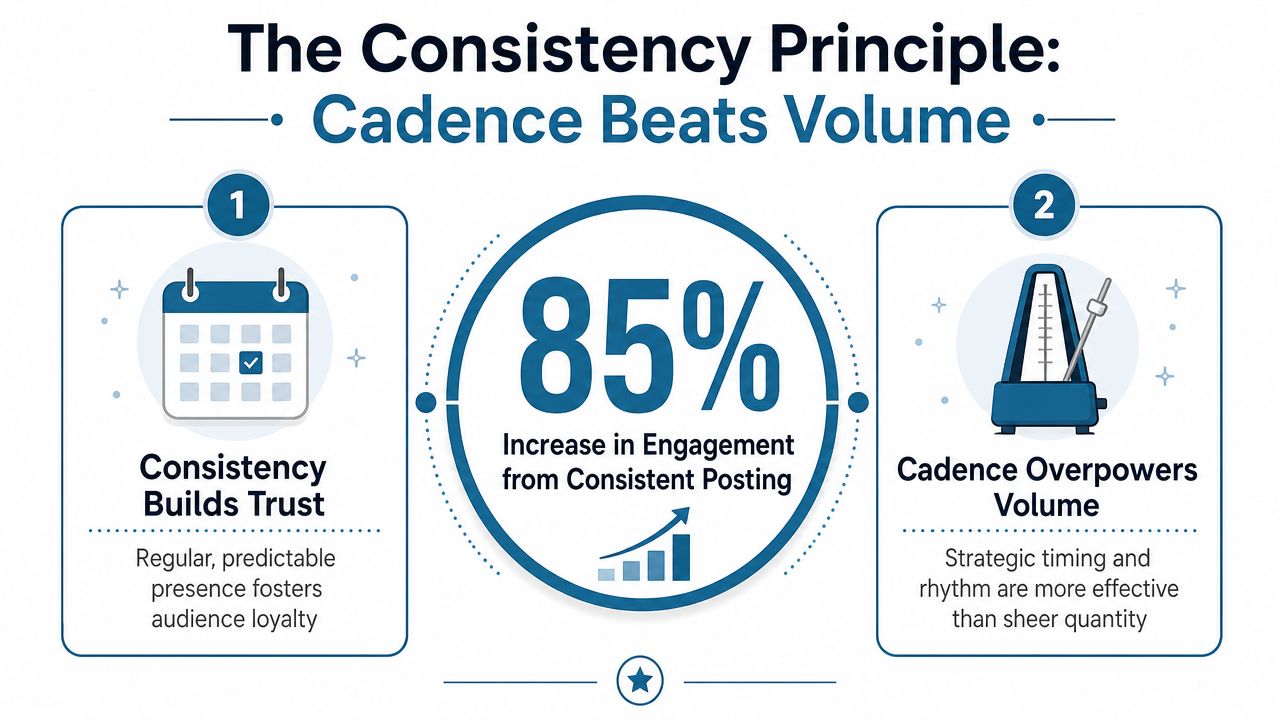
The strongest social strategy in real estate is usually less dramatic than agents expect. It isn't a burst of daily posting for two weeks, followed by silence. It's a stable rhythm that trains both your audience and the platform to expect useful content from you.
Research summarized by AvenueHQ, citing Buffer, found that consistent posting frequency is the single most critical driver of engagement for real estate agents, with the most consistent posters receiving up to 5× more engagement per post than inconsistent users. That same source identifies 3 to 5 times per week as the industry sweet spot because it balances visibility with sustainability (AvenueHQ on weekly social posting cadence).
Why regular cadence works better
Platforms reward recognizable behavior patterns. When you publish on a steady schedule, your posts are easier for the algorithm to categorize, distribute, and test with your audience. Your followers also learn what to expect. That matters more than agents realize.
Consistency does three things at once:
- It builds recall: People don't hire the agent who posted the most in one week. They remember the agent who kept showing up.
- It sharpens engagement signals: Regular posting creates a cleaner pattern of comments, saves, replies, and profile visits.
- It reduces production stress: A realistic schedule leads to better captions, better visuals, and fewer compliance mistakes.
Why volume alone usually backfires
Daily posting can work if you have a real system. Most agents don't. They have a phone, a Canva account, and a packed calendar. When volume outpaces workflow, quality drops fast.
A helpful comparison exists outside real estate too. This piece on an effective YouTube growth strategy makes the same core point: sustainable publishing beats erratic volume because audiences respond to reliability.
The platform notices rhythm. Your audience notices usefulness. Both matter more than noise.
Your Cross-Platform Posting Cadence for 2026
Posting frequency should match how each platform is used. Instagram rewards visual variety. Facebook tends to respond better to steady, quality-first posting. LinkedIn gives more room for thoughtful commentary. X moves quickly and requires more repetition to stay visible.
Here's a practical planning table you can use with your team.
Recommended posting cadence by platform
| Platform | Recommended Frequency | Content Focus |
|---|---|---|
| Instagram Feed | 3 to 5 times per week | Reels, carousels, listing highlights, market insights |
| Instagram Stories | Daily | Behind-the-scenes updates, polls, new activity, quick property moments |
| Once per day is sufficient, or fold into a 3 to 5 times per week primary cadence if resources are limited | Community updates, listings, local market education, open house reminders | |
| 2 to 3 times per week | Market perspective, client process education, agent insight, business-facing commentary | |
| X | 5 to 7 times per week | Short observations, local market notes, event reminders, fast-turn reactions |
Platform-specific guidance
Instagram needs enough activity to stay visible, but not so much that every post starts looking the same. AARE recommends that agents post on Instagram at least three times per week, mixing carousels, reels, and static posts to keep engagement healthy and avoid fatigue (AARE social platform guidance for Realtors).
Facebook is less about flooding the feed. Corefact notes that Facebook's algorithm prioritizes quality over quantity, and once per day is sufficient for maintaining presence without draining resources (Corefact social media best practices for real estate). For many agents, that means repurposing strong Instagram or listing content rather than creating separate material from scratch.
LinkedIn deserves a different tone. Treat it like a professional authority channel, not a listing dump. Two to three thoughtful posts each week usually outperform generic daily updates because the audience expects perspective, not just promotion.
X moves faster. If you use it, post more frequently with lighter content. Market reactions, local event commentary, and quick observations fit better there than polished listing graphics.
A workable weekly model
If you're a solo agent, a realistic weekly mix looks like this:
- Three primary posts: One educational, one promotional, one community-focused
- One or two additional posts: A reel, client story, or market insight
- Daily Stories: Quick, informal updates that don't require full production
- Weekly human review: Check captions, compliance, local accuracy, and comments before the next batch goes out
That last point matters. Automation can schedule and draft, but every week still needs human review. Markets change, listing status changes, and wording matters.
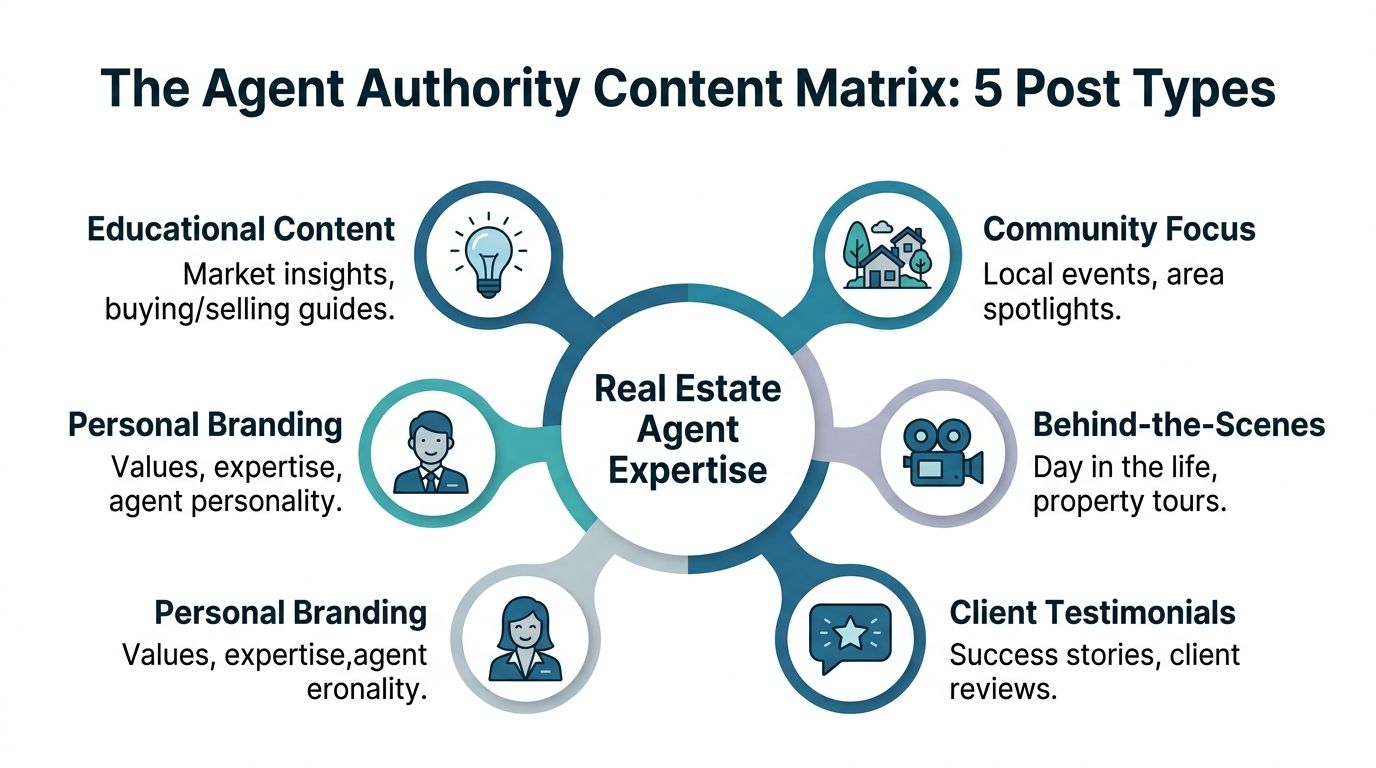
The Agent Authority Content Matrix Five Post Types
Frequency answers only half the question. The other half is what you post often enough to become known for.
Data compiled by Amplifiles indicates that the 80/20 rule still holds up in real estate content: 80% of posts should align with client interests such as tips, market stats, and useful guidance, while 20% can be self-promotional. The same source notes that 72% of buyers report trusting agents more after seeing social proof and educational content (Amplifiles real estate social media statistics).
The five post types that keep a feed balanced
Listing announcements
Necessary, but they shouldn't dominate your feed. Use them to showcase marketing quality and property positioning.Hyper-local market updates
These posts build authority faster than generic motivational content. Explain inventory shifts, days-on-market patterns, pricing behavior, and buyer questions in plain English.Client success stories
Social proof matters because it helps future clients see how you guide decisions, solve problems, and communicate through the transaction.Neighborhood spotlights
Focus on amenities, architecture, transit access, parks, retail corridors, and event activity. Stay feature-based and Fair Housing compliant.Agent authority posts
These posts showcase your judgment. Talk about pricing strategy, negotiation prep, showing feedback, staging observations, or what sellers overlook.
Why this mix works
A feed made entirely of listings reads like inventory. A feed built from these five categories reads like expertise.
For agents who don't want to appear on camera constantly, resources like BlitzReels faceless real estate can help generate video formats that still feel active and modern without requiring a full talking-head workflow every day.
A strong real estate feed should answer three silent client questions: Do you know the market? Do you know the process? Can I trust you with a major decision?
Actionable Post Templates for Real Estate Agents
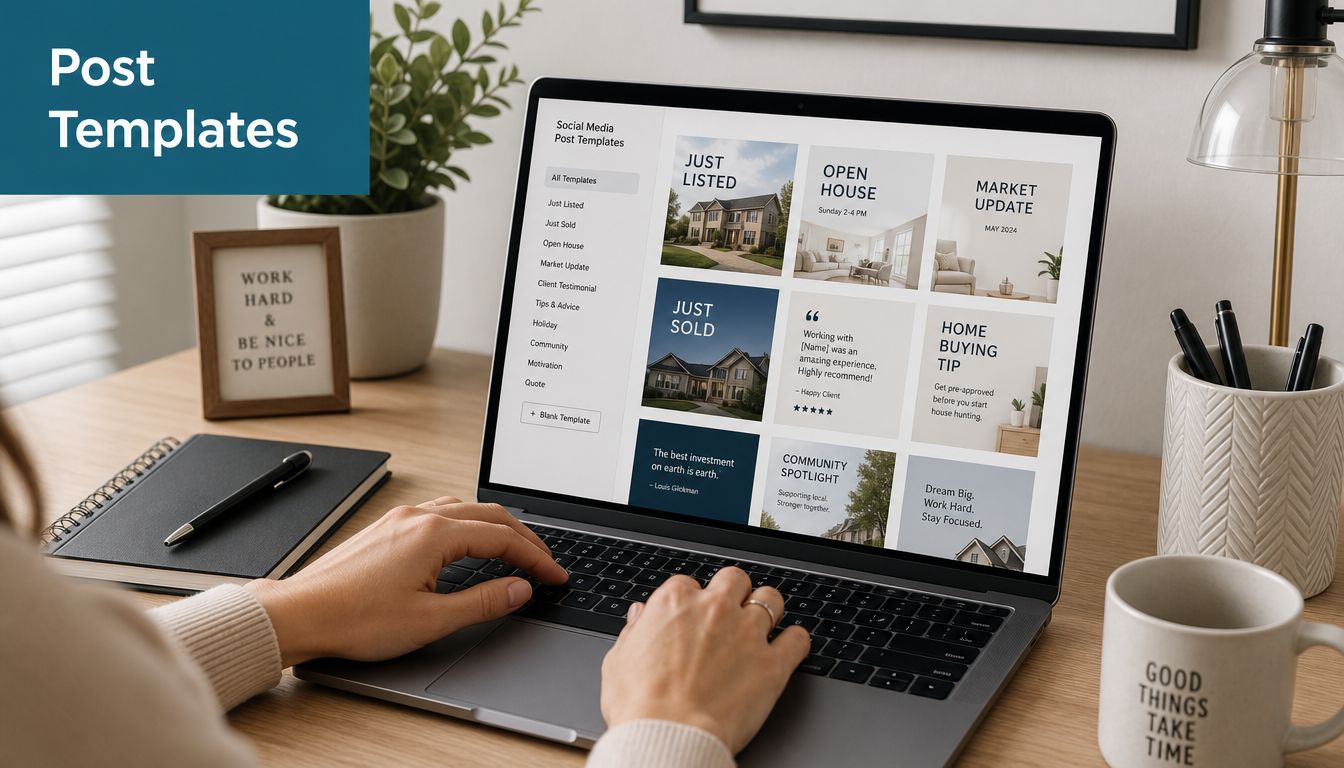
Theory doesn't save time on Tuesday afternoon. Templates do.
The five examples below are built for LinkedIn, but each can be adapted for Instagram captions, Facebook posts, or short-form video scripts. They also follow a simple rule: describe the property, process, or market using facts and features, not assumptions about who should live there.
Template one for listing announcements
Best format: Carousel or short property reel
Caption template:
Just listed in [area/community name].
This home offers [feature 1], [feature 2], and [feature 3], with a layout designed for practical daily living and entertaining. Notable details include [kitchen finish], [outdoor feature], and [recent upgrade or unique architectural detail].
If you'd like pricing details, showing information, or the full property package, send me a message.
Hashtag ideas:
#JustListed #RealEstate #HomesForSale #[CityName]RealEstate #ListingAgent
CTA:
Message me for the full details or to schedule a private showing.
Fair Housing note:
Avoid phrases that describe the home by the type of person who should live there. Focus on features such as floor plan, lot size, finishes, storage, natural light, parking, or proximity to amenities.
Template two for hyper-local market updates
Best format: LinkedIn text post with chart, Instagram carousel, or talking-head video
Caption template:
A quick market read for [city or neighborhood]:
Buyers are paying close attention to pricing, presentation, and how quickly a home creates momentum. Sellers who enter the market with realistic positioning and strong marketing are putting themselves in a better place than sellers who assume every property will attract immediate demand.
If you're planning to list this season, the preparation phase's importance is often underestimated. Pricing strategy, photo quality, repair decisions, and launch timing all shape the first wave of buyer response.
CTA:
If you want a custom read on your neighborhood, reach out and I'll walk you through the local picture.
Hashtag ideas:
#MarketUpdate #RealEstateAdvice #[CityName]Homes #HomeSellingTips
Fair Housing note:
When discussing location, stick to market conditions, housing stock, transit access, public amenities, and comparable property trends. Don't describe an area in ways that imply preferred residents.
Compliance check: If a neighborhood sentence sounds like it describes the people instead of the place, rewrite it.
Template three for client success stories
Best format: Static graphic, short video recap, or text post with one property photo
Caption template:
Closed with happy clients in [market].
This transaction came together because we stayed disciplined on preparation, communication, and negotiation. We handled [inspection issue, pricing pivot, timeline challenge, or offer strategy] and kept the process moving without losing sight of the client's priorities.
Every deal has its own moving parts. The value isn't just getting to the closing table. It's knowing how to manage the moments that could derail the deal.
CTA:
If you're planning a move and want a clear process from day one, I'd be glad to talk through it.
Hashtag ideas:
#JustSold #ClientSuccess #RealEstateAgent #ClosingDay
Fair Housing note:
Never reveal sensitive client information or imply anything about personal background. Keep the focus on service, strategy, communication, and transaction management.
Template four for neighborhood spotlights
Best format: Reel, photo carousel, or short narrated slideshow
Caption template:
This week's local spotlight is [area name].
What stands out here is the mix of [housing style], [local amenity], and [transportation or access feature]. Residents and visitors have access to [parks, retail corridors, restaurants, waterfront, trail systems, business districts, or civic spaces], which gives the area a strong day-to-day convenience factor.
For buyers, the important question isn't whether an area is “hot.” It's whether the housing options, access, and property characteristics line up with their goals.
CTA:
Want a breakdown of homes and price ranges in this area? Send me a message.
Hashtag ideas:
#NeighborhoodSpotlight #[CityName]RealEstate #LocalLiving #CommunityUpdate
Fair Housing note:
Avoid words like “safe,” “exclusive,” “family-friendly,” or anything tied to protected classes. Describe features of the area, not the kind of people who may live there.
Template five for agent authority posts
Best format: LinkedIn post, selfie video, or educational carousel
Caption template:
One mistake I see sellers make is treating online marketing like an afterthought.
The first impression isn't the lockbox. It's the listing copy, photography, social rollout, and how clearly the property is positioned online. Weak descriptions and generic captions don't just look forgettable. They make it harder for buyers to understand why the property deserves attention.
If you need inspiration for stronger listing language, these real estate property description examples are a helpful benchmark for how to write with more clarity and specificity.
CTA:
If you're preparing to list and want direct feedback on positioning, reach out.
Hashtag ideas:
#ListingStrategy #RealEstateMarketing #SellerTips #AgentAdvice
Fair Housing note:
Authority content still needs compliance review. Don't use broad claims about who a home is “perfect for.” Tie every statement to the home's physical features, layout, and location attributes.
How to use these templates without sounding canned
Use the structure, not the exact wording. Swap in your market language, recent client questions, and current inventory context. Then review the whole week before it goes live.
A practical workflow looks like this:
- Draft in batches: Write one week at a time, not one post at a time.
- Vary the format: Turn one market topic into a carousel, one video, and one text post.
- Review for compliance: Check neighborhood references, audience assumptions, and property phrasing.
- Add a human note: One sentence from an actual showing, listing prep session, or market conversation makes the post feel real.
Automating Consistency Without Losing Authenticity
Most agents don't need more ideas. They need a better production process.
That's where automation helps, but only when it's used correctly. Generic AI tools can draft quickly, but they don't understand listing context, brokerage workflow, or the language risks that come with real estate marketing. They can produce something that sounds polished and still creates compliance problems or generic copy that blends into every other feed.
The best workflow is hybrid
Use automation for the heavy lift. Use human review for judgment.
That means:
- Generate drafts in batches: Captions, listing descriptions, market posts, and community spotlights
- Review once a week: Confirm status changes, local references, compliance language, and tone
- Personalize before publishing: Add the insight only you have from client conversations and active inventory
This is why purpose-built systems tend to outperform generic prompt workflows for busy agents. A tool designed for listing to social media campaign automation can structure the workflow around actual real estate deliverables instead of forcing you to invent every post from scratch.
Automation should remove repetition, not remove your judgment.
If your content sounds like a robot wrote it, the problem usually isn't automation itself. It's the lack of editing, local context, and final review.
From Posting Plan to Digital Authority
A strong posting strategy isn't about staying busy. It's about becoming recognizable.
Agents who win on social usually do three things well. They post on a schedule they can maintain. They rotate through content that shows market knowledge, process expertise, and real client value. They use systems that keep production moving without letting quality slip.
That combination turns social media from a recurring task into a business asset. Over time, your feed becomes a visible record of how you think, how you market, and how you guide clients. That's what builds digital authority.
If you're comparing tools to support that workflow, this review of the best AI software for listing agents is a useful next step.
The short answer to how often should real estate agents post is simple. Post often enough to stay visible, but not so often that quality collapses. For most agents, that means a steady weekly cadence, a balanced content mix, and automation backed by human review.
If you want a simpler way to keep that system running, ListingBooster.ai is built specifically for real estate agents, teams, and brokerages who need compliant listing descriptions and social content without relying on generic AI outputs. It's a practical fit for agents who want consistent marketing, weekly review control, and a cleaner path from listing input to ready-to-publish content.
Walk In With the Campaign Already Built
Listing copy, social posts, sourced Market Insights, growth scheduling, and direct publishing after approval from one real-estate-specific system. 25 free credits to start.
Related Posts
 Uncategorized
Real Estate Content Marketing: The 2026 Playbook
Listings with video can generate 49% more qualified leads, according to a 2026 real estate digital marketing roundup. That figure changes the question. Real estate content marketing isn't about how often you post. It's about whether your listing, expertise, and local knowledge can be found, understood, and cited by people and by the AI tools […]
 Uncategorized
AI for Real Estate Marketing: A Practical Playbook
A new listing goes live on Tuesday morning. You write the description from memory, schedule three social posts, answer showing requests, and move on to the next client task. By afternoon, the listing has plenty of activity on your side of the business, but the phone still isn't producing the conversations you expected. That gap […]
 Uncategorized
What Is IDX and Why It Still Matters for Real Estate
A new agent usually hears “IDX” during a brokerage onboarding call, nods along, and hopes nobody asks for a definition. Then the questions arrive: Why are listings appearing on the website? Who controls the data? Why did a property remain visible after its status changed? And will the same pages be readable by ChatGPT, Perplexity, […]