Winning the Google AI Real Estate Search Game
For years, we've thought about real estate search as typing keywords into Google and sifting through the results. That's all changing. A Google AI real estate search is less like using a search engine and more like having a conversation with a highly informed assistant who gives you direct answers.
Instead of just a list of websites, buyers get immediate, summarized property recommendations. This shift is fundamentally altering how homebuyers find properties and connect with agents online.
The New Front Door to Real Estate

Picture this: a homebuyer bypasses the big portals like Zillow entirely. Instead, they just ask their phone, "Find me a four-bedroom house in Scottsdale with a pool and a modern kitchen for under $900k." The detailed, conversational answer they get back—packed with photos, property specifics, and even agent suggestions—is your new digital front door.
Think of it like the switch from paper maps to GPS. A map shows you the roads, but a GPS tells you the best route. Google's AI doesn't just list websites; it pulls information together to actively recommend the specific properties and agents it believes are the most relevant and authoritative.
How Property Search Is Changing
This table breaks down the key differences between the old way of searching and what we're seeing now with AI. It's a fundamental shift in how information is found and presented.
| Attribute | Traditional Google Search | Google AI Search |
|---|---|---|
| User Interaction | Types keywords ("Scottsdale 4br pool") | Asks natural questions |
| Result Format | A list of blue links to websites | A direct, summarized answer with visuals |
| Information Source | Websites ranked by authority and relevance | Synthesized information from multiple sources |
| Agent's Goal | Get a click to the listing page | Be featured in the AI's answer |
The bottom line is that the game has changed. Your focus needs to shift from just ranking your website to becoming the primary source for the AI's answers.
Understanding the Shift in Discovery
At its core, Google’s AI is built to understand context and intent, not just isolated keywords. It connects concepts to deliver a single, comprehensive answer, and that has massive implications for how you get found.
- From Clicks to Answers: The goal is no longer just to earn a click to your website. The new win is having your expertise, your listings, and your name featured directly within the AI-generated response.
- Conversational Queries: Buyers are asking complex, detailed questions in plain English, the kind that traditional search engines often struggled to handle effectively.
- Zero-Click Searches: The rise of AI answers is accelerating a trend that was already happening. Data now shows that over 60% of Google searches end without a click to any website. This is because the AI gives the user what they need right on the results page. You can dig into more stats about this behavior on The Voice SF.
Your success now hinges on becoming the definitive 'answer' for your local market. When Google’s AI looks for an expert, your digital presence must send the clearest, most authoritative signals.
This isn't just another marketing trend to watch—it’s a critical business pivot. Agents who adapt now will become the go-to resource for both the AI and the clients who rely on it. Those who don't risk becoming completely invisible online.
How AI Is Rewriting Property Discovery

Let’s get into the nuts and bolts of how this new home-buying journey actually works. It's no longer about a buyer just typing 'homes for sale in Austin' into a search bar. The property search of today is more like a conversation, where a buyer can fine-tune what they’re looking for in real-time with an AI assistant.
This goes way beyond simple text searches. A potential buyer could upload a photo of a mid-century modern living room they clipped from a magazine and ask, "Find me homes for sale near me with this aesthetic." This isn't some far-off future concept; it's happening right now, and it’s completely changing how your listings get discovered.
This shift from static searching to an interactive dialogue is being driven by platforms like Google’s AI Overviews, ChatGPT, and Perplexity. For many buyers, these tools are quickly becoming the first stop—acting less like a search bar and more like a personal concierge.
From SEO to AEO: The New Standard
For years, we've all been laser-focused on Search Engine Optimization (SEO). The entire game was about getting your website onto the first page of Google. Now, a new discipline is taking over: Answer Engine Optimization (AEO).
AEO isn’t about ranking a link; it's about being the answer. When someone asks an AI a question, it pulls information from multiple sources it trusts and stitches together a direct response. Your goal is to make sure your listings and your expertise are woven into that response.
The distinction is crucial. With AEO, winning isn't about getting a click. It's about being featured and recommended directly within the AI's summary, making you the implied authority on the subject.
The Impact of Visual and Conversational Search
Thanks to AI, finding a property is becoming far more intuitive. Buyers no longer have to contort their thinking to fit a search engine's rigid keyword rules. Instead, they can search the way they actually think and talk.
We’re already seeing a massive behavioral shift. Recent data shows that over 40% of homebuyers now start their property search on AI platforms rather than on traditional search engines. People are uploading photos of architectural styles they like and asking the AI to 'find homes currently for sale that look like this.' It's a clear signal that visual search is becoming a primary tool for discovery.
This trend isn't something you can ignore; it demands a strategic pivot. To stay relevant, your marketing now has to cater to these new, highly specific, and often visual questions.
Answer Engine Optimization is about making your content so clear, authoritative, and well-structured that an AI has no choice but to recognize you as the expert and feature your information directly in its answer.
Practical Implications for Real Estate Agents
So, what does all this mean for your day-to-day business? It means the information you're putting online has to be structured in a way that AI can easily understand and trust.
Think about these key changes:
- Listing Descriptions Matter More: AI tools are reading your MLS descriptions for specific features. Vague, fluffy language gets ignored. Detailed, descriptive text that highlights unique selling points gets pulled into AI answers.
- Hyperlocal Content Is King: Writing a blog post that answers "What are the best school districts in North Scottsdale?" or "What's the commute like from Chandler to Phoenix?" positions you as the local expert an AI will quote.
- Your Digital Authority Is Your Lifeline: The AI is programmed to prioritize sources it deems trustworthy. That means a well-maintained Google Business Profile, a steady stream of positive reviews, and an active professional social media presence are no longer optional—they’re authority signals.
Adapting to this new reality is non-negotiable if you want to be in business for the long haul. Getting a handle on the fundamentals of AI search optimization for real estate listings is the first step toward building a business that thrives in this new environment.
Why Your Old SEO Playbook Is Making You Invisible
For the better part of a decade, real estate marketing had a simple, clear-cut goal: get to the top of Google. The entire strategy was built around winning that precious click. But the ground has shifted beneath our feet. That old playbook, the one focused exclusively on ranking your website, is now a fast track to being completely overlooked.
Traditional SEO was all about being the most attractive blue link on a page of search results. The new objective is worlds apart: you need your expertise and your listings featured directly within the AI's answer. This is a massive shift, and it makes a lot of old-school tactics useless.
Let's put it another way. Old SEO was about convincing people to visit your digital storefront. The new model, which you can think of as Answer Engine Optimization (AEO), is about having the AI grab your best products and advice and present them to the customer on the digital sidewalk—long before they even consider visiting your store.
The Problem With "Zero-Click" Searches
The biggest challenge to the old way of doing things is the explosive growth of "zero-click searches." This is exactly what it sounds like: a user asks Google a question, gets the answer right there on the results page, and never clicks through to an actual website. Google’s AI Overviews are pouring fuel on this fire.
Think about it from a homebuyer's perspective. Why would they bother clicking ten different links to piece together information on a neighborhood when an AI can summarize it all for them in one neat package? They won't. We're already seeing a huge chunk of all Google searches end without a single click, and that number is only going up.
This means even a #1 ranking no longer guarantees you'll get seen, let alone get any traffic. If the AI scrapes the key details from your listing and presents them in its own summary, the user has absolutely no reason to visit your website. Your content gets used, but you don't get the credit or, more importantly, the lead.
In this new AI-powered world, your goal isn't just to be found by users. It's to be understood and trusted by the AI itself. The AI is the new gatekeeper standing between you and your future clients.
If your online presence doesn't send loud, clear signals of authority, the AI will simply pull its answers from a competitor who does.
How Does an AI Decide Who to Feature?
An AI doesn't "trust" like a person does. It builds confidence by analyzing data. It's looking for signals of authority, consistency, and expertise across the entire web, like a super-thorough researcher cross-referencing dozens of sources before they're confident in a fact.
The AI is constantly scanning your entire digital footprint to see if you're the real deal. This includes:
- Your Website: Is the content well-organized, rich with detail, and laser-focused on your specific local market?
- Your Google Business Profile: Is it completely filled out, frequently updated, and stacked with recent, positive reviews?
- Your Social Media: Are you consistently posting about the market and engaging with your audience?
- Your Listings: Are the property descriptions packed with specific, meaningful details that an AI can easily understand?
If this information is weak, outdated, or contradicts itself, the AI sees it as unreliable. For instance, if your website claims you're a luxury condo specialist but your Google Business Profile is a ghost town and you haven't posted on social media in six months, the AI will just pass you by. It will turn to another agent whose digital signals are strong and cohesive, making them the source for its answer.
This is a critical wakeup call. Your old SEO strategy might still be trickling in some traffic, but it's making you invisible where it counts most—inside the answers of a Google AI real estate search. To win, you need a new strategy built from the ground up to make you the AI's most trusted expert in town.
Becoming the AI's Top Recommended Agent
Making the leap from being just another agent online to becoming the AI's go-to recommendation isn't about finding a single magic bullet. It's a deliberate strategy, a bit like building a case. You need to assemble a comprehensive digital identity that consistently signals you're the expert—the most authoritative and trustworthy voice in your market.
I'm going to break this down into three core pillars: mastering your Google Business Profile, creating hyperlocal content that answers real-world questions, and using Schema Markup to speak the AI's language. Each piece builds on the last, creating a powerful presence that AI systems are designed to find and feature.
Think of it like preparing a star witness for a trial. The AI is the judge, and your entire online footprint is the evidence. Your job is to present a clear, consistent, and compelling case that proves you are the definitive expert for your area.
Pillar 1: Fortify Your Google Business Profile
Your Google Business Profile (GBP) is way more than a digital business card now. For an AI, it's a primary source of truth. When someone asks Google, "Who's the best real estate agent in Scottsdale?" the first place the AI looks for clues is GBP data. It's scanning for completeness, recent activity, and what others are saying about you.
An incomplete or dormant profile is a huge red flag for the system. To really dial it in for AI, you've got to focus on these key elements:
- Fill Out Everything: I mean everything. Go through every single field available—services offered, specific service areas, and a detailed, keyword-rich business description. Don't leave any blanks.
- Generate and Engage with Reviews: A steady stream of positive, recent reviews is probably the single most powerful trust signal you can have. Make it a habit to ask clients for them, and make sure you respond to every single one, good or bad.
- Post Weekly with Google Posts: Use this feature to share market updates, new listings, and client success stories. It's a direct signal to Google that you are an active, engaged professional in your local market.
Your GBP is the foundation. Without a strong, active profile, anything else you do to gain visibility will be fighting an uphill battle.
The goalposts have completely moved for agents. Success isn't about traditional page one rankings anymore. It's about getting recommended by an AI when a potential client asks a specific, conversational question.
For agents looking to stay competitive, real estate SEO in 2026 is less about ranking pages and more about being recommended by AI. The whole game is shifting to getting your expertise featured in Google AI Overviews or sourced by tools like ChatGPT, Gemini, and Perplexity. Buyer search behavior is changing fast, and you can dive deeper into these emerging home search trends to see what it means for agents who want to stay ahead.
Pillar 2: Create Hyperlocal, Expertise-Driven Content
AI is built to find answers to very specific questions, so it naturally prioritizes content that does the same. Generic blog posts like "5 Tips for Buying a Home" are now just noise. To get noticed, you have to become the undisputed source for hyperlocal information.
This means you need to start creating content that answers the exact questions your ideal clients are asking before they even know who you are.
For instance, instead of writing a broad article about your city, drill down and create a definitive guide to a single neighborhood. You could cover things like:
- School District Nitty-Gritty: Go beyond just ratings. Talk about specific programs, school culture, and zoning quirks.
- Real-World Commute Times: Provide realistic commute estimates from that neighborhood to major employment centers during rush hour.
- The Local Vibe: Detail the parks, hidden-gem restaurants, and shops that make that area unique.
- Housing Stock Deep Dive: Discuss the common architectural styles, typical lot sizes, and average price points.
This is the kind of content that directly answers a conversational query like, "What's the best neighborhood in Chandler for a family with young kids and a $600k budget?" When an AI finds your detailed guide, it recognizes you as a true authority and is far more likely to feature your insights in its generated answer. We cover more ways to do this in our guide on improving real estate search visibility with ChatGPT.
Pillar 3: Use Schema Markup as Your AI Translator
Okay, this is the most powerful and criminally overlooked tool in an agent's arsenal: Schema Markup. The best way to think of Schema is as a secret language that lets you talk directly to search engines and AI. It's a bit of code you add to your website that explicitly labels your content, which means the AI doesn't have to guess what it's looking at.
For example, without Schema, an AI sees "3 bed, 2 bath" as just a string of text. But with Schema, you can label it as numberOfBedrooms: 3 and numberOfBathroomsTotal: 2. This structured data is perfectly clear and incredibly valuable to an AI trying to match a property to a user's very specific request.
By adding Schema to your property listings, you are essentially translating your property details into a format the AI understands perfectly. This dramatically increases the odds that your listings will get pulled directly into AI-generated answers for queries like, "show me three-bedroom townhomes with a two-car garage." It’s the ultimate way to make sure your data is clear, accurate, and ready for an AI recommendation.
Using Technology to Automate Your AI Visibility
Let's be realistic. Manually tackling every part of an Answer Engine Optimization (AEO) strategy—keeping your profile pristine, churning out hyperlocal content, and wrestling with Schema Markup—is a monumental task. While all these steps are crucial, the sheer effort can feel like taking on a second full-time job.
This is exactly where technology shifts from being a simple convenience to a core part of your competitive strategy. The right platform can serve as the command center for your entire AI optimization plan. It handles the most repetitive, time-consuming tasks, takes the technical guesswork out of the equation, and makes sure every piece of content is perfectly structured for a Google AI real estate search.
Essentially, it allows you to focus on what you do best—working with clients—while your digital foundation is expertly built for you in the background. This process all comes down to three core pillars: your digital profile, your content, and the technical schema that makes it all work.
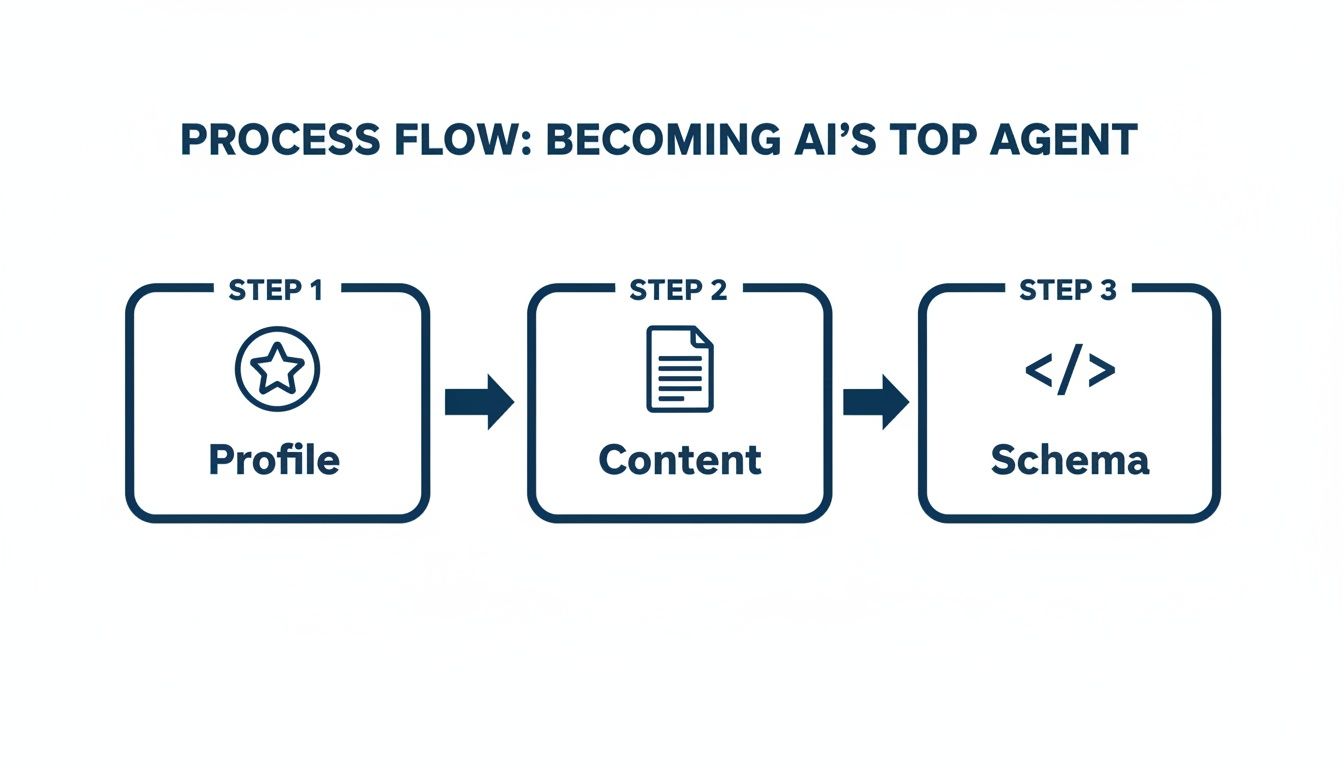
As you can see, a winning AEO strategy isn't about just one thing. It's about integrating your personal brand (Profile), demonstrating your market expertise (Content), and speaking the technical language that AI systems understand (Schema).
Streamlining Your Listing Marketing
This is where a tool like ListingBooster.ai comes in. It was built to solve the core AEO challenges by automating the creation of AI-ready content and the technical markup that goes with it. It’s designed to connect the dots between your properties and AI visibility.
Think of the platform as your dedicated AI marketing engine. For instance, its Listing Commander feature can take a single property and instantly generate a full suite of marketing materials. This isn't just about pulling in generic MLS text; it creates AI-optimized property descriptions written to be easily digested by language models, full of the specific details that answer conversational search queries.
The biggest hurdle for agents isn't knowing what to do; it's finding the time to do it all consistently. Automation bridges that gap, turning strategy into execution without draining your most valuable resource—time.
More importantly, the platform automatically embeds the necessary Schema Markup for you. This removes what is often the biggest technical roadblock for agents. You no longer have to learn code or stress about making a mistake; the system handles the translation, making your listings instantly understandable to Google's AI Overviews and other systems.
For a deeper look into this, check out our guide on real estate marketing automation for agents.
Building Your Authority on Autopilot
Beyond marketing individual listings, you need to establish yourself as the local expert to get recommended by AI. This requires a steady flow of hyperlocal content that proves you know your stuff. This is where another key feature, Authority Builder, comes into play.
Authority Builder automates the creation of the exact content we've been talking about—local market updates, neighborhood guides, and practical tips for buyers. It helps you build a digital footprint that screams "local specialist," which is precisely the kind of source an AI is programmed to trust and cite when someone asks, "Who's the best agent in my town?"
By generating content that answers the specific, nuanced questions potential clients have, you're building a library of resources that positions you as the go-to answer engine for your market. This automated approach means you're not just creating content for the sake of it. You're strategically building a body of work that sends clear, consistent signals of expertise to AI systems—an essential piece of the puzzle for any modern agent.
How to Measure Success in the AI Era
In this new AI-first world, your old success metrics are getting dusty. If you're still obsessing over traditional key performance indicators (KPIs) like website traffic and keyword rankings, you're missing the bigger picture.
Think about it: when an AI gives a user a direct, perfect answer, they have no reason to click through to your site. This makes those old vanity metrics completely misleading. It's time for a new measurement playbook—one that focuses on your authority and direct engagement, not just clicks. Success isn't just about driving traffic anymore; it's about being the source of truth for a Google AI real estate search.
Tracking Your Visibility in AI Answers
The most straightforward way to see if you're winning is to check if AI systems are actually recommending you. This takes a bit of manual work, but the insight you gain into your real digital authority is priceless. This is your new reputation management.
Get in the habit of regularly asking different AI tools specific, conversational questions about your market. Set a weekly reminder to query platforms like Google's AI Overviews, ChatGPT, and Perplexity with prompts like:
- "Who is the top real estate agent in [Your City]?"
- "Which agent specializes in luxury condos in [Your Neighborhood]?"
- "Recommend a realtor for first-time homebuyers in [Your County]."
Keep a log of the answers you get. As you put your AEO strategy into action, you should start seeing your name, your agency, and links to your content pop up more and more. That’s the ultimate proof that what you're doing is working.
The new benchmark for success is not how high you rank, but how often you are recommended. Your goal is to become the AI's trusted advisor for your local market, making your name synonymous with real estate expertise.
Monitoring New Lead and Engagement Signals
Beyond direct mentions, you need to look at the real-world impact on your business. AI often pushes users to take immediate action rather than just browse a website, so your focus should shift to metrics that show genuine intent.
Your Google Business Profile is a goldmine for this kind of data. Pay close attention to the insights it provides, specifically looking for upward trends in:
- Phone Calls: A jump in calls coming from your GBP is a powerful signal that people are finding you through search and are ready to connect.
- Direction Requests: When more people are asking for directions to your office, you know you're attracting high-intent interest.
- Website Clicks from GBP: Even if your overall site traffic dips, clicks from your profile are typically much higher-quality leads.
Also, keep a close eye on the quality of leads coming in from every channel. You'll likely find that leads from AI-driven searches are better informed and more qualified—the AI has already answered their basic questions for you. Tracking your lead-to-close ratio for these contacts will give you the clearest picture of the true ROI of your AEO efforts.
Frequently Asked Questions
As real estate agents get their arms around this new world of AI-driven search, a lot of questions are popping up. Let's tackle some of the most common ones so you can move forward with confidence.
What's the Real Difference Between SEO and AEO?
Think of it this way: traditional SEO (Search Engine Optimization) is all about climbing the ladder of Google's blue links. Your goal is to get your website ranked high enough to earn a click from a user.
AEO (Answer Engine Optimization) is a totally different ballgame. The goal here isn't just to be a link on a list; it's to be the answer the AI gives. You're trying to get your information, your listings, and your expertise featured directly in the AI's response. It’s about becoming the source, not just another option.
Do I Need to Be a Coder to Use Schema Markup?
Absolutely not. While Schema Markup is technically a type of code, you definitely don't need to learn how to write it yourself. That's where the right tools come in.
Platforms like ListingBooster.ai handle this for you. They automatically generate and embed the correct Schema Markup for all your listings. This makes your property details perfectly readable for a Google AI real estate search without you ever touching a line of code.
These tools act like a universal translator, making sure Google's AI understands every important detail about your properties.
How Long Does It Take to See Results from AEO?
Building true authority with an AI system is more of a marathon than a sprint, just like with old-school SEO. It's an ongoing process of consistently providing valuable content and proving you're a trusted source.
That said, you can get some quick wins right out of the gate. The fastest results will come from two things:
- Dialing in your Google Business Profile: This is the lowest-hanging fruit. A complete and active profile is a massive trust signal for AI.
- Using Schema on every new listing: This immediately gives your properties a better shot at showing up in those specific, conversational searches.
From there, consistently publishing great local content will build on that early momentum. Every blog post, market update, and neighborhood guide helps solidify your status as the go-to expert, eventually turning you into the agent the AI recommends most in your area.
Stop letting AI ignore you and start getting recommended. ListingBooster.ai is your command center for creating AI-optimized property descriptions, hyperlocal content, and the Schema Markup you need to dominate this new era of search. Try it free and see how you can automate your authority.
Walk In With the Campaign Already Built
Listing copy, social posts, sourced Market Insights, growth scheduling, and direct publishing after approval from one real-estate-specific system. 25 free credits to start.
Related Posts
 Real Estate SEO
How to Get More Seller Leads with Real Estate SEO in 2026
Organic search still produces seller leads. The difference is how those leads are discovered, filtered, and trusted before a homeowner ever contacts you. For years, agents treated SEO as a way to rank a few pages and wait for form fills. That approach misses what seller SEO does. It puts your name, market coverage, and […]
 Real Estate SEO
Local SEO for Real Estate Agents with AI: A 2026 Guide
Real estate leads are still won or lost in local search, but the way agents earn visibility has changed. A strong position in search no longer guarantees attention, because buyers and sellers increasingly see AI-generated summaries before they ever click a website. That changes the job. Agents now need a web presence that search engines […]
 Real Estate SEO
How to Build Topical Authority as a Real Estate Agent: 2026
Real estate SEO used to reward volume. Publish enough pages, target enough keywords, and you could usually earn some visibility. That playbook is fading. The stronger model now is a connected authority system, built around pillar pages and supporting clusters that cover the buyer and seller journey in depth, as outlined in this real estate […]