Fair Housing Words to Avoid Real Estate: 2026 Guide
You're probably doing this already. You paste listing notes into an MLS draft, clean up the obvious rough edges, then hesitate over a phrase that sounds good but feels risky. “Perfect for families.” “Safe neighborhood.” “Walk to church.” “Exclusive community.” The copy reads naturally. The compliance issue is that natural marketing language is often exactly where Fair Housing trouble starts.
Agents get into problems because they write for an imagined buyer instead of the actual property. That's the mistake. If you fix that one habit, most of the common Fair Housing language mistakes disappear fast.
The Foundation of Fair Housing in Real Estate Marketing
The rules around Fair Housing words to avoid in real estate aren't arbitrary. They come from the U.S. Fair Housing Act, enacted in 1968 as Title VIII of the Civil Rights Act, which prohibits housing-related discrimination in advertising based on race, color, religion, national origin, sex, disability, and familial status, as explained by the National Fair Housing Alliance's responsible advertising guidance.
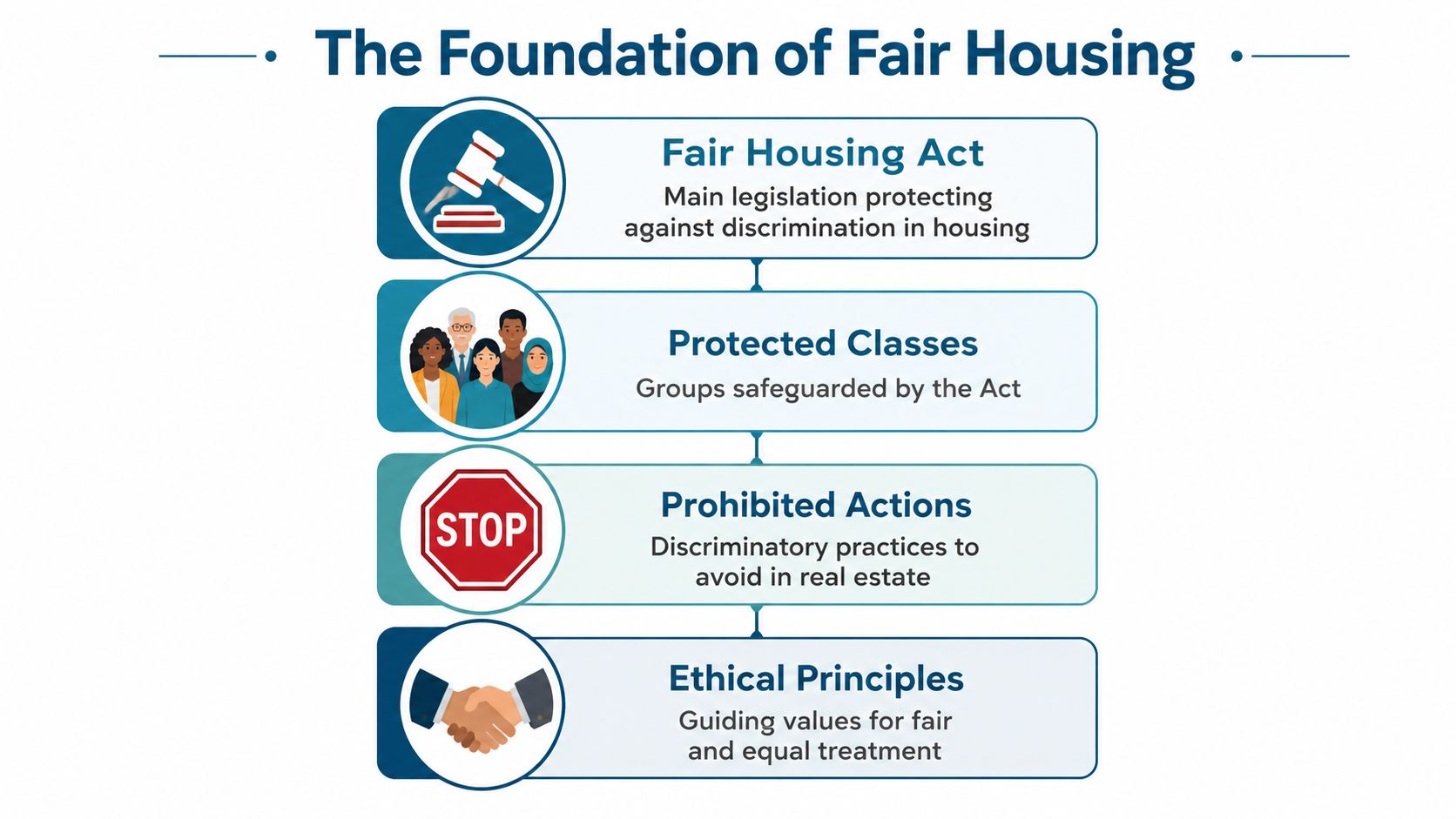
That's the practical foundation for every MLS remark, Instagram caption, flyer, email blast, and listing video script you approve. Your marketing can't show a preference, limitation, or exclusion tied to a protected class. It also can't do that indirectly.
What this means in daily practice
You're not allowed to market a home based on who you think should live there. You are allowed to market the home based on what it objectively offers.
That distinction matters more than any blacklist.
- Protected class reference: Saying or implying a buyer should be a family, a single person, a Christian, or someone without disabilities creates risk.
- Property-focused description: Sticking to layout, room count, upgrades, lot features, transit access, and nearby amenities keeps your language grounded.
- Indirect signals count: Even soft phrasing can be read as steering if it points toward or away from a protected group.
Practical rule: If the sentence answers “who should live here?” rewrite it. If it answers “what does this property offer?” you're on much safer ground.
Compliance isn't just defensive lawyering. It's professional marketing discipline.
The Core Principle Describe the Property Not the People
If you remember one thing, make it this. Describe the property, not the people.
That rule is the cleanest way to write effective copy without drifting into discrimination. It also makes your marketing stronger, because feature-based language reaches a broader audience than audience-targeted language ever will.
A fenced yard is a feature. “Perfect for kids” is a buyer profile. A first-floor bedroom is a feature. “Ideal for seniors” is a buyer profile. A condo near restaurants and transit is a feature-based location description. “Ideal for young professionals” is not.
Why this mindset works
When agents chase the “ideal buyer,” they narrow the audience and increase risk. When agents describe tangible features, buyers decide for themselves whether the home fits their lives.
Here's the shift:
Instead of: “Perfect for families”
Write: “Four-bedroom layout with separate living spaces and a fenced backyard”
Instead of: “Ideal for young professionals”
Write: “Low-maintenance condo with easy access to downtown dining, transit, and major commuting routes”
Instead of: “Great for retirees”
Write: “Single-level layout with a first-floor primary suite and low-maintenance landscaping”
If you want a sharper feel for feature-first writing, review these property description examples. The pattern is simple. Lead with facts, layout, finishes, and access. Skip assumptions about the occupant.
The best compliant copy doesn't sound sanitized. It sounds precise.
Quick Reference Risky Phrases and Safer Alternatives
Bookmark this and use it before you hit publish.
Fair Housing Phrase Quick Reference
| Risky Phrase (Avoid) | Protected Class Implicated | Safer Alternative (Focus on Features) |
|---|---|---|
| Perfect for families | Familial status | Four-bedroom home with open living areas and a fenced backyard |
| Ideal for young professionals | Can imply age, and can function as steering | Low-maintenance home near downtown offices, dining, and transit |
| Empty nester | Familial status | Efficient floor plan with main-level living |
| Great for singles | Familial status | Compact layout with flexible living space |
| Safe neighborhood | Can function as steering | Well-lit streets, sidewalks, gated entry, or nearby public amenities |
| Walk to church | Religion | Close to community amenities and local gathering spaces |
| Exclusive community | Can imply exclusion | Gated entry, private road access, or controlled building access |
| Traditional neighborhood | Can imply preference or exclusion depending on context | Tree-lined streets, established homes, or classic architectural details |
| No children | Familial status | Follow lawful occupancy rules and state them neutrally if needed |
| Handicap-friendly | Disability | Accessible features such as ramp entry, wider doorways, or roll-in shower |
High-Risk Category Phrases Implying Familial Status
Familial status violations are common because agents use them casually. “Perfect for families” sounds harmless. It isn't. It signals a preference tied to a protected class.
The same goes for “great for singles,” “ideal for empty nesters,” and “bachelor pad.” Each phrase tells the market who you think belongs there. That's exactly what your advertising should never do.
Why these phrases create risk
Familial status law protects people from being steered toward or away from housing based on household composition. When your copy says “perfect for families,” you're not just describing space. You're indicating the preferred occupant.
That can deter buyers or renters who don't fit the picture you painted. It can also support a complaint even if you didn't intend discrimination.
A better approach is bluntly simple. Describe the layout and let the buyer interpret utility.
Say this, not that
Here are safer rewrites that still sell the home:
Not: “Perfect for families”
Use: “Spacious layout with multiple bedrooms, open common areas, and a fenced backyard”Not: “Great for kids”
Use: “Large backyard, bonus room, and generous storage”Not: “Ideal for empty nesters”
Use: “Manageable footprint with main-level living and minimal exterior upkeep”Not: “Perfect starter home for a young couple”
Use: “Efficient floor plan with updated kitchen and low-maintenance lot”
What to highlight instead
Focus on specifics the home has.
- Room configuration: Bedroom count, office, flex room, split-bedroom layout
- Flow: Open kitchen, separate living areas, first-floor suite
- Outdoor use: Patio, deck, fenced yard, corner lot
- Practical convenience: Laundry room, attached garage, built-in storage
If the phrase depends on guessing a buyer's life stage, cut it. If it describes measurable features, keep it.
High-Risk Category Phrases Describing Neighborhood Inhabitants
Neighborhood copy is where many experienced agents get sloppy. They stop describing place and start describing people. That's where “safe neighborhood,” “exclusive,” “walk to church,” and “ideal for young professionals” show up.
Those phrases don't just market location. They imply who belongs there.
Industry guidance makes this point clearly. The idea of “words to avoid” is broad, not a neat little blacklist. One compliance list says its examples are “all-inclusive” but not complete, and another guide notes Pennsylvania's list contains more than 60 “bad words” or phrases, including “empty nester,” “ideal for,” “traditional,” and references to race, religion, or national origin, according to SmartMLS fair housing words and phrase guidance.
Common problem phrases
Here's why these phrases are trouble:
- “Safe neighborhood” can function as coded steering.
- “Walk to church” points to religion.
- “Exclusive community” suggests limitation or exclusion.
- “Ideal for young professionals” describes people, not place.
Safer neighborhood rewrites
Replace vague or coded language with objective location facts.
| Risky neighborhood phrase | Better rewrite |
|---|---|
| Safe neighborhood | Sidewalk-lined streets, street lighting, gated entry, resident amenities |
| Walk to church | Near community amenities, local gathering spaces, and neighborhood services |
| Exclusive community | Controlled access entry, private road, or gated subdivision |
| Ideal for young professionals | Close to business districts, dining, transit, and major commuter routes |
Describe proximity, infrastructure, access, and amenities. Don't narrate the demographics of the area.
Subtle Violations Steering with Adjectives
The obvious phrases are easy to spot. The subtle ones are more dangerous because agents defend them.
“Traditional.” “Private.” “Mature.” “Secluded.” None of these words is automatically illegal. But context can turn a neutral adjective into a steering signal. That's why lazy adjective use is a compliance problem.
Context matters more than the word alone
“Traditional brick colonial with formal dining room” is a property description. “Traditional neighborhood” is different. It can imply a preferred social or cultural profile rather than an architectural one.
“Private backyard” is usually fine when it describes fencing, trees, or lot orientation. “Private community” or “exclusive area” needs more care if the wording starts to imply who is and isn't welcome.
Better practice
Try this filter before you publish:
- Architectural or physical? Keep it if the word describes the structure, finish, or lot.
- Demographic or cultural? Rewrite it if the word hints at the kind of residents you expect.
- Subjective safety or prestige claim? Replace it with concrete features.
Examples:
Instead of: “Traditional neighborhood”
Use: “Established neighborhood with tree-lined streets”Instead of: “Exclusive enclave”
Use: “Gated subdivision with limited street access”Instead of: “Mature area”
Use: “Established landscaping and larger lot sizes”
Strong copy is specific copy. Vague prestige language creates risk and usually isn't persuasive anyway.
Fair Housing Rules Apply to Images Videos and Targeting
Agents still treat compliance like a copywriting issue. It isn't. The same standards apply to photos, videos, and paid distribution choices.
If your visuals consistently show only one type of person, you may be signaling a preference even if the caption is clean. If your ad targeting excludes groups in ways tied to protected characteristics, you've moved from careless marketing into a much bigger problem.
Where teams miss this
A few recurring mistakes show up in real campaigns:
- Lifestyle-heavy creative: Ads focused on one demographic instead of the property.
- Selective audience exclusions: Narrow targeting that effectively screens out protected groups.
- Video scripts that drift into buyer profiling: The footage is compliant, but the narration isn't.
The safer operating standard
Use property-first visuals whenever possible. Exterior shots, room shots, amenity photos, floor plan graphics, and neighborhood infrastructure are easier to defend than staged lifestyle imagery centered on one demographic.
For digital campaigns:
- Review the audience settings before launch.
- Remove targeting assumptions tied to religion, family makeup, disability, or similar characteristics.
- Check captions and voiceover scripts with the same rigor you apply to MLS remarks.
The format doesn't change the rule. An Instagram Reel can create the same Fair Housing issue as a printed flyer.
The Compliance Safety Net Using AI The Right Way
Generic AI is fast. It's also unpredictable. Ask a general-purpose model for a listing description and it will often produce language that sounds polished but slides straight into “perfect for families,” “ideal for young professionals,” or other audience-based phrasing.
That's not a technology problem. It's a workflow problem. Agents are using broad writing tools for a regulated use case.
Generic AI versus purpose-built real estate AI
A generic tool can draft quickly, but it doesn't automatically understand your brokerage review standards, MLS sensitivities, or Fair Housing risk patterns. You have to catch those issues yourself every time.
A real-estate-specific workflow is more useful when it keeps the copy anchored to property facts and checks for risky language before publication. That's where a tool like ListingBooster.ai fits. It's built for real estate listing descriptions and social content, with Fair Housing compliance checking designed to flag protected-class references and steering language before approval.
A practical AI workflow
If you use AI, use it like this:
- Start with structured facts: Beds, baths, layout, upgrades, lot details, access, amenities.
- Prompt for features, not audiences: Tell the system to avoid describing the buyer.
- Run a compliance pass: Review every “ideal for” phrase, every lifestyle assumption, every coded adjective.
- Check channel-specific output: MLS, social posts, flyers, and video scripts need separate review.
If you're also building video into your listing marketing, this complete guide to video marketing for agents is useful because it helps teams think through format and distribution without losing the property-first focus. The same discipline applies when you write converting real estate descriptions. Persuasion is fine. Buyer profiling isn't.
Your Practical Fair Housing Compliance Checklist
Use this before every listing goes live. Every time. No exceptions.
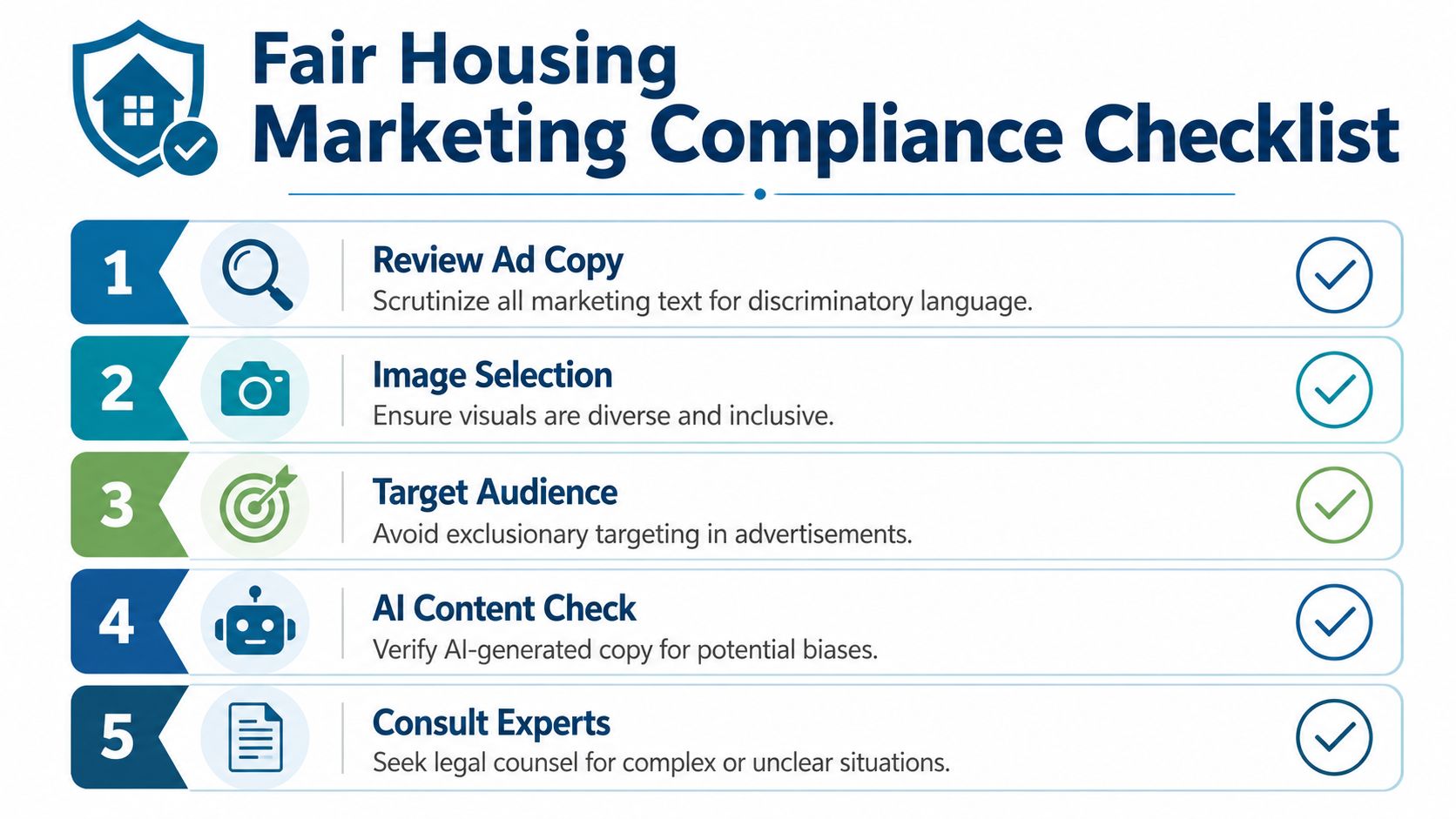
Pre-publish review
- Check the copy: Remove references to who should live there. Keep only property facts, layout, features, and neutral location details.
- Scan for high-risk phrases: Catch “perfect for families,” “safe neighborhood,” “walk to church,” “exclusive,” and “ideal for young professionals.”
- Review visuals: Make sure photos and videos focus on the property and don't imply a preferred demographic.
- Review targeting settings: Paid campaigns should not exclude or prioritize audiences in ways that create Fair Housing risk.
- Check AI output manually: Never assume generated copy is safe just because software wrote it.
If you want a workflow built around this review process, tools that help agents generate legal property descriptions can reduce rewrite time. They don't replace your judgment. They support it.
Frequently Asked Questions about Fair Housing Language
Can I say “perfect for families” if the house has a big backyard?
No. The backyard is a feature. “Perfect for families” is a statement about the preferred occupant. Write the feature instead: fenced backyard, covered patio, play space, or outdoor entertaining area.
Is “safe neighborhood” allowed?
Don't use it. Safety claims are subjective, and the phrase can function as steering. Stick to observable facts like gated entry, sidewalks, lighting, traffic patterns, or proximity to public amenities.
Can I mention schools?
Yes, but do it carefully. You can reference objective school-related facts, such as school district information or proximity, as long as you're not using that information to imply who the property is for. Keep the wording factual and property-centered.
What about “walk to church”?
Avoid it. That ties your marketing to religion. If the point is convenience, say the property is near community amenities, neighborhood services, or local gathering spaces.
Is “exclusive” always a problem?
It's risky because it can imply exclusion. Most of the time, you're better off describing the actual feature you mean: gated access, limited-entry building, private road, or controlled access lobby.
Is “empty nester” acceptable?
No. It's one of the clearer examples of familial-status steering. Replace it with the reasons someone might like the home, such as main-level living, smaller footprint, or lower-maintenance exterior.
Should I say “handicap-friendly” or “accessible”?
Use accessible and describe the actual features. Say ramp entry, wider doorways, no-step shower, elevator access, or first-floor bedroom and bath. Specificity is clearer and more professional.
Is “master bedroom” a Fair Housing violation?
It isn't the core Fair Housing issue agents should focus on here, but many brokerages and MLSs prefer “primary bedroom.” Follow your MLS and brokerage standards. It's a straightforward swap and usually the cleaner choice.
If you want a cleaner process for listing copy and social content, take a look at ListingBooster.ai. It's built for real estate teams that want property-focused marketing and a compliance check before publishing, without relying on generic AI drafts that need heavy cleanup.
Walk In With the Campaign Already Built
Listing copy, social posts, sourced Market Insights, growth scheduling, and direct publishing after approval from one real-estate-specific system. 25 free credits to start.
Related Posts
 Uncategorized
Real Estate Content Marketing: The 2026 Playbook
Listings with video can generate 49% more qualified leads, according to a 2026 real estate digital marketing roundup. That figure changes the question. Real estate content marketing isn't about how often you post. It's about whether your listing, expertise, and local knowledge can be found, understood, and cited by people and by the AI tools […]
 Uncategorized
AI for Real Estate Marketing: A Practical Playbook
A new listing goes live on Tuesday morning. You write the description from memory, schedule three social posts, answer showing requests, and move on to the next client task. By afternoon, the listing has plenty of activity on your side of the business, but the phone still isn't producing the conversations you expected. That gap […]
 Uncategorized
What Is IDX and Why It Still Matters for Real Estate
A new agent usually hears “IDX” during a brokerage onboarding call, nods along, and hopes nobody asks for a definition. Then the questions arrive: Why are listings appearing on the website? Who controls the data? Why did a property remain visible after its status changed? And will the same pages be readable by ChatGPT, Perplexity, […]