Automated Content For Real Estate Agents That Wins Listings

Automated content is essentially an AI-powered marketing assistant that takes your raw property data—the address, beds, baths, and key features—and instantly spins it into a full set of polished marketing materials. It’s the difference between spending hours writing copy and spending minutes reviewing it.
This technology is what allows top agents to move from being constantly overworked to becoming hyper-efficient, giving them a serious edge in a competitive market.
What Is Automated Content In Real Estate

Imagine you've just signed a new listing. Instead of blocking off your afternoon to write, you plug the basic details into a system. Almost immediately, it hands you back a complete marketing kit. We're not talking about simple Mad Libs-style templates; this is smart technology that crafts genuinely strategic and engaging content designed to hook buyers and wow your sellers.
Think of it as a force multiplier for your marketing. You provide the raw ingredients, and the system bakes the entire cake. A single address can generate:
- Persuasive Property Descriptions: Written to grab attention on the MLS, Zillow, and Realtor.com.
- A Complete Social Media Campaign: Ready-to-go posts covering every milestone, from "Coming Soon" to "Just Sold."
- Engaging Email Copy: Perfect for announcing the new listing to your sphere of influence.
- Professional Flyer and Brochure Text: Ensures your print materials match the quality of your digital presence.
The whole idea is to do the heavy lifting once and let technology handle the tedious, repetitive parts. This gives you back precious hours to focus on what actually moves the needle in your business: talking to clients, negotiating deals, and building relationships.
Who Benefits From Content Automation
This isn't just a fancy tool for big, tech-forward teams. Agents at every stage of their career can see a real impact.
For the solo agent, it's a game-changer. It means getting your nights and weekends back. Instead of spending 5-7 hours on marketing for every new listing, you can get it all done in under 10 minutes and compete with brokerages that have huge marketing departments.
Growing teams gain something just as valuable: consistency. Automation makes sure every single agent is putting out top-notch, on-brand marketing. No more inconsistent messaging or sloppy posts that can dilute the brand you've worked so hard to build.
For brokerages, it's about providing a powerful, scalable tool that helps every agent succeed. It dramatically reduces the need for a large in-house marketing team while ensuring all content is compliant with Fair Housing guidelines and local MLS rules—a huge risk-reduction benefit. This sets a high standard of professionalism for the entire company.
The reality is, this kind of automation isn't a luxury anymore. It's becoming a fundamental part of running a successful modern real estate business.
Manual Effort vs Automated Efficiency
To really grasp the difference, let's look at the time sink of traditional marketing versus the speed of an automated system. This table breaks down the hours spent the old way compared to the minutes it takes with the right tool.
| Marketing Task | The Manual Way (Hours Per Listing) | The Automated Way (Minutes Per Listing) |
|---|---|---|
| Writing MLS Property Description | 1.5 – 2 Hours | < 2 Minutes |
| Crafting 5-7 Social Media Posts | 2 – 3 Hours | < 3 Minutes |
| Creating Email Newsletter Copy | 0.5 – 1 Hour | < 1 Minute |
| Writing Flyer & Brochure Text | 0.5 – 1 Hour | < 1 Minute |
| TOTAL TIME SPENT | 4.5 – 7 Hours | < 7 Minutes |
As you can see, the time savings are staggering. What once took up an entire day can now be handled during a coffee break, freeing you to focus on dollar-productive activities that grow your business.
Why Automation Isn't Just an Option—It's Your New Baseline
In real estate, speed and visibility aren't just advantages anymore; they're the bare minimum for staying in the game. The race to grab a buyer's attention or land that next listing is won in minutes, not days. While your competition is still fumbling with property descriptions, an agent using automation is already launching a full-blown marketing campaign, cementing their reputation as the go-to expert in their market.
This isn't about working a little faster. It’s a total shift in how you run your business. When you bring automated content into your real estate practice, you're not just saving a few hours. You're getting back a huge chunk of your life, locking in a consistent brand voice, and scaling your marketing efforts without ever having to hire an assistant.
Get Your Most Valuable Asset Back: Time
The biggest, most immediate win with content automation is getting your time back. Think about it. Instead of burning hours writing property descriptions, social media captions, and email blasts for every new listing, you could generate a complete, professional marketing package in less than ten minutes.
What could you do with an extra five to seven hours for every single listing? That time adds up fast. You could be:
- Following up on leads: Actually building relationships with the people who want to work with you.
- Negotiating deals: Giving your full attention to getting the best outcome for your clients.
- Networking: Hitting local events and forging partnerships that bring in more business.
- Meeting clients: Spending more face-to-face time earning their trust.
This is the whole point. Automation moves you from being a content creator back to being a business builder. It lets you focus on the human connections that no AI can ever replace.
Lock in a Flawless, Consistent Brand
Your brand is your promise. Every flyer, social post, and newsletter you send out either strengthens that promise or chips away at it. When you’re rushing to get a new listing live, it's easy for inconsistencies to creep in, and suddenly your messaging feels scattered.
Automation acts as your brand's bodyguard. It ensures every piece of content that goes out the door—from the tone of voice to the visual style—is perfectly aligned with who you are.
This kind of consistency is what builds trust. When people see your marketing, they instantly recognize it as yours: professional, polished, and reliable. This is how you create a memorable brand that doesn't just blend into the sea of other agents.
This is even more critical for teams and brokerages. It makes sure every agent, no matter their marketing savvy, represents the company with the same high standard of professionalism. It protects the brand's reputation and guarantees every client gets a consistent experience.
Platforms like ListingBooster.ai are designed for this, generating a whole suite of marketing materials from a single set of property details to ensure a unified message.
The interface makes it clear how one entry can power a ton of content, all with a consistent look and feel, taking the guesswork out of branding.
Scale Your Marketing—Not Your Payroll
As your business grows, your marketing workload explodes. More listings mean more descriptions to write, more social campaigns to run, and more emails to send. In the past, this meant hiring a marketing assistant or even a small team, which adds serious overhead.
Automation completely flips that script. It gives you the power to market five, ten, or even twenty listings with the same effort it used to take for one. That's real scalability. The tech handles all the repetitive stuff, freeing you to grow your market presence without growing your payroll. Operating this lean is a massive competitive advantage.
The numbers don't lie. The AI in real estate market is projected to skyrocket from $164.96 billion in 2023 to a mind-boggling $731.59 billion by 2028. The technology powering this boom is the very same stuff that automates content and turns tedious tasks into powerful marketing. You can dig deeper into these AI agent trends on leewayhertz.com. The takeaway is clear: agents who don't get on board with these tools will find themselves left in the dust.
How to Build an Automated Content Workflow That Actually Works
Knowing that automated content can help your real estate business is one thing. Actually putting a system in place is a completely different ballgame.
The great news? You don't need to be a tech wizard or block out a week on your calendar to get started. Building a smart, automated workflow is surprisingly straightforward. It’s all about creating a repeatable process that takes a new listing and turns it into a full-blown marketing campaign in just a few minutes.
Let's walk through the five simple steps to make this happen.
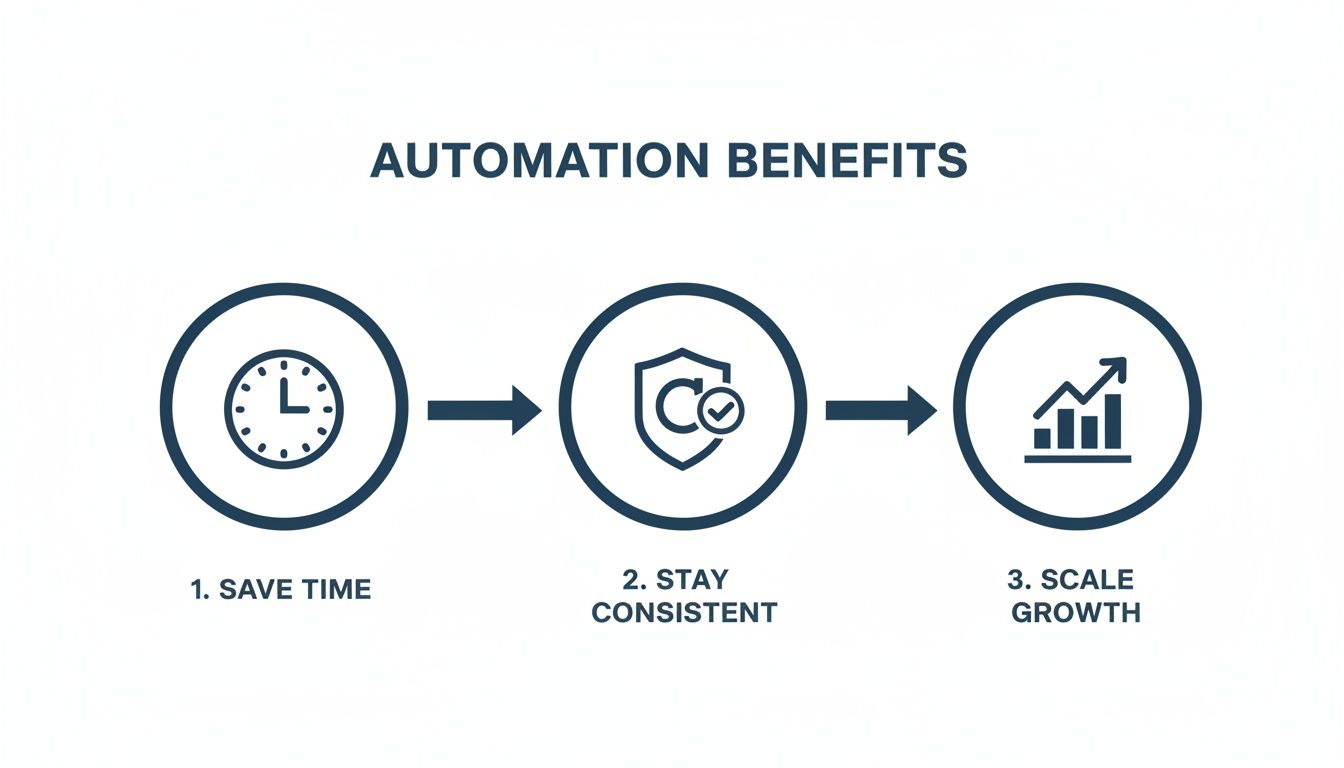
This isn't just about saving time. It's about creating a powerful cycle where efficiency and consistency fuel the growth you need to scale your business.
Step 1: Choose the Right Automation Platform
First things first, you need the right tool for the job. And I don’t mean a generic AI writer. You need a platform built from the ground up for real estate agents. Why? Because generic tools just don't get the nuances of property marketing or, more importantly, the strict compliance rules we all have to follow.
Think of your ideal platform as the command center for all your listing content. As you vet your options, make sure they have these non-negotiable features:
- Direct MLS Integration: This is the big one. The tool absolutely must be able to pull data directly from an MLS feed or at least a Zillow link. This single feature eliminates tons of manual data entry and prevents errors from the start.
- Multi-Channel Content: It has to create everything you need. We're talking MLS property descriptions, social media posts for Facebook, Instagram, and LinkedIn, email newsletters, and even copy for print flyers.
- Built-in Compliance Checks: A top-tier platform will automatically scan for Fair Housing Act red flags. This is a massive safeguard for your license and your business.
- Complete Control: Automation should deliver a killer first draft, not a final, unchangeable product. You must have the ability to easily edit, tweak, and personalize every single word.
Picking the right platform is the foundation for everything that follows. It's the difference between a tool that’s a small help and a system that completely changes how you do business.
Step 2: Get Your Initial Setup Done
Once you’ve made your choice, getting set up should be quick and painless. The best systems are designed for busy agents, not IT pros. It’s usually just a matter of plugging in a few key details to establish your brand and professional identity.
This initial setup typically takes less than ten minutes and involves entering info like:
- Your name, brokerage, and contact details.
- Your professional headshot and company logo.
- Your brand's tone of voice (e.g., "professional and trustworthy" or "friendly and approachable").
The most powerful tools, like ListingBooster.ai, are ready to go almost immediately. Give them a property address or an online listing link, and they can start generating content right away. This minimal setup means you can go from sign-up to your first full marketing package in minutes.
Step 3: Generate Your First Marketing Suite
Okay, this is where the magic happens. With your account set up, you can now generate a complete marketing package for a new listing almost instantly. Just feed the system the property address, and the AI goes to work, crafting a whole suite of materials specifically for that home.
This is the entire point of an automated content workflow for real estate agents. It replaces hours of tedious writing and design with a few clicks, giving you a professional, cohesive campaign that's ready to launch.
In just a few moments, you should have a full set of assets at your fingertips—from an SEO-friendly Zillow description to a full social media calendar complete with captions and images.
Step 4: Review and Personalize the Content
Automation gives you speed, but your personal expertise provides the soul. This fourth step is probably the most important: a quick review to add your personal touch. This is your chance to inject your unique market knowledge and local flavor into the AI-generated copy.
The AI can do a great job describing the granite countertops, but only you can add that perfect local detail like, "Just a short walk from the best coffee shop in the neighborhood, The Daily Grind." It’s these human touches that take content from good to great and build real connection with buyers.
Spending just five to ten minutes here ensures your authentic voice shines through, which is crucial for building trust. You can explore more modern strategies and tools for today's real estate agents to see how this fits into a bigger picture.
Step 5: Schedule and Distribute Everything
With your polished content ready to go, the final step is getting it out there. A truly great automation platform doesn't just create the content; it helps you distribute it, too. Instead of logging into Facebook, then Instagram, then your email platform, you can schedule everything from a single dashboard.
This lets you map out the entire promotional plan for a listing in one go. You can schedule the "Coming Soon" teaser, the big "Just Listed" announcement, the open house reminder, and the "Just Sold" celebration all at once. This organized, set-it-and-forget-it approach guarantees consistent marketing for your listings, freeing you up to focus on what you do best: selling homes.
The Two Types Of Content Every Agent Needs
A solid real estate content strategy is a lot like running a successful race. You need the explosive power of a sprinter to get off the blocks and the steady endurance of a marathoner to win in the long run. For agents, this means mastering two distinct but equally crucial types of content: Listing Content and Authority Content.
Thinking you can get by with just one is a classic misstep that holds so many agents back. Listing content gets you in front of buyers today, but it's the authority content that makes people remember you and seek you out tomorrow. When you get both working together, you create a powerful marketing engine that just keeps feeding you new business.
Listing Content: The Sprinter for Quick Wins
This is the content that gets a specific property sold. It’s all about the transaction, it's urgent, and its sole purpose is to grab the attention of active buyers and sellers right now. When most people think of real estate marketing, this is what they picture—the "now" content that drives your daily business.
Think of it as the sprinter in our race. It's built for speed and immediate impact, designed to achieve a very specific, short-term goal. The job of listing content is to turn a casual scroller into someone who schedules a showing or makes an offer.
Examples of essential listing content include:
- Compelling MLS Descriptions: Punchy, optimized copy that makes a property’s best features pop.
- Social Media Campaigns: A planned series of posts that build excitement from "Coming Soon" to "Just Listed," "Open House," and finally, "Just Sold."
- Email Announcements: Targeted blasts to your database letting everyone know about a hot new property.
- Print Materials: Sharp text for flyers and brochures that looks just as good as your online posts.
This is where automated content for real estate agents shines and delivers an immediate payoff. A good platform can whip up a full set of these materials in minutes, making sure your new listings get a massive wave of exposure from the moment they hit the market.
Authority Content: The Marathoner for Brand Longevity
While listing content is all about the house, authority content is all about you. This is your long-term play—the relationship-building content that cements your status as the go-to expert in your market. It’s not focused on one deal; it's about building lasting trust and credibility.
This is the marathon runner of your strategy. It’s steady, consistent, and builds the brand endurance you need to succeed in any market, up or down. The goal is to educate, inform, and help, so when someone is finally ready to make a move, you’re the first and only agent they think of.
This type of content answers your clients' questions before they even know they have them. It shows you have a deep-seated understanding of the local market and that you're a valuable resource, not just another salesperson.
Key authority-building content includes:
- Neighborhood Guides: Deep dives into local communities, covering everything from schools and parks to the best local coffee shop.
- Monthly Market Updates: Smart, data-driven analysis of what's really happening with home prices and inventory in your area.
- Homebuyer and Seller Tips: Genuinely helpful advice that demystifies the buying and selling process for people.
- Agent Positioning Posts: Content that showcases your unique approach, client testimonials, and professional insights.
Let's be honest, creating this kind of content from scratch takes a ton of time, which is why so many agents let it slide. But today, modern automation tools can generate this critical content for you, helping you build a rock-solid reputation without the grind.
Why You Can’t Afford to Neglect Either One
If you only focus on listing content, you become a commodity. You’re only as relevant as your current inventory, and once a property sells, all that marketing effort vanishes. This transactional cycle puts you on a hamster wheel, constantly chasing the next deal to stay visible.
On the other hand, if you only publish authority content without showing off your active listings, you risk looking like a market commentator instead of an active agent. You might build a great reputation, but clients won't see tangible proof that you're actually in the trenches selling homes.
A balanced strategy is the only way to win. The buzz from your listing content grabs immediate attention and pulls new people into your world. Once they're there, your authority content nurtures that relationship, building the trust that transforms a one-time client into a lifelong fan who sends referrals your way for years.
So, What Are the Real Risks of Using AI?
Let's be honest, jumping into any new technology feels a bit like stepping into the unknown. When it comes to automating your content, it’s smart to ask the tough questions. If you don't, you could be setting yourself up for some serious headaches down the road.
The trick is to think of AI as your super-efficient assistant, not your replacement. It still needs you—your expertise, your oversight, your final sign-off. By tackling the big concerns head-on, you can use these tools to build your business without putting it at risk.
Let's walk through the three main things to watch out for: data privacy, compliance rules, and keeping your brand voice intact.
Keeping Your Data and Your Clients Safe
You're dealing with sensitive information every single day—property details, client names, you name it. Handing that over to a new platform can feel a little unnerving. Where does it all go? Who sees it? This is a huge deal.
A trustworthy automation tool will be crystal clear about how they handle your data. Before you even think about signing up, dig into their privacy policy and look for these non-negotiables:
- Secure Data Handling: Make sure they use top-notch encryption to protect your information, both when it's being sent and when it's stored.
- Clear Privacy Policies: The platform should state, in no uncertain terms, that they will never sell your or your clients' data. Period.
- Limited Data Access: The tool should only access the bare minimum information needed to create the content, with tight controls on who can see it.
This is why choosing a platform designed specifically for real estate is so important. They get it. They understand the confidentiality you’re bound to.
Staying on the Right Side of Fair Housing and MLS Rules
Compliance isn't just a buzzword; it's the bedrock of your business. One accidental slip-up with Fair Housing language could jeopardize your license, and breaking local MLS rules can lead to hefty fines and a reputation you can't easily fix. Honestly, writing descriptions quickly by hand can be surprisingly risky—it’s just too easy for a problematic phrase to slip in when you’re rushing.
A great automation system is your safety net. The best tools have compliance checkers built right in, actively scanning for and flagging language that could be seen as discriminatory based on race, religion, familial status, or other protected classes. It catches potential problems before you publish.
This isn't just about avoiding violations. It’s about reinforcing good habits and ensuring every piece of marketing you put out there is professional, ethical, and above reproach.
Protecting Your Unique Brand Voice
This is probably the number one fear I hear from agents: "Will this make me sound like a robot?" It’s a totally valid concern. You've spent years building a brand and a reputation based on your unique personality, and the last thing you want is to sound generic.
The key is to stop thinking of AI as a one-click-and-done solution. The real magic happens in a simple two-step workflow: generate, then personalize.
Let the AI create a solid first draft. It does the heavy lifting. Then, you swoop in for a few minutes to add your personal touch. Weave in your knowledge of that specific neighborhood, mention a local landmark, or just tweak the phrasing to match your style. That final human layer is what turns a good piece of content into great marketing that actually connects with people.
For more ideas on this, our blog has a ton of advice on maintaining your brand while scaling your marketing.
How To Measure Your Content Automation ROI
It's easy to get excited about new tech, but how do you know if it's actually making you money? When it comes to automated content in real estate, looking at likes and shares just won't cut it. To really figure out your return on investment (ROI), you have to connect the dots to what truly matters: your time, your bank account, and your business growth.
Getting past the surface-level fluff tells you the real story. Are you closing deals faster? Are your leads getting better? Answering these questions is how you prove your automation strategy is more than just a shiny object—it's a core part of your business.
Quantify Your Reclaimed Time
The first and most obvious win from automation is getting your time back. Think about it. Before, you were probably spending 5-7 hours creating marketing materials for every single listing. The first thing you should track is how much of that time you're now saving.
Calculate the hours saved per listing. Seriously, do the math. If creating a complete marketing package now takes you 15 minutes instead of 5 hours, that's a huge victory. Now, multiply those saved hours by what your time is worth. That number is your immediate ROI, and it's often more than enough to justify the investment.
Think of it this way: every hour automation gives you back is an hour you can pour into things that actually make you money—like following up with hot leads, meeting with clients, or hammering out a contract. This is the bedrock of your content automation ROI.
Assess Lead Quality and Engagement
More leads are nice, but better leads are what grow your business. Good automation shouldn't just pump up your inquiry numbers; it should improve the quality of those inquiries. A sloppy, inconsistent marketing message attracts window shoppers. A polished, targeted campaign gets the attention of serious buyers and sellers.
So, how do you measure this? Keep an eye on a few things:
- Lead-to-Appointment Ratio: What percentage of people who reach out actually end up in a meeting or a showing? If this number is climbing, it's a great sign your content is hitting the right notes with qualified people.
- Inquiry Specificity: Listen to the kinds of questions people are asking. "Tell me about this house" is a weak lead. "Can I schedule a showing for tomorrow at 4 PM to see the backyard and kitchen?" is a buyer with high intent.
Track Performance on Listing Portals
How your listings perform on the big portals like Zillow and Realtor.com is a direct report card on your marketing. These platforms give you hard data showing exactly how potential buyers are engaging with your content.
For every property, dig into these portal metrics:
- Views and Saves: If you see a jump in how many people are viewing and saving your listings, it means your automated descriptions and professional photos are doing their job—they’re stopping the scroll.
- Inquiries and Tour Requests: This is the bottom line. A healthy stream of messages and tour requests coming directly from these portals is proof that your content is convincing people to take the next step.
By focusing on these real-world business results, you can see without a doubt whether your automated content system is working. If you're curious about the specific costs and potential returns of a tool like ListingBooster.ai, you can review our pricing plans here.
Still Have Questions? Let's Clear Things Up.
Even when you see the potential, it's smart to ask tough questions before diving into new tech. Let's tackle the most common concerns agents bring up about automating their content.
"Will This Stuff Sound Like a Robot Wrote It?"
That's the number one worry, and it's a fair one. We’ve all seen generic, clunky AI writing. But today’s tools are a world away from that. The trick is to think of the AI as your brilliant new assistant—it creates a solid first draft, and you provide the finishing touch.
You spend a few minutes weaving in your personal insights about the neighborhood, the unique charm of the home, or a specific feature you know buyers will love. This way, you get the best of both worlds: incredible speed and your authentic, expert voice.
The workflow is simple: generate, then personalize. Let the machine do the heavy lifting, then you add the human element that truly sells the home.
"What About Fair Housing Compliance? Am I at Risk?"
This is a big one, and surprisingly, writing everything yourself can actually be riskier, especially when you're in a hurry. It’s easy to accidentally use a word or phrase that could land you in hot water.
Top-tier automation platforms designed for real estate have Fair Housing compliance checks built right in. They actively scan the text for problematic language and flag potential violations before you publish. Think of it as an essential safety net for your business and your license.
"Is This Just for Creating Social Media Posts?"
Not at all. That’s just scratching the surface. A truly powerful automation system is a full-blown marketing engine. You feed it the listing data once, and it produces a complete set of marketing materials.
It’s not just a few social captions. You get:
- Polished, optimized property descriptions for your MLS and major portals like Zillow.
- A complete social media campaign, with posts for every stage from “Coming Soon” and “Open House” all the way to “Just Sold.”
- Ready-to-go copy for your email blasts, client newsletters, and even print flyers.
It’s about creating a consistent, professional marketing campaign across every channel for every single listing, without spending hours doing it manually.
Ready to see how ListingBooster.ai can give you back hours on every listing and elevate your marketing? Start your free trial today and generate your first complete marketing package in minutes.
Walk In With the Campaign Already Built
Listing copy, social posts, sourced Market Insights, growth scheduling, and direct publishing after approval from one real-estate-specific system. 25 free credits to start.
Related Posts
 AI Tools & Technology
Best Real Estate Marketing Platform for Solo Agents
Google Business profiles with 50+ reviews see 400% more map views than profiles with fewer reviews, according to Agent Elite as cited by FlippingBook's real estate marketing tools roundup. That stat changes the conversation. The best real estate marketing platform for solo agents isn't just a CRM with drip campaigns, and it isn't just a […]
 AI Tools & Technology
AI Powered Real Estate Listing Promotion: A Guide for 2026
Most agents still think listing promotion means better photos, a polished MLS description, and a few social posts. That playbook isn't enough anymore. AI powered real estate listing promotion now has a different job. It has to make your listings and your expertise understandable to machines that answer buyers directly. If your content can't be […]
 AI Tools & Technology
10 Best AI Tools for Listing Agents in 2026
It’s 8 PM on a Tuesday. You just got home from a showing, but your new listing goes live tomorrow. You still need to write the MLS description, create social posts, and get a postcard into something that doesn’t look homemade. That last-minute scramble is where a lot of listing agents live, and it can […]