AI search optimization for real estate: Boost Listings & Attract Buyers
Optimizing for AI search is all about structuring your online presence—everything from your property listings to your agent bio—so that conversational AI like ChatGPT and Google’s AI Overviews can find you, understand what you do, and recommend you to buyers and sellers. It's a fundamental shift. Instead of just targeting keywords, you're positioning yourself to be the definitive answer when people ask AI for help.
Why AI Is the New Front Door for Homebuyers
The way your next client finds you has changed, and it happened faster than most agents realize. For years, the path was simple. A potential buyer would head to Google and type in something like "homes for sale in Denver." That's not the starting point for a lot of people anymore.
A huge and growing number of buyers are skipping that old-school search bar entirely.
They're starting their home search by having a conversation with an AI. They're not using clunky keywords; they're asking detailed, natural questions.
- "Find me a real estate agent who specializes in historic downtown condos under $800k."
- "What are the best family-friendly neighborhoods with top-rated schools near the tech corridor?"
- "Show me three-bedroom homes with a large backyard and a recently remodeled kitchen."
This isn’t some far-off trend—it’s happening right now. Traditional SEO is still part of the puzzle, but it’s not enough on its own. It was built for a world of blue links. AI search is different; it’s designed to deliver a single, confident answer. If your digital presence isn't built in a way that AI can easily understand, you're completely invisible in these critical conversations.
The Shift to Conversational Discovery
What’s really happening here is a move from keywords to intent. An AI doesn't just look for "Denver homes." It pulls together information from all over the web—your website, your Zillow reviews, neighborhood blogs, local business directories—to figure out who is the most credible and relevant expert for a very specific, nuanced request.
The goal of AI search optimization for real estate isn't to rank #1. It's to be the answer. You need to build a digital identity so clear and trustworthy that an AI has no doubt about presenting you as the go-to local expert.
This change is picking up speed like you wouldn't believe. By 2026, the real estate industry saw a massive surge in AI adoption, with 92% of corporate real estate firms running AI pilots—a huge jump from just 5% three years earlier. This is happening because consumer behavior is changing. We're already seeing over 40% of homebuyers starting their property search right inside an AI chat, bypassing Google completely. You can explore more data on this AI-driven pivot in real estate search for a deeper dive.
Your Advantage in This New Landscape
For any agent ready to adapt, this is a golden opportunity. Big brokerages are still trying to figure it all out, running tests and forming committees. But individual agents and small teams can be nimble and move fast. By focusing on creating a rich, interconnected, and machine-readable online footprint, you can become the source that AI models learn to trust and recommend.
This means looking at every single one of your digital assets with a new lens:
- Your Listings: The descriptions can't just be a list of features. They need to tell a compelling story about the lifestyle a buyer gets with the home.
- Your Profile: It has to be crystal clear about your niche, the specific areas you serve, and your proven track record.
- Your Content: Your blog posts and social media need to directly answer the questions your ideal clients are asking every day.
The agents who get this right aren't just going to keep up; they're going to grab a serious competitive edge. They’re building a brand that's discoverable not just by people, but by the AI assistants that are quickly becoming the main gateway to the real estate market.
Building an AI-Readable Digital Footprint
To show up in the new world of AI search, you have to start thinking less like a marketer and more like a data scientist. AI engines like Google's and ChatGPT aren't just "browsing" your website; they're consuming and connecting data points. They're looking for clear, consistent signals that define who you are, what you specialize in, and where you work.
The whole game is about making it incredibly easy for these systems to understand and trust your expertise. An AI builds its picture of you by piecing together information from your website, your Google Business Profile, client reviews, and your Zillow profile. If those sources tell different stories, your authority gets watered down, and you become invisible.
This is a fundamental shift away from just chasing keywords. We're moving toward becoming the direct, authoritative answer to a person's question.
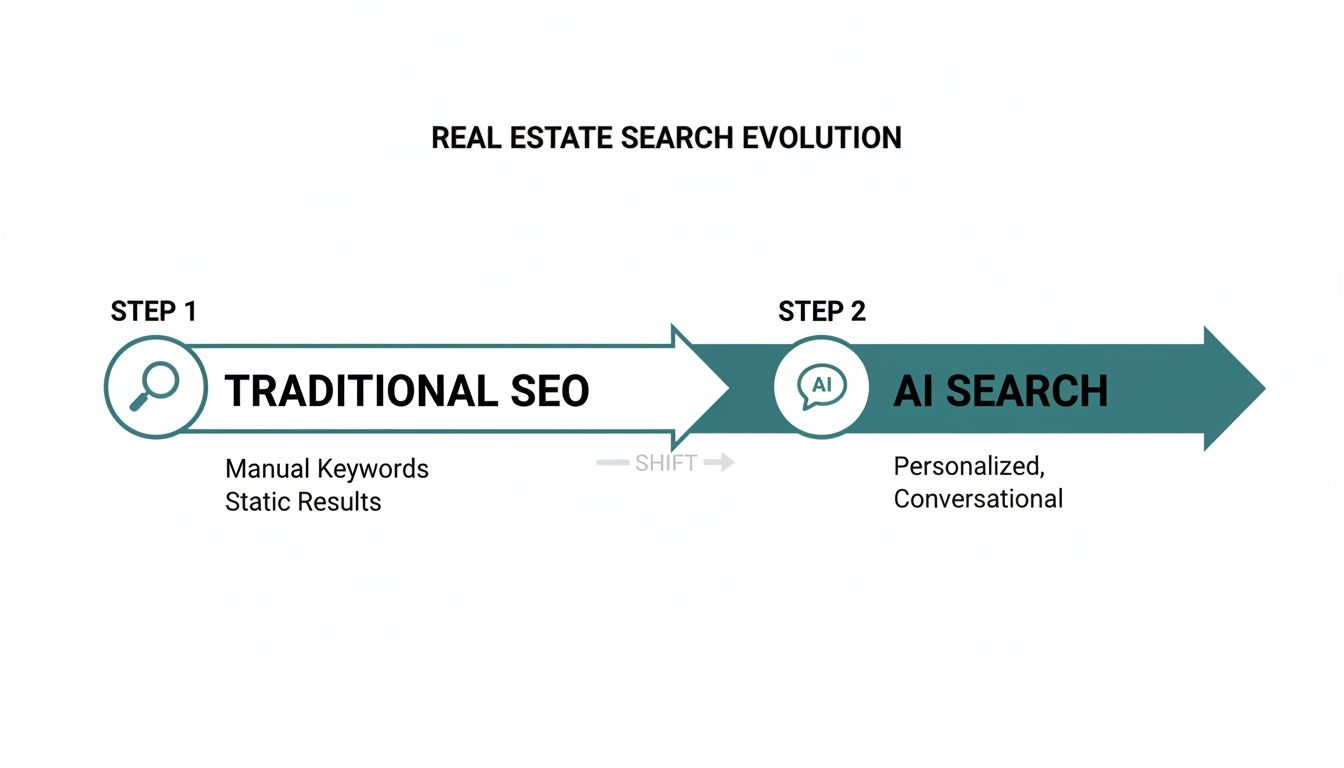
As you can see, the old model was about ranking. The new model is about being the source of truth for a conversational query.
The Secret Language: Structured Data and Schema
The most powerful tool in your technical arsenal for AI search optimization for real estate is structured data, specifically using Schema.org markup.
Think of schema as a set of secret instructions you add to your website's code. It doesn’t change how your site looks to a human visitor, but it speaks directly to machines, telling them precisely what your content is about. It removes all the guesswork.
Instead of an AI trying to figure out if you're a real estate agent from the text on your "About" page, you use RealEstateAgent schema to declare it explicitly. That's a huge signal of clarity and authority.
An AI is like a librarian trying to organize the world's information. Schema markup is the Dewey Decimal System for your business—it tells the AI exactly where you belong on the shelf, making sure you get recommended for the right queries.
For a property listing, you can use schema like SingleFamilyResidence to tag details like the number of bedrooms (numberOfRooms), square footage (floorSize), and unique features (amenityFeature). That structured data is infinitely more valuable to an AI than a simple paragraph of text it has to parse.
Essential Schema Markup for Real Estate Agents
Here’s a quick-reference table of the most critical schema types to get implemented on your website. This is the bedrock of your AI-readable footprint.
| Schema Type | Key Properties to Include | Why It Matters for AI |
|---|---|---|
RealEstateAgent |
name, address, telephone, areaServed, knowsAbout |
Directly tells AI your profession, location, and areas of expertise. |
SingleFamilyResidence |
address, floorSize, numberOfRooms, amenityFeature, geo |
Provides structured, unambiguous details about a specific property. |
Review |
reviewRating, author, reviewBody, itemReviewed |
Feeds AI trust signals directly from your clients' experiences. |
RealEstateListing |
datePosted, price, itemOffered (linked to the property) |
Clearly defines the transactional nature of the page for an AI. |
LocalBusiness |
openingHours, paymentAccepted, hasMap, department |
Solidifies your status as a legitimate, local service provider. |
Putting this schema in place is non-negotiable. It’s the single biggest technical step you can take to make your website more visible to AI.
Your Google Business Profile Is Your AI Anchor
When an AI model wants to understand a local business, your Google Business Profile (GBP) is one of the first and most trusted sources it checks. It's the anchor for your local identity. An incomplete or inconsistent profile is a major red flag that tells an AI you might not be a credible source.
Optimizing your GBP for AI is more than just filling in the blanks. It’s about strategically proving your local dominance.
- Be Hyper-Specific with Service Areas: Don't just put "Phoenix." List the specific neighborhoods and zip codes you dominate, like "Arcadia (85018)" or "Biltmore Area (85016)." This is how you capture "near me" and hyper-local searches.
- Lock Down Your NAP: Your Name, Address, and Phone number (NAP) must be 100% identical everywhere—your website footer, social media, and all real estate portals. A simple variation like "St." vs. "Street" can create confusion for an AI.
- Use Google Posts Like a Local Blogger: Share market updates, new listings, open house announcements, and community news. This feeds Google’s AI a constant stream of fresh, locally relevant information tied directly to your business profile.
- Coach Your Clients on Reviews: Reviews are gold. Gently encourage clients to mention the neighborhood they bought or sold in or the specific type of property you helped with ("He was a lifesaver finding us a condo in Old Town Scottsdale"). Those details are powerful signals of your niche expertise.
Tying It All Together
Finally, consistency is the glue. Every single platform you're on should tell the same story about who you are and where you're the expert. This can be a challenge for agents and teams to manage, which is why exploring different AI tools for real estate agents can be a huge help in keeping your messaging tight and consistent.
Run a quick audit of your digital presence. Ask yourself:
- The Bio Test: Is my bio on Zillow, Realtor.com, and my own website telling the exact same story about my specialties and service areas?
- The Branding Test: Am I using the same professional headshot and brand colors everywhere to create an instantly recognizable identity?
- The Property Description Test: Do my listing descriptions use a consistent voice and always highlight the unique lifestyle features relevant to my target buyer?
When you meticulously align all these pieces, you create a powerful, interconnected web of information. Each consistent signal reinforces your authority, making it dead simple for an AI to see you as the go-to expert for real estate in your market. This is what building a modern, machine-readable brand is all about.
Optimizing Listings for Conversational Search
Let's be honest, conversational AI doesn't care about your standard "3 bed, 2 bath, updated fixtures" description. That kind of language is practically invisible to a smart assistant trying to answer a real buyer's question. If you want to win at AI search optimization for real estate, you have to stop writing inventories and start telling stories.
This is a fundamental shift in how we approach listing copy. Instead of just listing what a house has, we need to explain what it offers. Don't just say "fenced-in backyard." Instead, paint a picture: "Enjoy total privacy in a fully fenced backyard, perfect for summer barbecues and a safe space for kids and pets to play freely." That’s the kind of natural, descriptive language that AI is built to understand and reward.

From Features to Lived Experiences
The real trick is to translate every single feature into a tangible benefit or a vivid experience. You have to get inside the head of a buyer and anticipate their conversational queries. An AI is far more likely to serve up your listing for a search like, "find me a home with great natural light for my houseplants," if your description talks about the "sun-drenched living room with south-facing windows that fill the space with bright, airy light all day long."
Here’s how this looks in practice. It's a simple, but powerful, change in mindset:
Instead of: "New home office"
Try this: "A dedicated main-floor office gives you a quiet, professional space for remote work, complete with built-in shelving to keep you organized and focused."
Instead of: "Close to parks"
Try this: "You're just a five-minute walk from the entrance to Oakwood Park, giving you instant access to miles of walking trails, playgrounds, and community green space."
This reframing makes your listing infinitely more useful to both a person scrolling through Zillow and the AI that's helping them search.
The Power of AI-Enhanced Image SEO
Of course, the words are only half the story. AI now "sees" your property photos, which means optimizing your images is no longer optional—it's essential. When you upload a picture of a kitchen, an AI doesn’t just register a room; it identifies specific elements like the countertops, appliances, and sink style. This is where you can get a huge leg up.
Tagging your images with descriptive alt text helps the AI understand exactly what's in the picture. This simple step dramatically increases the odds of your listing popping up for very specific searches.
AI-powered computer vision can analyze your property photos and automatically add SEO-friendly tags for features like 'quartz countertops,' 'stainless steel appliances,' or 'farmhouse sink.' This process makes your images—and by extension, your entire listing—discoverable for highly specific buyer queries.
This isn't some far-off future tech; it's already here. The 2025 National Association of Realtors' Technology Survey found that 68% of Realtors are already using AI tools to boost their marketing. We're seeing these tools tweak photos and metadata, leading to 15-25% faster sales by making listings more visible on major portals. Discover more insights about how AI automation is reshaping real estate marketing and see what your competition is up to.
Crafting the Perfect AI-Friendly Listing
When you combine that narrative-driven copy with meticulously tagged images, you create a powerful, AI-readable asset. The goal is to build a complete digital profile of the property that leaves nothing to the imagination.
Here are a few quick wins you can implement on your very next listing:
- Lead with Lifestyle: Open your description with a hook that paints a picture of what it's like to live there.
- Get Hyperlocal: Drop in names of neighborhoods, local parks, and popular nearby coffee shops to firmly place the property in its community.
- Rename Your Image Files: Before you even upload, change
IMG_2475.jpgto something like123-elm-street-remodeled-kitchen-with-island.jpg. - Write Detailed Alt Text: For every photo, add a short, descriptive sentence. For example: "Spacious primary bedroom with large windows overlooking the tree-lined backyard."
By making these changes, you're not just writing a better property description. You're building a rich data source that’s perfectly structured for conversational AI, ensuring your listings get seen, understood, and recommended to the right buyers.
Build Your Authority with AI-Ready Content
If you want AI to recommend you, it first has to see you as a true authority. This isn't about tricking an algorithm; it's about proving you're the real deal through consistent, high-value content. Think of it this way: AI models scan and synthesize a mind-boggling amount of information to find the most trustworthy and helpful answer. Your job is to become that answer for your local market.
This means you need to create a deep web of content that directly addresses the specific, conversational questions your future clients are asking. Forget basic blog posts. You're building an entire library of expertise that signals to AI that you are the go-to expert for real estate in your town.

Answer Questions Before They're Even Asked
The heart of your content strategy should be getting ahead of what people are asking. They aren’t just typing "homes for sale in [City]" anymore. They're asking AI assistants detailed, nuanced questions, and you need to have the answers published and waiting on your website.
Your content should be built around these kinds of real-world queries:
- Neighborhood Guides: Go deep on every neighborhood you serve. Don't just list amenities; paint a picture of the lifestyle. What’s the vibe on a Saturday morning? Where do locals grab coffee? This is the rich, textured detail that AI is looking for.
- Market Updates: Move past generic stats. Explain what the numbers actually mean for a local buyer or seller. Your content should be able to answer a question like, "What does a 5% interest rate change mean for my budget in the Northwood neighborhood?"
- Buyer and Seller Pain Points: Write articles that solve common problems. Topics like "How to Win a Bidding War in a Competitive Market" or "The Top Mistakes First-Time Sellers Make" immediately establish you as a helpful guide.
This proactive approach is the bedrock of AI search optimization for real estate. You're directly feeding AI models the clear, useful information they're designed to find and share.
Think in Topics, Not Just Keywords
The old SEO game was all about ranking for specific keywords. The new game is about owning entire topics. An AI wants to see that you have comprehensive knowledge about a subject, not just one popular blog post that hit the mark.
This is where the idea of "content pillars" comes in. A content pillar is a massive, central piece of content on a broad topic, which you can then break down into many smaller, related articles.
Example Content Pillar: "Relocating to [Your City]"
- Main Pillar Post: A detailed, ultimate guide covering everything a newcomer would need to know.
- Spoke Posts (linking back to the main pillar):
- "The Top 5 Family-Friendly Suburbs in [Your City]"
- "A Simple Guide to Understanding Local Property Taxes"
- "Comparing School Districts in the [Your City] Area"
- "Best Dog Parks and Pet-Friendly Spots for New Residents"
This hub-and-spoke structure clearly demonstrates your deep expertise, making it incredibly easy for an AI to recognize your authority and recommend your content for a whole host of relocation questions.
Creating this web of interconnected content does more than just answer a single question. It builds a knowledge graph that an AI can clearly see, establishing you as the central hub of information for your market.
The data is already starting to back this up. AI referral traffic, while still new, is becoming a key source of high-intent leads. Right now, the real estate industry captures just 1.01% of website traffic from AI sources like Perplexity and ChatGPT. Although that number seems small, this traffic is made up of motivated users who convert at a higher rate. For agents on the ball, this highlights a massive opportunity to build an AI-readable digital footprint. You can see more of these emerging real estate AEO benchmarks to get a sense of the landscape.
A Practical Content Plan for Busy Agents
I know what you're thinking—creating all this content sounds exhausting. But it doesn't have to be. Your unique local knowledge is the raw material, and you're creating it every single day.
- Document, Don't Create: Turn your daily client conversations into content. Did you just explain the pros and cons of a specific school district? That's a blog post. Did you just tour a new construction development? That's a neighborhood spotlight video.
- Use a Simple Q&A Framework: For each piece of content, frame it as a question and answer. Use headings that sound like real questions people would ask, like "What Are the Typical Closing Costs for a Buyer in [Your County]?" This makes your content incredibly easy for both humans and AI to understand.
By consistently publishing helpful, locally-focused content, you build a powerful moat around your business. You become the trusted source that AI—and more importantly, your future clients—turn to first. For more ideas on getting started, you might find our guide on AI marketing for real estate agents helpful.
How to Know If Your AI Optimization Is Actually Working
So, you've put in the work to optimize your listings and profiles for AI search. That's great, but how can you be sure it's actually paying off? Unlike classic SEO where you can get fixated on a single keyword ranking, measuring success with AI is more about watching a collection of signals that prove your authority is growing. The real goal isn't just to rank—it's to become the go-to source that AI trusts and recommends.
You won't find a tidy, all-in-one dashboard for this just yet. Instead, you'll need to play detective and connect the dots between a few key metrics. When you see these numbers moving up and to the right, you'll know your strategy is hitting the mark.
The KPIs That Matter Most
Think of this as gathering evidence. The proof of your success will pop up in your website analytics, your lead sources, and even in your initial conversations with new clients. I'd suggest starting a simple spreadsheet to track these data points month over month.
Here’s what you should be watching closely:
A Bump in Direct Website Traffic: This is a big one. When someone types your website address directly into their browser, it means they already know your name. This is often what happens right after an AI has mentioned you, and it’s a powerful sign that your brand recognition is on the rise.
More Branded Search Queries: Jump into your Google Search Console and look at the search terms people are using to find you. An increase in searches for your name, your team's name, or your brokerage (like "Jane Doe real estate") is pure gold. It shows your reputation is spreading organically.
Leads Mentioning AI: This is the most direct feedback you’ll ever get. Make it a habit to ask every single new lead, "How did you hear about us?" The moment you start hearing things like, "I asked ChatGPT for the best agent in…" or "Google’s AI answer recommended you," you’ll know you've cracked the code.
Digging for Clues in Google Search Console
Your Google Search Console is an absolute must-have for this—and it's free. It gives you a direct window into how searchers are finding you, whether through a traditional search or an AI-powered one.
Head over to the "Performance" report. This is where you can filter queries to see the exact questions leading people to your site. Keep an eye out for long, conversational phrases. A search like "best real estate agent for first-time buyers in Scottsdale" is a perfect example of how people talk to AI. Seeing more of these queries pop up is a clear indicator that your content is hitting the right notes for conversational search.
The whole point of AI optimization is to become the definitive answer to a user's question. When your content starts surfacing for these super-detailed queries, it's proof that you're successfully carving out your niche authority in the eyes of the algorithm.
Quick Wins You Can Implement Today
Building true authority in the eyes of AI is a marathon, not a sprint. But there are a few high-impact things you can do right now to get some early traction. These steps are designed to send strong, immediate signals about who you are, where you work, and what you’re an expert in.
Hyper-Target Your Google Business Profile: Don't just list your city. Go into your profile and add the top 5-10 specific neighborhoods or zip codes where you're the undisputed local pro. This is how you show up in those hyper-local, "near me" AI recommendations.
Rewrite Your Top 3 Listing Descriptions: Pick your three most important listings and give the descriptions a makeover. Use that narrative, lifestyle-focused language we talked about. Instead of just listing features, translate them into benefits. Paint a picture of what it feels like to live in that home and be part of that community.
Add a Mini Q&A to Your Homepage: Create a small "Frequently Asked Questions" section right on your homepage. Answer 3-4 of the most common questions you get from clients, and use the full question as the heading for each answer. This makes your expertise instantly scannable for AI crawlers.
By tracking the right KPIs and knocking out these quick wins, you can start building a clear picture of your progress. To take it a step further, specialized real estate listing marketing software can help automate some of these tasks, freeing up your time while making sure you stay visible.
Common Questions About AI for Real Estate
Jumping into AI search can feel like charting unknown waters. It’s completely normal to have questions about how this all works and, more importantly, what it means for your real estate business. Let's tackle the most common ones I hear from agents so you can move forward with confidence.
How Is AI Search Different From Traditional Google SEO?
This is a big one. For years, we’ve all been conditioned to think in terms of keywords. Traditional SEO is a game of ranking for phrases like "homes for sale in Austin." You fight to get your website link onto that coveted first page.
AI search flips the script entirely. The goal isn't just to be a link in a list; it's to be the answer to a conversational question. Think about how a person would actually ask for help: "What are the best Austin neighborhoods for families with a $700k budget?"
To answer that, an AI doesn't just look for keywords. It pulls together information from dozens of sources it trusts and presents a single, direct response. This means your strategy has to change. You need to focus on feeding the AI the right signals: structured data (like schema markup), consistently helpful content, and a rock-solid local reputation built on reviews. You're trying to convince the machine that you are the most reliable expert for that specific need.
Do I Need to Be a Tech Expert to Do This?
Honestly, no. Not even close.
I get it—words like "schema markup" sound complex and make you think you need to learn code. The good news is that modern real estate tools are built for the rest of us. Many platforms can automatically generate AI-ready descriptions and apply all the necessary structured data behind the scenes. You never have to see a single line of code.
For your own website, there are simple plugins that do the heavy lifting. Your real job is to focus on the strategy. It’s all about creating genuinely useful, hyper-local content that proves you know your stuff. The tech is just there to amplify your expertise, not replace it.
The most important skill in the age of AI isn't coding; it's clarity. If you can clearly articulate your value and local expertise, you have everything you need to succeed. The tools are just there to help you amplify that message.
How Long Does It Take to See Results From AI Optimization?
This isn't like flipping a switch on a Facebook ad. Think of it more like planting a tree than starting a motor. It’s a long-term strategy that builds momentum over time.
You can definitely see some early traction within a few weeks, especially if you tackle the quick wins. Fully optimizing your Google Business Profile and beefing up your current listings with better, narrative-driven copy can get the ball rolling.
But to build the kind of deep authority that makes you a top AI recommendation? That typically takes about three to six months of consistent work. The key is persistence—regularly publishing expert content, gathering client reviews, and showing up as the local authority. The sooner you start building this foundation, the bigger your head start will be when everyone else tries to catch up.
Will This Strategy Also Generate Seller Leads?
Absolutely. In fact, it's one of the most effective ways to get in front of sellers before they've even decided to list.
Homeowners almost always start their journey by asking research questions. They're turning to AI for answers to things like:
- "What is my home worth in the Northwood neighborhood?"
- "Who is the top listing agent for historic homes in Savannah?"
- "What are the average days on market for a four-bedroom house in my zip code?"
When you create content that directly answers these questions—like detailed local market reports, case studies of your recent sales, or articles explaining your unique marketing process—you position yourself as the obvious expert. So when a potential seller finally asks an AI for an agent recommendation, your digital footprint makes you the logical choice. High-intent leads come directly to you because you were the source of truth from the very beginning.
Stop being invisible in the age of AI search. While other agents scramble, ListingBooster.ai transforms your properties into a complete, AI-optimized marketing suite in minutes. Generate scroll-stopping social content, compelling MLS descriptions, and print-ready assets that prove you’re the market leader.
Walk In With the Campaign Already Built
Listing copy, social posts, sourced Market Insights, growth scheduling, and direct publishing after approval from one real-estate-specific system. 25 free credits to start.
Related Posts
 Uncategorized
8 Real Estate Quotes for Social Media That Convert in 2026
Social media didn't become optional branding for agents and brokers. It became buyer discovery. Canva cites a Facebook report showing that 79% of homebuyers use online resources, including mobile, at some point in their property search. That single shift explains why so many “Just Listed” graphics now disappear into the feed without doing much for […]
 Uncategorized
AI Listing Description Generator for Real Estate Agents
Traditional listing visibility is no longer just an MLS problem. It's a discoverability problem across AI-driven answer engines, buyer-facing search experiences, and every channel where your property details get repeated, summarized, and recommended. That's why an AI listing description generator for real estate agents matters now. Not because it saves you from writing one paragraph. […]
UncategorizedYour Fair Housing Compliant Listing Description Generator
You're probably staring at the same box every agent knows too well: the listing description field is blank, the photos are uploaded, the facts are in the MLS, and you need copy that sounds sharp without creating a compliance problem. That tension is real. A good description helps market the property. A careless one can […]