AI Marketing for Real Estate Agents: How It’s Used and Where It Fits
You've likely heard the buzz around "AI marketing for real estate agents," but what does it actually mean for your business? Forget the complex jargon. At its core, AI marketing is about using smart technology to automate and improve the repetitive, time-consuming parts of your job, allowing you to focus on client relationships and closing deals.
Think about the hours spent writing property descriptions, creating social media posts, or preparing materials for a listing presentation. AI tools can handle much of that heavy lifting, providing a consistent and professional foundation for your marketing efforts. This guide explains what AI marketing means in practice, how agents are using it, and where it fits into a modern real estate workflow.
What AI Marketing Means in Real Estate

In plain language, AI marketing for real estate agents isn't about robots replacing agents. It’s about leveraging technology as an efficient assistant that handles critical marketing tasks with speed and consistency. Instead of staring at a blank page trying to find a new way to describe "natural light," you can input a property's key features and receive a polished, MLS-compliant description in seconds.
The practical value of AI is how it streamlines day-to-day operations. It supports agents in several key areas:
- Listing Descriptions and Property Content: Generate compelling property narratives that meet MLS guidelines and are optimized for different platforms.
- Search Visibility: Structure listing content to improve how it appears on Google, major portals, and even in new AI-powered search tools.
- Social Media Content at Scale: Create and schedule a consistent stream of posts, market updates, and property highlights without the daily grind.
- Listing Presentation Preparation: Quickly assemble marketing plans and competitive analysis to present to potential sellers.
- Time Savings and Consistency: Reclaim hours previously spent on manual content creation while ensuring every marketing piece maintains a professional tone.
The goal isn't to replace your expertise—it's to amplify it. AI handles the grunt work, freeing you up to focus on strategy, building relationships, and negotiating deals.
Common AI Marketing Use Cases for Agents
Let’s move from theory to practice. Savvy agents are integrating AI into their workflows to work smarter, not just harder. This isn't a futuristic concept; it's a real advantage being used today. Here are the most common use cases, framed as workflow support rather than a magic solution.
Content Creation for Listings
The most immediate application is generating marketing content for new listings. Agents use AI to create multiple versions of property descriptions from a single set of details. This means getting a concise, MLS-compliant description while simultaneously producing a more detailed, story-driven narrative for a personal website or blog.
Platform-Specific Optimization
Different platforms have different rules and audiences. AI helps tailor content for specific channels like the local MLS, Zillow, and Realtor.com. This includes adjusting character counts, formatting, and highlighting features that perform best on each site, improving a listing’s visibility and appeal.
Social Media Scheduling and Post Generation
Consistency is key to social media, but it's incredibly time-consuming. Agents use AI to generate an entire month's worth of social media posts for a listing, including captions, image suggestions, and relevant hashtags. This ensures a steady online presence without the daily effort.
Presentation and Pre-Listing Materials
One of the most powerful uses is in preparing for listing appointments. Instead of scrambling to pull together examples of past work, an agent can use AI to generate a custom marketing preview for a prospective seller's property. This includes a draft listing description, a sample social media plan, and a competitive marketing analysis, demonstrating proactive expertise.
Authority and Market Content
Beyond individual listings, AI is used to establish local expertise. Agents can quickly draft insightful neighborhood guides, market trend analyses, and helpful blog posts. By consistently publishing valuable information, they build their brand and become a trusted resource in their community.
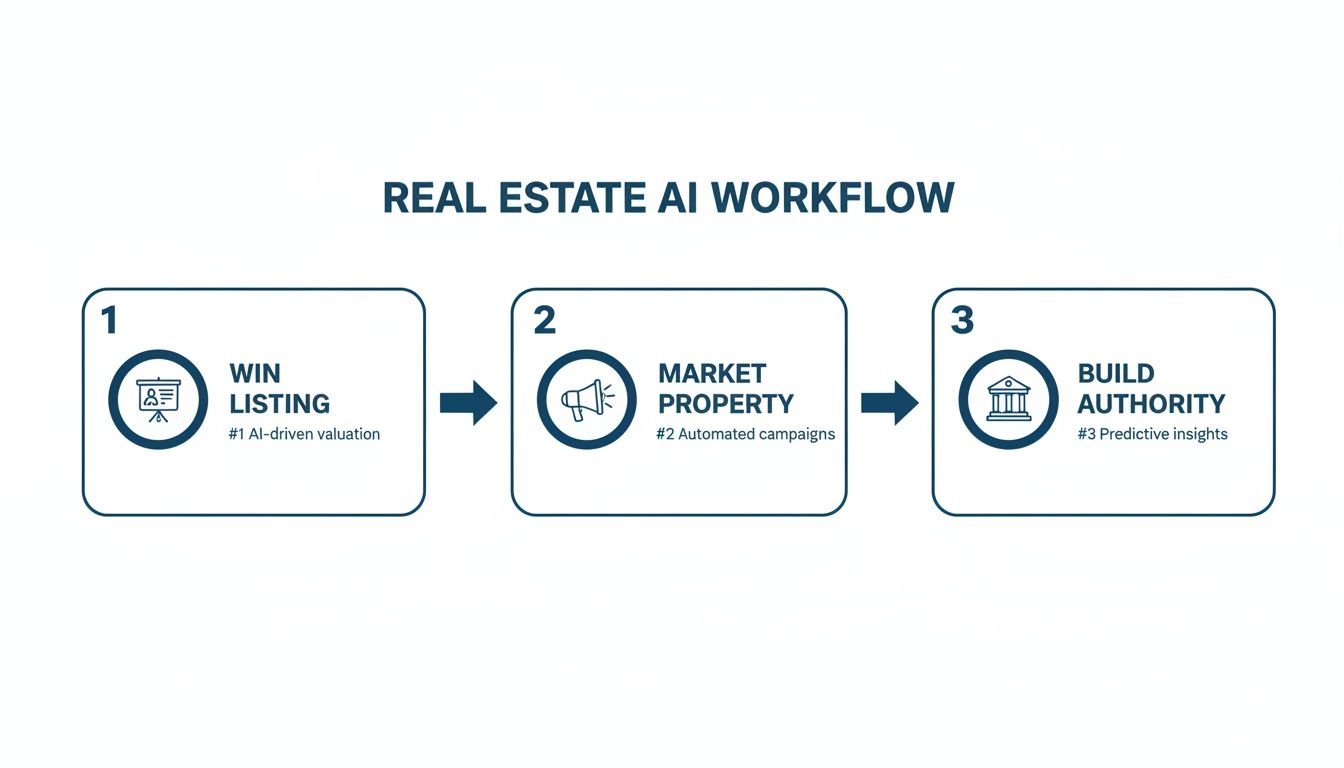
This isn't just a trend; it's a massive shift. Projections show that by 2026, AI will be a core part of real estate, with 70% of professionals adopting new tools annually. Morgan Stanley even estimates that automating just 37% of an agent's tasks could unlock $34 billion in efficiency gains. You can read the full 2026 State of AI in Real Estate Marketing report to dig deeper into the data.
Tools Agents Use to Support AI-Driven Marketing
Once agents understand the use cases, the natural next question is about the tools. It’s crucial to see these tools as assistants that execute a strategy, not as replacements for an agent’s judgment. They make tasks faster and more consistent.
AI marketing for real estate agents typically combines content creation, distribution, and consistency. While some agents rely on general-purpose AI writing tools, others use real estate–specific platforms that account for MLS formatting, platform requirements, and presentation needs. Tools in this category include a mix of general AI assistants and industry-focused platforms such as ListingBooster.ai, depending on how structured an agent’s marketing workflow needs to be.
Listing Content & Presentation Tools
These tools focus on preparing listing descriptions, platform-specific content, and materials agents use during listing appointments. They are designed to streamline the pre-listing and active marketing phases.
- ListingBooster.ai – A real estate–specific AI platform used by some agents to generate MLS-compliant listing descriptions, platform-specific marketing content, and presentation materials as part of their overall marketing workflow.
- General AI Writers – Tools like ChatGPT can be used with specific prompts to draft property descriptions, blog posts, and other marketing copy. They require more detailed instruction to ensure real estate compliance.
General AI Assistants and Schedulers
Another common approach is pairing a general-purpose AI writer with a social media scheduling tool that has AI features.
- AI-Powered Social Schedulers: Many popular social media management platforms now integrate AI to suggest optimal posting times, generate caption variations, or create simple graphics, helping agents maintain an active presence.
The choice between a general tool and one built for real estate often comes down to workflow preference. Specialized platforms save time because they understand industry terminology and compliance from the start. General tools offer flexibility but require more effort to guide.
Recent data shows the impact of these strategies: 60% of agents report their highest ROI is coming from social media marketing, often powered by AI, and 52% of leads generated through these efforts are higher quality. You can find more eye-opening AI agent statistics on warmly.ai to see how quickly the landscape is changing.
How AI Shapes Your Brand and Puts You on the Map

Adopting AI into your marketing is more than a time-saver; it’s an upgrade to your brand's digital presence. Consistent, high-quality content is the foundation of online visibility. By using AI to produce polished, platform-specific content for every listing, you expand your digital footprint and improve your visibility on traditional search engines and emerging AI-powered search platforms.
This consistency presents your brand as a sophisticated, modern marketing operation, which is increasingly important to potential sellers.
Moving Beyond Automation to Build Real Authority
The true value of AI marketing emerges when it helps you build authority at scale. By consistently publishing insightful market updates, neighborhood guides, and helpful content, you position yourself as the go-to local expert.
Seller expectations are rising. They seek partners with a clear, tech-forward marketing strategy. The AI sector in real estate is projected to grow from $222.65 billion in 2024 to $303.06 billion in 2025, signaling a massive industry transformation. You can find more real estate marketing statistics here to understand the full scope.
AI isn't about replacing what you do. It's about amplifying your expertise, building your reputation, and showing sellers you're equipped to win in a competitive market.
Answering Your Questions About AI in Real Estate
Adopting new technology naturally brings up questions. Here are answers to some of the most common inquiries from agents considering AI for their marketing.
Do I Need to Be a Tech Whiz to Make This Work?
Not at all. Modern real estate AI platforms are designed for agents, not developers. If you can enter a property address or copy and paste information, you have the necessary skills. The purpose of these tools is to simplify your job, not add another complex system to manage.
What About Fair Housing Compliance?
This is a critical consideration and a significant benefit of using a real estate-specific AI tool. The best platforms are trained on Fair Housing guidelines to help avoid discriminatory language. AI focuses objectively on a property's features—like granite countertops or a fenced yard—rather than making assumptions about potential residents. While you are always the final reviewer, the AI provides a compliant foundation to build upon.
Can AI tools real estate agents use help me win more listings?
Yes, by making you appear more prepared and professional. When you walk into a listing presentation with a complete, ready-to-launch marketing plan—including a sample MLS description and a 30-day social media calendar—you demonstrate a level of marketing savvy that builds immediate trust and sets you apart from the competition.
Is This Going to Replace My Professional Copywriter?
Think of AI as a powerful assistant, not a replacement for human expertise. It can get you 80% of the way to a finished piece of marketing content in seconds. Your role is to add the final 20%—the unique neighborhood insights, personal voice, and local details that only an expert can provide. The AI handles the heavy lifting, freeing you to focus on the high-value strategic touches.
Conclusion
AI marketing in real estate isn’t about replacing agents—it’s about reducing manual work and improving consistency. As expectations around digital presence and content quality increase, agents are experimenting with different ways to integrate AI into their marketing workflows. The specific tools matter less than understanding how AI fits into listing preparation, presentation, and ongoing visibility. To learn more, visit the real estate marketing blog.
Walk In With the Campaign Already Built
Listing copy, social posts, sourced Market Insights, growth scheduling, and direct publishing after approval from one real-estate-specific system. 25 free credits to start.
Related Posts
 AI Tools & Technology
Best Real Estate Marketing Platform for Solo Agents
Google Business profiles with 50+ reviews see 400% more map views than profiles with fewer reviews, according to Agent Elite as cited by FlippingBook's real estate marketing tools roundup. That stat changes the conversation. The best real estate marketing platform for solo agents isn't just a CRM with drip campaigns, and it isn't just a […]
 AI Tools & Technology
AI Powered Real Estate Listing Promotion: A Guide for 2026
Most agents still think listing promotion means better photos, a polished MLS description, and a few social posts. That playbook isn't enough anymore. AI powered real estate listing promotion now has a different job. It has to make your listings and your expertise understandable to machines that answer buyers directly. If your content can't be […]
 AI Tools & Technology
10 Best AI Tools for Listing Agents in 2026
It’s 8 PM on a Tuesday. You just got home from a showing, but your new listing goes live tomorrow. You still need to write the MLS description, create social posts, and get a postcard into something that doesn’t look homemade. That last-minute scramble is where a lot of listing agents live, and it can […]